Day One in Day Z

My humble beginnings in Day Z.
When I came to, I was on the shore of Chernarus—225 square kilometers of zombies, bandits, and soviet architecture—and found that I’d lost all my gear, apart from a puny Makarov that I couldn’t remember carrying before becoming stranded, and a canteen of water, some bandages, and a tin of marginally-edible brown. This is Day Z, a mod in alpha for ARMA 2: Combined Operations, and in traditional zombie-narrative fashion, this is the story of how I died.
Chillin’ in the Pit

A wallpaper image for Avernum, courtesy of the game’s site.
I love a good surprise, which may be why I’ve been playing so much Avernum: Escape from the Pit, a remake of Avernum (1999), which was itself a remake of Exile: Escape from the Pit (1995). When I saw it available on Steam, I decided on a whim to see if Spiderweb Software’s brand of old-school goodness could take root in the thorny soil of my RPG-weary heart. I’m glad I took that gamble.
Find out why, after the jump (that was for you, wedge).
Sentinel Comics #135: Hero… to Zero!

Absolute Zero is decimated by Baron Blade’s first attack.
LAST TIME (SC #134) (you should read this before continuing), Absolute Zero of the Freedom Five was joined by the solar-powered Ra and the mysterious Haka to find and destroy Baron Blade’s Terralunar Impulsion Beam. The good Baron had the decency to establish his base camp amidst the ruins of Atlantis, off the coast of Madagascar, which made for pretty easy pickings for our unlikely squad of heroes. Unfortunately, the moment the Beam was deactivated (and the world saved, incidentally), Baron Blade himself showed up with one heck of a grudge. Already weakened by their attack on the Baron’s camp, our heroes sure are in dire straits, in…
Sentinel Comics #135: Hero… to Zero!
Sentinel Comics #134: The Blade of Atlantis
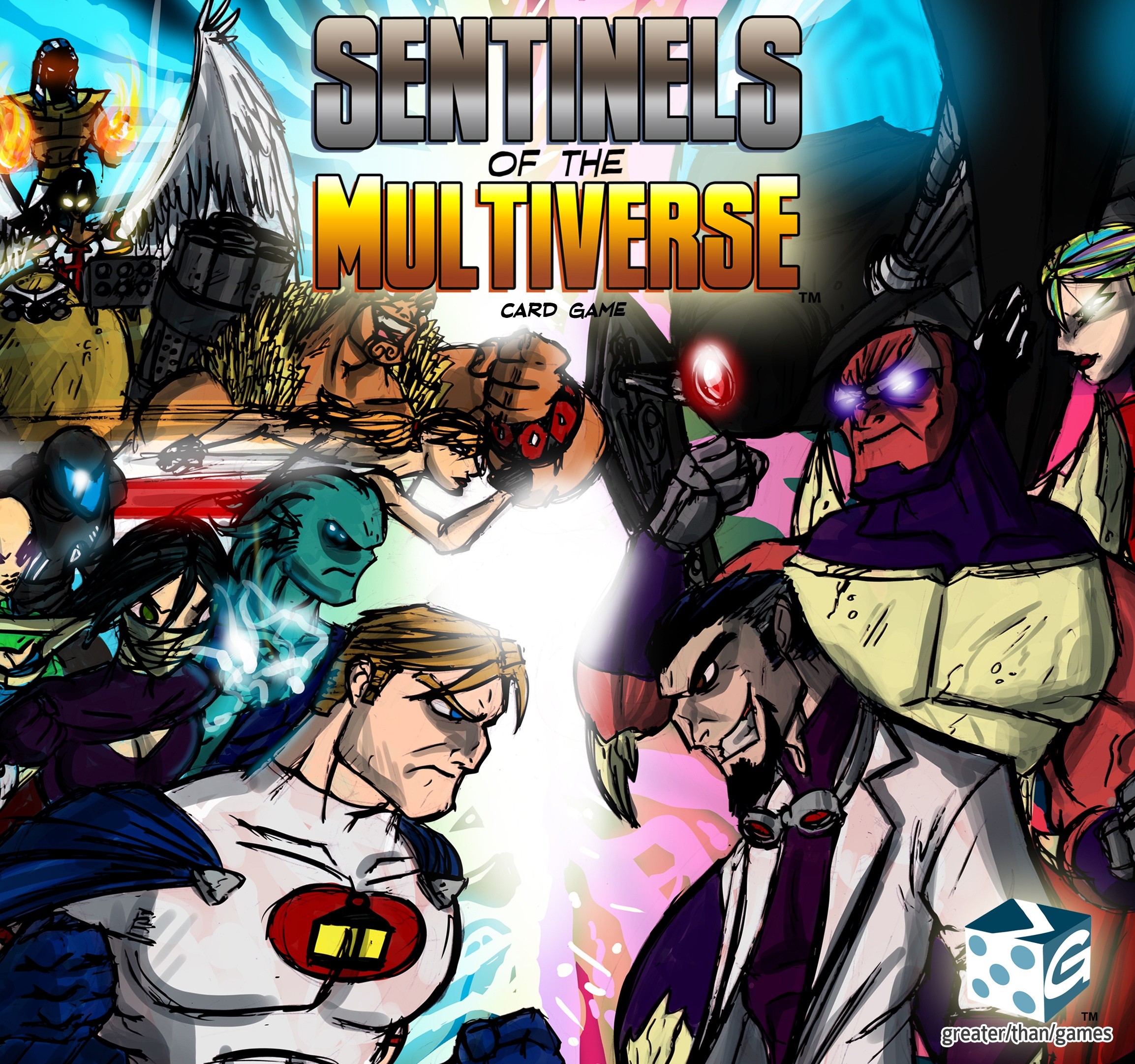
The Sentinels continue their fight against the enemies of the Multiverse!
LAST TIME (SC #133) Legacy had led the Freedom Five to finally uncover Baron Blade’s plot to use lost Atlantean technology to power his Terralunar Impulsion Beam. Unfortunately, this left four of the Freedom Five halfway around the world and unable to make it to Atlantis before the dastardly beam’s activation (loyal readers will recall that Tachyon’s super-speed had been temporarily lost along with her memories back in SC #124). With Visionary and the Inhuman Tempest lost in space and time thanks to Grand Warlord Voss (SC #130), and with Fanatic trapped in an alternate reality of Omnitron’s creation (SC #125), the task has fallen to Absolute Zero to lead a team of unlikely allies to save the world in…
Sentinel Comics #134: The Blade of Atlantis!
5 (More) Reasons for Running with Rifles

Army men, about one-eighth as fun as Running with Rifles.
Back in January, I talked a bit about my experiences with the still-unfinished Running with Rifles from Modulaatio Games. Three months later I’m still a faithful player—after all, it’s a rare game that elicits fond reminiscences of the social introversion of my youth.
These days, the game that’s helping me reconcile with my solitary memories is even better. For exactly five reasons. Let me clue you in, and in the process heal the lingering demons of your childhood.
Living at the End of the World: Lone Survivor

The happiest thing you're going to see this entire article.
I’m not the right person to talk about horror games, because deep down (this is a secret, so please don’t tell either of the people that are under the impression that I’m undiluted awesomesauce), I’m a weenie. I thought Doom 3 was really scary. System Shock 2? Never beat it. Amnesia: The Dark Descent? Played twenty minutes and had to take a shower. Terraria? Well, that floating eyeball boss is troubling.
I did, however, finish Lone Survivor from Superflat Games (which is Jasper Byrne). This was only possible because it’s the true awesomesauce. Let me tell you why.
Sword. Also, Sworcery

The Scythian contemplates a mysterious island in S:S&S EP.
Long and shameful list of links: Superbrothers: Sword & Sworcery EP from Superbrothers and Capy, and featuring the delightful tunes of Jim Guthrie, is now out on Steam, which marks the first appearance of this well-received (including by Time Magazine) game on PC. Whew!
I wasn’t expecting to enjoy S:S&S EP. As it was only available on iOS-powered devices (my phone may be useless, but I pay half as much for the privilege of that uselessness), I hadn’t seen any of the reviews or buzz surrounding it. When I saw that it had made the pilgrimage from the ‘Pad to the PC, I figured I would take a look, but I assumed the transition would be marred by poor resolutions, wonky ported gameplay, and perhaps a bit too much—dare I utter the word?—pretentiousness. I mean, have you seen that title? I’m glad to have been wrong. A few hours later, I’m pleased to say that although there are times that S:S&S EP stumbles, those few instances are dwarfed by refreshing accomplishment.
Ever-Changing: Proteus

My first view of the island. My island. Not yours. Mine.
I’ve been playing Proteus, a game about exploration and music by Ed Key and David Kanaga. I can tell you what it is—I already have, really—but I’m finding it difficult to shape words to fit. You see, time is not constant on one the game’s island, which is generated anew each time you play. Often the days are languorous, stretching and relaxing at their own pace. Just as often, days suddenly bleed into nights and weeks pass in mere seconds, as though you were the placid observer of a world riding on a hummingbird’s wings. It’s a game about change, and—to me—about perspective.
Take the above picture as an example. It’s pretty, but flat. As a still image, it looks like someone could draw it up in MS Paint in fairly short order. In motion, it’s something else entirely.
The Board Game Box Review

The board game boxes under review on our first installment of The Board Game Box Review!
Okay, I’m taking Space-Biff! across the threshold into true nerd territory. This is nerdier than a sixteen-hour game of Runewars, a GLaDOS pumpkin, or dressing up as characters from RAGE… alright, less nerdy than that last one.
I’m writing this because if there’s one thing I can’t stand (and trust me, there’s at least one thing I can’t stand), it’s poorly-designed board game boxes. That’s right: When the box is too big, too small, won’t play Tetris with other games, or falls apart after a year, it really ticks me off something mighty. And I’m sure there’s at least one other person out there who feels the same way. Cue The Board Game Box Review.
A Parable of Ambition: Syndicate
The opening screen. Which I actually like.
The other day I had a realization: I’ve been talking about so many smart but rough-looking indies here on Space-Biff! that I’ve totally neglected to write about something good-looking but dumb. I recently finished my second playthrough of Syndicate from Starbreeze Studios and EA, and so it feels like the time is right to talk about why I think it’s an excellent but forgettable shooter.


