Abstracts Get Political: COINTELPRO
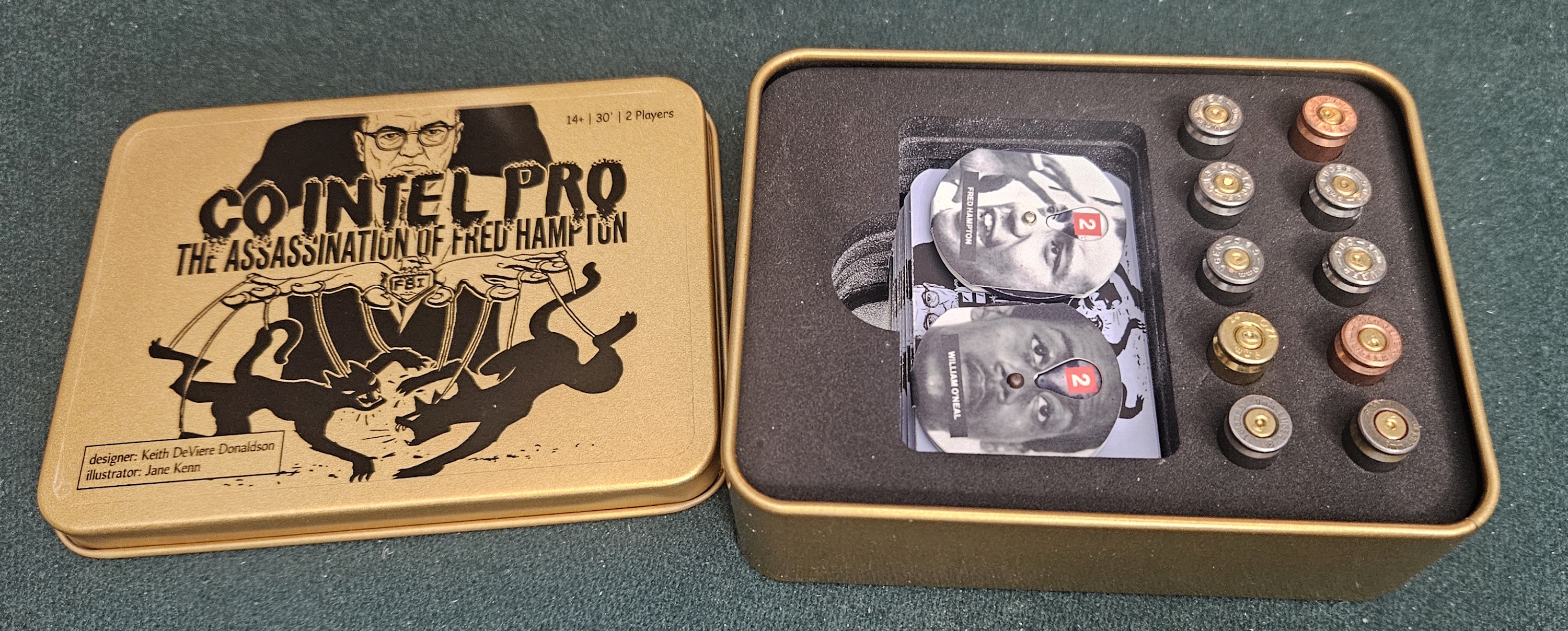
I don’t often receive boxes of bullets in the mail. Or even boxes of bullet casings. Because COINTELPRO: The Assassination of Fred Hampton doesn’t actually include bullets, only the spent brass that would normally hold the projectiles. When the game arrived, I hefted the entire handful. Ten casings, nine millimeter, five different manufacturers. Primers burnt. Cordite faint but noticeable.
Fred Hampton was shot four times. Twice in the initial barrage from outside the apartment where he slept, possibly drugged by his head of security and FBI informant William O’Neil; twice more at close range after officers realized he was still alive. He was the deputy chairman of the Black Panther Party of Illinois, but the crime that had drawn the FBI’s attention wasn’t any particular clash between the Black Panthers and the police, nor even the Rainbow Coalition he had formed with poor white Southerners and Puerto Ricans. No, it was the party’s Free Breakfast Program for neighborhood kids that had drawn J. Edgar Hoover’s ire.
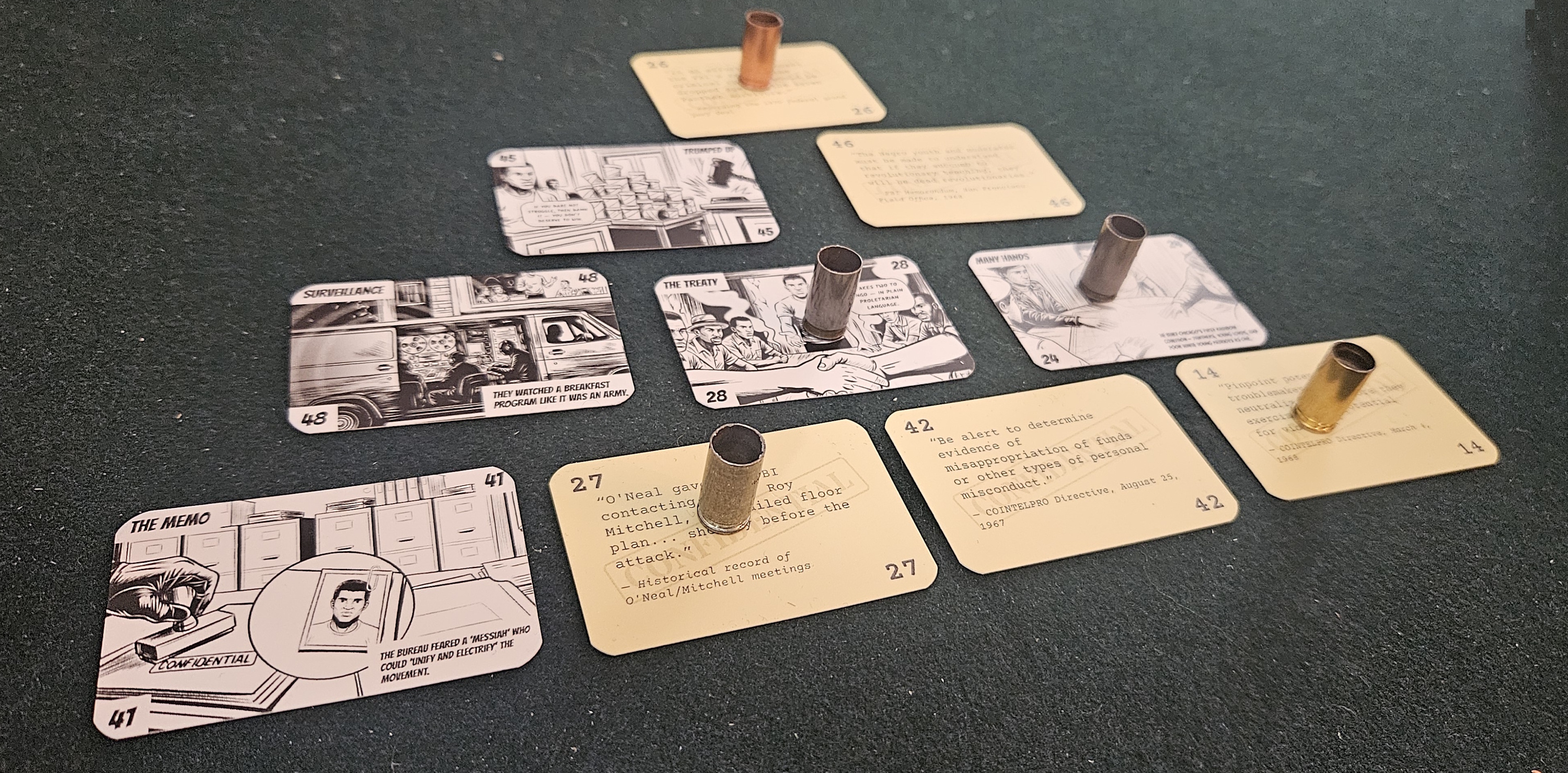
Building the Chicago chapter of the Black Panther Party… and infiltrating it.
COINTELPRO: The Assassination of Fred Hampton is a board game designed by Keith DeViere Donaldson and illustrated by Jane Kenn. Unlike most board games that tackle serious topics, it isn’t the domain of multi-use event cards and global maps. Matthias Cramer’s Watergate lands a bit closer, but still doesn’t quite capture the deep abstraction of Donaldson’s approach. If anything, this belongs to a different tradition, one simultaneously older and more radical. This is the domain of games like Suffragetto, with its rows of truncheon-wielding bobbies and martial-artist suffragettes. Like Guerrilla Checkers, with its general infantry marching along different leylines than its slinking insurgents.
Which isn’t to say the game isn’t evocative. Quite the opposite.
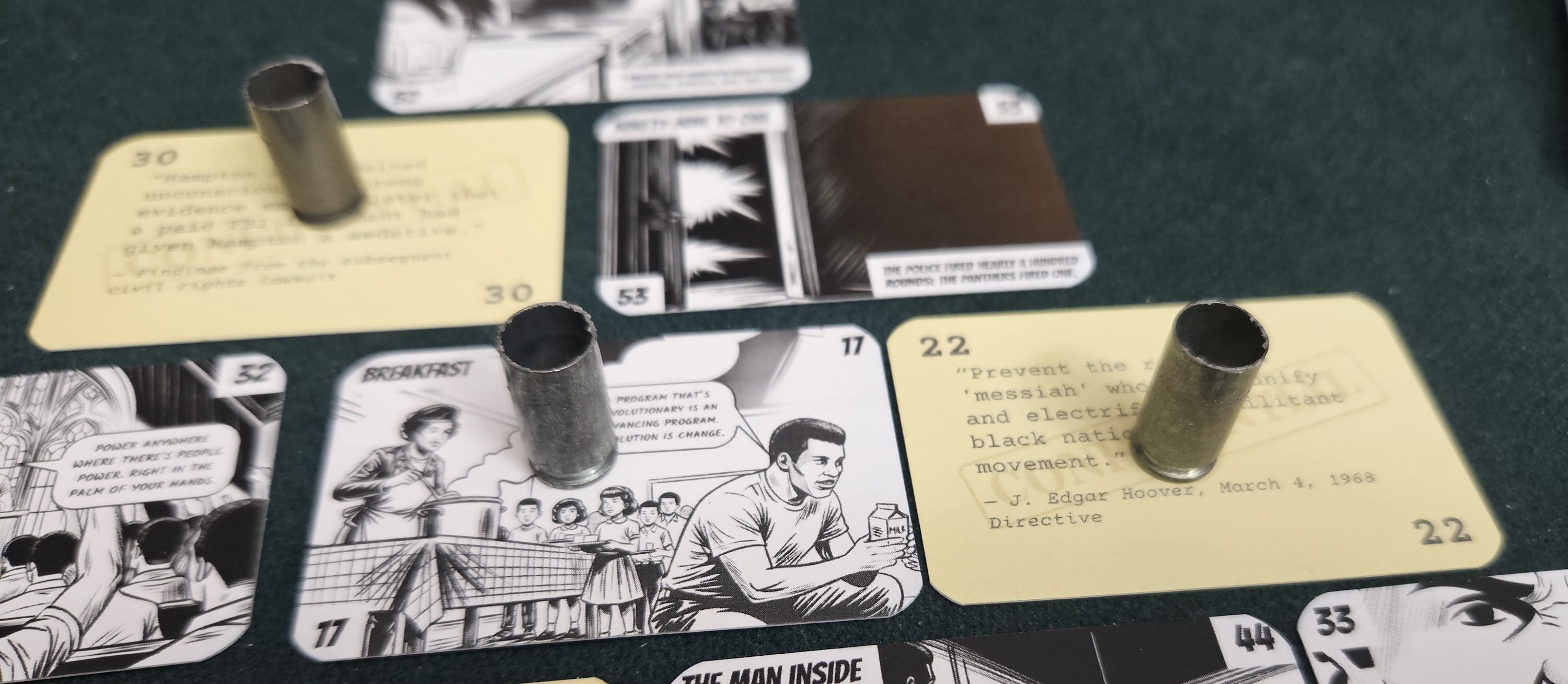
There are two sides. One player is Fred Hampton. The other is William O’Neil. The board is presented as a pyramid of ten cards, drawn and constantly refreshed from a deck of sixty. These cards are evenly divided between two dramatically different aesthetics. Hampton’s cards, illustrated by Kenn, are portrayed as panels from a graphic novel about the deputy chairman’s life. In one, he speaks at the funeral of a slain comrade; in another, he shares his famous quote about how you can kill a revolutionary but not the revolution. The others are shown as memos within the FBI, typed and sterile and hidden from public disclosure. These cards, once arranged on the table, become a conceptual representation of the Black Panther Party of Illinois. When a bullet is on a card, it has been infiltrated. O’Neil’s goal is to infiltrate the entire organization. Hampton’s is to clear the board or, barring that, to survive until the deck has been emptied.
What follows is a tense dance between Hampton and O’Neil. By removing cards from the pyramid, others tumble into their place. This lets both sides manipulate the structure of the organization, but never with much ease. Meanwhile, the placement of O’Neil’s bullet casings becomes a matter of utmost importance. At the end of every turn, whichever side controls the most “clean” cards at the bottom of the pyramid gets to either add or remove another casing. The problem for Hampton is obvious, but organizational corruption also prevents O’Neil from commanding as much sway as he would prefer. Back and forth it goes, cards and casings shifting, until the noose either cinches tight or slips free.
Hmm. Suspiciously political, if you ask me.
It’s easy to be dismissive of abstract games. When playing COINTELPRO, there’s little need to think about the particulars of Hampton’s assassination. How many of the Black Panthers’ most violent engagements were directly encouraged by O’Neil, for example, or the backdrop of oppression that functions as necessary context for the rest of the game. Devoid of background, don’t these games dissolve into something else entirely?
To some degree, this is true. One doesn’t need to read the damning FBI memos or sequence the graphic novel to receive a flipbook overview of Hampton’s life, accomplishments, and betrayal in order to operate COINTELPRO purely as a wind-up monkey. Of course, that misses the point of many board games. But it would also be a mistake to brush off Donaldson’s design as overly abstract. When examined closely, a number of little touches put the player in the headspace of its actors.
For one thing, COINTELPRO is subtly asymmetrical, giving both sides access to a private action that can do as much harm as good. For O’Neil, this is his ability to escalate the party’s activities. This adds another bullet to the board, but at the price of discarding a pair of cards from the deck. In essence, he has encouraged more radical action, putting the party in danger, but also made it more likely for Hampton to survive in the long run if he can overcome the current crisis. Meanwhile, Hampton can “bad-jacket” his cards, removing a clean Black Panther to also sweep a bullet from an adjacent card. By casting suspicion on his own people, he slowly isolates the bad apples tossed into the barrel by O’Neil — usually a bad idea, but one that can prove useful when Hampton’s back is against the wall.
But the real distinction is born out in the basic gameplay. Simply put, it’s easier to build than to destroy. Hampton’s goal is to create something durable, while O’Neil’s is to chip away at the foundations until the entire structure comes crumbling down. This quickly gives both sides a distinct emotional register. Playing as Hampton is an exercise in frustration: you carefully position your cards, ensure the removal of any one operative won’t result in catastrophe, and then watch as your unseen foe still manages to undermine your best efforts. On the other side, playing as the informant feels weaselly and cheap. It helps that the basic game is unbalanced in O’Neil’s favor, placing the extra brawn of Big Brother on his side.
Curiously, there’s an advanced variant that includes a card market that allows Hampton and O’Neil to replace unfriendly cards. This is the more balanced way to play, but it also sheds Hampton’s sense of swimming upstream. I’m glad it’s included, if only because it gives us little dials that show Hampton and O’Neil directly. But it feels like a concession to those who bellyache nonstop about balance. There was nothing balanced about the contest between Fred Hampton and the surveillance apparatus of the United States. The clue’s in the name. COINTELPRO, the FBI program that infiltrated and discredited progressive organizations, may have been discontinued in ’71, but when we have ICE agents infiltrating church services and union meetings, it seems very little has changed in the intervening half a century.
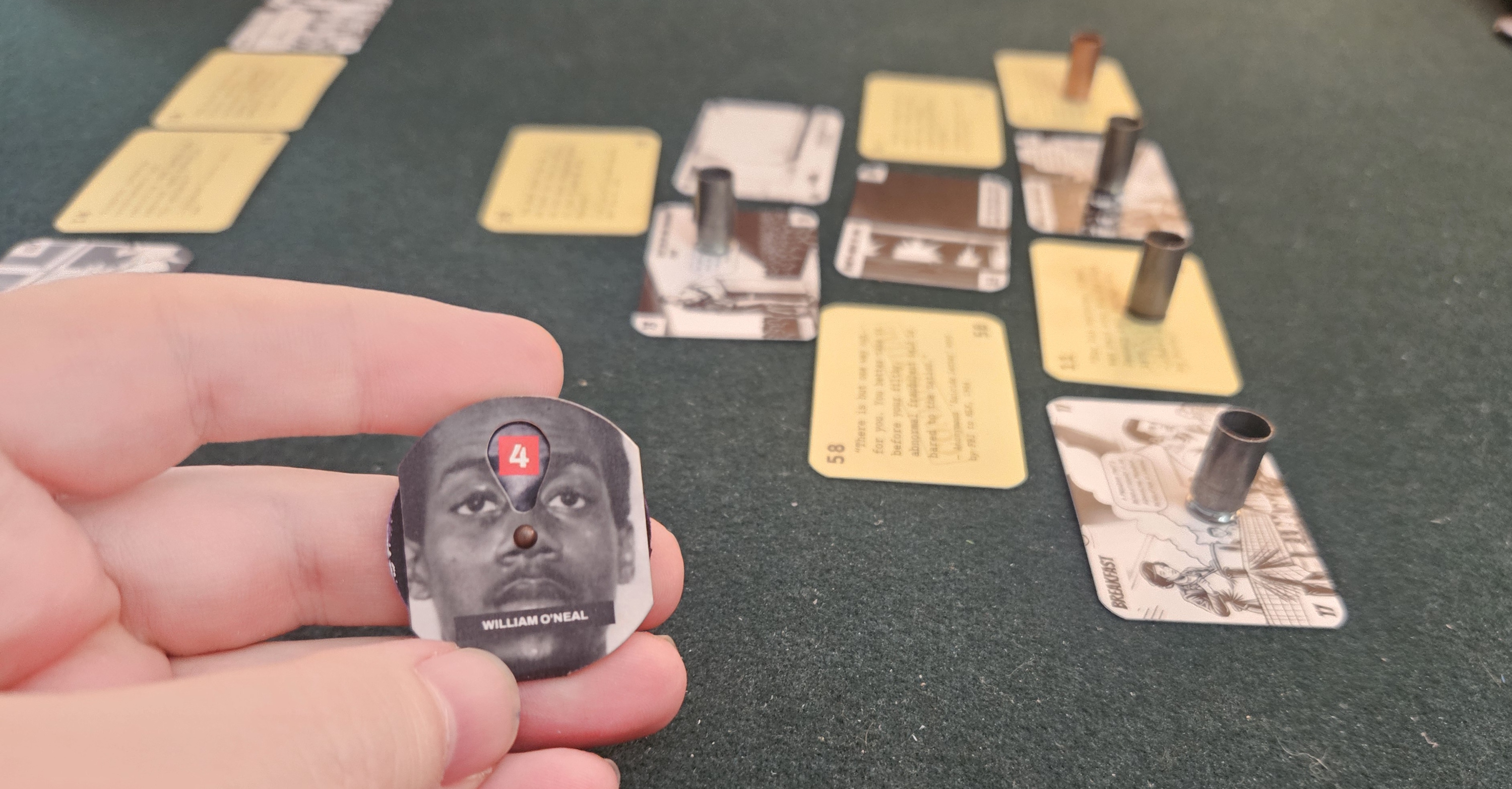
The advanced mode lets players swap out cards from a market.
In any case, the result is quite the thing. COINTELPRO: The Assassination of Fred Hampton is not only a worthwhile board game, but also a delayed growl of frustration at the injustice of a country that manufactures the consent to murder its own citizens for the crime of filling empty bellies. Fred Hampton’s final days could have been shaped into a more traditional experience, but there’s something to be said for this incarnation in particular. For the world of difference between Kenn’s comic-panel illustrations and the direct words of the people who murdered him. For the cordite-dusted bullet casings that serve as play counters.
As for those counters… they are such small things. I’ve discharged thousands of those casings in my life. Tens of thousands. I know their shape and heft. Five to six grams. Between 80 and 90 grains. I’ve swept them into baggies for friends and family members to reload, pinched them from brush and dirt. And they never weighed so much as they do in this strange and arresting board game.
A complimentary copy of COINTELPRO: The Assassination of Fred Hampton was provided by the designer and publisher.
(If what I’m doing at Space-Biff! is valuable to you in some way, please consider dropping by my Patreon campaign or Ko-fi. Right now, my third-quarter newsletter is open to all.)
Posted on November 2, 2026, in Board Game and tagged Abstracts Get Political, Board Games, COINTELPRO: The Assassination of Fred Hampton. Bookmark the permalink. 1 Comment.


Very interesting indeed. I believe this is one of the games that will be featured at the SDHistcon “Night Market” event in San Diego this weekend.