Given the Land If They Lived Righteously

I’ve never been to Machu Picchu, but it was the site that demonstrated to me at an uncomfortably young age that history wasn’t just one thing but many, and that those many things were subject to a wide range of interpretations. Even, possibly, that they might end friendships.
Which is appropriate, because that’s exactly what Wiñay Kawsay, designed by Alison Collins, is all about.
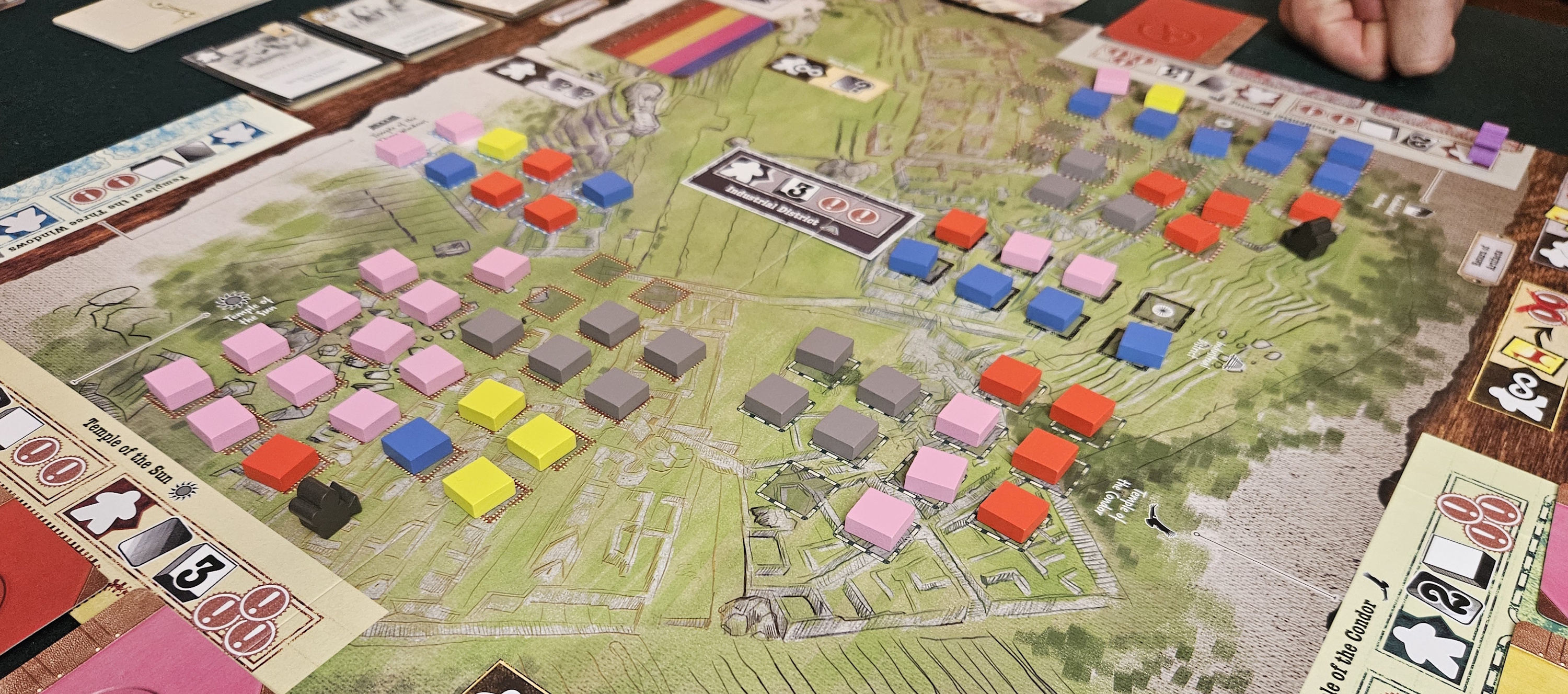
Machu Picchu, from above.
At a sky-high level, Wiñay Kawsay is set at Machu Picchu. You can see it right there. The map is even helpfully labeled with the various temples and complexes that were constructed by the Inca Empire sometime in the 15th century.
But the game is also set elsewhere: in universities and magazine offices, at dig sites and museum storerooms, and in the minds and imaginations of historians, archaeologists, students, and countless readers and viewers. For such a complicated tale, not to mention one told by a freshman designer, Wiñay Kawsay is deftly told. Collins weaves an entire warehouse of threads together with real deftness. The resultant tapestry — perhaps more appropriate, the cumbi — appears simple. In reality, it’s anything but.
Most board games would have their players build Machu Picchu. In Wiñay Kawsay you’re here to deconstruct it. To deconstruct and dig and brush away sediment, to catalogue, to publish, to argue. In its earlier incarnation, the game’s full title was “Wiñay Kawsay: Publish or Perish,” a mouthful that was nonetheless instructive. You are historians, practitioners of a 20th-century discipline rather than artisans of the 15th-century, and the mountaintop ruins have yet to yield their secrets.
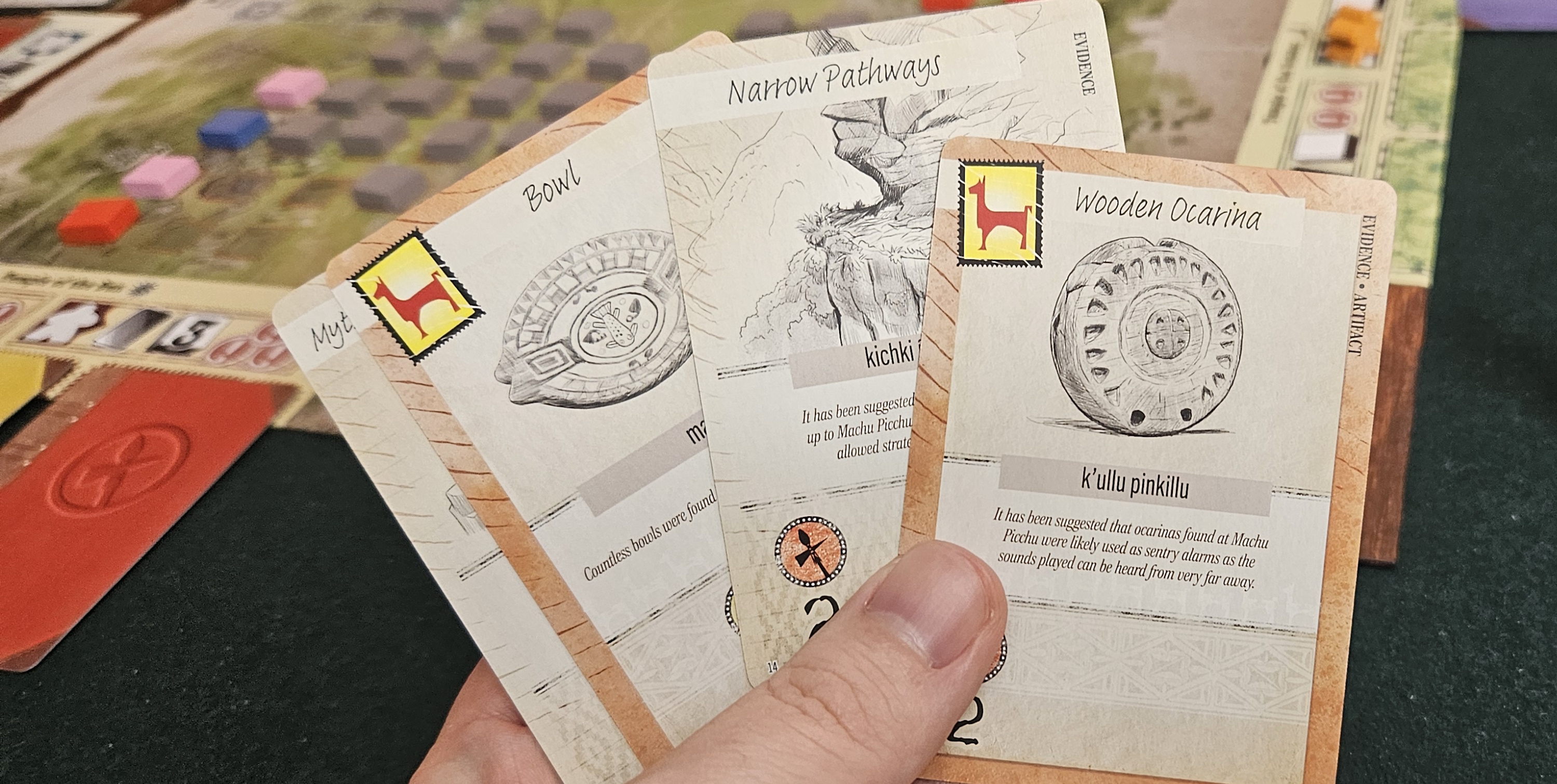
Evidence cards extracted from the dig site.
Little by little, your search scratches the surface. Gray blocks are removed from the map along with evidence cards, their backs color-coded with hints about their nature. This portion of the game is operated via worker placement, with researcher meeples deployed to recover blocks and artifacts. As the rulebook indicates, there’s an element of destruction to this process. Stones must be removed — carefully, with intention to be replaced, but removed all the same — to uncover what lies beneath. Artifacts will be removed for study and, often, displayed in far-off countries or private collections. In game terms, this translates to “impact.” For every block displaced and card recovered, you move along a track, leaving a trail of displacement in your wake.
Everything recovered reveals a function. Ornate pottery speaks to wealth. Sudden abandonment hints that the site may be one of the continent’s mythical lost cities. Guardhouses and moats and narrow bridges indicate military use. The astronomical alignment of windows and dwellings prompts thoughts of the heavens.
Very quickly, however, one thing becomes clear. There is no singular “truth.” At least there isn’t one hidden in the deck of evidence cards. There are tendencies, certainly. In the aleatory shuffle that begins each round, sometimes a corner of Machu Picchu develops in one way or another. A cluster of pink cards speaks to the site’s religious importance; a scattering of reds lends credence to the idea that this was a military citadel.
But it’s what you do with these fragments of evidence that makes Wiñay Kawsay so compelling.
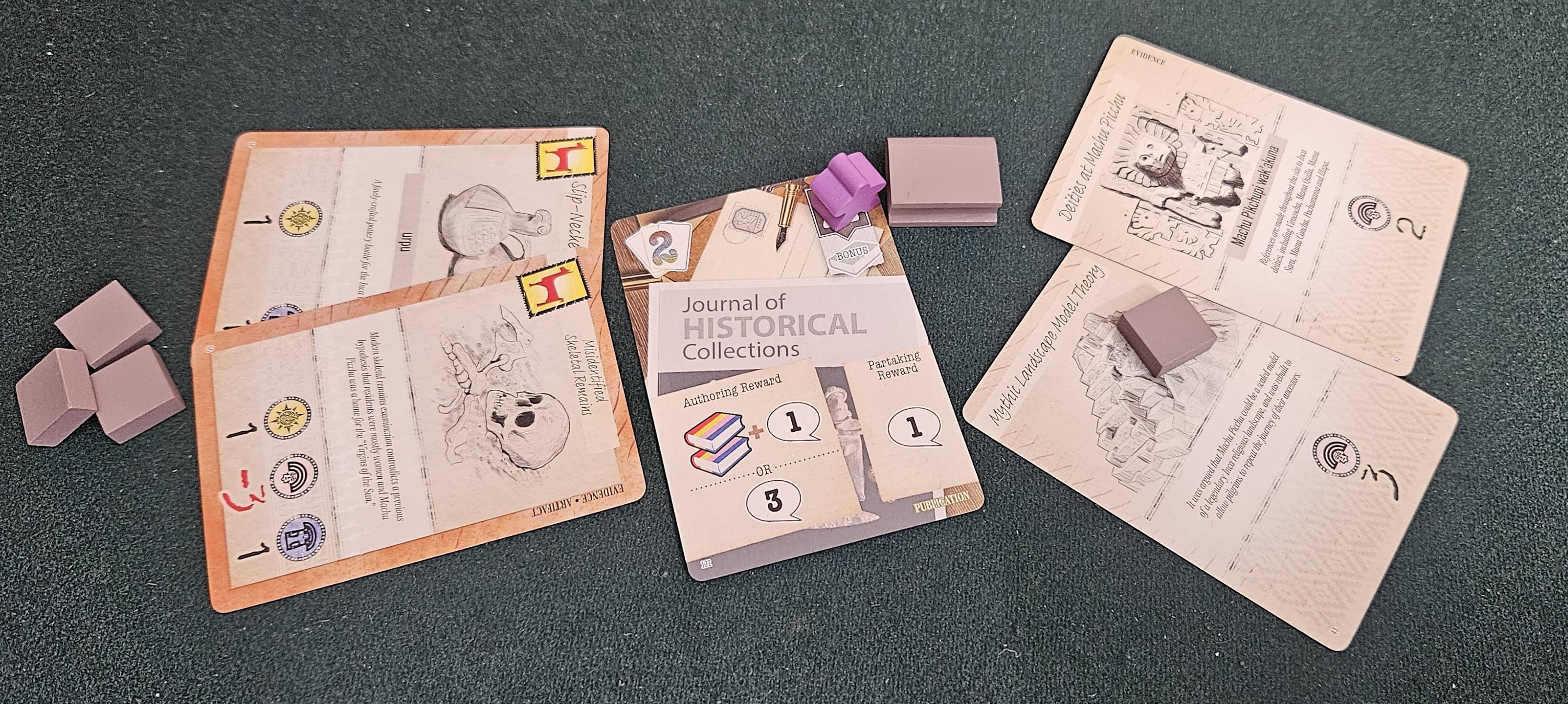
Academic publishing works exactly like this.
First, evidence must be published. This is presented via an atypical auction system. One player approaches a publication — a journal of military history, say, or a compendium of ancient history. They arrange their evidence cards and at least one of the gray blocks they took from the dig site. This is their bid.
At this point, competing players are allowed to get in on the action with their own cards and blocks. When everything is revealed, this might result in competing interpretations. In fact, it’s downright common. Icons are tallied to reveal which interpretation is most favored at the moment. Then the player who submitted the bulk of the evidence in that interpretation becomes the publication’s author, adding a color-coded book or two to the professorial desk that serves as their resource shield.
In its abstraction, this auction system captures something of the discourse that is historical authorship. Ideas matter, but only in the turbulence of publication and counter-publication. Along the way, things fall through the cracks. One interpretation that seemed solid might slip out of favor, only to resurface later when its evidence card is dredged from the archives. Meanwhile, material artifacts — a broken spine, misgendered bones, grave goods — become tally marks in ideological tug-of-wars, disappear into a crate somewhere, and then are found later to be returned to Peru, usually with some gravity of ceremony to ensure your institution doesn’t get in too much trouble for pillaging somebody’s heritage.
Which is to say it’s all so very earthy. This is history as tangible product, something dug out of the earth and then fiercely argued over. History, even, as personal prejudice and petty squabbles. It’s history as the ongoing conflict between fieldwork and archive work. And the game hasn’t even unveiled its centerpiece yet.
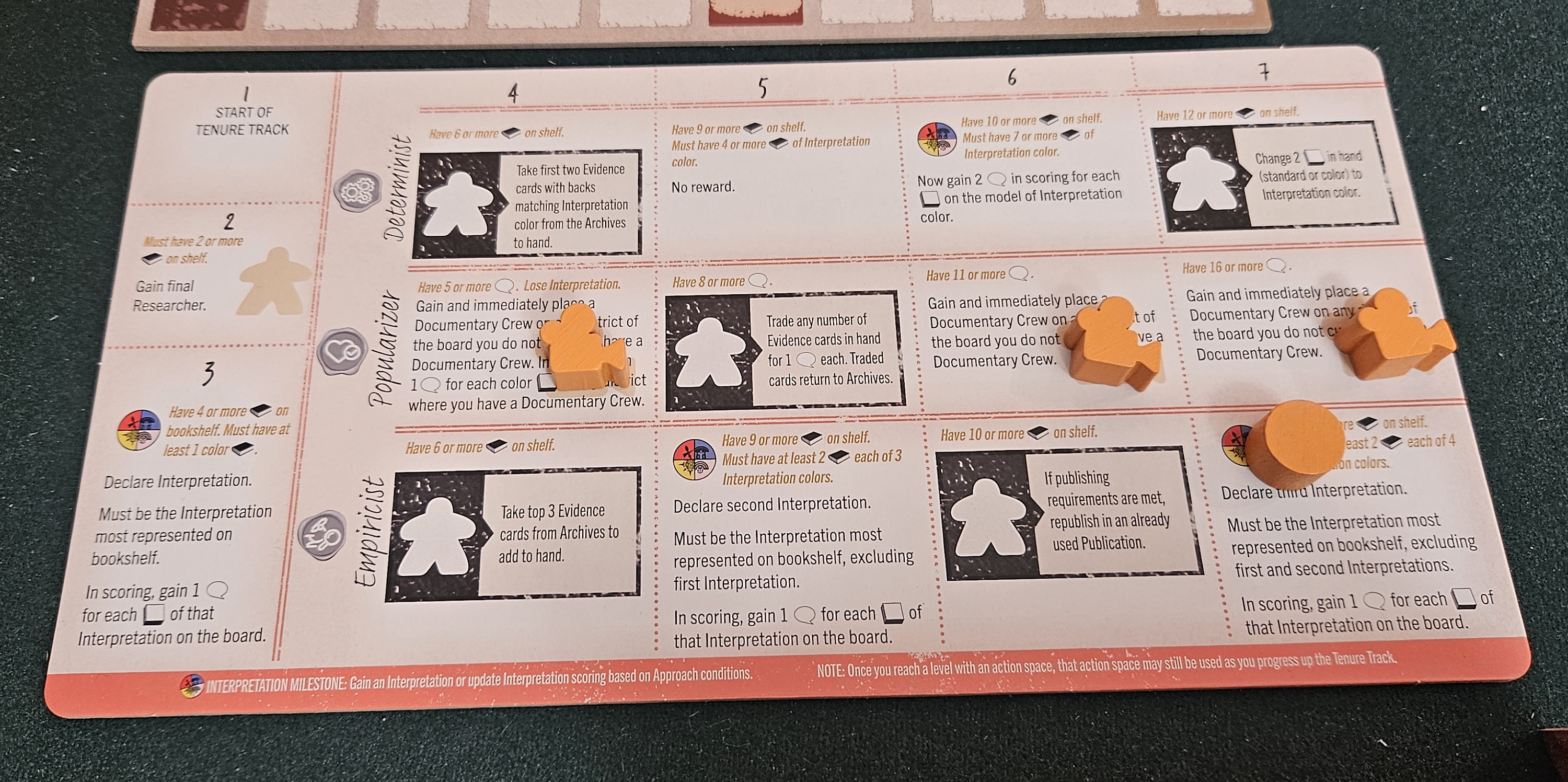
The tenure track is fraught with frustrating requirements. Accurate.
When the game opens, you haven’t yet established a favored interpretation. That occurs naturally as you publish your first papers. But then, maybe twenty minutes in, the game shifts gears. You have your interpretation. Now you’re asked how you’ll defend it.
There are three options. The first one, the one most of us would recognize as history as an ideal practice, is Empiricism. Over time, your approach to the evidence changes. This requires you to put forward and defend multiple theories — sometimes contradictory theories. By publishing books in multiple colors, your ultimate reward is a well-rounded score derived from a whole range sources.
In some ways, Empiricism is a safe bet. Any and all evidence might become valuable. But as you’ll soon discover, it’s also a precarious approach. On the opposite end of the ideological spectrum is Determinism. This approach puts forward a single theory at all costs, seeding only a single color across the map of Machu Picchu, but scoring those blocks over and over again. As a Determinist, you have the answer already in mind. The evidence is down there. All that remains is to find it. And to ignore, bury, or overwhelm any evidence to the contrary.
The third route sits somewhere in the middle: the Popularizer. Rather than having an interpretation at all, the Popularizer is here to talk about how cool history is. Basically, you’re the 20th-century history version of those I Fucking Love Science social media pages that share unsourced listicles about how neutron stars prove the universe is one big brain, maaan. In some ways, this is the safest route. As soon as you declare yourself a Popularizer, you ditch the burden of having an interpretation at all. Instead, you gain a documentary crew. This you place on one of Machu Picchu’s sites, where it earns points for every colored block. Not only some, like the Empiricist. Not only one, like the Determinist. All. As your popularity expands, you unlock additional film crews to cover further sites. Maybe you’ll even talk about aliens on some podcasts.
(Note: There are no aliens in Wiñay Kawsay. Thank goodness.)
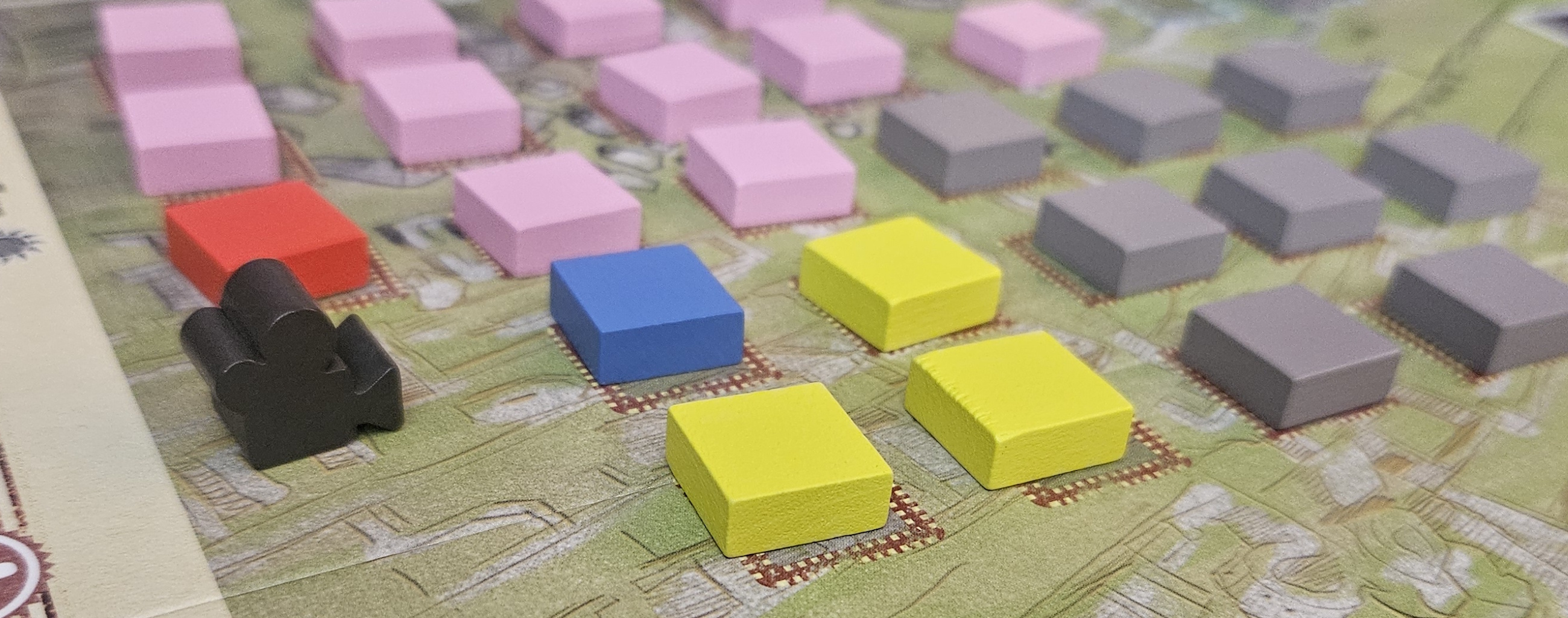
“According to one article we found on the internet, the Inca preferred Easter hues.”
What’s so fascinating about the model Collins has presented here is that it demonstrates not only the process of uncovering and writing history, but also its dangers and drawbacks.
Here’s my favorite example. In one session, I was playing as an Empiricist. That meant I favored nearly all evidence, right? Well… sorta. As the game progressed, one of my rivals outed himself as a Determinist. Specifically, a Determinist for the military theory, the idea that Machu Picchu was a citadel that projected force onto the surrounding agricultural communities.
And he was doing a bang-up job of finding evidence. Red cards, the ones that support the military interpretation, were appearing all over the place. When a lull in mace-heads and splintered bones finally presented itself, our resident Determinist had already unlocked the special action that let him plunge into the archive — the discard pile, which is very much in-play throughout the entire game — to pull out cards that matched his ideological slant. The board was redder than the binding of Chairman Mao’s Quotations. Or the cover of a Dan Bullock board game. Very red indeed, is what I’m saying.
Which meant that I, the Good Guy, the One Who Accepted All Evidence, started burying red blocks every chance I got. I still earned them, of course. In the course of publishing articles about The Militant Traditions Evident in the Soil Layers of Machu Picchu, I gave the military theory its due. Still, while I was oh so impartial on paper, beneath my player shield I was hoarding red blocks rather than adding them to the map. I even scoured each round’s opportunity cards for new ways to swap one color for another. A lecture series became a chance to discuss how, yes, there were some military artifacts here and there, but they really bore religious significance. Adios red blocks, hello pink blocks. I capitalized on popular beliefs to add more yellow blocks to the Temple of the Sun. I abused radiocarbon dating to swap reds for blues in the Residential District.
And I won. By the slenderest possible margin, I took it. I’d become the very thing I supposedly despised, a vandal of the archaeological and written record. But I’d beaten my foe, and done so while remaining the very model of a modern history-writer. To the outside world, anyway.
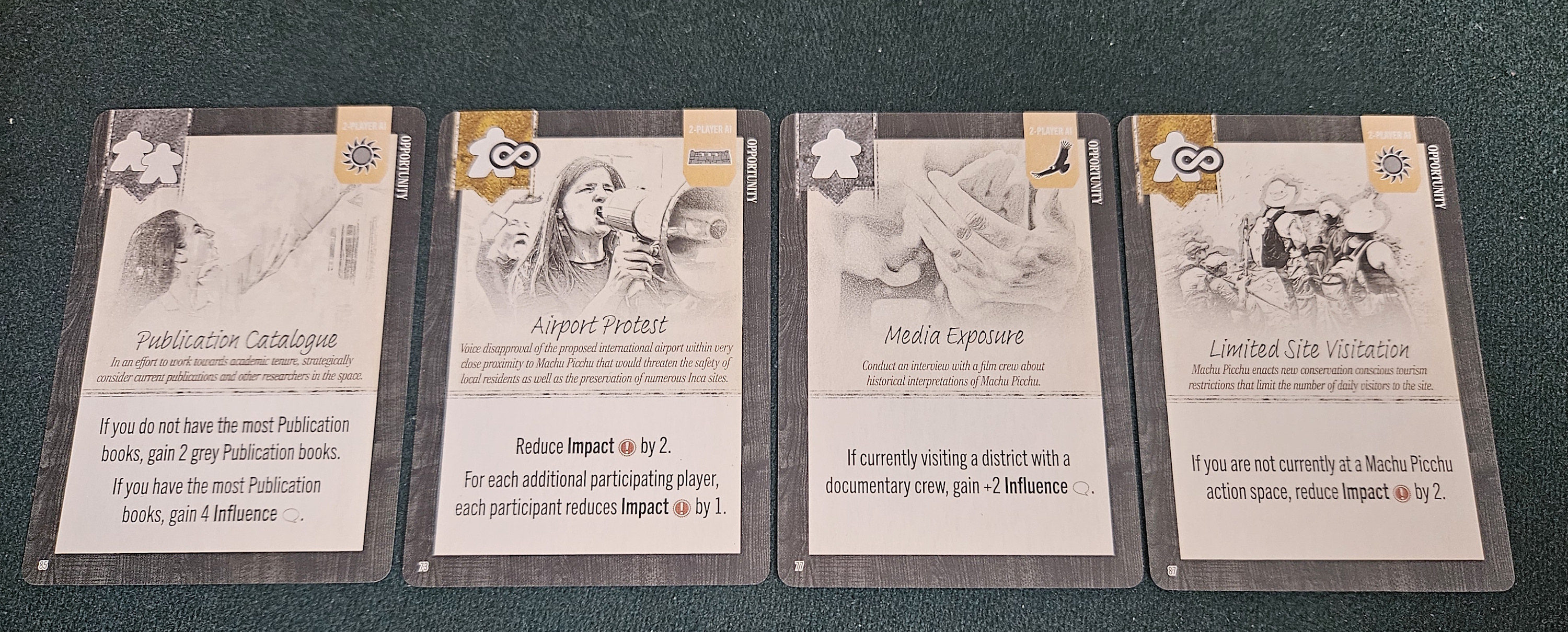
Opportunity cards consider the broader social sphere.
I wish I could say that these abuses of history are the exception, but that hasn’t been my experience. I grew up in a culture that enthusiastically encouraged higher education for everyone… provided everyone then used that education to prove the right things.
Machu Picchu was one more bystander of that culture war. In middle school, a close friend bragged to our group about how his father was taking people on tours that proved the Book of Mormon had really happened: it had been a Nephite stronghold, a satellite kingdom of Zarahemla that was wiped out in the war against the Lamanites a few hundred years after Jesus Christ had visited the Americas. In reply, I pointed out that the latest radiocarbon dating placed its origins no earlier than 1420, and furthermore argued that it was problematic to rob an indigenous group of their history to service a white Christian millenarian narrative.
LOL. I didn’t say any of that. I didn’t know the first thing about the Inca, and I probably would have told you that “cultural appropriation” was when you really liked bratwurst. But those ruins were a long way from where my seminary teacher said Zarahemla was really located, so I bounced back with something like “That’s bonkers.” Eloquent seventh-grader fare.
Anyway, my friend got very upset. “Are you calling my dad a liar?” upset. Not-talking-for-three-days upset. So upset that he stopped eating lunch with me.
Because even when history is very badly done, it matters. That’s one of the things Collins seems to be saying in Wiñay Kawsay. These ruins are real. The artifacts we draw from them are real. But the stories we tell about them are only perceptions of reality. Better or worse, accurate or inaccurate, studious or half-baked, they were written by people who had their own versions of the Inca, or what certain items must have been used for, or how this story could be told.
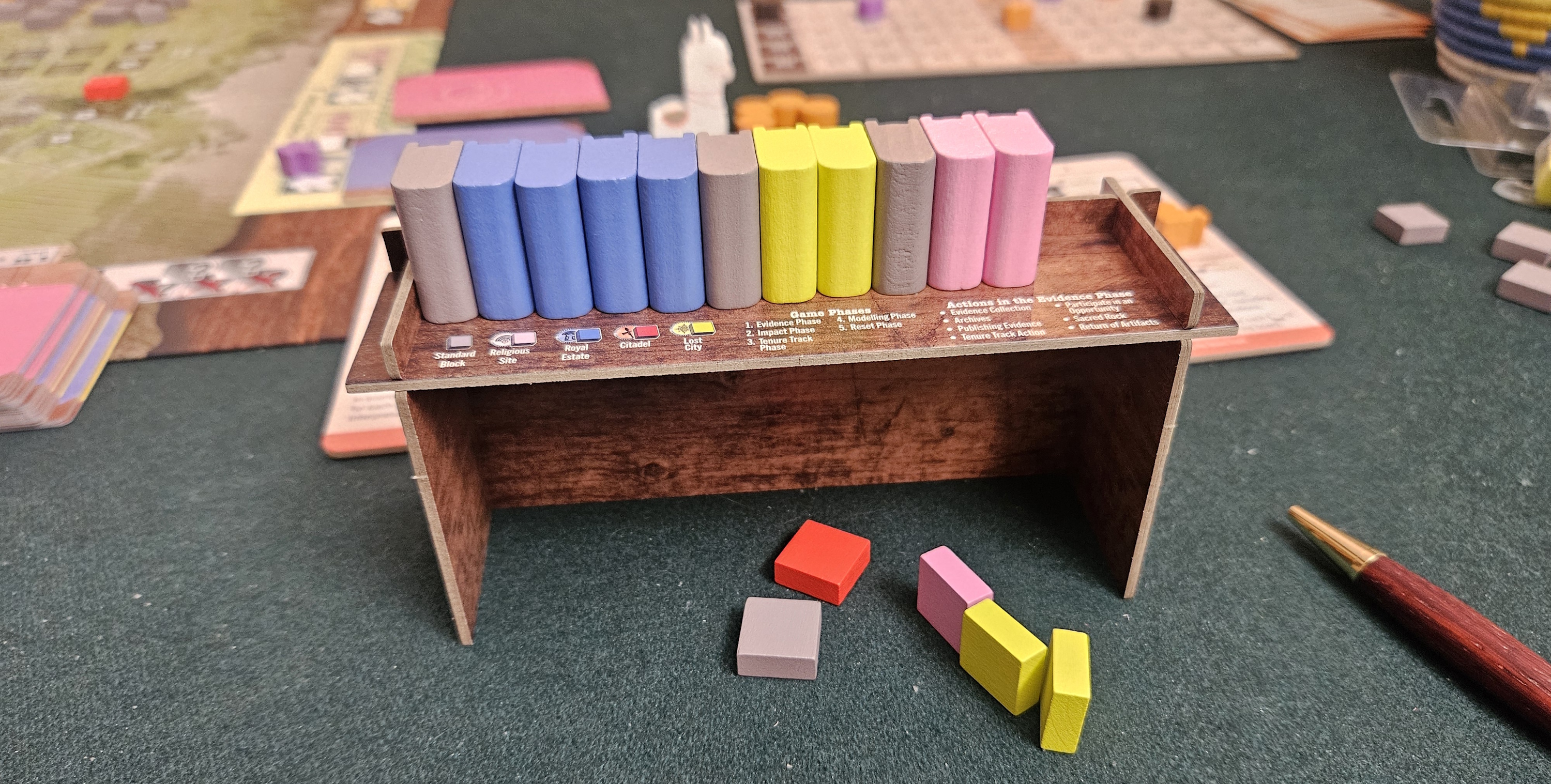
My publications.
This situates Wiñay Kawsay in rare company. Plenty of games use historical settings, but not many of them are about history. Wiñay Kawsay is about history. It’s about how history is the study of primary sources and artifacts, but about how it’s also about relating a story that makes sense. The result is a warning as much as it is a love letter, a game that believes in the process of making good history — in looking at the past, the entirety of it — but which is never unaware that bad history is always close at hand, one error, oversight, or unexamined bias away. Hopefully there are correctives, found in peer review and publishing and debate. Hopefully.
At any rate, Collins has crafted something impressive, a heady blend of sharp gameplay and shaper insight that’s far simpler and more playable than anyone could rightly expect.
A complimentary copy of Wiñay Kawsay was provided by the publisher.
(If what I’m doing at Space-Biff! is valuable to you in some way, please consider dropping by my Patreon campaign or Ko-fi. Right now, my third-quarter newsletter is open to all.)
Posted on October 13, 2026, in Board Game and tagged Board Games, Wiñay Kawsay, WizKids. Bookmark the permalink. 1 Comment.


I did a double take and had to reread the paragraph about your conversation in middle school. I was thinking, “no way, that’s total BS!” So relieved to see the LOL afterward. Nearly lost all faith in you, Dan. 😀