Tantrums in the Sandbox
Of the handful of things I appreciate about Pax Playground, the most significant is the way it reminds me of recess. Its very existence is playful — this is, after all, a Pax game that lasts twenty minutes and bucks tradition by refusing to touch history with a ten-foot pole, let alone compose loopy footnotes about it.
More importantly, David Masnato, who previously did the art for Matilda Simonsson’s Turncoats and Pax Penning, uses Pax Playground to reproduce the anxieties of childhood. Like a child, you step into the game buoyed by possibility — and weighted down by it. As a game about play, it’s playful; as a game about becoming yourself, it’s as fretful as a kid trying to decide which sweet to pick out at the store.
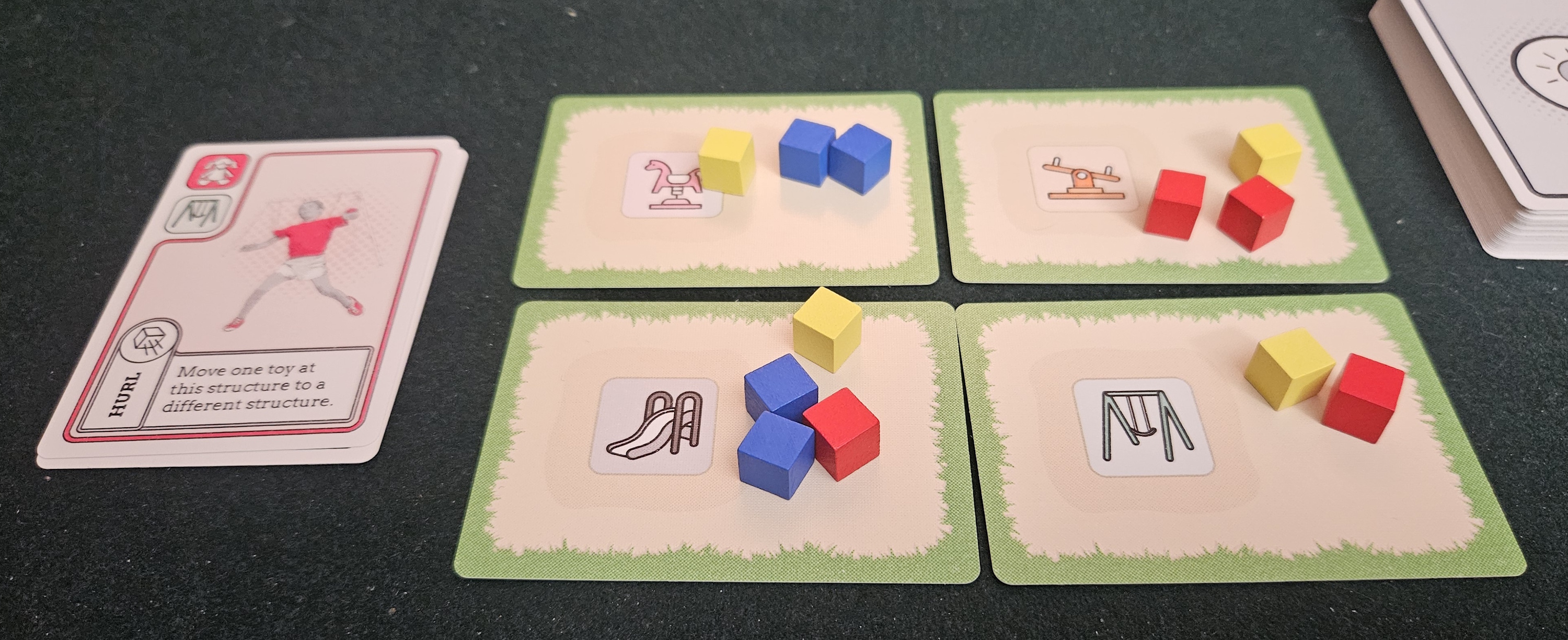
Who will rule the playground? Not you. Playgrounds are for playing, not ruling.
When Pax Playground opens, you’re presented with the titular playground. There are five locations in all, four of which, the slide, swings, teeter-totter, and rocking horse, are also considered structures. These locations begin with some number of toys. There are three types: blue for cars, yellow for yo-yos, and red for dolls. The schools I attended as a youngster never permitted toys, forcing us to manage our own black-market trade in Pogs and Matchbox cars and eventually Magic: The Gathering cards. Swap out a few nouns and the whole thing becomes achingly familiar.
Your objective is twofold. First, you want to make friends. Second, you want to stay true to yourself. Or maybe those should be the other way around. First, stay true to yourself. Second, make friends. Perhaps it’s a question of priorities.
As any kid can tell you, making friends isn’t as easy as you think it is, MOM. At any given time, the playground has a favorite toy, determined by which of those three colors wields the most majorities across those five locations. You also have a favorite toy. This one is tallied based on the cubes in your possession and the cards you’ve banked face-down. When the game concludes, if your favorite toy and the playground’s favorite toy are in alignment, you’ve struck up some friendships based on shared interests. Otherwise, you’re the weird kid performing yo-yo tricks while everyone else is playing with dolls.
Meanwhile, staying true to yourself is a question of fulfilling the objective card that was dealt to you in secret during setup. These offer a variety of goals, all tied in some way to the state of the playground. A picky child, for example, might want to ensure there’s only one type of toy at their favored location, while a determined child stacks a whole pile of toys together in one place.
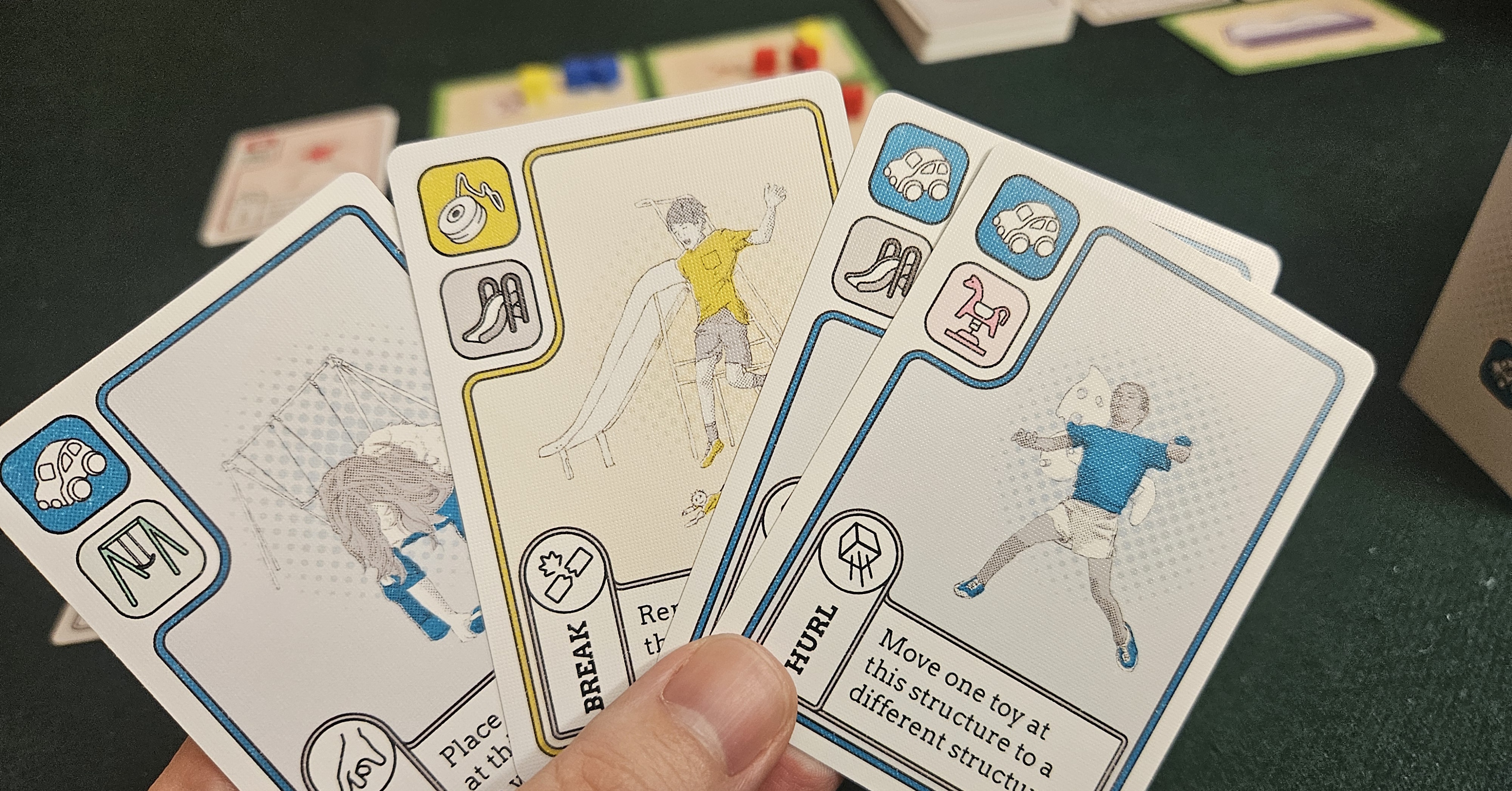
The many ways to play.
Easier said than done. Thanks to a truly devious card system redolent of the stones from Turncoats, every action spends something from your possession and beckons you slowly but surely toward the game’s conclusion. Your hand opens with five cards. You’ll never draw or draft a replacement. Furthermore, a card only triggers its action if it matches either the toy or the location in the discard pile. For such a short game, expect to spend a lot of time studying your cards for worthwhile plays.
The only way around this limitation is to throw a tantrum. This sends you to the sandbox, the playground’s fifth and normally inaccessible location, where a selection of market cards can break the usual symbol-matching problem. The hitch is that throwing a tantrum spends a toy from your backpack. However, this also presents an opportunity. Because the sandbox can only be adjusted by children having a meltdown, a tactical tantrum can tweak the playground’s favorite toy to your liking without having to play nice with the other children. Future business majors, here’s your life lesson: sometimes it pays to be bad.
In all cases, these limitations are the beating heart of Pax Playground’s gameplay. It’s hard to play cards, and even harder to make them do what you want. It’s even possible that you’ll be forced to play on your own for a while, daydreaming about your favorite toy even if it undermines your long-term strategy. For a game that appears so lighthearted, the mechanical principles are uncompromising.
Then again, I suspect that’s the point. Adults often look back on childhood as a period without cares or responsibilities. This is only true if one considers their principal responsibilities to be economical: rent, bills, employment. Everything else — and I mean everything, from one’s moral behavior to their social obligations to the frightening burden of who you’re becoming minute by minute — is not only every bit as large and intimidating to a child as to an adult, but significantly larger.
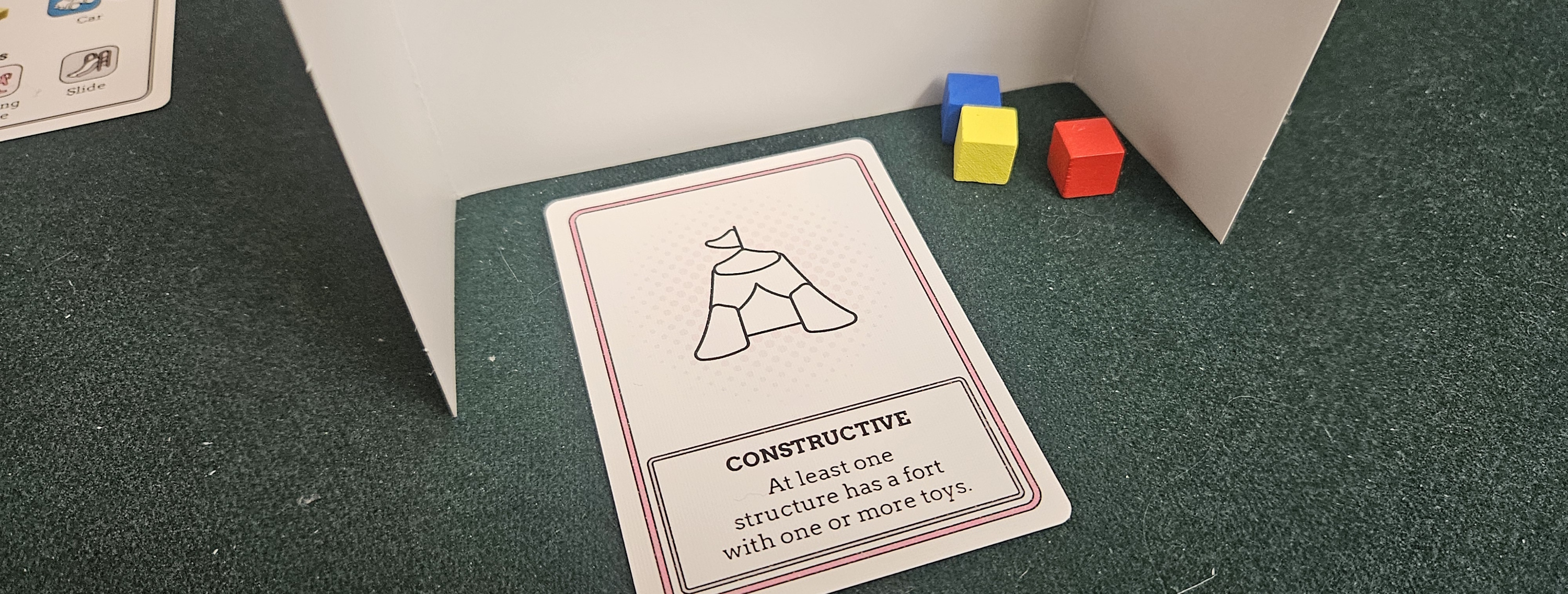
Will you stay true to yourself? Possibly.
In one respect, Masnato softens the blow. While Pax Playground asks its players to think through the ramifications of every move, it takes a loose hand when it comes to victory conditions. Like a few recent titles, there’s no definite win-state, only the lingering question mark around whether you made friends and/or stayed true to yourself.
Here’s the old man in me speaking: at times, victorless games strike me as a brand of ludic malpractice. As fun as it can be to sit around and engage in directionless play, the medium that we call board games generally requires some guiding principle. That direction, more often than not, is most clearly expressed through victory conditions.
Now, I’m sprinkling qualifiers around for a reason. There are some perfectly wonderful victorless games out there. I’ve even recommended some of them. What’s more, I’m not sure the objection applies to Pax Playground. For one thing, it does feature objectives, and they result in fairly natural rankings at the table. While there might be some quibbling over one player making friends but betraying their values while another stays true to themselves but remains lonesome, it’s reasonably easy to say that meeting one objective is better than none and accomplishing both is pretty dang great.
Even setting that aside, Pax Playground succeeds because it raises one of the most pressing concerns of human life, whether on the playground, in the workplace, or really anywhere else: the tension between conformity and individualism. What’s more, it asks the question in a way that doesn’t result in a cliché “conformity bad, individualism good.” As a social creature, it’s healthy to foster friendships, even if we sometimes have to feign interest in a friend’s new hobby. On the flipside, the personal values listed on the cards aren’t things like honesty or generosity. They’re attributes like pickiness, indecision, or the pressing need to erect a fort around the seesaw.
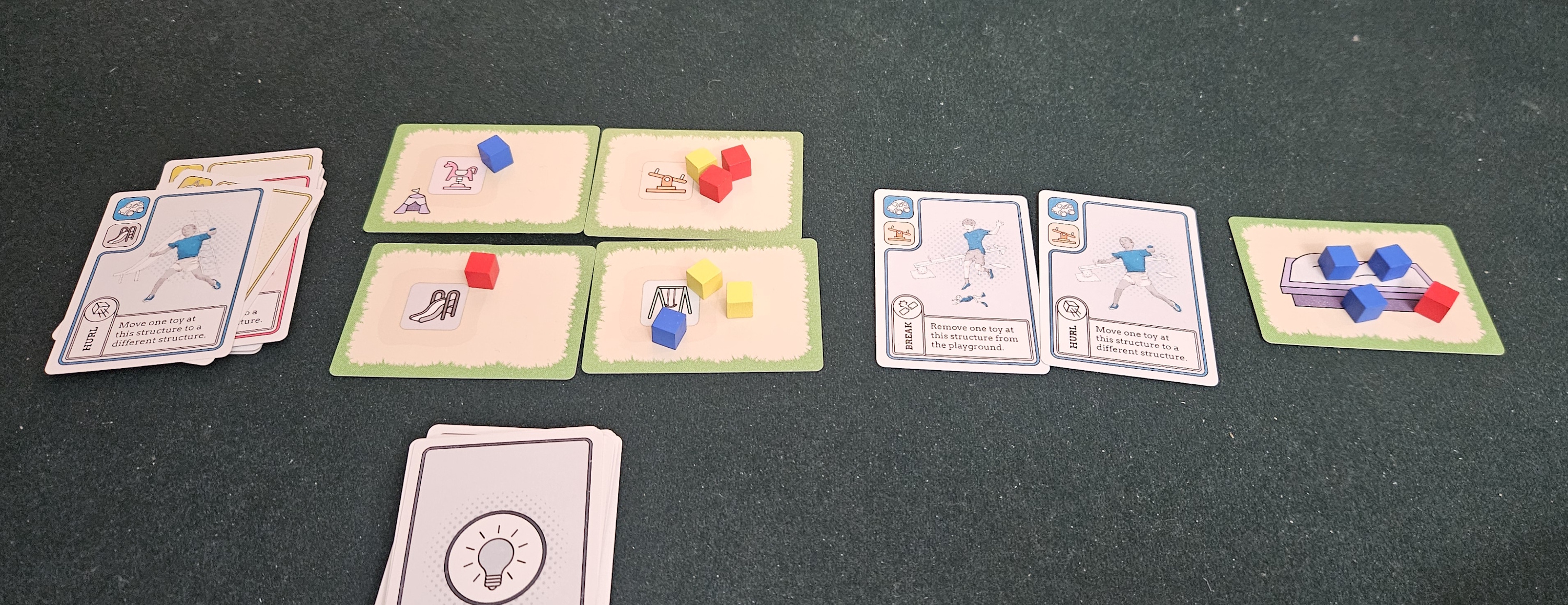
The sandbox is for time-outs.
Which isn’t to say those traits can’t be worthwhile! I’ve built more forts as a parent than I ever did as a kid. It’s just that Pax Playground declines to put down stakes. Instead, Masnato has crafted a system that’s challenging to operate but allows any errors to fall on soft ground. As a feat of design, it’s quite the thing to behold, simultaneously painstaking and without immediate consequence.
In that sense, Pax Playground is a game about childhood. About the pressure to become yourself, about the wide-open frontier that is your future, so vast and uncharted as to be terrifying. But it’s also about having the liberty to mess up now and then. It is, in both senses of the word, a sandbox. And every so often, it’s worth the time-out to throw a hissy fit.
A complimentary copy of Pax Playground was provided by the publisher.
(If what I’m doing at Space-Biff! is valuable to you in some way, please consider dropping by my Patreon campaign or Ko-fi. Right now, supporters can read the next installment in my series Talking About Games, this time tackling the topic of what makes a good list! Naturally, the piece includes a list.)
Posted on October 7, 2026, in Board Game and tagged Board Games, Pax Playground. Bookmark the permalink. Leave a comment.


Leave a comment
Comments 0