To Boldly Shuffle

Ah, Captain’s Chair. I’ve already logged my appreciation of Nigel Buckle and Dávid Turczi’s remapping of Imperium into the Star Trek universe. Like that series, now sadly defunct thanks to the shuttering of the board-gaming side of Osprey Games, this is an information-dense deck-builder that absolutely revels in its moreishness. Quite literally. It features more icons, more decks, and more chrome-laden rules per cubic micron than any other deck-builder I can recall.
Now there’s a second-wave box, To Boldly Go. If you’ve played the original, you know what to expect. Seriously, newcomers can just read my previous review.
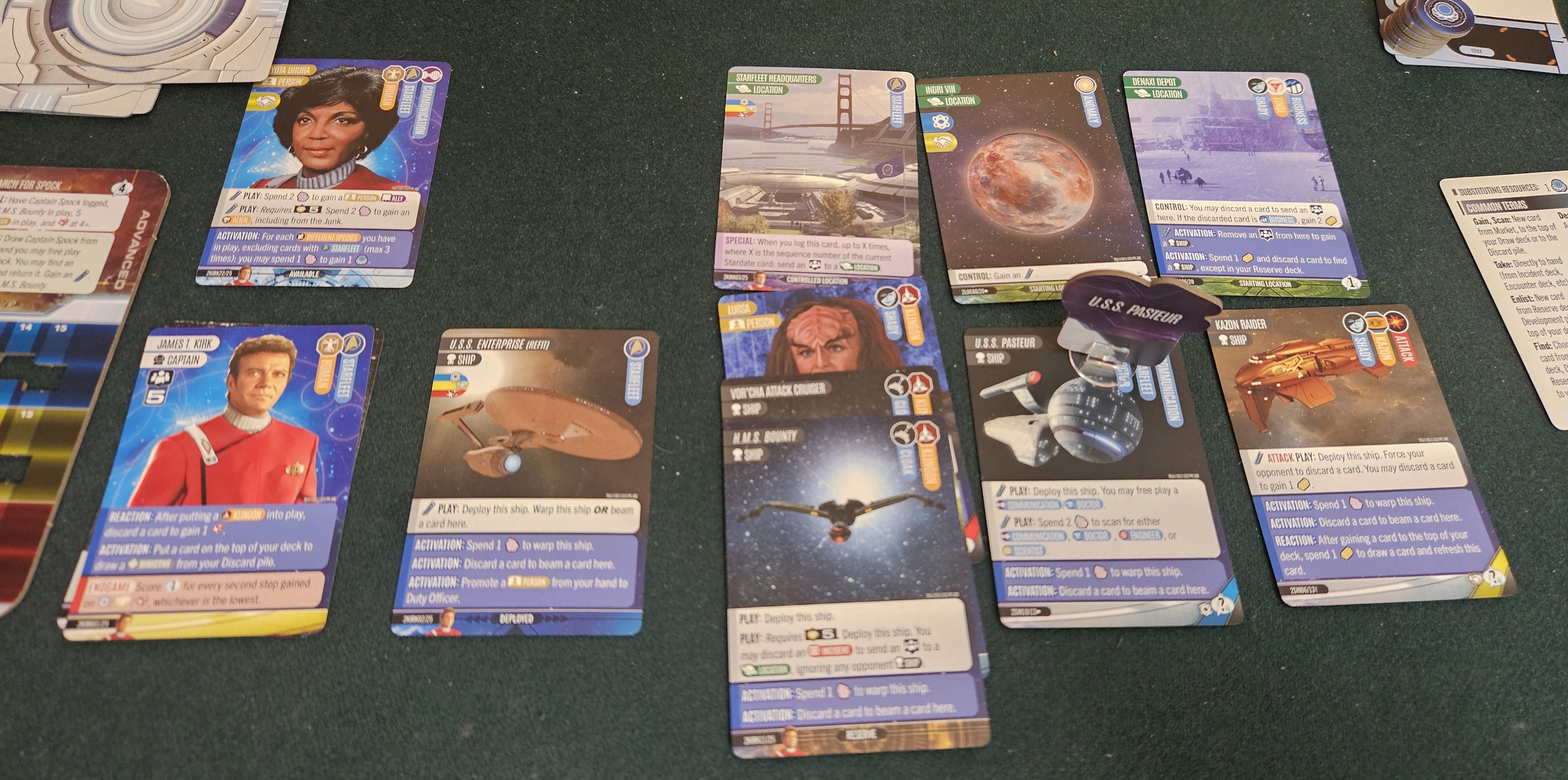
Kirk out here Kirking.
I really wasn’t bluffing. I’m not about to spill anything new. OR AM I? Look at me, playing like Q.
For the most part, To Boldly Go repeats the accomplishments of that original set, featuring six new captains who can either be commanded in one of the game’s default duels or faced as an opponent in the (excellent) solitaire mode. As with Imperium, these decks are what make Captain’s Chair Captain’s Chair. Like an unassimilated technological and biological lifeform, they’re distinct.
How distinct? Distinct enough that there’s good news and bad news.
First, the good. The captains in To Boldly Go are even more dissimilar than those in the base box. Even the ones that are relatively “baseline,” like Soval, Philippa Georgiou, and the long-awaited James T. Kirk feel different on the table. Having served as an ambassador to Earth, Soval fuels his abilities by dismissing them as a species — in game terms, by literally chucking them out of his hand. Which is a bit of a double-edged ability, since he wants to fill his deck with enough exemplars of mankind to keep his better abilities churning. Kirk, meanwhile, is an all-rounder, forced to emphasize the game’s various flavors of influence equally. The flipside is that, as the grandfather of this galaxy, he’s more likely to draw encounters, the ultra-powerful scoring cards that most captains only see one or two of throughout an entire session.
The other captains are wackier, and I mean that entirely as a positive. Khan breaks the game’s usual rules, dispensing with the customary science/diplomacy/military track to instead mind-control a diverse crew and start shouting Moby Dick quotes at his enemies. No, really. He has Moby Dick quotes. Archer, being the flashback character, starts with a deck that fits in his starting hand and nearly no away team tokens for conquering planets. Instead, he has to rush to form the Federation from scratch, giving him some incredible early-game momentum but the testiness of having to forge synergies from first principles. And then there’s Rebner. I haven’t seen a single episode of Below Decks, so I have to trust Buckle and Turczi when they inform me that Rebner’s whole deal is that he’s a total moron. He draws only three cards per turn, can’t utilize science or diplomacy at all, and his cards get stronger as they find and don big hats.
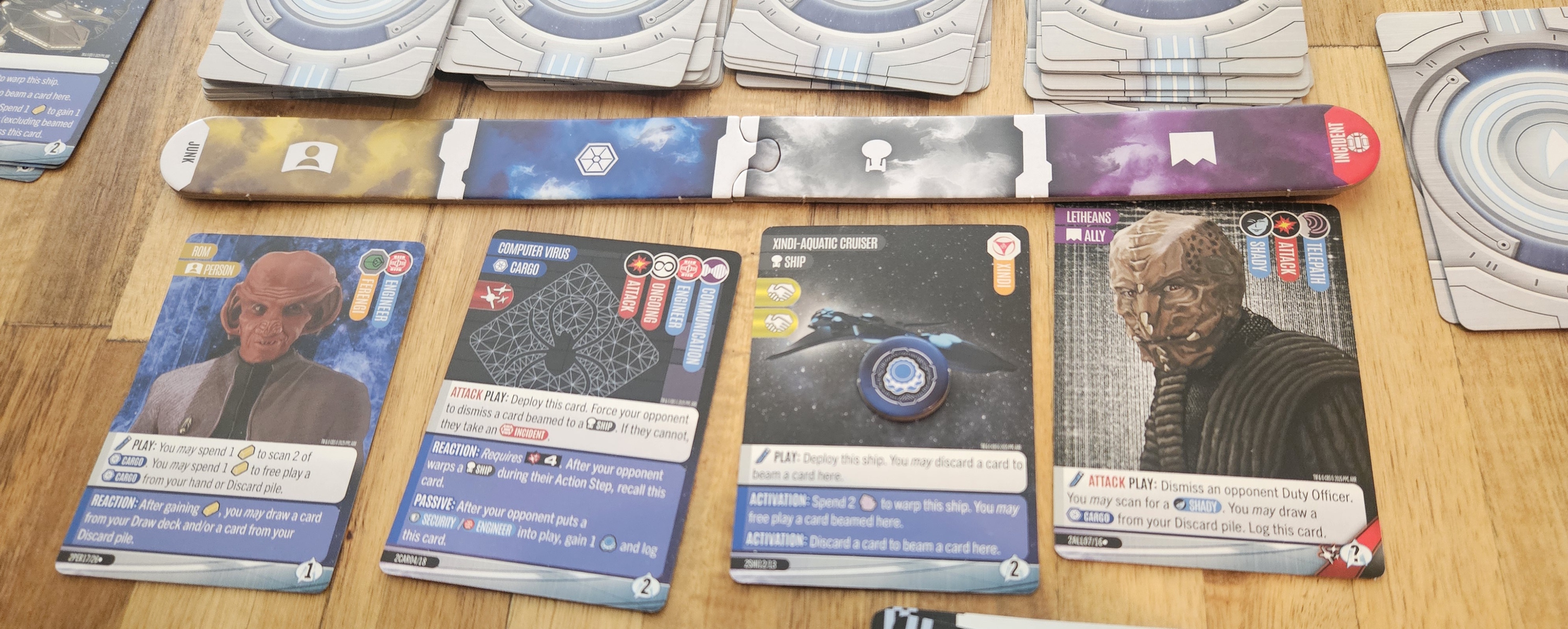
Aha, a card market!
Actually, Rebner has become my object lesson for To Boldly Go at large. He’s a total hoot to play, and moreover he’s forced me to embrace a portion of the game I’ve always tended to overlook. Returnees to Captain’s Chair might already know what I’m talking about. In the market, there are four main decks that players can freely recruit from. Three of those decks — people, ships, and allies — offer immediate utility. The fourth, the one called “cargo,” has always been a little trickier to use. These are special items that… well, they do all sorts of things. Which is both the value and the drawback of cargo. You’re never quite sure what you’re going to get. Most function as attachments, things you can merge with other cards to bestow new abilities. But they aren’t always that, and sometimes their wilder effects can be more trouble than they’re worth.
Rebner, with his crew’s emphasis on securing and wearing fancy hats, makes cargo a necessity. His starting deck has a bunch of hats, both in its starting pool and for later recruitment, a stark contrast with most captains who might have one or two tucked into their reserve. What’s more, a couple of additional hats can be found in the cargo market deck. They get a “helmet” tag and everything.
But that reveals an issue with To Boldly Go. More specifically, an issue with merging To Boldly Go with the original Captain’s Chair and any forthcoming sets.
In short, the original game didn’t contain any helmets. Which means that poor stupid Rebner is going to have a heck of a time finding any hats for his crew when using the original Captain’s Chair market, whether on its own or blended with the offerings from To Boldly Go.
Of course, the issue is broader than a shortage of hats. It’s that each captain has their own objectives to pursue, and these objectives often require them to dive through the market for specific keywords. Some of these tags are standardized across sets. Roughly half the card pool has been duplicated from the original box, and there are always plenty of humans, Vulcans, and Klingons. For captains who need specialized tags, merging or crossing-over sets just became a testy proposition.
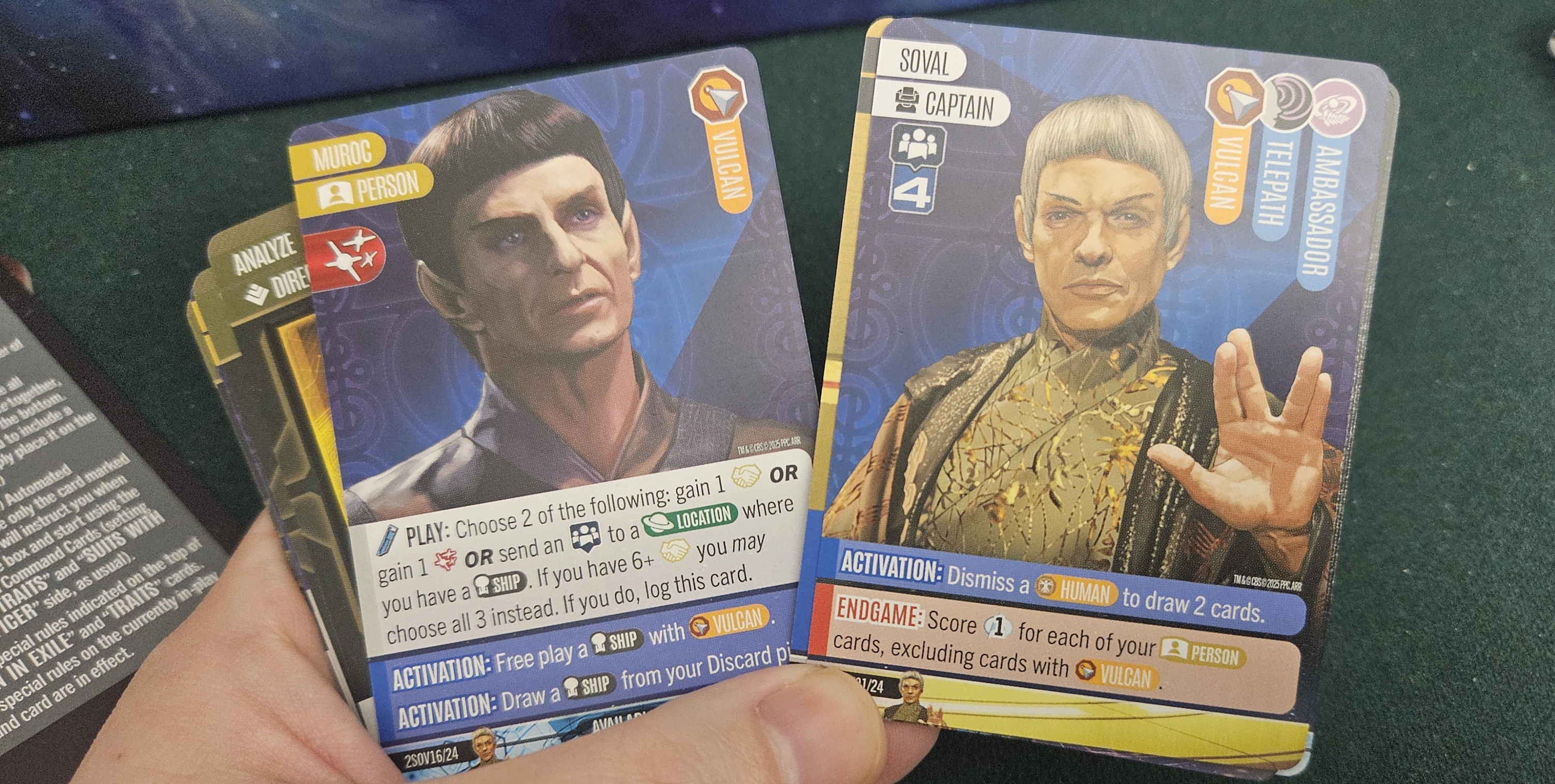
As before, the icons are nice and crisp, but also… there are tons of them.
This isn’t to say the issue is a dealbreaker. Nor that it presents an intractable problem. There have always been tools for rifling through the decks of Captain’s Chair, in particular the “scan” ability that allows players to search through a certain number of cards — even multiple market decks — to mine a specific keyword. It’s pretty rare that you’re beholden solely to whichever cards are currently on display.
But it highlights a certain jankiness to the system. Turczi has compared sets to drafting cubes. Captains function best with the cards in their box, not necessarily when merged across sets. Which, to some degree, makes the whole thing a little less appealing, at least to this guy. I’d much rather rest assured that I could have Kirk face down Koloth or Picard take on some theoretical third-wave Borg Queen without worrying about the composition of the market introducing its own subspace turbulence.
Because, yeah, Captain’s Chair is good enough, even with these bumps, that I want to keep exploring what it has to offer. Even at its most maximal — frankly, thanks to that quantity-is-quality — there’s a thrill to seeing how Buckle and Turczi can mine their deck-building system for new ways to express this particular setting. I loved the diversity of cultures in Imperium, that it was possible to have something sprawling like the Roman Empire throw down with the Olmec and the Inuit, each with their own cultural focuses, and still function at all, let alone present such a compelling contest.
Here, decks are even more distinct. Combined with the additional flexibility of a system that stretches further than its predecessor, the result is a game that keeps me coming back. Even when, on occasion, it frustrates me with its avalanche of icons, a lane-battler core that sometimes gets lost amid everything else, and now the persnicketiness of sets that don’t effortlessly merge.
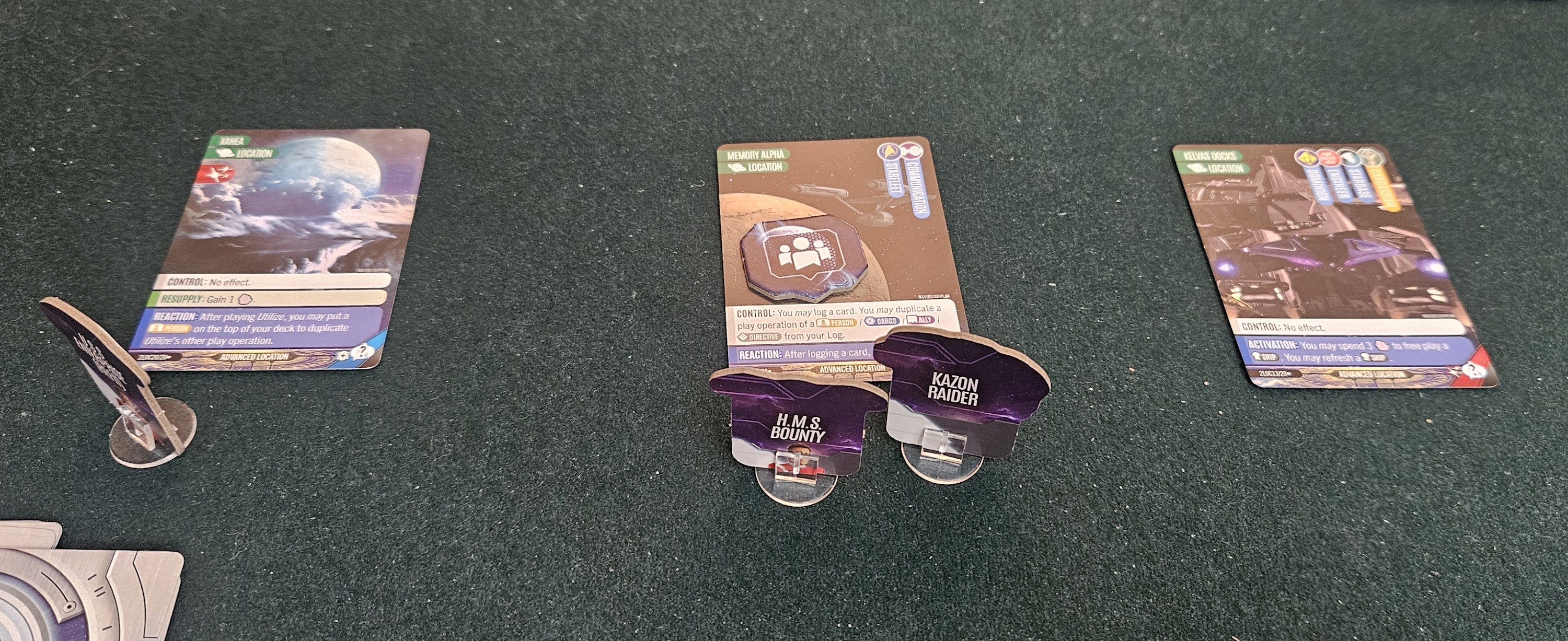
Captain’s Chair is also a lane-battler. Sorta.
Maybe this was always inevitable. As Imperium grew, that system faced similar aches and readjustments. Any growing pains are only compounded by the sheer enormity of what’s contained in each box. So much for balance; then again, it was always a remote possibility with decks as varied as these.
Either way, here’s to another Captain’s Chair. Going forward, I think I’ll boldly shuffle everything together, consequences be damned.
A complimentary copy of Star Trek: Captain’s Chair: To Boldly Go was provided by the publisher.
(If what I’m doing at Space-Biff! is valuable to you in some way, please consider dropping by my Patreon campaign or Ko-fi. Right now, my third-quarter newsletter is open to all.)
Posted on October 27, 2026, in Board Game and tagged Alone Time, Board Games, Star Trek: Captain's Chair, WizKids. Bookmark the permalink. 1 Comment.


I will say that Nigel Buckle has said that he likes to just shuffle everything together. So one of the designers prefers a cube format, while the other does not. The game is intended to function both ways. If you actually do the math the icon dilution doesn’t change that much from merging decks, especially with the SCAN keywords as you mentioned. As someone that also prefers to just mix it all together, I agree that hearing that one of the designers likes to keep the sets generally separate, it also turned me off a bit. I just want other people that feel similarly to also know the other side of the coin.
I’d love to hear what you think of the Freeman deck from the Second Contact expansion, both her (from Lower Decks) and Pike (from Strange New Worlds) are super interesting.