Cumulostratic Cruise

On not-so-rare occasions, I get to play board games before they’re fully polished. There’s something about seeing a game struggle through its growing pains, watching its knobbly limbs grow lithe and athletic, its protrusions smooth and frictionless, that recalls editing a novel for publication or appraising frames for the final cut. Most of the time, this process is a hard one. “Murder your darlings,” Sir Arthur Quiller-Couch said of an author’s finest phrases. Cut them down to size. That’s what it takes to make something great.
Only I’m not convinced we don’t sometimes murder a little too liberally. Sometimes I’ll play a finished game only to discover that the essential soul that made its earlier incarnation worth experiencing has been killed along with the wobbly iconography and degenerative action states. Somewhere in the process, development has sanded down the knobs and protrusions — and left little more than a burnished stick. Good for a walk, perhaps, but not especially notable.
Which brings us to Braided Skies, created by Dan Germain and Stonemaier Games.
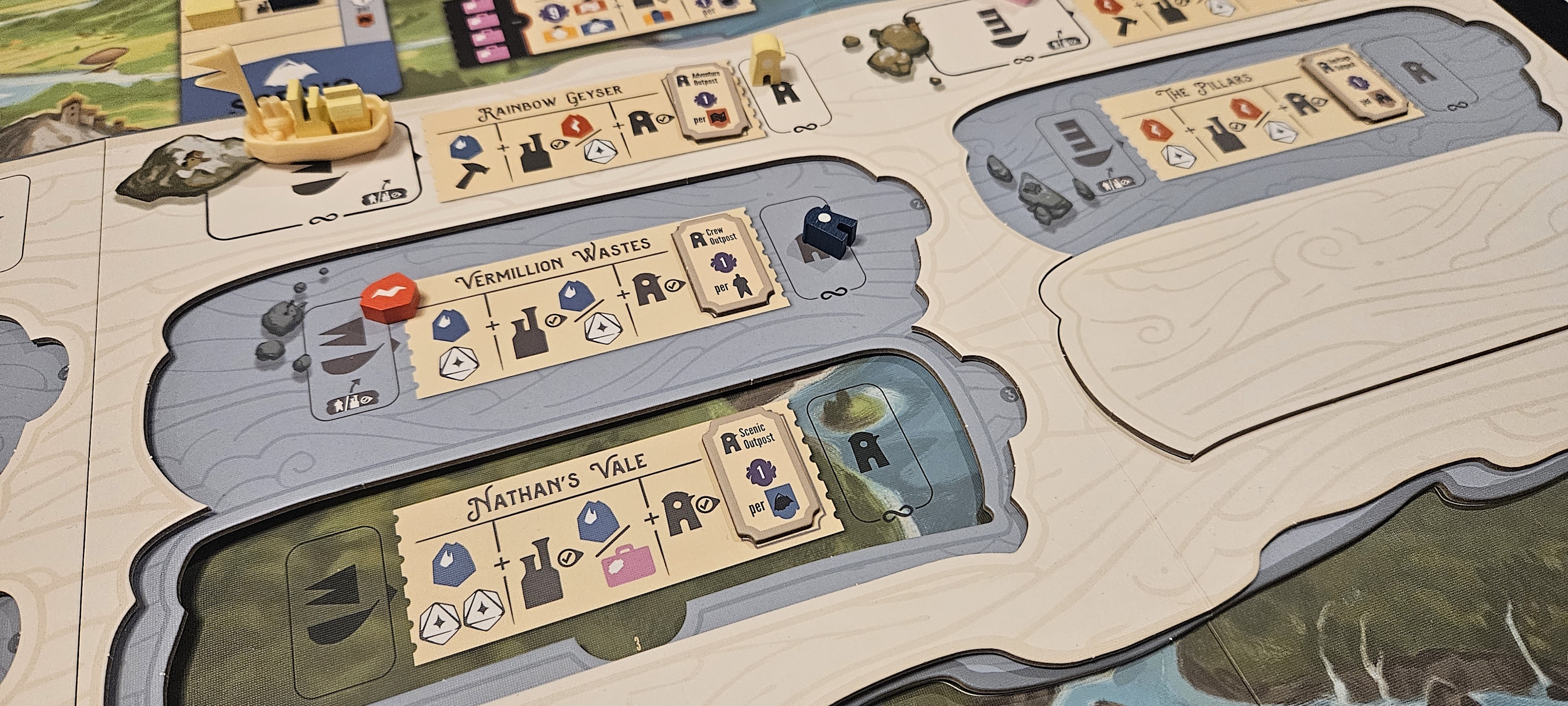
When I say a game has “topography,” I don’t usually mean it literally.
Ever played a board game about operating a tour company that whisks hard-earned customers to exotic locales aboard custom pleasure craft? That’s Braided Skies. Or, well, Braided Skies is the other one. The one that isn’t Galactic Cruise. It’s a gentle game. Strait-laced. Customary.
Literally. In an era when worker placement has the air of either a past fad or something that complements other systems rather than standing on its own, Braided Skies puts the concept front and center. Turns consist of taking an airship, of which you own three, and sending it to a destination. Most of the time, these placements are completed without restriction. Only on occasion do you need to pay attention to the vessel’s little flags, whether one, two, or three, to determine whether it can safely navigate to a particular port.
There are variables on the formula, as you might expect. The mainstay is the game’s approach to topography. When Braided Skies opens, a thick cloud layer covers most of the board. Technically it’s two layers of additional cardboard, buckled against one another with the help of hidden magnets, but you get the gist. These layers conceal additional ports that are only gradually uncovered as you visit the spots on top of them. The clouds part to reveal some bonus — an extra card, one of the multi-colored “tapstones” that function as airship fuel, maybe a few seeded points at a location to incentivize a visit — and then, underneath, a new location brimming with resources to exploit.
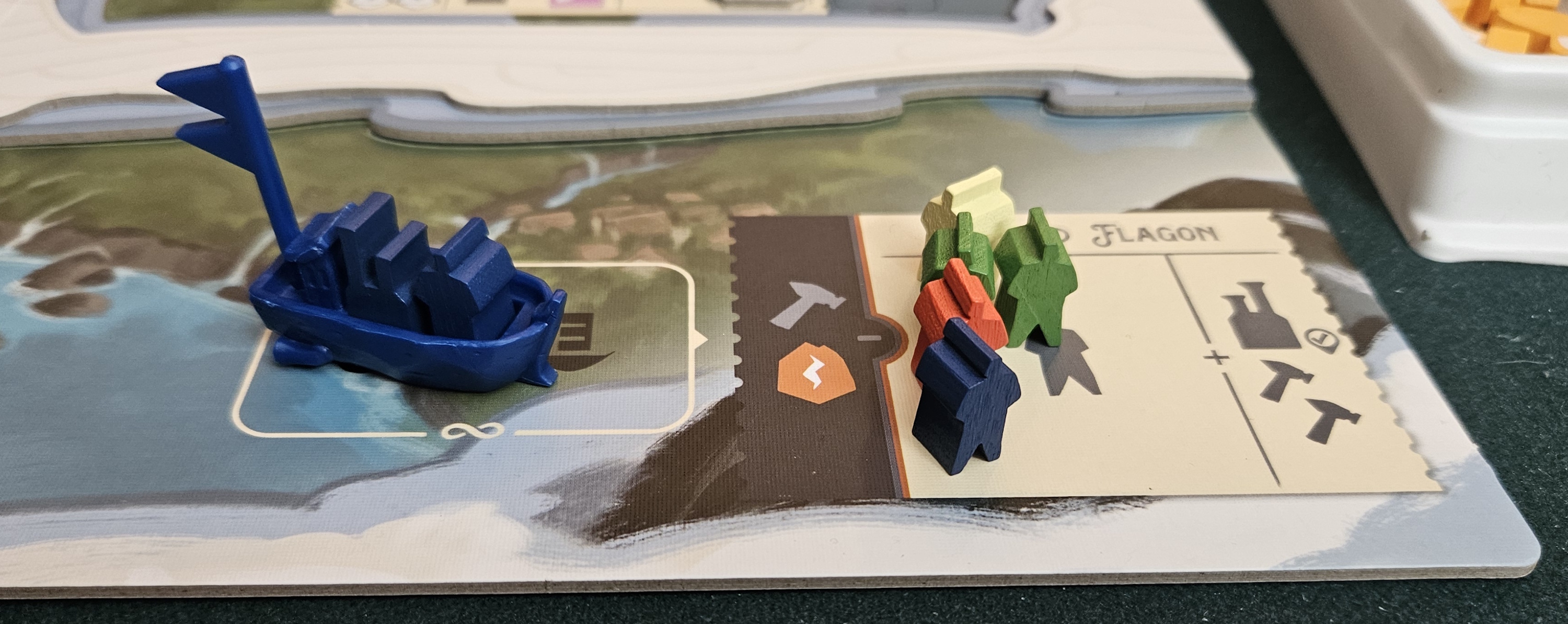
Adding workers to my workers.
Similarly, ships and ports alike exist to be upgraded. Since they function as your workers, the former are the real highlight, permitting both a sailor and a little factory to come along for the ride. (A little loosely, it must be said. It would have been preferable for them to snap into place rather than wobbling over the side at the slightest nudge. Crewing an airship is no joke.) These upgrades goose the value of the ports you visit. Similarly, many ports can be staffed with outposts for another helping.
Which is all to say, where your early airships feel a little underwhelming, it isn’t long before you’re fielding — floating? — absolute resource-guzzlers. Every time you descend into port, your hold swells with tapstones and tourists. This in turn initiates a little… I wouldn’t call it a minigame. It’s far too light for that. But a mini-minigame, one where your newfound cargo must be loaded into the proper slots or get left behind. It’s always free to load cargo into the ship that did the hauling, provided there’s room. Loading stuff onto other ships costs grit, a more abstract resource, and might be worthwhile if you’ve added the right outfitting cards to a ship.
Look, this is all a mouthful, but in practice it’s silky smooth. Ships go out and pick up resources. Resources go into your ships. The more outfittings a ship has, the more it can hold. The real highlight, though, is what those outfittings do when you bring a ship back home.
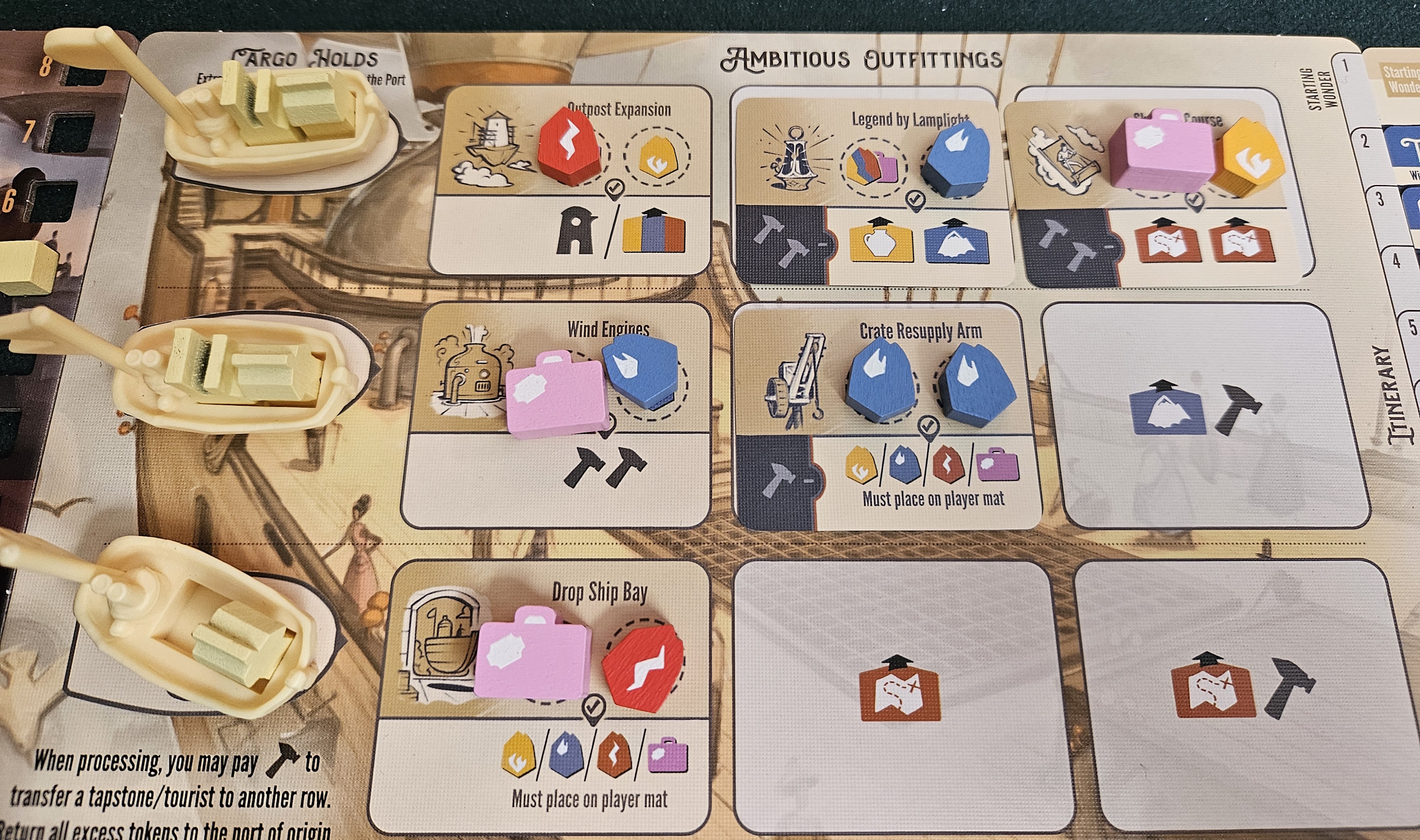
Recalling your ships is maybe the best part of the game.
Recall turns have long been the bane of worker-placement games, and if there’s any one thing that Stonemaier Games has set out to solve, it’s the recall turn. Germain has done as good a job as any, and likely better. The idea is that returning ships trigger all their outfittings, but only if they’re full of resources. This is how you… well, everything. Speed along the tracks that act as game timers and make your card icons more valuable in the endgame. Earn points. Gain passive trickles of resources. Add extra outposts to the map. More often than not, it’s the return trip that’s the more exciting of Braided Skies’ tidal phases. Going out, you get resources. Coming back, you put those resources to work.
Naturally, resources don’t only serve that one purpose. The real spills of points are found on the map, mostly in the form of wonders. Basically, these are the destinations you’re delivering passengers to, provided you haven’t forgotten about them in your distraction with other shiny possibilities, which I’m somewhat pleased to report has happened to me on more than one occasion.
This in turn produces a certain tension. Should you spend all those resources to secure access to another wonder? Or ensure your recall turn will be as stocked as possible? As generous as Braided Skies is, it isn’t uncommon to find oneself just short of having enough resources to have it both ways.
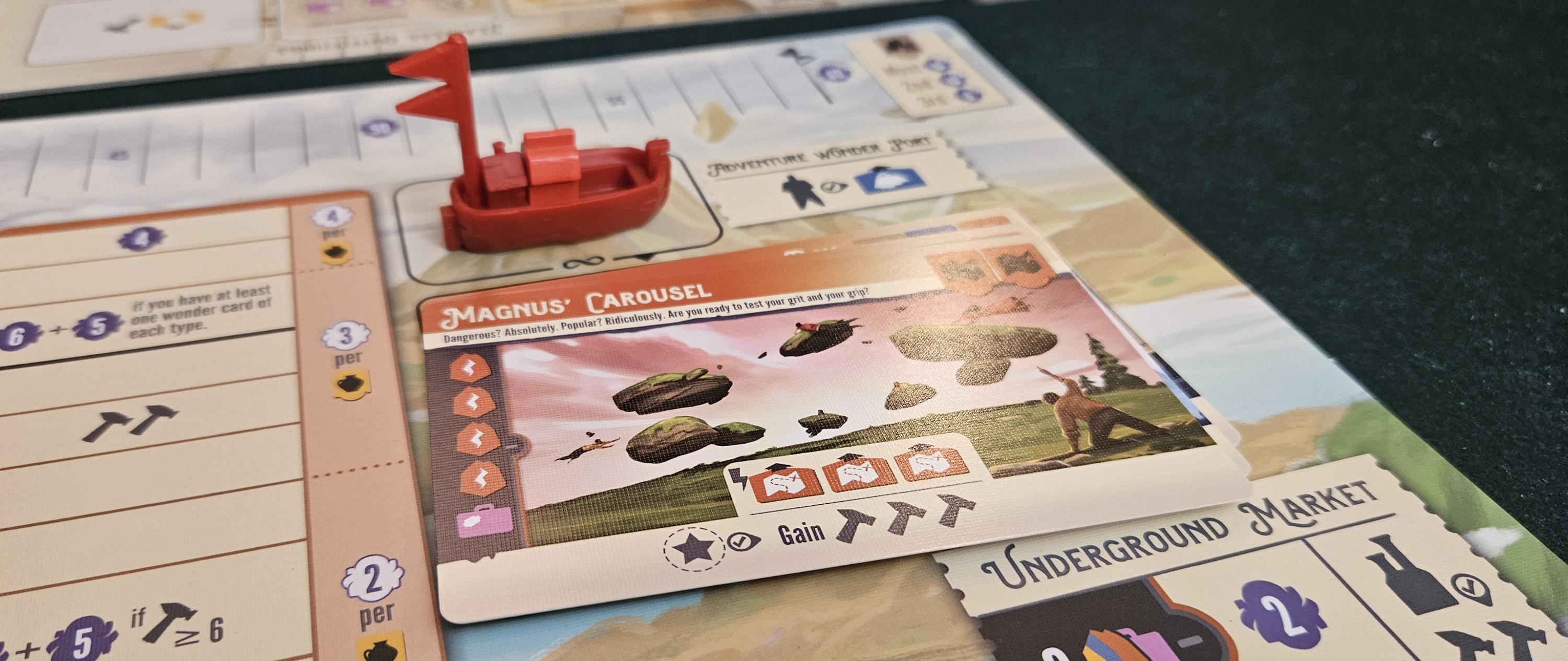
Eventually you’ll have to actually take tourists to tourist places.
Which isn’t the same as saying there’s any stress to these decisions. Like much of Stonemaier’s output these days, Braided Skies is as buffed of friction as possible. There’s a certain arc to the game that rarely deviates from its appointed path. Early on, everybody stocks their ships with factories and crew. Later, they onboard huge amounts of resources and churn them into points. Every so often — but not often enough to make it really matter — someone will require a specific ship to visit a particular port.
But this doesn’t extend to wonders, nor to any of the actual points-scoring locales. The result is an endgame gold rush for points, one with hardly any consideration for, say, sweeping something out from under a rival. There’s no sacrifice to anything. No dangerous headwinds to navigate; no spots that sacrifice a shipboard factory for a heap of points. If anything, the board seems to develop from one side to the other. Halfway through the game, the spaces along the bottom are all but obsolete. Why visit them? You’ll never need to crew up again. The time for new outfittings has passed. Now is the time to gather and spend resources.
Really what I’m trying to say is that Braided Skies is rewarding but hollow. Every move gives you something, but it isn’t often that something will be demanded in return. I have no idea if there was a more rough-and-tumble version of this game at some point. One where blocking mattered. One where a keen move could upend an opponent’s plans with purpose rather than incidentally. But I hope so. If only because Braided Skies truly is impressive, in its way, full of systems that feel good to manage and some smart ideas about how to evolve a map and make recall turns exciting. Those parts of the game deserved extra kindling. Something they could spark against.
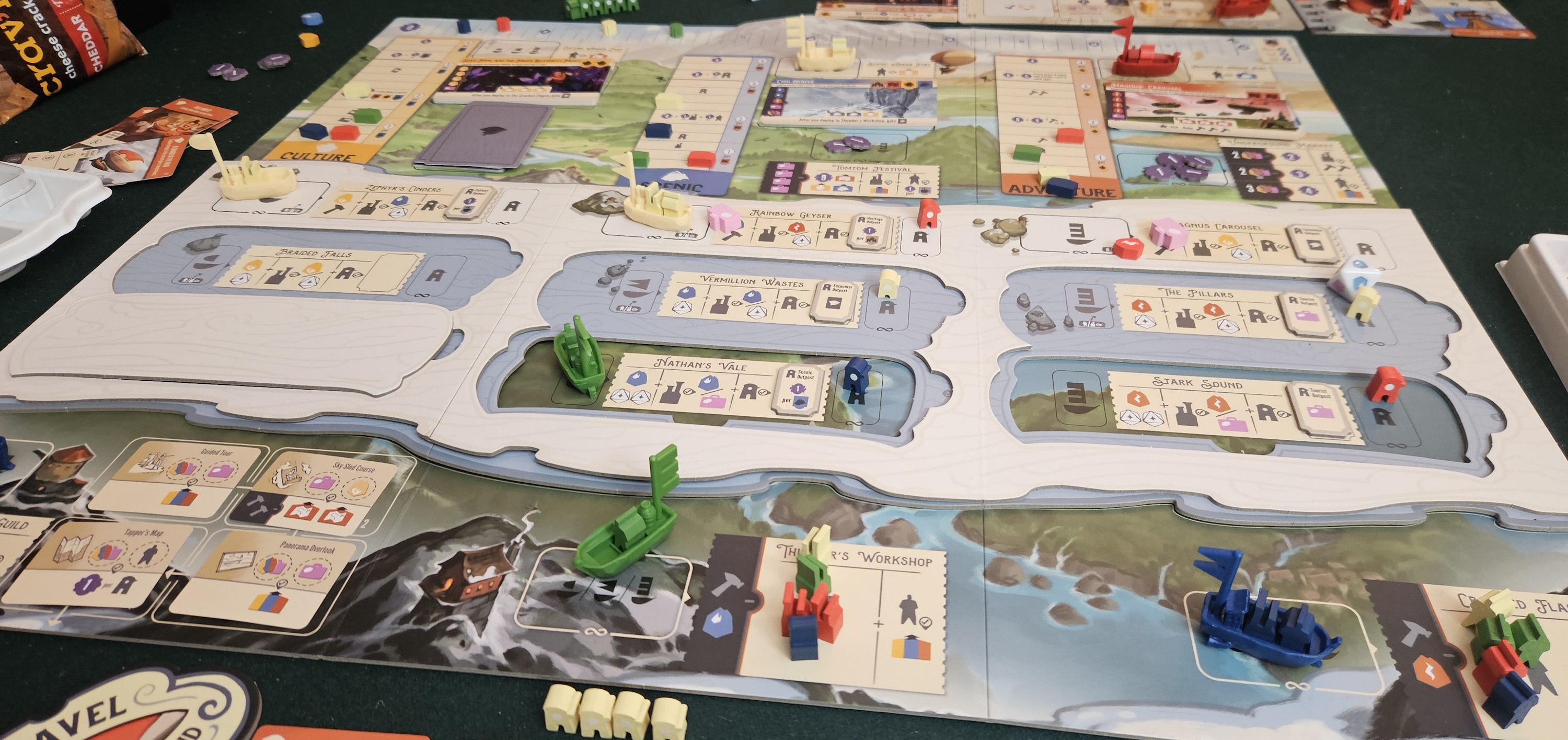
Braided Skies sure is a looker.
On the whole, then, Braided Skies is a feel-good game that struggles to elicit grander emotions than the muted pleasure of adding more tokens to your stockpile, ticking along a scoring track, or ticking along a different scoring track. It’s lighter than the titles that usually get pegged as too light for “serious” play, the Wingspans and Wyrmspans and Finspans. If not in terms of rules — a caveat I add entirely for the sake of Wingspan Pocket — then in terms of consequence.
Still, I’ve enjoyed my time soaring across this particular cloud-banked continent. Enjoyed and forgotten. But enjoyed all the same.
A complimentary copy of Braided Skies was provided by the publisher.
(If what I’m doing at Space-Biff! is valuable to you in some way, please consider dropping by my Patreon campaign or Ko-fi. Right now, my third-quarter newsletter is open to all.)
Posted on October 12, 2026, in Board Game and tagged Board Games, Braided Skies, Stonemaier Games. Bookmark the permalink. Leave a comment.


Leave a comment
Comments 0