Blog Archives
Monks in a Funk

To discover how I feel about Andreas Schmidt and Michael Kiesling’s Heaven & Ale, you don’t have to look much further than the rulebook. On the very first page, you’ll find the usual list of components. Here are some barrels. Monks. Sheds. Yeast and hops, barley and wood. Everything a monastery needs to brew enough beer to wash away the sting of losing Lindisfarne.
Turn the page, however, and all that stained-glass prettiness is scrubbed until all that remains is a blank pane. No longer are the resources barley and water and yeast; they’re yellow and blue and white. Gone is the veneer of monastic life, and certainly missing is the whole “brewing beer” thing. Trappists living the Rule of St. Benedict? You might as well be stevedores living the rule of finish loading these shipping containers by five p.m. or bust.
Fox in Box

Whether it’s a free-for-all like Hearts or Oh Hell, or a team setup like Euchre or Bridge, trick-taking games are family classics for quite a few people, including many who wouldn’t consider themselves “board” or “card” players. Yet it’s a genre I never found myself engaged by. No reason, really. It just wasn’t something my family did, and therefore it wasn’t something that I did.
Joshua Buergel’s The Fox in the Forest has changed that, at least in the short-term. Let me show you why.
Two Minds about Darkest Night

Today on Two Minds About…, Dan Thurot and Brock Poulsen are absolutely going to disagree about the sublime cooperative and solo game Darkest Night. Total disagreement. Friendship-shaking disagreement.
Dan: Wow, that sounds rough. Been good knowing you, Brock.
Brock: Our friendship had a good run, but this is the one! This game will sunder our fraternal bond forever.
Bios: Mega-fun-a

One of the most-repeated criticisms of Phil Eklund’s designs is that they hew closer to simulations than proper games, complete with persnickety rules exceptions, icon-strewn layouts, and overly dense rulebooks crammed with scientific and historical footnotes. And that’s to say nothing of the gameplay itself. If Eklund feels that the outcome of the Renaissance was due to some nebulous conflagration of commerce, class, religion, and imperialism, then by hook or by crook his game on the topic is going to contain a nebulous conflagration of commerce, class, religion, and imperialism.
At first glance, the second edition of Bios: Megafauna — which Eklund co-designed with Andrew Doull and Jon Manker — appears determined to prove the stereotype, with a rulebook liable to make even a veteran gamer’s mind wander somewhere between defining Cheshire cat mutations and the sprawling glossary where certain rules have been sent to wither in obscurity. And don’t even get me started on the mental gymnastics necessary to forge your way through that first learning game.
Imagine my surprise, then, to discover that this just might be Phil Eklund’s most accessible game since… scratch that. Most accessible, full stop.
Greece Fire: A Look at Omen

If you’ve been following Space-Biff! for more than a Thermopylae minute, you’ll know that I’ve mentioned Omen: A Reign of War once or twice. This is one of those rare games that opens with a bang and just keeps going, producing more kicks per minute than a two-story dojo. Now its creator, John Clowdus, has signed with Kolossal to give his small-box classic a bigger-box treatment, including a third entry in the series that steps away from the warring demigods of Greece and toward the warring demigods of Persia. So, you know, it’s super original.
Anyway, what makes Omen such a great game? Let’s take a look.
Fantastiqa: Pocket Dimension

There’s a certain enchanting quality to Alf Seegert’s latest, Rival Realms. Set in a sort of pocket dimension of Seegert’s wonder-realm of Fantastiqa — and literally sliding into a large pocket, how’s that for appropriate? — and expounding upon the card-laying system he first crafted in Musée, it’s an otherworldly experience, as though its players have left their concerns hanging in the wardrobe and stepped straight into Narnia.
The Lonely Degenerate
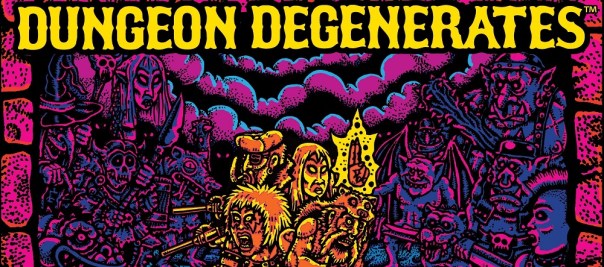
There’s a certain comforting blandness to the usual adventure game setting. Armored heroes. Lithe elves. Hardy barbarians. Green-skinned orcs and soaring dragons and icky spiders. A land of plenty thrown into peril. You know the drill. It’s certainly been the drill long enough.
Dungeon Degenerates isn’t satisfied merely breaking away from this formula. It also needs to smash it with a sledgehammer. After all, as spoken by another notable iconoclast, “When you come at the king, you best not miss.”
I’m going to spill the conclusion of this review right now: Dungeon Degenerates does many things, but miss is not among them.
Make a Million for You Overnight
Despite its staid outward appearance, Hardback is the byproduct of word game inbreeding. Its daddy is Tim Fowers, the same fella who brought us Paperback a couple years back, while its father is Jeff Beck, creator of last year’s Word Domination. Even a description of its particular playstyle feels like dendrochronology performed on a family tree: what Paperback was to Dominion, Hardback is to Star Realms.
Fortunately, that word-jumble statement is actually pretty easy to explain.
Yesteryear: The Angle of Jupiter’s Dangle

Spartacus? Didn’t that game come out six years ago? In board game time, that’s at least forty years! True enough. But this is the first entry in a series about the games I’m still playing even though their cardboard scent has worn off and the cards are starting to look frayed around the edges. Not the classics, exactly, but the good stuff that’s never lost its appeal or lost its place on my shelf. This is Yesteryear.
Before his unfortunate passing in late 2016, I had the pleasure of meeting Sean Sweigart exactly once. I had no idea who he was. He was happy to keep it that way. When I asked whether he was the designer of the game he was demoing, he responded that, no, he wasn’t, he was just a guy who enjoyed sharing good games. And with titles like Spartacus, Firefly, Sons of Anarchy, Homeland, and Star Trek: Ascendancy under his belt, he wasn’t entirely fibbing.
Digital Cardboard: Antihero

If I were the Grand Emperor of Defining Things, in order to qualify as a digital board game — as opposed to qualifying as a digital adaptation of a cardboard board game — it would be a requirement that your digital board game do something that a regular board game couldn’t do sitting on my table. Yes, I just used the phrase “board game” four times in one sentence. That’s probably a world record.
To its credit, Tim Conkling’s Antihero is a digital board game that understands both the limitations of board games and how to stretch them when you place a screen between its players. Let me show you what I mean.

 SPACE-BIFF!