Liberation Ludology, Part Four: El Salvador
At long last, we’re nearing the end. After Uruguay, Peru, and Nicaragua, El Salvador is the fourth and final scenario in Stephen Rangazas’s The Guerrilla Generation. We’ve seen urban resistance movements that neglected to reach the people they were bent on liberating, a cult-of-personality communist party who went to any lengths to maintain their doctrines, and far-right death squads whose activities were so vicious that they became invaders of their own country. Now, in El Salvador, we’re going to see a little bit of everything as the FMLN launches its first offensive against the government in January 1981.
But the story doesn’t begin there. It never does. History is a story, and stories need beginnings. But reality is not a story. There are any number of root causes to this particular insurrection. We might begin with Farabundo Martí, from whom the FMLN drew its name. He was executed by firing squad in 1938 after his uprising of peasants was massacred by the government. Or we could start with that regime’s formation in 1931 through coup d’état and its repressive rule for more than four decades.
This time, however, the most suitable starting point is a priest: Óscar Romero.
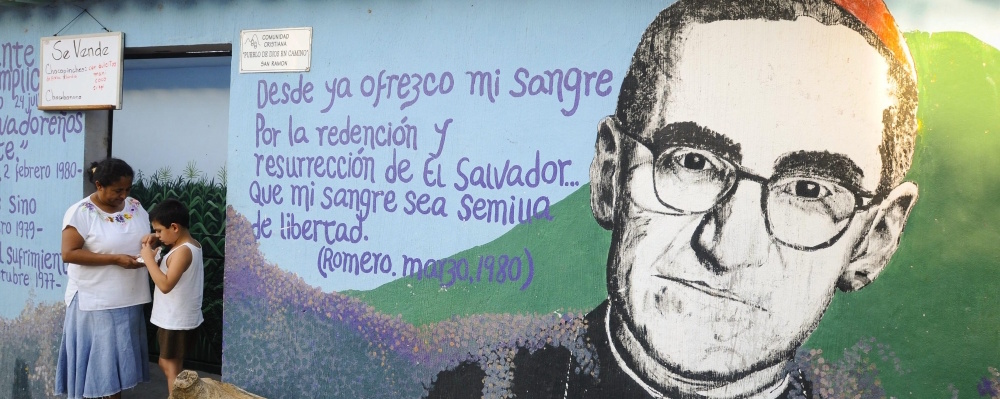
One of the many murals of Óscar Romero.
Óscar Romero was appointed the fourth archbishop of San Salvador in 1977. A native Salvadoran, Romero was a social conservative, and indeed this was one of the reasons his appointment had been considered. The priesthood of El Salvador had long been divided along social lines, with some priests supporting stability while others favored “liberation theology.” This was a relatively new strain of Catholic thought, born out of the Latin American revolutions and foreign interventions of the ’60s. As with any issue of dogma, there were contrasting definitions of liberation theology, but the gist was that the poor and downtrodden were being deliberately kept in place by both individuals and systems, and that good Christians were therefore called upon to reflect the living ministry of Jesus Christ by rectifying their suffering. Priests who supported liberation theology, then, tended to be sympathetic toward Marxist thought and communist guerrillas, while those critical of it fell into the opposite camp. Romero’s appointment was accepted with relief by the regime. Unsurprisingly, the liberationists were bitterly disappointed.
(Sidenote: North American and European readers might note a similarity between liberation theology and the concept of “woke” as it originated among African-Americans in the Jim Crow-era United States. These strands of thought arose from different sources, but as a quick and dirty analog one could do a lot worse. Short version: you are being kept poor on purpose, the jackboots have it in for you, and it behooves young people to get woke to reality so they can survive this hostile state of affairs.)
Only a month after Romero’s appointment to San Salvador, one of his personal friends, the Jesuit priest Rutilio Grande, was assassinated. This came as a shock to Romero. After all, Grande had been one of the good ones. Despite speaking out against the government on certain issues, he had also argued for a pastoral ministry that was disconnected from Marxism. After every effort to walk a middle path, he had still been gunned down by state security forces only a few miles from where he had been born. Romero requested an investigation. He was met with silence.
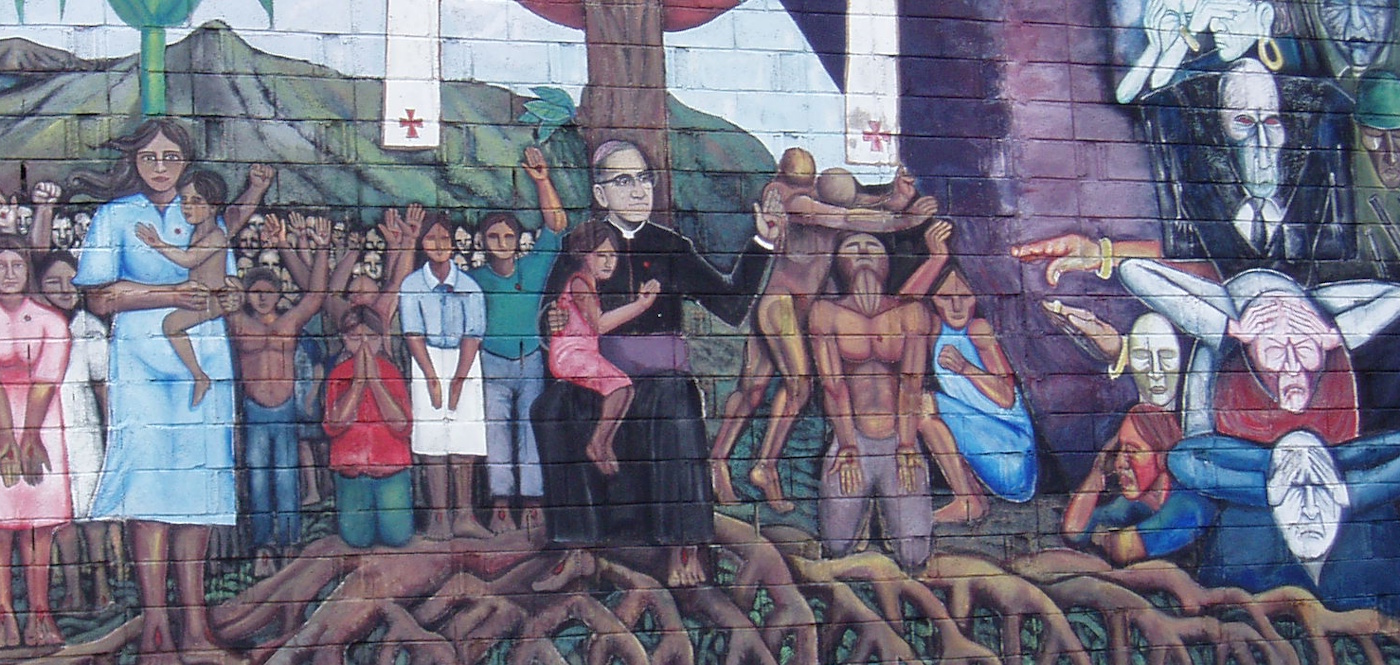
Another mural.
In his own words, Romero became devoted to following Grande’s path. He spoke to the people via weekly radio broadcasts, his diocese newspaper, and his sermons, repeatedly listing the government’s killings, tortures, and disappearances. When the joint military-civilian Revolutionary Government Junta proved as brutal as the military dictatorship it had replaced, he appealed to President Jimmy Carter to halt the flow of U.S. military aid and Pope John Paul II to condemn the regime. Again, silence. Even as his popularity among the people grew, it seemed everybody with access to real power was content to ignore his pleas.
Despite his inability to effect change, somebody was listening. Because that’s always how it goes with those who live by the gun. One must not only be victimized. One must be grateful for their place in life. One must submit.
In March 1980, Archbishop Romero called upon Salvadoran soldiers to reject the government’s crimes against humanity. The next day, he was shot through the heart by a gunman as he delivered a sermon at a small chapel attached to Hospital de la Divina Providencia. His funeral was attended by a massacre in the streets. The shooters fired from rooftops with rifles and threw smoke bombs into the crowds of mourners. At least thirty were killed. In response, José Napoleón Duarte, four years in advance of his presidency, blamed both sides of the political spectrum for the violence, and used it as pretext to decline an official inquiry into Romero’s murder. The meddlesome Archbishop, whom the regime had welcomed only three years earlier, had been silenced for good.
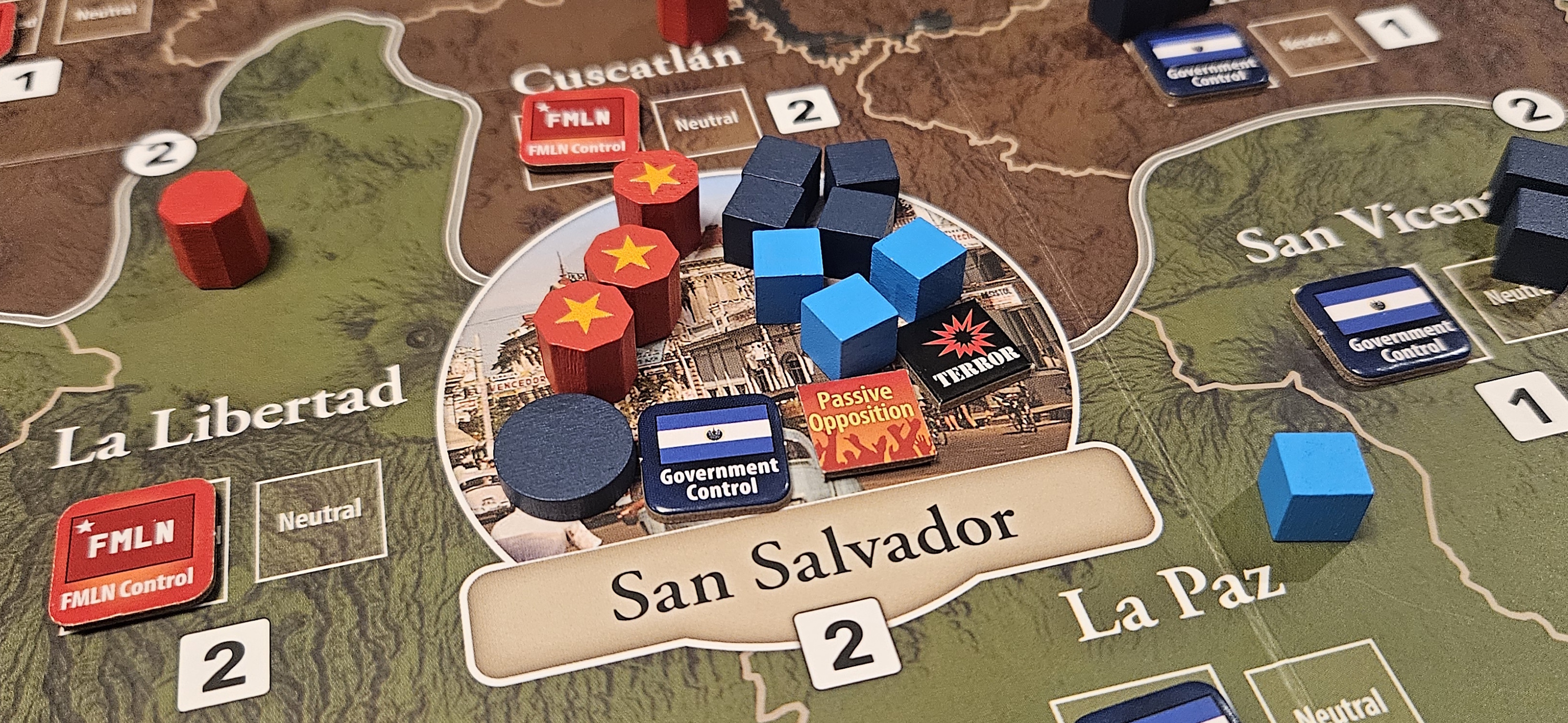
The FMLN launches one of their offensives.
Nine months later, the FMLN launched its first offensive against the government.
This is where the fourth scenario of The Guerrilla Generation begins. The FMLN, fed up with the government’s constant human rights abuses, rolls from the highlands into the coastal and urban portions of the country. Potentially, large numbers of blue government cubes will be removed in an instant and the guerrillas will possess large swaths of territory. For a system that usually portrays insurgent forces as incapable of such a concerted assault, it’s a shocking opening gambit.
To accomplish this, Rangazas takes cues from a handful of earlier titles, most notably the “pivotal event” cards that made their first appearance in Mark Herman’s Fire in the Lake. At the time, these were a profound departure for the series. For those who don’t know the COIN System very well, events are normally seeded at random throughout the deck. Thanks to their chaotic appearance, they represent occurrences that fall beyond the factions’ ability to set into motion, but which one of them might leverage to their advantage. When Volko Ruhnke designed Andean Abyss, the first volume in the series, it represented a change in the way card-driven wargames presented player agency. Rather than putting every event into players’ hands — both literally and figuratively — factions were now presented as reactive. Something would happen: a massacre, the death of a politician, an influx of war materiel from an interested third-party nation. And then you, the player, would decide whether that event was worth acting upon.
Fire in the Lake presented another option. Some events, Herman’s system argued, represented moments of clear player agency. It wouldn’t make any sense for the Tet Offensive to blindside the Viet Cong, for example. So each player was given a single pivotal event. One card in their hand, which could be used at the player’s discretion to cancel an ordinary event and launch a special action.
The El Salvador scenario begins with one such event. Only in this case, the event has already been played. “FMLN Offensive Rocks Country” starts on the table. All at once, the FMLN, which the game presumes is largely in its historical situation as of January 1981, undertakes a country-spanning sweep. It won’t be enough to topple the regime, as FMLN leaders had hoped historically. But it sets the tone for what’s to come. This is a knock-down drag-out fight. The FMLN is significantly tougher than most of the series’ insurgencies; the Government, significantly weaker. But the Government has a prize trainer in its corner. The United States. Duh. And the U.S. is currently packing the Government’s gloves with enough silver eagles for a knockout punch.
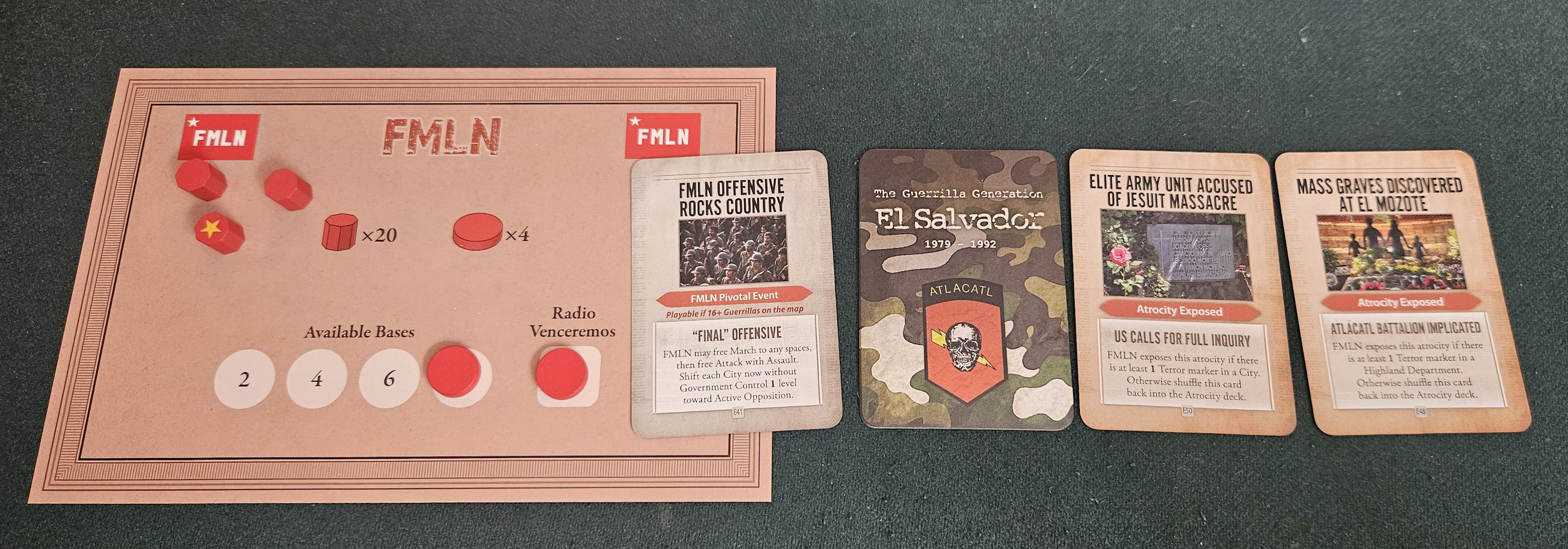
Uncovering the regime’s war crimes.
From there, the scenario settles back into the system’s usual rhythm of events and faction activities. It isn’t long before both sides begin to have money trouble. The FMLN isn’t as willing to extort the local populace as some of its peers in other volumes. Managing its finances is a slow process, requiring careful spending and hard tradeoffs between building local support or using local resources to maintain their momentum.
The Government, meanwhile, is similarly pressed. There simply isn’t enough in the coffers to resist the FMLN’s offensive. This is where the United States rears its head. As in many previous volumes, the Government’s resources are bolstered by an Aid marker. Rather than releasing a trickle of resources at pre-appointed intervals, however, here Aid functions as a secondary cash reserve, with the niggling problem that the Government can only avail themselves of this pool for certain operations. Basically, while the U.S. is happy to send endless bundles of cash to resupply Government forces in urban centers, Congress balks when a massacre shows up on the evening news. It’s a testy relationship, one that encourages the appearance of stability even as the FMLN claims additional territory outside the cities.
It’s also the COIN System at its most ideological. In the past, I’ve critiqued the series as being frustratingly “blind” when it comes to ideology — and by extension, of defaulting to a conservative position that elides the nuances that underpin these conflicts. Basically, COIN’s emphasis on procedure excels at “what” and “how,” but usually flubs the “why.” We see the outcomes of ideology — the tanks and planes, the massacres and coverups, the boots on the ground — but not so much the reason those tanks were delivered to faraway places, the regime’s need to conceal those massacres, or the half-truths that were sold to the public to convince them to sacrifice their young men and women to fight a war that has nothing to do with them. It’s not especially far-fetched to see in titles like Land and Freedom, Versailles 1919, and Revolutions an ideological intervention into a system that was, itself, a procedural intervention on the card-driven wargames that came before it.
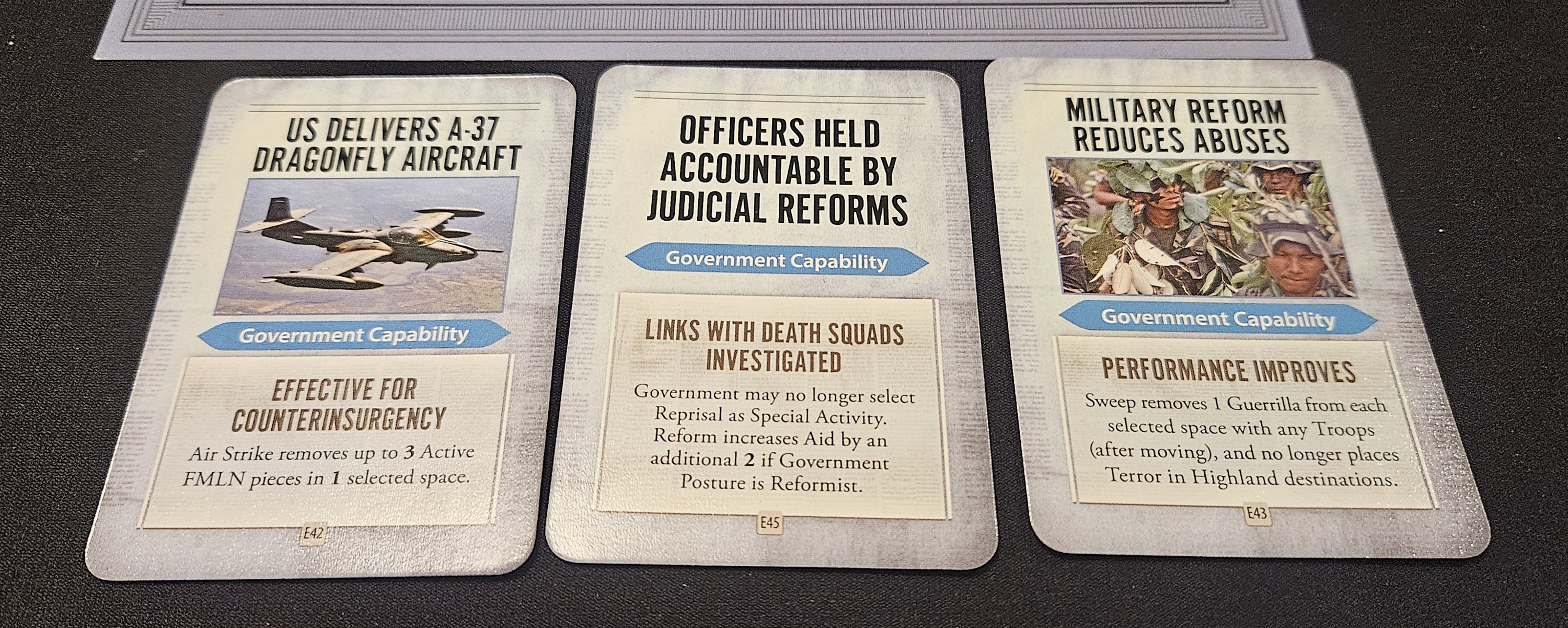
“Reform” can be misleading.
I don’t know if Stephen Rangazas is the strongest designer to handle the COIN System to date, but he makes a good case for being the most clear-eyed. Both of El Salvador’s factions are uniquely hemmed in by ideological concerns. In addition to their desire to govern the populace, the FMLN must uncover and promulgate the reason for their offensive. The why to the what. They do this by revealing cards from a personal deck to demonstrate the Government’s crimes against its citizens. Crimes that would continue over the twelve-year course of the Civil War, with the post-war commission stating that security forces were responsible for eighty-five percent of civilian casualties. By revealing these crimes, the FMLN doesn’t bolster their position immediately, and even risks the occasional backfire when the wrong card is revealed. They are, in effect, building a case during wartime for how the peace will be conducted.
For the Government’s part, they’re asked to walk a tightrope between taking a hard rightist stance toward the insurgency or introducing reforms to rein in their troops. (And secure greater U.S. Aid, but surely that isn’t the prime motivator. Right?) As these reforms are embraced, it becomes harder to conduct reprisals. And the Government is positively horny to conduct reprisals. It’s the easiest way to batter the population into… well, not supporting the Government, but at least they won’t be supporting the FMLN either.
It isn’t long before El Salvador becomes a zombie state, completely bankrupted and in thrall to foreign funding. It’s a stark ludic representation of a regime that has bought its continued right to abuse its citizenry by indebting itself to a hemispheric hegemony whose interests shift with the wind. Or, in game terms, with a whole bunch of event cards.
In some ways, the scenario pulls up short. There is no card for Óscar Romero. Perhaps his assassination came too early for the game to model. Robert D’Aubuisson, the death squad commander who ordered Romero’s death, he has a card. It isn’t flattering, reflecting his antagonistic nature and inability to avoid controversy. That’s as close to the Archbishop as the game gets. His absence is a reminder that no simulation reaches every corner, no matter how long the broom’s handle.
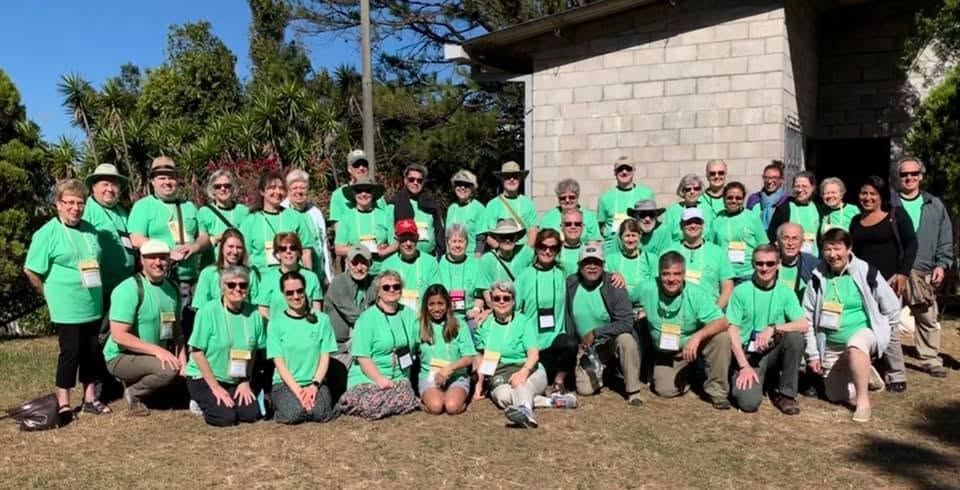
I’m in there somewhere. Don’t look, though. Please don’t.
The one time I visited El Salvador, as a member of an ophthalmic surgical mission in early 2019, Óscar Romero was everywhere. We were hosted in Juayúa by a Catholic retreat, so the imagery of St. Romero was unsurprising, especially given his canonization only a few months earlier. But his visage appeared everywhere beyond the compound walls as well. On the streets of San Salvador, beside the walls of coffee plantations, inside coffee shops. A plaque marked where bullets had penetrated the wall during his funeral massacre.
Growing up, my Father was deeply conservative, but with a compassionate streak that suited his status as a medical doctor. When he began visiting Latin America to perform cataract surgeries — one eye per patient so the surgical team could double how many people they treated — he underwent a transformation. His nature grew more thoughtful; his veneration of Ronald Reagan and Teddy Roosevelt melted away. He began reading books about saints. Little by little, he started talking with more frustration and less condemnation about the state of the poor.
We also started getting along a bit better. But that’s neither here nor there.
I went with him in 2019 because he sensed this might be one of the last trips he had in him. The pandemic hadn’t been declared in our hemisphere yet, but the medical community could see the writing on the wall, and political changes were threatening to make El Salvador even harder to visit. So I accepted his invitation, renewed my expired passport in a panic, and off we went.
There’s no need to bore you with the details. The indigence was extreme, but all poverty has the same leanness. The defining moment came a few months after the trip, when I related how one of our fellow volunteers had called the people “lazy.” Dad, who all my life had complained about panhandlers and freeloaders and takers, suddenly roared, with such force that I think it surprised him as much as me, “They’re not lazy. They’re poor.”
I’ve always been proud of my Father. For his work ethic. For how much he reads. For putting up with a son who’s totally unlike him. But in that moment, I became proud of his ability to change.
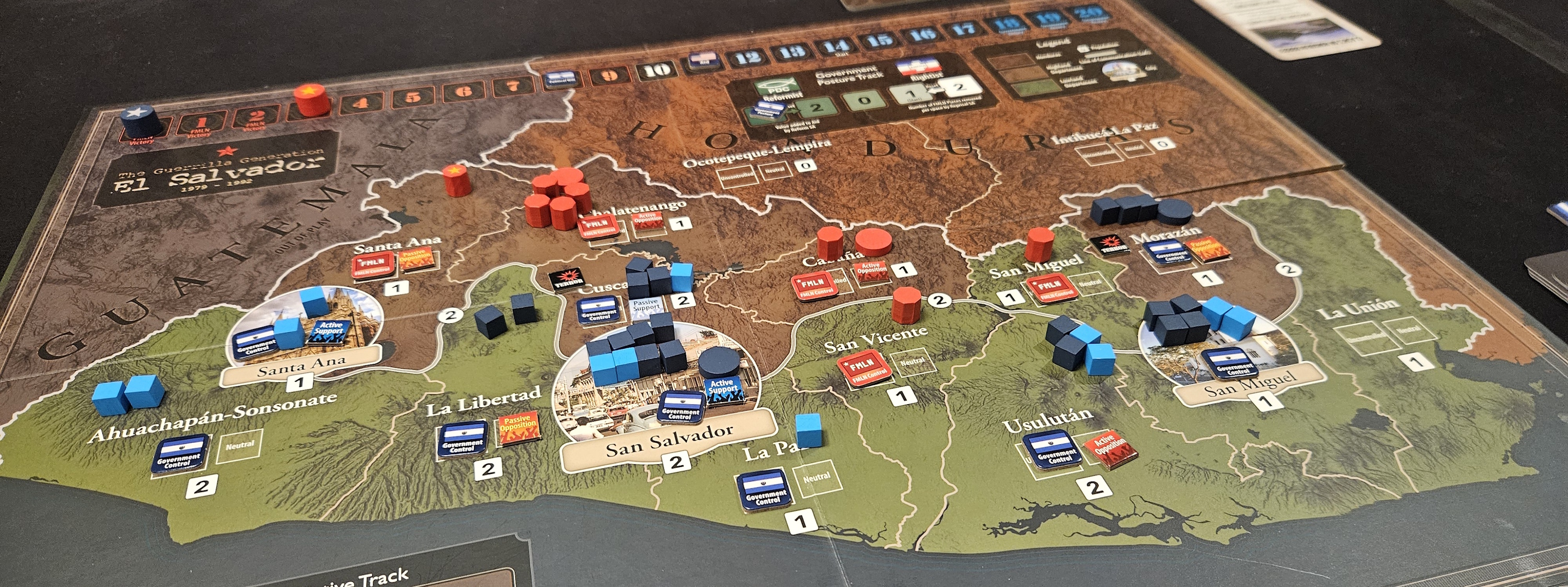
It’s possible for the government to find their footing. But at what cost?
When it comes to the COIN Series, El Salvador and The Guerrilla Generation more broadly also represent a change. As a system, COIN has sometimes been insightful and sometimes been blinkered. Often it has been both things in the same volume. With Rangazas’s work in this multipack and The British Way, it becomes something else. It tells a slightly different story, one less about counterinsurgent procedures and more about the systems that brought about these insurgencies in the first place.
Or, as Óscar Romero put it in his second pastoral letter, delivered at the Feast of the Transfiguration shortly after his appointment to San Salvador and the murder of his friend Rutilio Grande: “The Church has, quite rightly, denounced sin. Certainly she has denounced personal sins, and she has also denounced the sin that perverts relationships between persons, especially at the family level. But she has begun to recall now something that, at the Church’s beginning, was fundamental: social sin — the crystallization of individual sins into permanent structures that keep sin in being, and make its force to be felt by the majority of the people.”
Next time, we’ll examine those systems from afar via The Guerrilla Generation’s meta-campaign, which combines Nicaragua and El Salvador in Resisting Reagan.
A complimentary copy of The Guerrilla Generation was provided by the publisher.
(If what I’m doing at Space-Biff! is valuable to you in some way, please consider dropping by my Patreon campaign or Ko-fi. Right now, supporters can read the next installment in my series Talking About Games, this time tackling the topic of what makes a good list! Naturally, the piece includes a list.)
Posted on September 1, 2026, in Board Game and tagged Board Games, GMT Games, The Guerrilla Generation. Bookmark the permalink. 12 Comments.


I found you in the picture!
This is a good blog.
Thanks!
Gracias, Dan! Long time follower from Mexico. This is such a hard series to read, but I’m grateful you’re taking it head on.
Thanks for the kind words, jorge Z!
Excellent review, thank you for sharing such personal stories.
Thanks for reading, Christian.
Like you, Dan, El Salvadorian experience is close to my heart and consequently had great impact on me and my choices when I was 21 in the late 1980’s. I knew about the martyrdom of Romero (thanks for the biography in this review but I am curious why you included it; maybe that ties to my question below?) and the 4 US churchwomen. But when the 6 UCA Jesuit faculty and 2 laywomen were assassinated by US trained military death squad in November of 1989, that changed the course of my life direction forever. Is there a card in the game for them, perchance?
Yet, more to what I’m really curious about. I was hoping you could expound a bit more on the problem this COIN series and others have with the “ideological” component. I think I understand your critique but its still a bit opaque to me, including the default to the “conservative,” which I, as a student of liberation theology, want nothing to do with. Moreover, is there a way to overcome the lack of game mechanics for this element of the simulations, i.e. to take the “why” into account, or not? If there is, is there a game that does this well or at all? Does the lack of consideration of the “ideological” act as fatal flaw in this series and others? Whatever you can offer here would be most appreciated.
Heyz ProfZ. Good questions.
I included the assassination of Romero to contextualize the conflict more widely, both in an attempt to center it on a figure whose death has become emblematic of the Civil War rather than an abstract number, and to emphasize why this particular topic is meaningful to myself.
As for the larger question… it’s indeed a larger question! The (very) short version is that the COIN Series was created to demonstrate counter insurgent strategies. Hence its name: COunter-INsurgent. Some of the series’ later titles have done a better job of investigating the reasons why a particular insurgency might have occurred, or emphasizing the danger to civilians, or framing the factions in a nuanced light. This is one such title thanks to the way Rangazas centers tougher material like atrocities and coverups.
Thanks Dan. That is very helpful. Yes, it makes sense that COIN, in its own name, is about counter-insurgency, i.e. the “rebel scum.”
So, do the UCA Jesuit martyrs get a card? I would love to see it.
Do you think Rangazas’ game(s) is (are) more or less sensitive than other in avoiding ignoring the “why,” the “ideological” in these simulations?
(Asking for the long answer, if you willing) Is there a game, be it COIN, GMT, or any game, that is able to represent well in its mechanics this hard to quantify “why”/”ideological” in its presentation? Is it possible at all to do this and this is simply a limitation of the medium? I’ve probably played Twilight Struggle more than any other historical simulation game. I do think the “why” element is missing there (or is it not?), but I tend to “fill it in” in my experience of playing it, e.g. when I play or have played the Liberation Theology card from the Mid War. Again, I apologize if this is too expansive of a question for this venue, but your critique on this front really got me thinking. I think it is an adjacent question to the discourse around playing John Company. Love to hear more of your thoughts as I know you have them.
I believe the Jesuit martyrs are one of the atrocity cards.
Rangazas, on the whole, does a lot better with handling the “why” behind these insurgencies than most COIN volumes. And honestly, there are quite a few modern designers who are more interested in covering cultural history rather than only military history, which includes a wider range of consequences and/or causes for the kinetic conflicts we often see modeled in wargames. I’m not trying to be cagey, but I’m also holding onto some thoughts for the last part. I’d rather not write a whole essay as a comment only to need to replicate it in a few weeks when I write about Resisting Reagan!
Fair enough. I await your “essay” with baited breath.