Look at Me. I’m the CAPTCHA Now.

The smallest but most persistent indignity of our current digital age is the way we have all, every one of us, been press-ganged into service as human CAPTCHAs. You know, the Completely Automated Public Turing test to tell Computers and Humans Apart, as tortured an acronym as ever there was. How many bicycles are there in this image? Is that a stop sign or merely a reflection of a stop sign? Is this story real or fake? The computer can’t tell the difference. Which means you can’t ping your lost iPhone without decoding the golem’s underlying logic.
Kasper Lapp, it seems, fashions games with my discomfort as their first design principle. First it was That’s Not a Hat. Now it’s Totally Human.
I dislike Totally Human. But at least I dislike it for reasons that mark it as a very interesting game indeed.
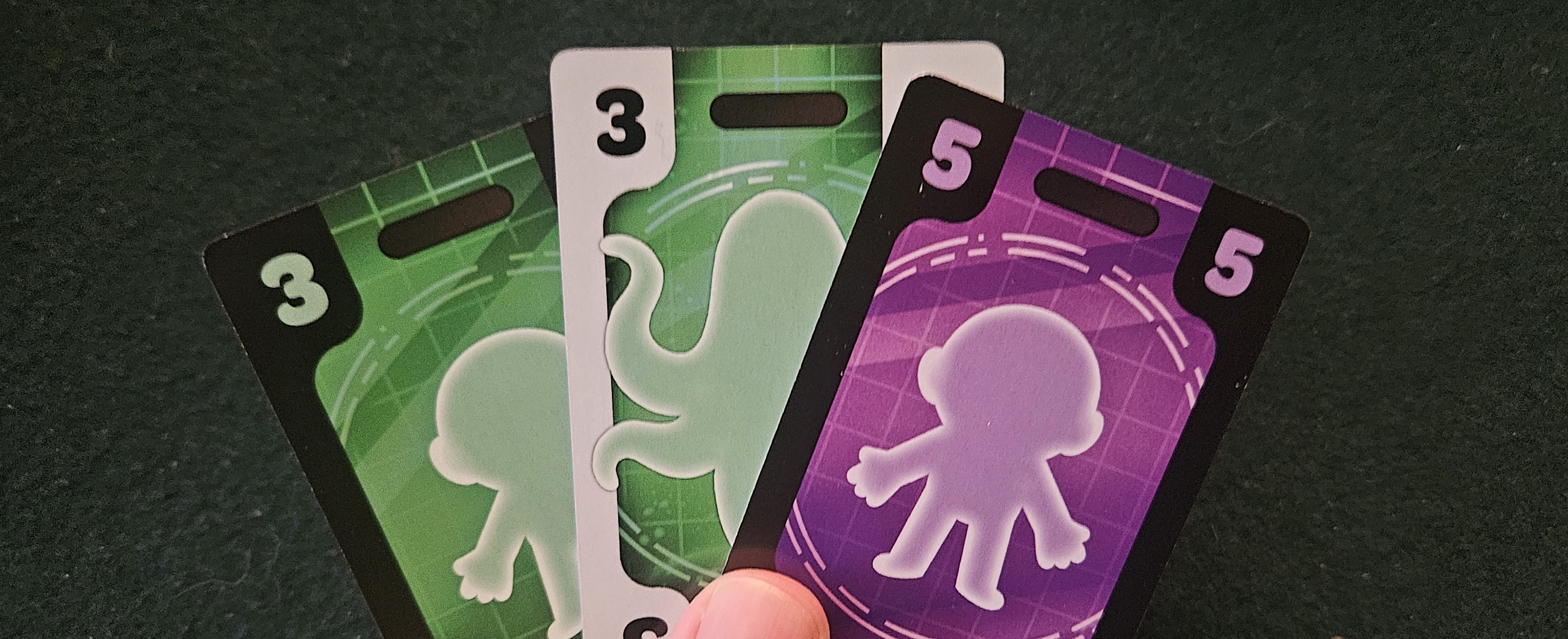
Uh oh. I’m an alien. No worries. I’ll just have you for dinner.
Imagine this. Your society, previously flawed but functional enough in principle, has been overrun by aliens. Aliens who eat humans. These aliens look like us, talk like us, even make art like us. But these things made by aliens are not human in nature. Oh no. They are the regurgitated mass of all that is human. Always backward, never forward. Remixed, never created. Always the tiniest scooch off.
That’s because the aliens are ChatGPT, hahahaaaaaaaaa
Calm down, Dan. Sometimes an alien is an alien.
You draw three numbered cards. If the whole trio shows the outline of an ordinary human, congratulations, you are an ensouled being fashioned through millions of years of evolution and perhaps the consciousness of the universe itself. If, on the other hand, even a single one of these cards shows an alien, sorry, you’re an alien. Your sole purpose in life is to snack on humans.
Because of the alien invasion, the humans are boarding shuttles to start new colonies somewhere far from Earth. But first, they need to sort through who’s who, lest the colonists get eaten en route like the crew in that one movie (spoiler). How will they accomplish this — DNA scans? Deep behavioral analyses? Having the applicants draw a picture of a person that doesn’t look like a bizarre homunculus?
No. By answering three abstract questions that set the hairs on the back of our neck prickling. The world’s ending, and we’re gonna Voight-Kampff our way through to the other side.
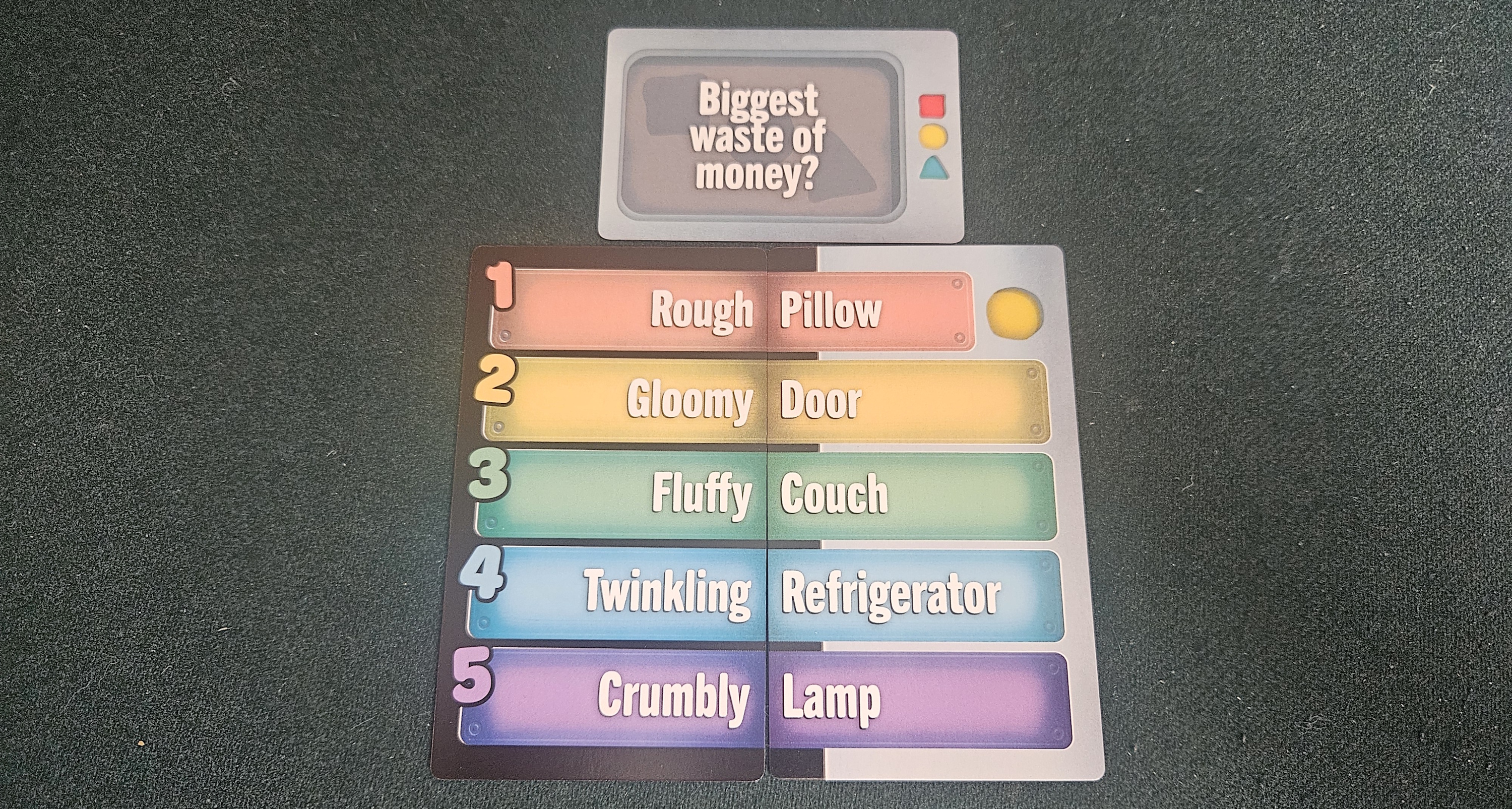
So. What’s the answer? Punk.
These questions are procedurally generated — not unlike a CAPTCHA. There are three components. First, the question. Second, a bunch of adjectives. Third, some nouns. This produces a five-fold multiple-choice test.
For example, you might be asked about the best name for a punk band. Is it (1) Slimy Cloud (2) Slow River (3) Unreliable Volcano (4) Well-Oiled Tree (5) Noisy Flower. Everybody simultaneously plays a card that reveals their chosen answer.
Here’s the catch that might force an alien to tip its tentacle. Humans can answer the questions however they like. But the aliens among us, they’re more limited. When they drew those three cards at the beginning, they received three numbers. Those are the digits they must use to answer the three questions posed by the game. They can choose the order they use the numbers, spending them like, I dunno, digital tokens or whatever, but they’re required to use those exact numbers.
In the case of the above question, the table’s answers will hopefully prove revealing. You’ll discover which of your friends listen to punk, those whose entire conception of punk is Green Day, and perhaps, if you aren’t so snobby that you airlock anyone who can sing all nine minutes of “Jesus of Suburbia,” which of your buddies is actually a stochastic nightmare that repeatedly consumes, vomits, and re-consumes humanity’s efforts at culture.
Once all three questions have been asked and answered, it’s time to climb aboard the rocket ships. Humans win by securing a spot on the most-populous colony ship. For genetic diversity in reproduction, obviously. Also, they would prefer to not be torn limb from limb. Aliens, meanwhile, win by eating a human. Usually this results in a spectrum of success, with a few humans blasting off into the cosmos while one or two aliens secure the necessary calories to survive for one more day.
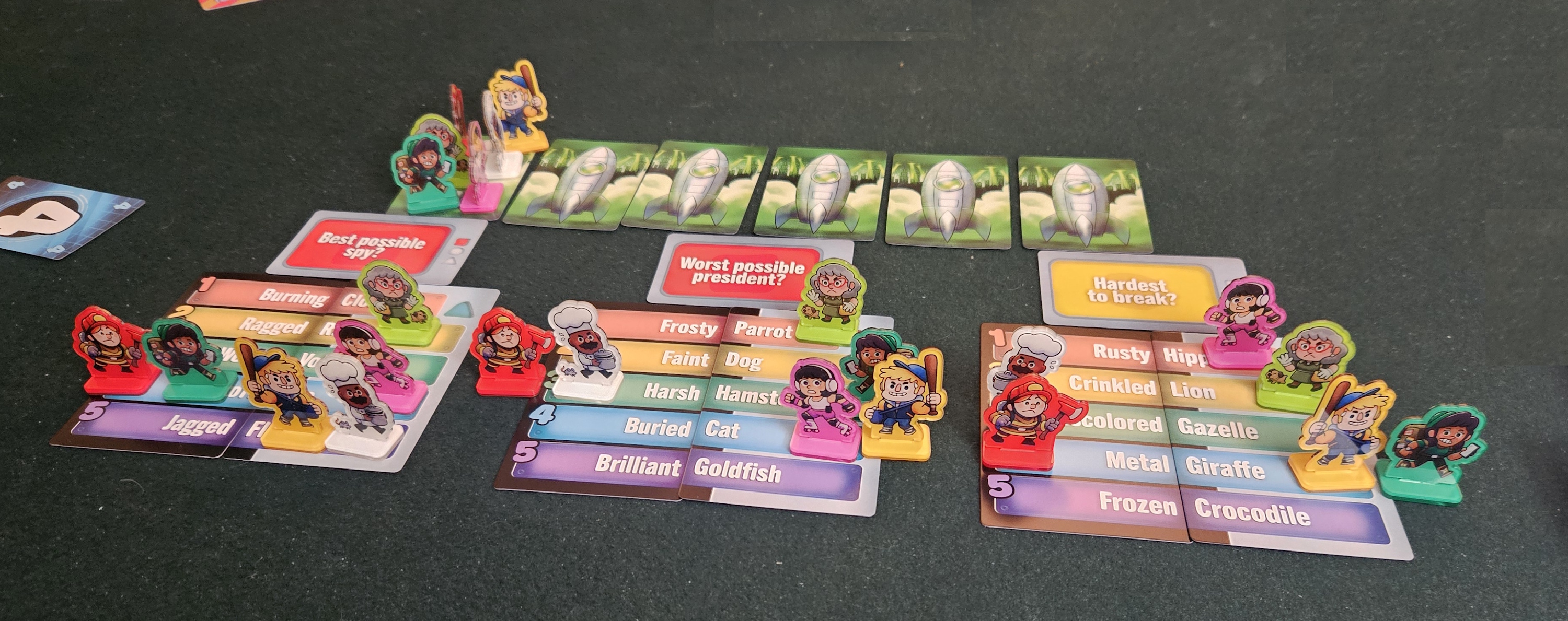
Three questions. That’s all you get.
Conceptually, Totally Human is intriguing. It taps into that wonky space of our brains that’s more intuitive than logical, especially when it comes to in- and out-grouping. While some questions are more obvious than others, plenty are full of gray spaces for players to squabble over and, sometimes, to get lost in. Is it harder to break a rusty hippopotamus (because hippopotamuses are the sturdiest animal on land) or a metal giraffe (because it’s metal)? Is there really a “best” thing to put into a hundred-year time capsule? Is Green Day punk?
And then, when it comes time to load the rockets, the ensuing debates are also vibe-based, reaching into a rucksack of mammalian instincts. On Bluesky, there was recently some discussion about the value of small talk beyond allaying boredom at a social event, such as establishing to fellow apes that you’re a friend rather than an aggressor — and, as an extension of that, the way neurodivergent folks might feel alienated by such a state of affairs. Totally Human could function as a ludic expression of that entire conversation. When there are aliens in our ranks, it’s often better to move with the crowd than to have a good reason for why you stand slightly apart from baseline. When one is perhaps a little alien, the consequences can be severe no matter how benign the distinction.
This makes Totally Human interesting to talk about, but not always enjoyable to experience. And I don’t mean in the usual way for social deduction games, where deception sometimes rankles those who prefer forthrightness. Totally Human wrings the concealment angle of the genre into a sort of social deduction distillate. It’s about hiding in plain sight and little else. You’re given the option to discuss and defend the team’s Q&A sessions, but either the questions are so binary that folks either fit the metric or they don’t, or else they’re so vague that very little can be gleaned from them. In either case, either you hide with at least one of your fellows or you wind up on the outside looking in, human or no.
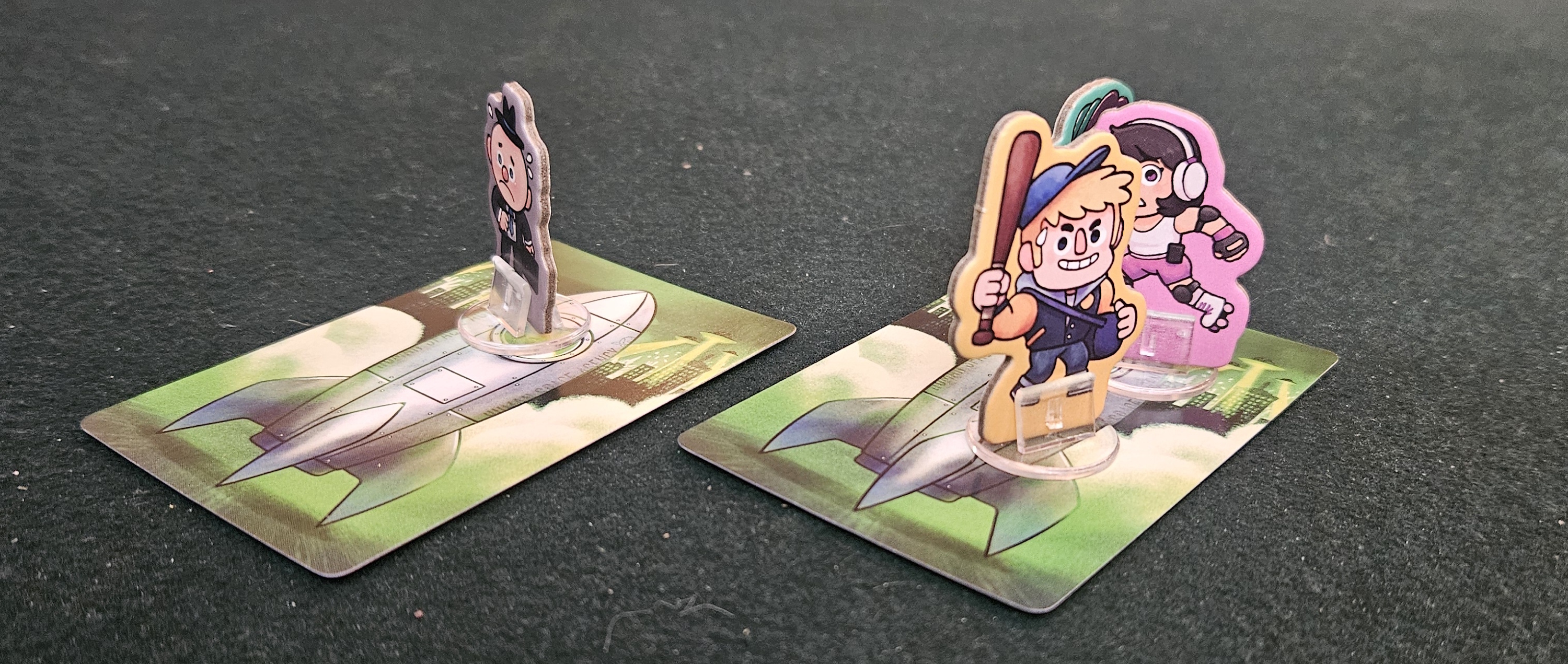
Blastoff! Hope you aren’t hobnobbing with a flesh-eating alien.
As a get-to-know-you game, there’s some value to be had here. Not only because you get to ask and answer silly questions, which provides an avenue for further insight into the socially anxious apes seated at your kitchen table, but also because those questions often lead down more interesting avenues. Provided you don’t shy away from all forms of small talk. In which case, you really should avoid this particular campfire.
For everyone else, Totally Human is totally fine. Personally, I wish its gameplay lived up to its premise. Beyond illustrating our tendency to cluster more closely with those who say the right words in the right sequences, there’s very little to see here. Maybe it’s a question of fatigue. In a world where every feed has become an extended CAPTCHA, it turns out I would rather not role-play as one, even for a mere quarter hour. My verdict: interesting but unsatisfying.
A complimentary copy of Totally Human was provided by the publisher.
(If what I’m doing at Space-Biff! is valuable to you in some way, please consider dropping by my Patreon campaign or Ko-fi. Right now, supporters can read the next installment in my series Talking About Games, this time tackling the topic of what makes a good list! Naturally, the piece includes a list.)
Posted on September 2, 2026, in Board Game. Bookmark the permalink. 2 Comments.


There should be a Pulitzer for pun titles, and this title should win that Pulitzer.
LOL. That would be the funniest lit award. I’d frame the annual winner.