The Short-Lived Fad of Planking

When I think of “planking,” I recall the trend where social media users would mount their rigid horizontal bodies in improbable locations. But there’s a second type of planking fad, one I only recently learned about. In the mid-1800s, a handful of entrepreneurs decided to construct toll roads made of wooden planks. Now, you would assume that a person in 1846 would have enough experience with wood to say, “No sir, that is an unsound investment. Such a road would deteriorate forthwith under the tremor of horse and carriage.” But like the investors of our day, these forward-thinkers were abnormally dopey. Over the course of the next decade, fortunes were padded or frittered as plank roads came and went, obsoleted by roads of gravel and bitumen.
Rough Roads, designed by Gil Hova and published under his label Informal Ferret Games, is all about this short-lived investment boom. While I’ve appreciated some of Hova’s work in the past, such as High Rise and The Networks, this is his strongest and most interesting output yet.
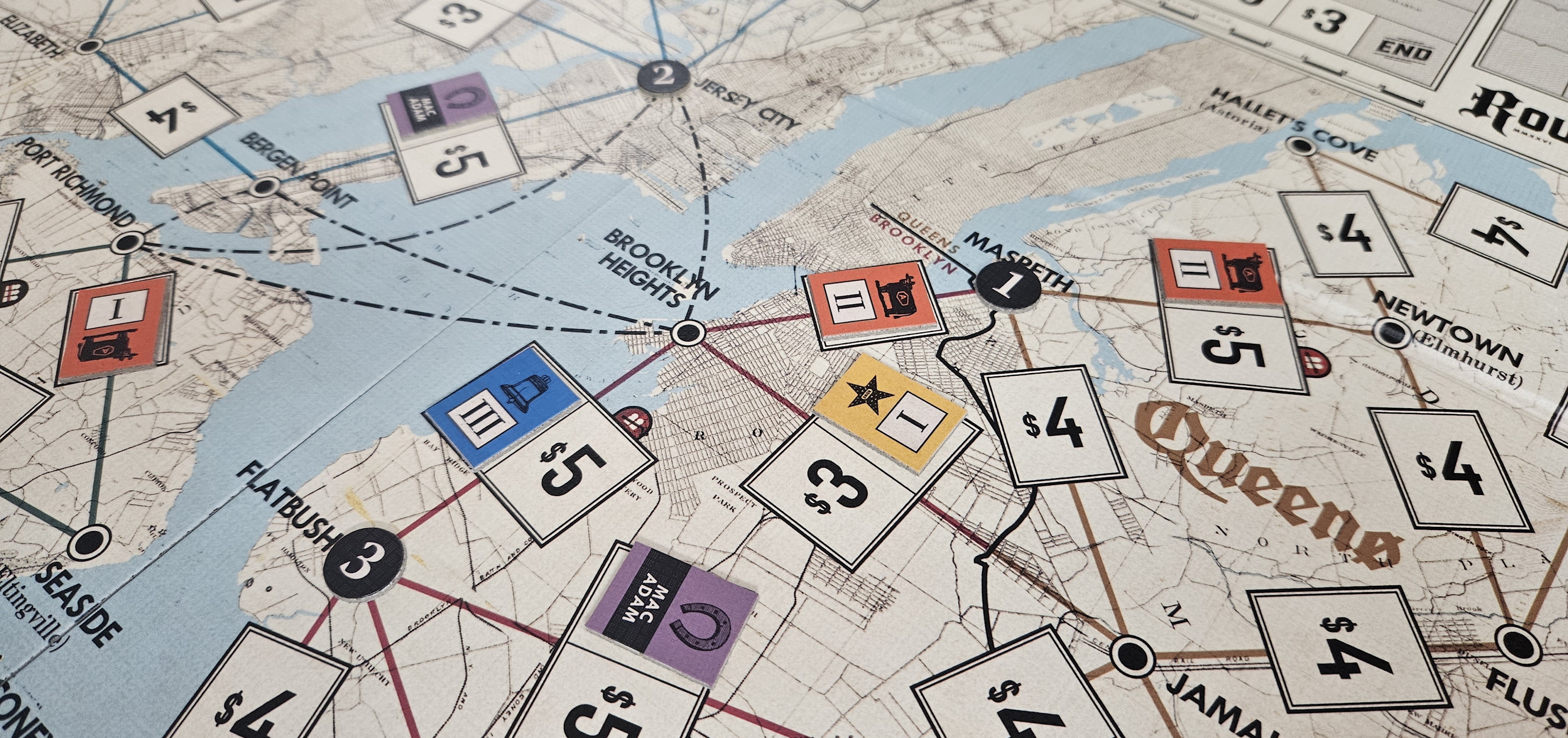
Time to plank.
On the surface, Rough Roads looks like a route-building game. With its map of New Jersey, Staten Island, Queens and Brooklyn — which subtracts either side of the bay to accommodate different player counts — there is, of course, some measure of connecting far-flung locations. Certain goal cards lead your company to stretch outward, awarding cash rewards for linking, say, Fresh Kills and Bergen Point, or Jamaica to Coney Island. Hova even repeats a trick that will be familiar to anyone who’s played a cube rails game. When you need to make a connection but the route is already filled by an opponent, you can pay them a fee for temporary use of the road. Thus the tollmaster becomes the tollbitch. But at least you’re a tollbitch who gets to fulfill this contract.
But while geographic linkages are the outward language of Rough Roads, at heart this is a game about riding an investment bubble a little more smoothly than the opposition. Its principal gameplay verbs are neither auctions nor shares in competing companies. Just because it looks like a train game doesn’t mean it chugs like one.
Instead, the centerpiece here is an action-selection system that leaves surprisingly deep imprints with each bite. Hidden by a shield, players plan four actions per round. With only four rounds before the game ends, that isn’t much wiggle room, either action-wise or in actual playtime, before the whole thing comes to a conclusion. There’s no flab on these bones. Even a single misspent action might cost one the entire session. Which makes it fortunate indeed that those sessions only occupy a little over an hour.
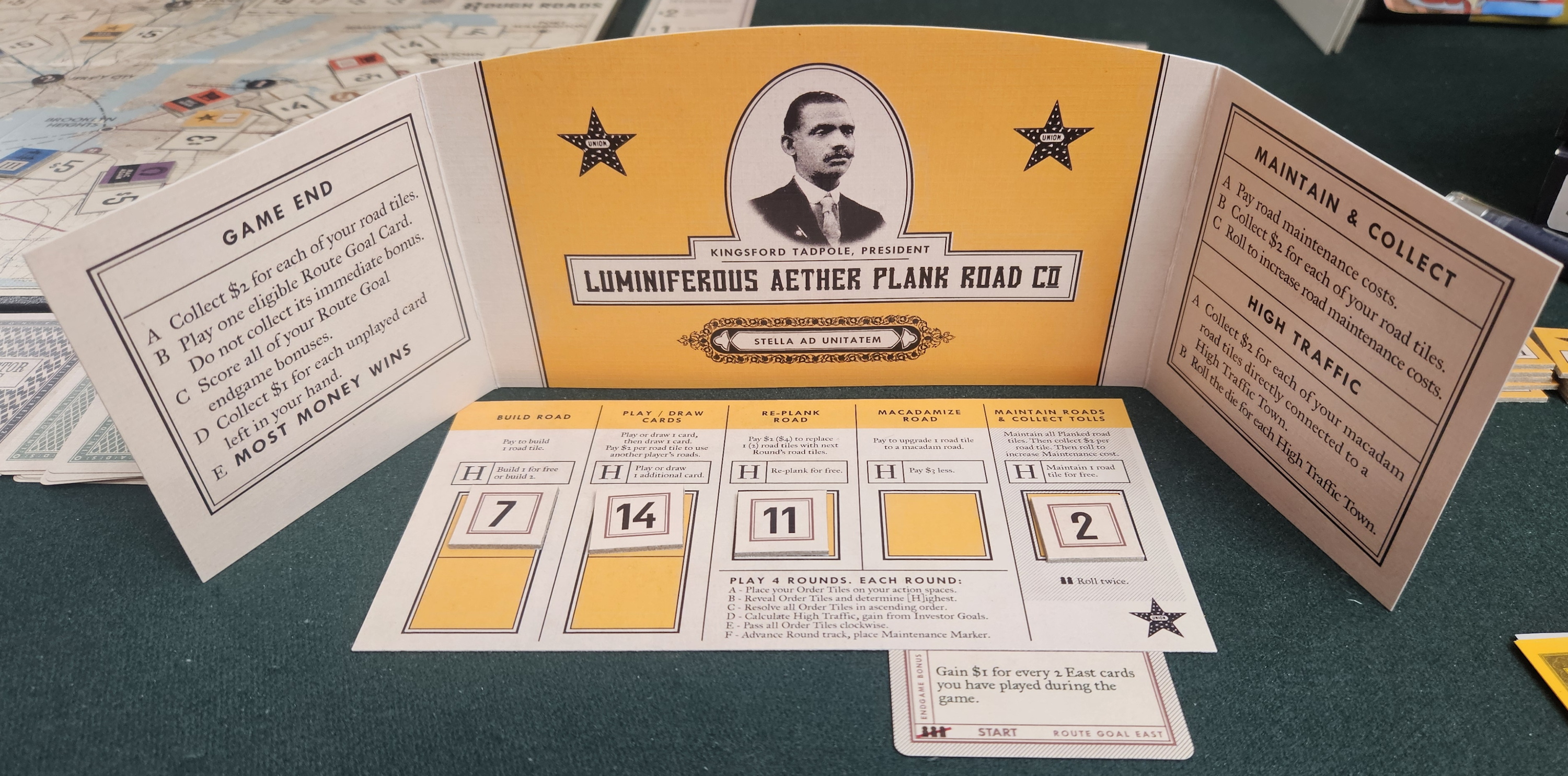
The action selection system is dang sharp.
Which isn’t to say this system is unfair. There are four sets of action tiles, each with its own range of digits. These are passed between players over the course of the game, giving each player a shake with each set. But the actual selection process rewards forethought more than anything. When actions resolve, they go in numerical order, making it possible to jury-rig a sequence where you earn enough cash to cover your roads’ maintenance, build roads and then modernize them, or, most satisfying of all, swoop in to build that pivotal connection before a rival company gets the option. Those low numbers are often your strongest pieces.
Except Hova is too clever to leave it at that. In each action category, going last in turn order awards a bonus. Being the last one to build a road means you can construct it for free (which is huge) or build two roads at once for full price (which is sometimes even huger). Modernizing your roads, whether by replanking or “macadamizing” them, becomes significantly cheaper as well, while being the last to play cards — basically, focusing on the investment and contract side of the business — means you can play or draw an extra option.
But what makes this system so compelling is that it’s possible to up-bid players with even relatively low-ranked action tiles. More than once, I’ve seen the 1-value tile somehow land the highest rank in its category, going first and receiving its last-place bonus. It’s all about priorities, both your own and those of your rivals. While it’s possible to build sturdy, predictable routes, it’s often more effective to complement your zigs with the occasional zag. Just don’t get too clever with it, as there’s nothing quite as rotten as playing so unpredictably that your own sequence of actions falls apart mid-round. Or believing you’ve outguessed your opponent’s actions only to stymie your own projects.
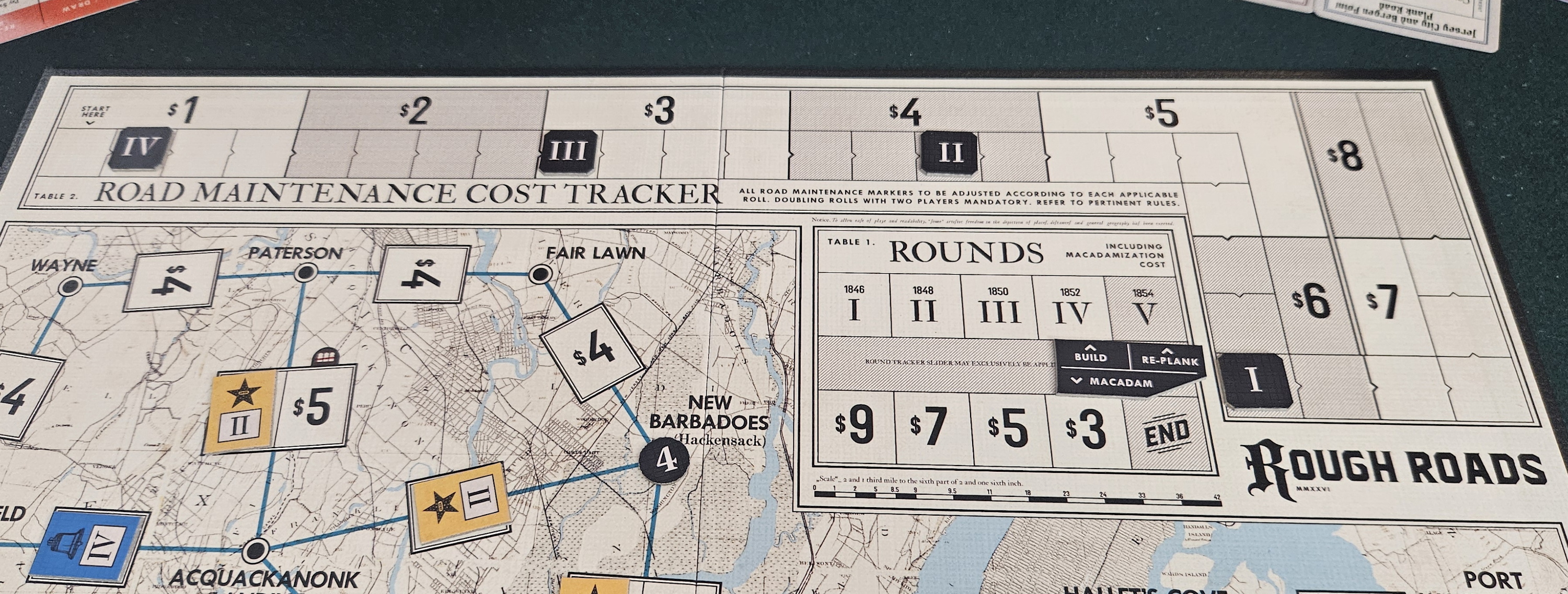
Oops! Turns out wooden plank roads rapidly deteriorate.
This is the first half of Rough Roads, tonally speaking. The syntropy to the entropy of your roads’ inevitable rot. For all your effort, it’s never far from mind that you’re shilling a shoddy product. Of your four actions each round, one must always be dedicated to maintenance and collection, a bundle that first sees you covering the repairs of all those wooden planks before you actually earn any cash from tolls. Failing to cover a road’s upkeep means abandoning it altogether, forcing players to engage in some light financial planning lest they lose what they’ve built. Even worse, over time roads grow more expensive to maintain, forcing you to reinvest in older connections rather than focusing on further growth.
What’s more, certain regions of the map are designated as high-traffic. These are worth extra cash each round, but also threaten to degrade prematurely. This results in broken roads that hog up space until you refurbish them. Worse — have you noticed a trend? — roads tend to break right before you determine whether you’ve fulfilled the current session’s investor goal. These have variable goals, but their one constant is that they award cash for your longest-distance connection. If that route happens to crumble in the middle, well, that’s too bad. As much as you’d prefer to pass along the unreliability of your roads to your customers, their erosion is likely to impact your plans sooner or later.
Some train games posit the danger of “rusting,” the moment when an older brand of locomotive becomes obsolete and is removed from play. Rough Roads feels like Hova built an entire game around the concept of rusting. Not only its slow-motion oxidation, but the steps needed to slow and remediate the corrosion.
Or to bypass the problem by embracing a better product. Plank roads were short-lived not only because they fell apart and sucked to travel on, but because better paving methods were just around the bend. Sturdier, smoother roads exist in the game’s macadamizing process, but they start off expensive and only grow cheaper with time. Rough Roads is therefore a game about modernization as much as it’s a game about flash-in-the-pan investments. It’s technically possible to invest in quality with your very first action. But why would you? That’s not nearly as profitable. Better to wait for the price to come down. Better to rattle a few thousand carriages along some misfitted struts.
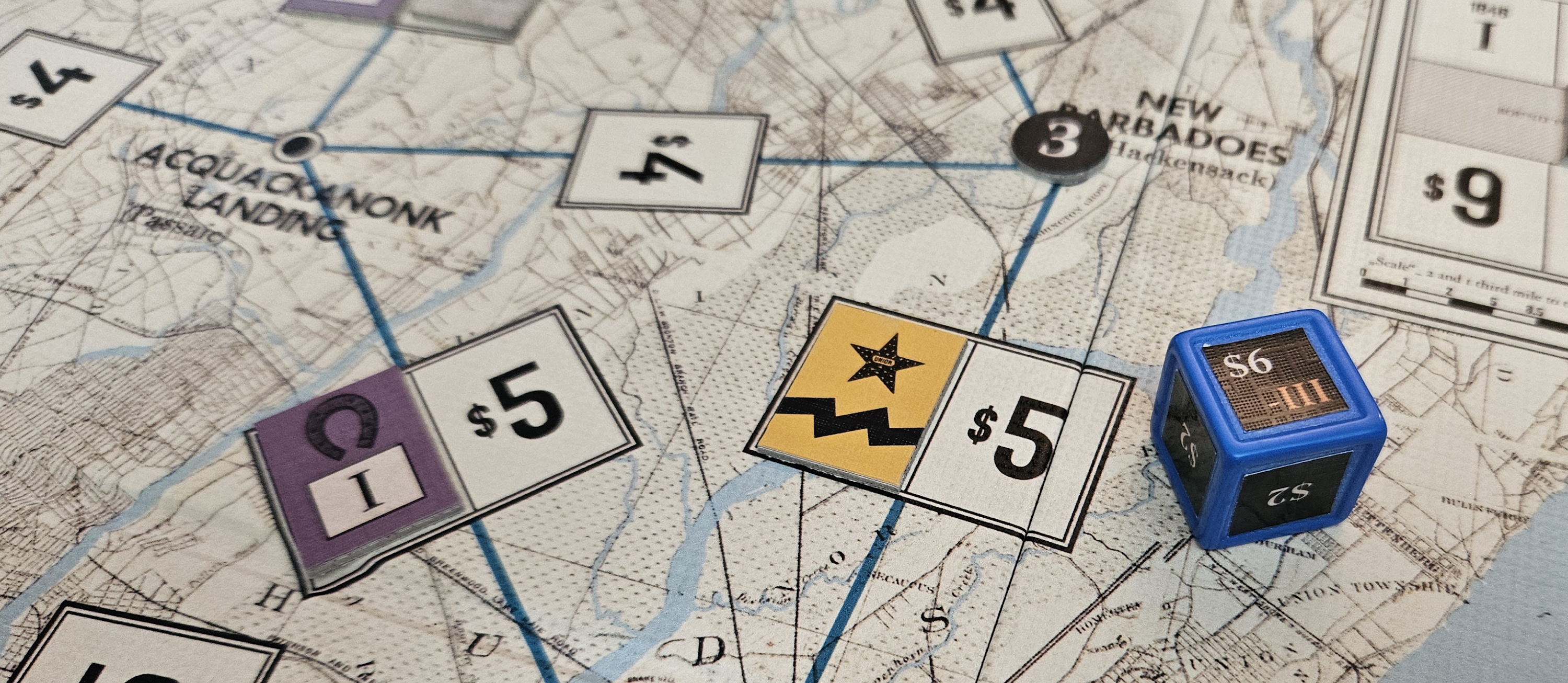
My high-traffic wooden road made heaps of cash… and then, predictably, fell apart.
The result is a fascinating experience, not to mention an eminently playable one. While it doesn’t hit the highs offered by some of its route-building peers, it’s reliable in a way that its roads are not. In particular, there are rich veins to be mined from its action selection system, elevating what would have otherwise been a boilerplate game about roads into something deeper and shrewder.
Which, all told, makes it the most interesting of Hova’s efforts thus far. In covering this unstudied corner of history, it winds up demonstrating something about the friction between short-term investments and long-term durability, about getting people where they need to go, and about the undying entrepreneurial dedication to crummy products. Rough Roads is one smooth ride.
A complimentary copy of Rough Roads was provided by the publisher.
(If what I’m doing at Space-Biff! is valuable to you in some way, please consider dropping by my Patreon campaign or Ko-fi. Right now, my third-quarter newsletter is open to all.)
Posted on November 18, 2026, in Board Game and tagged Board Games, Formal Ferret Games, Informal Ferret Games, Rough Roads. Bookmark the permalink. Leave a comment.


Leave a comment
Comments 0