You Can Always Go
Of the handful of titles in Robert Hovakimyan’s ludography — whether we’re talking about his jazzy duo Bebop and Shuffle & Swing, the buggy Gingham, or, sure, the Tic-Tac-Toe-derived Bombastic — Downtown is the one with the sturdiest bones. It continues Hovakimyan’s trend of chasing Knizia, but with extra stuff bolted on, only here the extra stuff feels like an extra dollop of Knizia. Which sort of defeats the Knizian minimalism of the exercise, but in a way that feels appropriate rather than at conflict with itself.
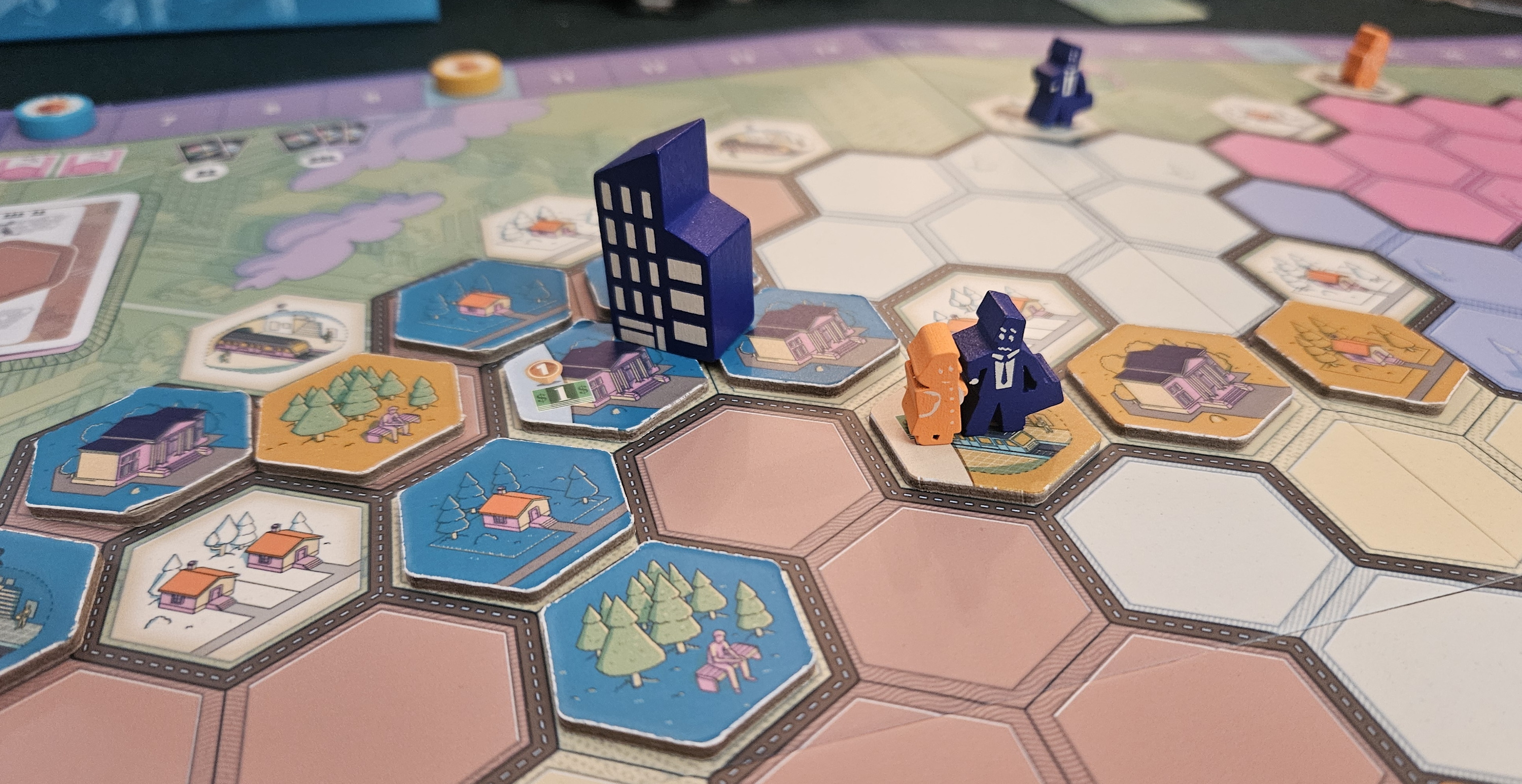
The two-player mode is not Downtown at its best.
At a high-concept level, Downtown is both a bag-builder and a city-builder, with whiffs of delivery and auction to round out the bouquet, but the terminology makes it sound more complicated than it really is. Pare away all the descriptors and Downtown is, at heart, actually a game about playing the odds and incentives against your fellows.
It works like this. Everyone is playing tiles to a shared urban map. Right away, there are two hitches. First, you aren’t guaranteed to draw the right tiles on any given round. When you need banks, there’s a chance, however slight, that you’ll wind up with residential houses only. Second, none of the tiles accomplish much by themselves.
Hovakimyan keeps the selection tight: there are only four structure types to mix into your bag, plus a couple of upgraded variants, selected during the end-of-round auction, which are potent but not so powerful that they bust the balance. Banks earn cash for adjacent tiles, but only become scoring powerhouses if you position three of them together. This forms a financial district worth a tidy amount of points at game’s end. Houses, meanwhile, are nearly worthless until they clump into neighborhoods, which suddenly makes them worth a whole heap of points at once. Parks trigger off of houses to earn points and park cards, themselves worth increasing digits when the game concludes.
The most complex of the group is the metro station. Upon being placed, these can hoover some number of passengers (usually two) across the city to move you along one of three tracks. Moving passengers costs money, and each type moves you farther along their corresponding track if their station is adjacent to their preferred district. Houses for kids, banks for salarymen, parks for old folks. It isn’t complicated as such, but it requires a bit more spatial awareness than anything else in the game.
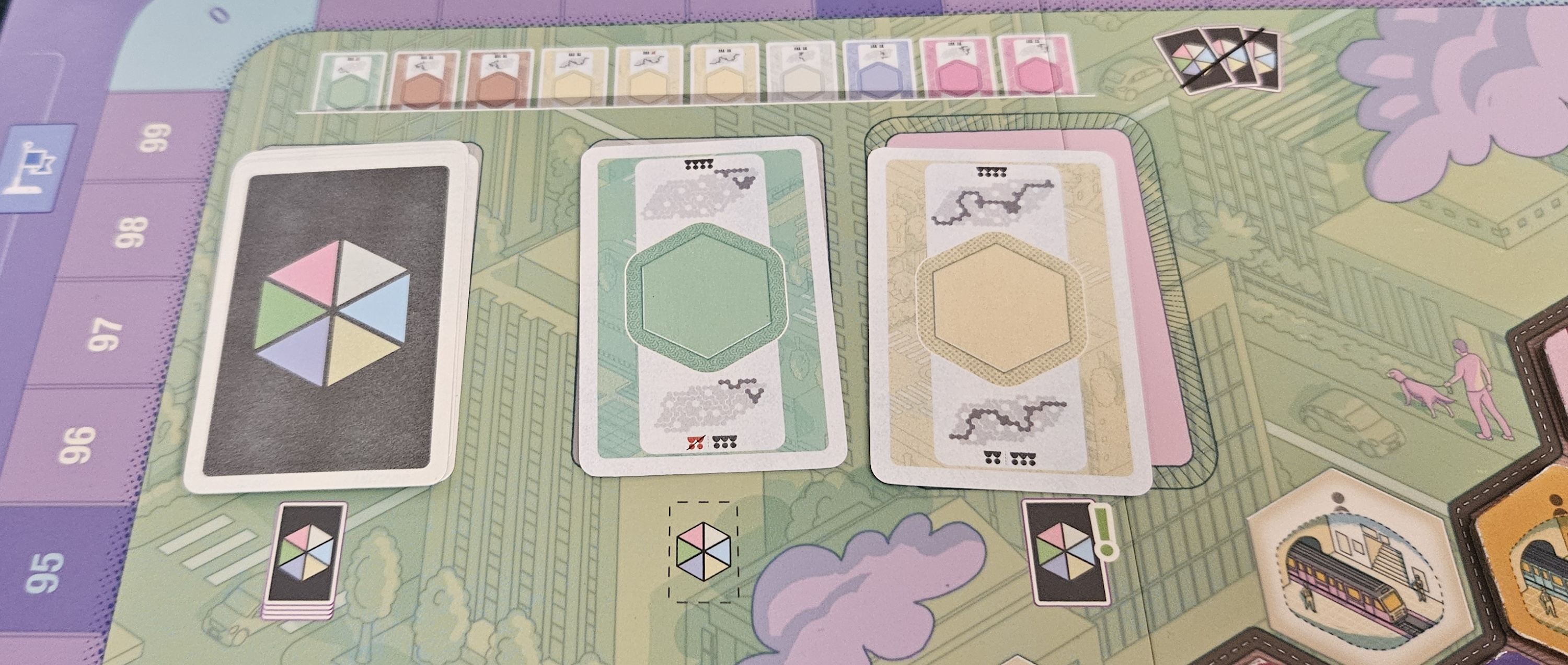
The game’s main constraint is that you can only play to certain districts each round.
As I noted earlier, each tile has a couple of upgraded versions. Two or three houses per hex instead of only one, banks that award points in addition to cash, metro stations that deliver extra passengers or make one of them free. That sort of thing.
Where the game’s placement puzzle really fires up, though, is the special structures. These can only be purchased at irregular intervals, and in addition to letting you place a handsome structure atop the tile that built it, they also trigger a couple of special abilities that adjust the game in more interesting ways. The hospital encourages you to create a single monstrous cluster of your own tiles. The church encourages you to drop off passengers next door. The casino awards cash instead of costing it, but is only worth points if entirely surrounded.
Crucially, Hovakimyan inverts the usual tile-placing formula by tightly monitoring where all these tiles can be placed. The board is divided into six color-coded zones. Some, like the green zone, are relatively small. Others, such as the yellow zone, wind across the entire city like a highway. Each zone is represented by a card — the larger by two or three cards — in a combined city deck. Each round, one card reveals where everybody is allowed to build, while another gives a peek at which region will unlock on the next turn. Sometimes this requires everyone to begin construction anew in a distant corner of the city, while at other times your structures will abut what’s come before.
This is really the crux of the entire game, not to mention Hovakimyan’s main departure from Knizia’s tile-layers. Not only are you playing the odds with your bag of suburbs and banks, each placement must also hedge your bets with the districts that will avail themselves to future construction. Not every card will be drawn, leaving certain portions of the city untouched by game’s end and rewarding those who most deftly adjusted to the city’s changing circumstances.
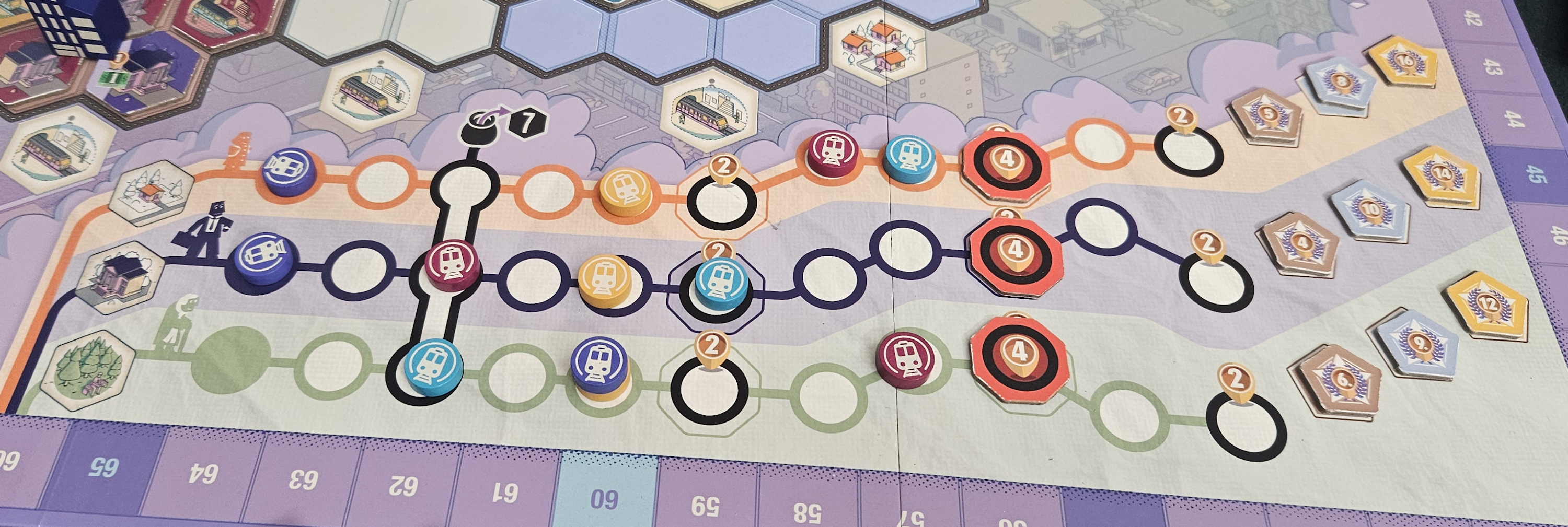
Deposited passengers are worth a heap of points.
It’s smart. Dang smart. Also sometimes frustrating, especially if you’ve built two-thirds of a financial district that will never be finished thanks to the city’s fickle zoning laws.
But this restriction manages to accomplish two things at once. Players are forced into proximity — forced to collaborate on banks, forced to snake one another’s metro passengers and contested neighborhoods — while never losing sight of the larger picture. There’s income, for example. At the end of each round, you earn either cash or points equal to your largest cluster that has at least one tile in the current zone. This encourages you to think laterally, locking down sectors that might branch into multiple districts.
It also fosters some really nasty blocking. I got called the F-word because I constructed a subway station that helped a bunch of old ladies lounge in the sun in the twilight of their lives, and I think that’s entirely unfair. Just because I stole those old ladies from my sister-in-law is no justification. To be fair, later I flipped her off for dumping a cookie-cutter house right in the middle of my banks. Basically, she had dumped the house from Up into the middle of my bustling cityscape, which is the opposite of how that movie went, in case you’ve forgotten. But flipping someone off is polite. Flipping the bird, we call it. And who doesn’t like birds?
The one hitch to the experience is that the auction system falls flat. That might not sound like a big deal, but since the auction awards placement in turn order, first pick at the upgraded tile draft, and access to a second upgrade, there’s good reason to bully the system to your advantage. The result is a spare tire around an otherwise lean game’s midsection.
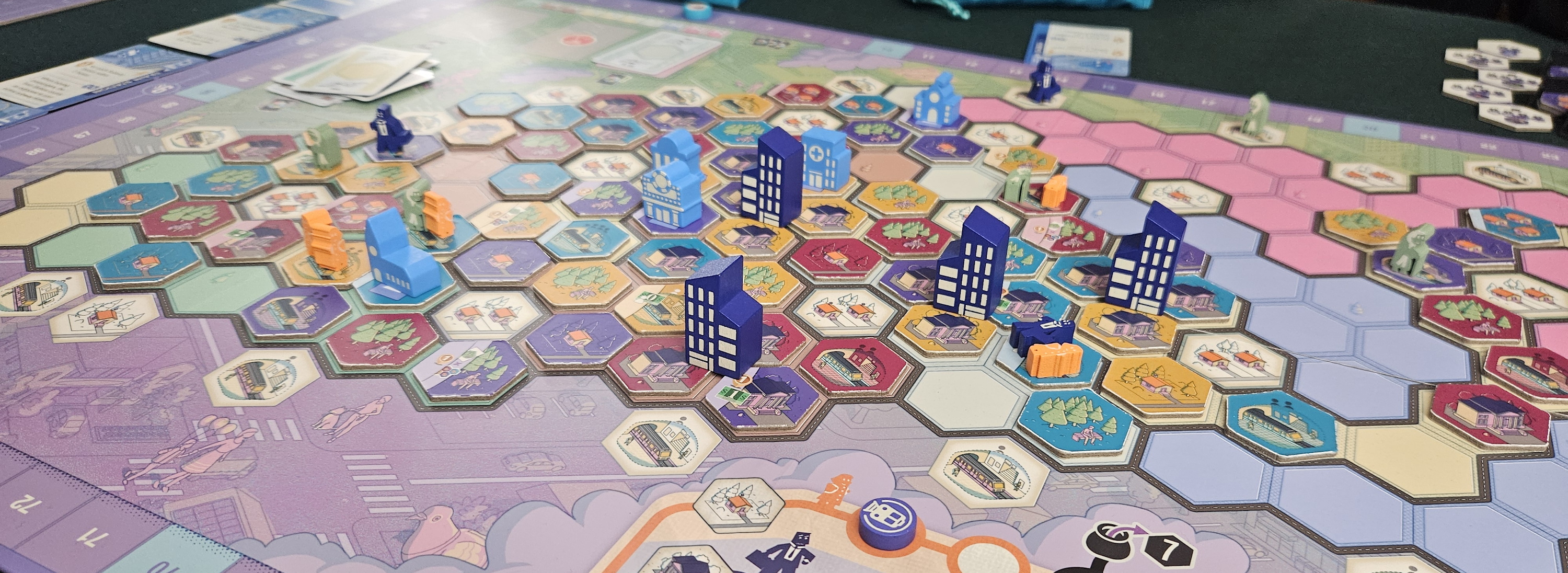
I do enjoy looking at a city.
On the whole, though, Downtown brings some new ideas to the table, especially where tile-laying games are concerned. In a year that’s boasted some truly excellent city-builders, foremost among them Rebuilding Chicago and Grinivil, it’s impressive to see Hovakimyan pushing the genre in a totally different direction. I would rank Downtown below those two, but it’s more interactive than the first and less woolly than the second, landing it in a nice middle space that encourages snitty tile placements, careful forethought, and a willingness to steal a rival’s old ladies.
Downtown will be on Kickstarter tomorrow.
A prototype copy of Downtown was temporarily provided by the publisher.
(If what I’m doing at Space-Biff! is valuable to you in some way, please consider dropping by my Patreon campaign or Ko-fi. Right now, my third-quarter newsletter is open to all.)
Posted on November 16, 2026, in Board Game and tagged Bitewing Games, Board Games, Downtown. Bookmark the permalink. 1 Comment.


Sounds like a brain stew to me…