Liberation Ludology, Part One: Uruguay

It’s safe to say that The Guerrilla Generation is the wargame I’ve been looking forward to the most since its announcement on the heels of The British Way. Like that title, this is a multipack by Stephen Rangazas, once again using Volko Ruhnke’s COIN System to examine four different conflicts over the course of the 20th century. This time, our destination is Latin America.
And it all begins with a comparatively small urban insurgency in Uruguay.
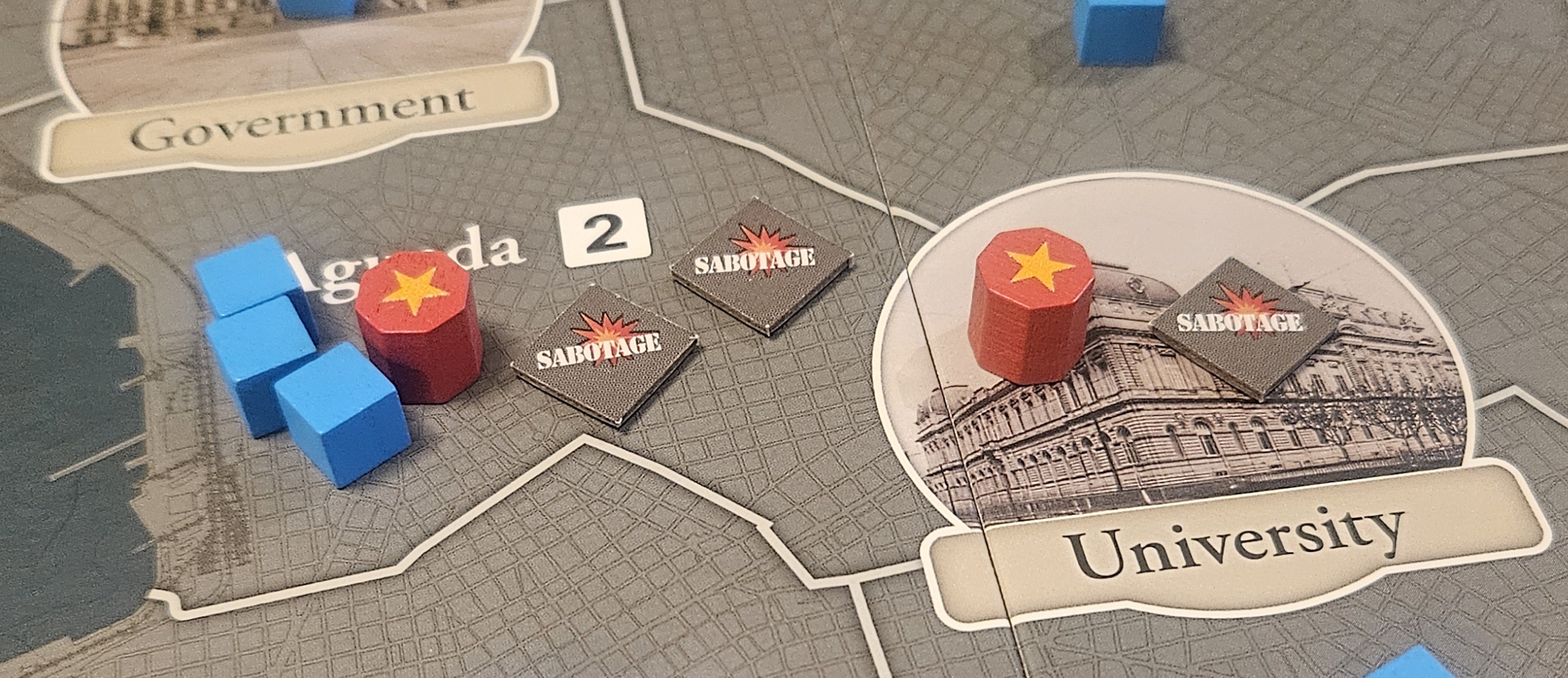
Ah, my favorite bastion of Marxist corruption.
If you’ve played even one COIN game before, the basic arrangement of their maps have probably solidified themselves in your mind. There are typically three types of spaces: rural zones, drawn in green or brown depending on the terrain being represented; urban centers, portrayed as gray bubbles where the country’s population is most concentrated; and lines of communication, the highway or rail networks that string everything together.
What sets the Uruguay scenario apart from every other map is that it all takes place within one of those concrete-hued bubbles. Unlike most of the insurgencies depicted by the series, this game’s revolutionaries, the Tupamaros, have confined most of their activities to Montevideo. Right away, this presents both advantages and disadvantages. In the former column, there’s no denying that it’s much easier to traverse a single city than an entire country. Acts of sabotage and intimidation take place where their impact will be greatest. The state’s juiciest targets — the armory, the prison, the university — are all right there. It helps, too, that it’s easy to blend in among the million-plus population.
But there are some stark disadvantages as well, and it’s here that Rangazas pulls the system in two contrasting directions. As with The British Way’s anti-colonial movements, The Guerrilla Generation examines how its four insurgencies differed in operation, ideology, and outcome. For their part, the Tupamaros are relatively restrained. This isn’t to say they’re nonviolent, like some Latin American analogue of the Indian National Congress from Gandhi. Installations will still be sabotaged. Key figures will still be kidnapped and held hostage in a roving prison. Soldiers and policemen will still be assassinated. But limiting the insurgency’s activities to Montevideo means there’s less opportunity for the revolutionary fires to fan out of control.
Indeed, that’s one of the core questions asked of the Tupamaros player. Founded in the wake of Fidel Castro’s successful takeover of Cuba — as presented in the second COIN volume, Cuba Libre — the urban nature of the Tupamaros reflected the ideals of their core membership. This was a middle- and upper-class movement, staffed principally with students and tradesmen rather than farmers and day laborers. At the outset, it’s impossible to overlook the lone insurgent cell situated comfortably within the university.
Thus, a tension is presented. Should the Tupamaros confine their activities to their original vision or expand their base? Neither option is perfect. Keeping the message focused restricts the manpower the Tupamaros can bring to bear, a problem that only grows more pressing as increasing numbers of revolutionaries are imprisoned. But the instant the organization expands its recruitment pool, rogue cells might spark violent actions that disgust Montevideo’s populace and sway their sympathies toward the regime. It’s a familiar conundrum for students of revolutionary history, but to my recollection it’s the first time we’ve seen it presented so clearly in the COIN Series.
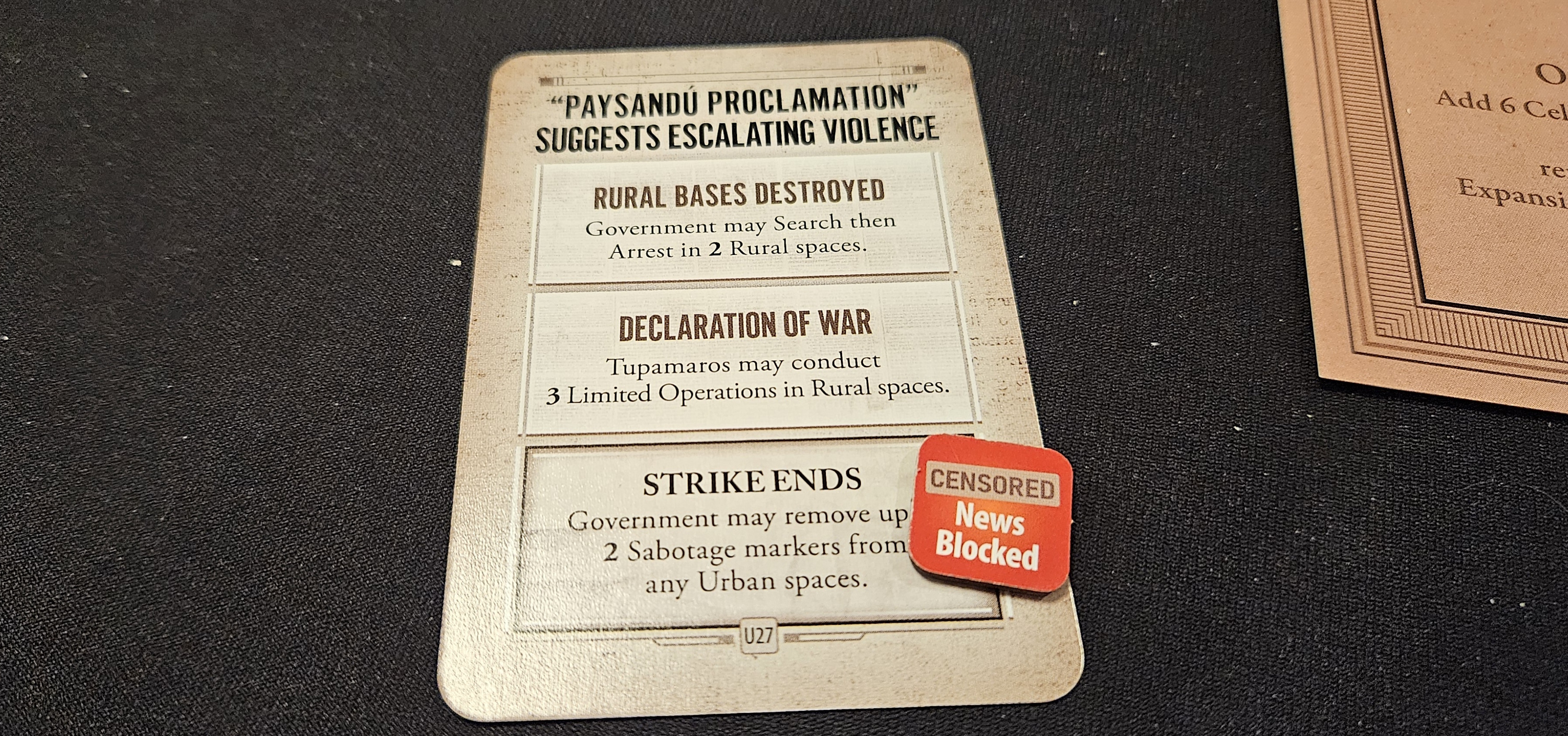
Events pull triple duty this time around.
This is only the first of the small touches that Rangazas deploys to great effect in the Uruguay scenario. The Tupamaros — who, it must be said, receive the module’s most interesting toys — are also the recipients of two other tweaks that speak to their urban nature.
First, supplies. At various points, the Tupamaros draw chits that represent the tools of their trade. Rather than being presented as generic “supplies,” here they’re delineated into distinct types that influence how the Tupamaros operate. Arms, for example, double how many sabotage markers their attacks place on the map, while escape vehicles make it easier to disappear after an operation. These chits are interesting, not to mention a great deal of fun to handle during gameplay, but their real advantage is that they imbue the Tupamaros with a certain materiality that has sometimes gotten lost in the COIN System’s sky-high perspective. Not to go all Marxist on anybody, but the organization’s material conditions inform its practice. (Or “praxis,” if we really want to lean into the forthcoming accusations.) Basically, you’re more likely to jump in guns blazing if you have guns. Or expand your organization if you have a bunch of order chits for bullying around your new recruits. Or lean into hostage-taking if the People’s Prison already has a few high-profile captives under lock and key.
While this gives the Tupamaros an ideological edge that’s missing from many of the more counter-insurgent-focused volumes of the COIN Series, an alteration to the function of the game’s event cards solves a very different issue. At the end of each turn, after both sides have had their chance to act, an event takes place. Not the usual event, the one that might be capitalized upon by either faction, but an unconnected occurrence in the third box at the foot of each card. This represents something happening beyond the reach of either the Tupamaros or the Government. An escape from a women’s prison, perhaps, or a worker’s strike somewhere in the city. (Or, in a subtle piece of humor, the United States Senate might denounce torture in Uruguay after sending advisors to teach proper torture techniques. The outcome of this denunciation: “No effect.”)
This makes the Uruguay scenario the most event-heavy of the COIN titles thus far, but also resolves one of the series’ underlying tensions — namely, the false perception that these particular actors would be all-powerful were it not for their rivals’ meddling. Here, it’s possible for things to occur that are simply beyond your control. Perhaps a new poll will show that the military has high approval ratings. Is that good or bad? Hard to say. It might be rather impactful indeed. Or it might not matter in the slightest. But it’s something that happens without the participation of the game’s factions. They can suppress the news, whether through propaganda or censorship, but either way they are thrust into a world in which they are major actors, but not the only actors.
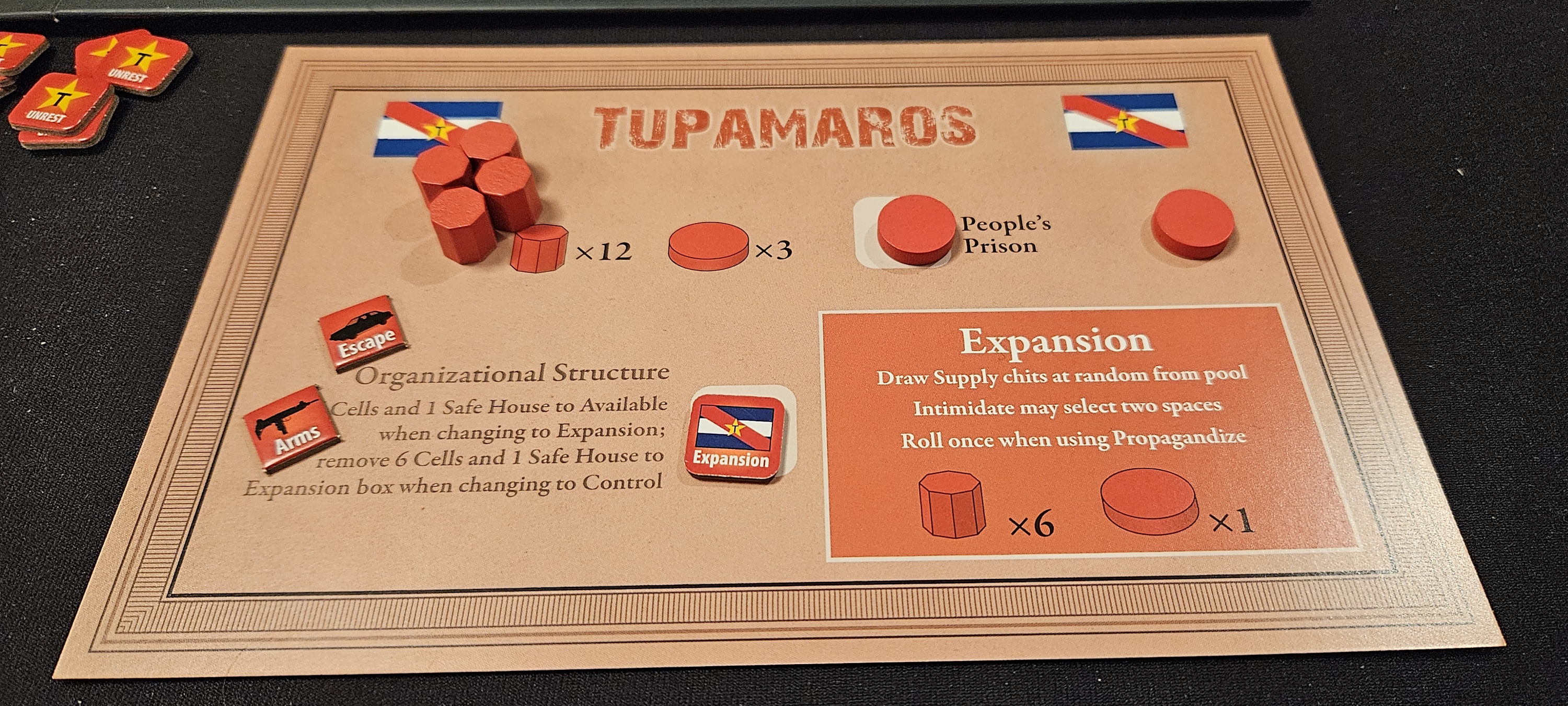
Guns, cars, hostages… the Tupamaros get all the fun stuff.
For the most part, the Uruguay scenario’s increased resolution suits both the history and the gameplay. The Tupamaros in particular are presented as a lively bunch, if also ill-equipped to effect sweeping change.
But this tighter focus also shows a COIN System straining at its limits. Peculiarities gnaw at the foundations, concessions to balance that are probably necessary to make the game function as intended, but present as artificial constraints on the pieces sitting on the map. Insurgent cells spring across the city at will, while Government police cubes trundle from one district to another. Intel chits pad the Government’s actions, doled out as a result of interrogated prisoners, but the system feels ancillary at worst, and a less enthusiastic version of the Tupamaros’ supply chits at best. I don’t have any strong feelings on the game’s balance, as I’ve seen both factions emerge victorious, but the Government is a drag to play compared to their more freewheeling countrymen.
Fortunately, these quibbles fade alongside the scenario’s grander accomplishments. Historically, the Tupamaros lost the war but won the long-term moral conflict. The Government, pressed to their limit, eventually called in the military to subdue the insurgency. The operation was successful, shattering the organization and holding its ringleaders hostage in squalid conditions for twelve years.
The Guerrilla Generation portrays this turn of events as well. On their own, the Government is unlikely to quell the uprising, especially if the Tupamaros player cleverly manages their supplies and balances their organization’s expansion and control. The Government is therefore presented with the option to call in the military. This bolsters their numbers dramatically, adding darker-hued cubes to the map that are immune to the petty intimidation tactics that have been the insurgents’ stock in trade. Once deployed, it’s almost guaranteed that the military will crush the revolution.
But this sets off a different victory tally. Now the Government is faced with the prospect of a fatal coup d’état. If their legitimacy drops below that of the military, they lose the game outright. In theory, in the moment, this also looks like a Tupamaros failure. Thanks to hindsight, Rangazas presents it as a victory for the underdogs. Yes, the coming years will see civic governance gradually phased out in favor of military rule. Yes, Tupamaros leadership will languish in prison. But eventually military overreach will pave the way for democratic reform and amnesty for the captives. Presumably, such an outcome places the game’s conclusion not in 1973 with the military coup, but in 2010 with the Tupamaro and twelve-year captive José Mujica being sworn in as the country’s 40th constitutional president.
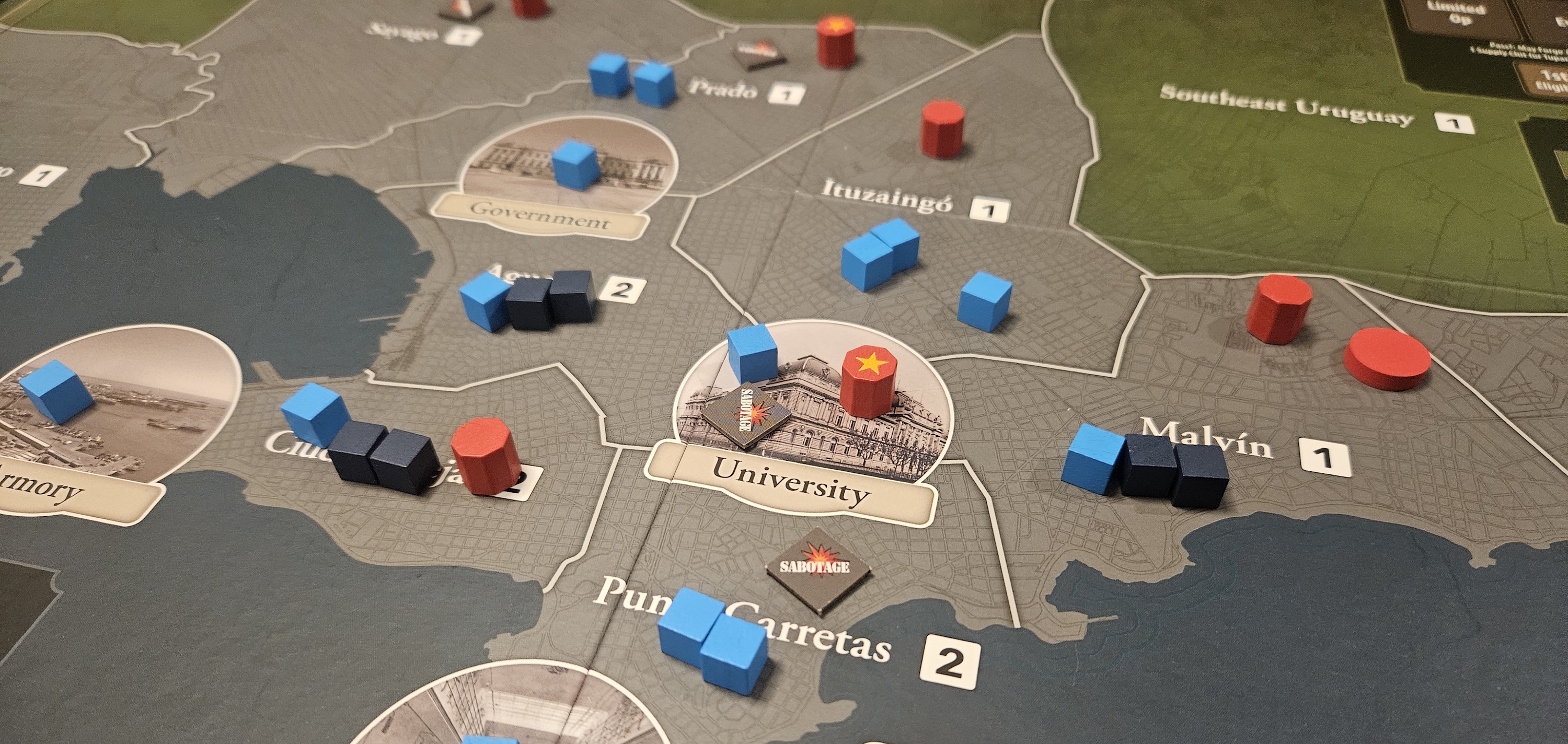
Deploying the military is likely the death knell of the Uruguayan regime.
There’s a certain reading of this outcome that might regard it as rose-tinted, perhaps even accelerationist in nature. Positioning a victory for the Tupamaros as more or less identical to their abject failure is a stark authorial choice. By no means was the civic-military dictatorship of Uruguay guaranteed to conclude in democratic reform.
Then again, I’d be more sympathetic to such a perspective if events had not, in fact, shaken out that way. All wargames are built on hindsight, through necessity if nothing else, and this is probably as close to true success as the Tupamaros were likely to get.
Either way, Uruguay provides a sterling entry point to The Guerrilla Generation. Its insurgency is a far cry from what we’ve seen from the series thus far, an urban uprising that struggled to obtain broad appeal, but made enough of a nuisance of itself to incite the suicide of the regime it opposed. We’ll see if the next three insurgencies are able to ride the tide of historical chance to similar highs. Spoiler: Don’t get your hopes up.
A complimentary copy of The Guerrilla Generation was provided by the publisher.
(If what I’m doing at Space-Biff! is valuable to you in some way, please consider dropping by my Patreon campaign or Ko-fi. Right now, supporters can read my first-quarter update of 2026: the best board games, movies, books, and more!)
Posted on June 9, 2026, in Board Game and tagged Board Games, COIN Series, GMT Games, The Guerrilla Generation. Bookmark the permalink. 10 Comments.


Holy smokies, a new series! Good start, Dan. Looking forward to the rest.
Thanks, johan! I am too.
I designed the first ever game on the Tupamaros back in 1995, using the prototype of what would become the “4-box” system for insurgency games that would finally partly inspire the GMT COIN system. It was one of my first wargame designs.
https://boardgamegeek.com/boardgame/7448/tupamaro
Now Stephen has designed the second ever game, 30 years later.
With the benefit of many years of new scholarship, hindsight and advances in game design, he has hit on some interesting new wrinkles.
Brian Train
Whoa! Brian, as ever, you have something to say about every topic! I would say I need to take a look at another of your games, but I have China’s War on my table as I type this, so I suppose I’m already getting ahead of my skis.
“Something to say about every topic… ” my dear late mother used to say something like that when she wanted me to shut up; I know you don’t mean it that way!
The year after I designed Tupamaro I designed Shining Path, the first ever game on the Sendero Luminoso movement which is probably the next one you will look at in Stephen’s quad.
https://boardgamegeek.com/boardgame/7337/shining-path-the-struggle-for-peru
As before, he has been able to add some interesting touches informed by later analysis and scholarship, while I did my game not long after the capture of Gonzalo and the insurgency was still actively sputtering away.
Looking forward to your thoughts on China’s War!
Sounds like an interesting game, I’m looking forward to this series. Are you going to try the rules for interlinking some of the games?
Yeah. The Resisting Reagan metagame only works with two of the scenarios, unlike the linking game that bridged all four scenarios in The British Way. So I’m leaving those two for last.
Pingback: Liberation Ludology, Part Two: Peru | SPACE-BIFF!
Pingback: Liberation Ludology, Part Three: Nicaragua | SPACE-BIFF!
Pingback: Liberation Ludology, Part Four: El Salvador | SPACE-BIFF!