Liberation Ludology, Part Two: Peru
When last we visited Stephen Rangazas’s The Guerrilla Generation, we looked at a localized urban insurgency in Uruguay, one that failed to bring about a socialist revolution, but eventually, after a period of military rule, saw former revolutionaries elevated to government positions, including the presidency itself.
Today’s scenario casts a wider net, not to mention a more tangled one. When the scenario opens in 1980, Peru has only recently emerged from its own period of ideologically complicated military dictatorship. Riven by debt and poverty, Peru now has a freshly elected civilian government that’s reluctant to give the military too much latitude, while a philosophy professor named Abimael Guzmán has just launched one of the most vicious insurgencies in Latin American history: the Shining Path.
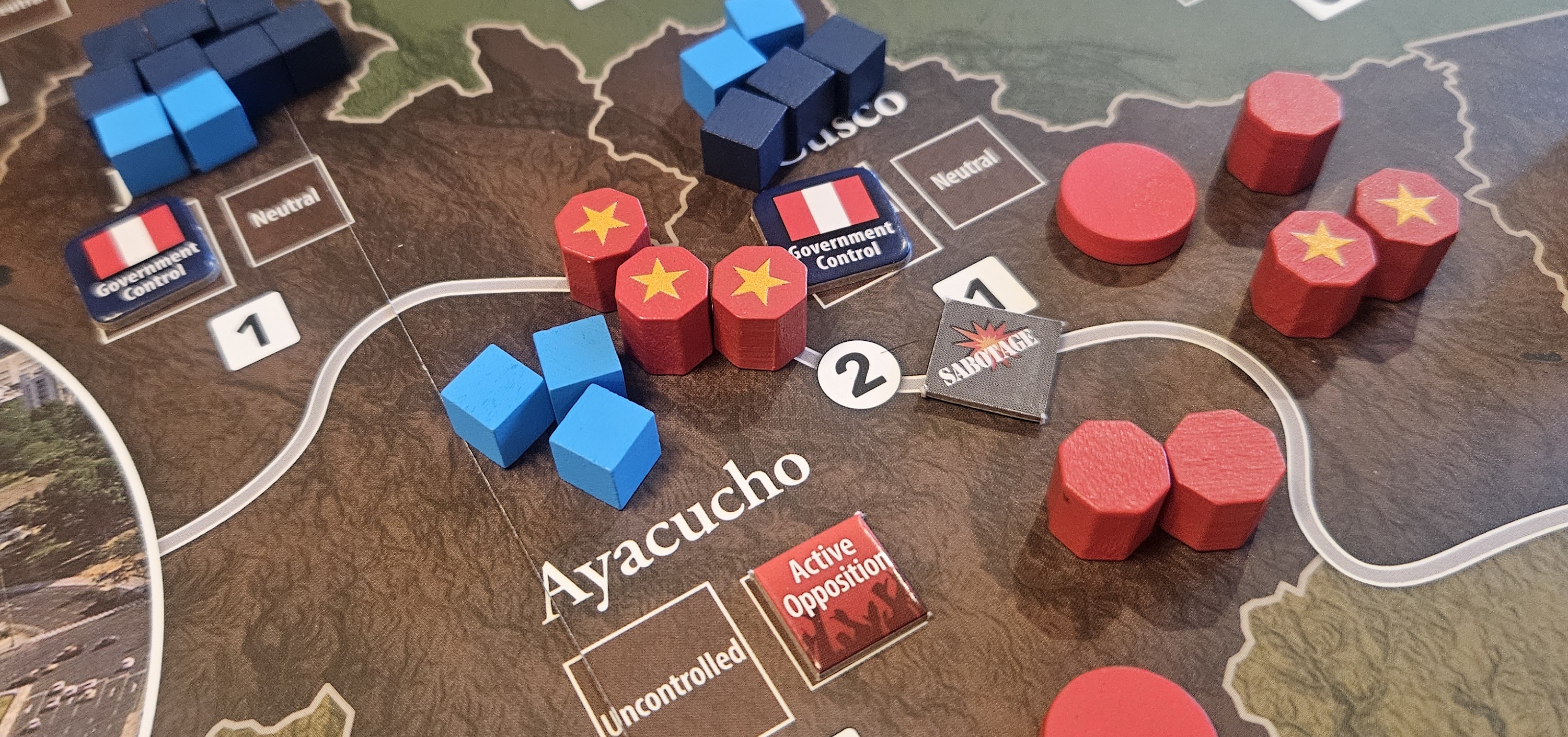
Welcome back to the countryside, comrade.
For long-time enthusiasts of the COIN Series, Peru finds itself on something closer to home turf than the Uruguay scenario. Unlike that country’s Tupamaros, the Shining Path has adopted the lessons of Che Guevara’s successful revolution in Cuba rather than merely his ideology. We’re back to observing the foco theory, in other words. This is a rural insurgency, with cells operating in far-flung locales where the government struggles to project force, pressuring the capital of Lima from the outside rather than from within.
As such, many of the series’ hallmarks are back in full force. Lima is but one theater of many, its highways radiating like tender arteries for any revolutionary to squeeze or sever. The countryside itself is broad, with rich but heavily policed coastal provinces, rocky highlands where even professional soldiers struggle to root out dissidents, and swaths of jungle that, let’s face it, nobody cares much about. This, in turn, necessitates a degree of bookkeeping. Control between the Government and the Shining Path must be constantly adjusted, while the relative support and/or opposition of the local population for the current regime in Lima is always under negotiation.
In other words, Peru looks a whole lot like COIN.
For the most part, it plays a lot like COIN as well, both procedurally and ideologically. Both sides receive more or less the same operations that Volko Ruhnke enshrined way back in Andean Abyss. The Government divides its time between protecting its vulnerable underbelly — mostly meaning its coastal provinces, highways, and Lima — and mounting sweep-and-assault operations meant to identify and then eradicate guerrilla forces. The Shining Path, meanwhile, tries to shore up its influence in its natural home territories in the highlands, and then infiltrate into those vulnerable territories to launch terror campaigns. Both sides are concerned about funding, both in securing their own and choking off any for their opponent.
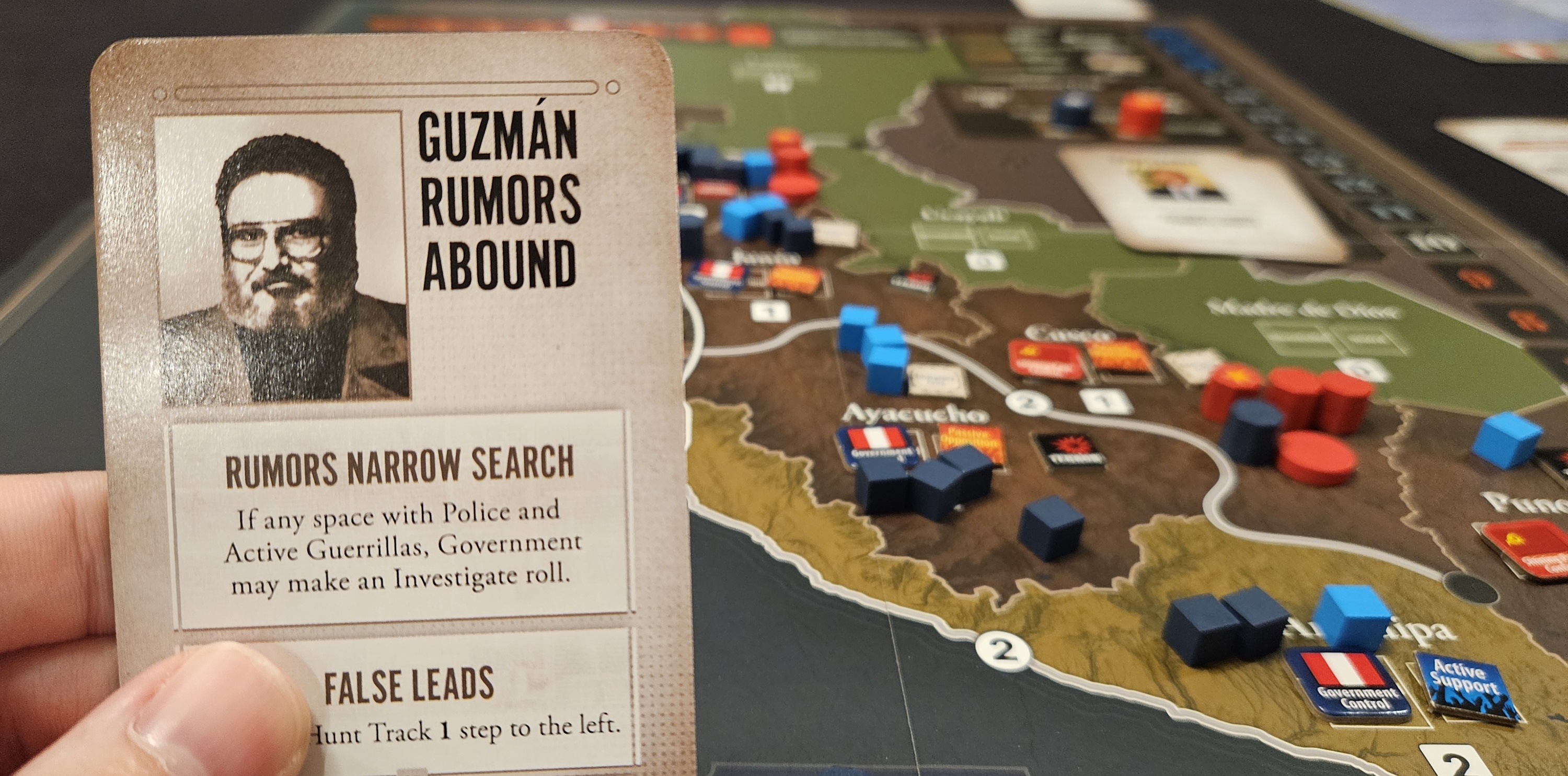
Waiting for Guzmán.
Where the scenario takes a more interesting turn is in the specifics of how it models this particular conflict, a strength that Rangazas has demonstrated previously in The British Way.
Let’s start with the Government. Like their peers in Uruguay, there’s some reluctance to let the military off the leash, although here there are plenty of troops on the map from the very beginning. In this case, certain military activities can only be taken in emergency zones, special designations limited to highland regions under threat from the Shining Path. Normal protections don’t apply in these zones, allowing the military to conduct reprisals against civilians, but also to form rondas campesinas, peasant patrols, which act with training, arms, and above all official recognition. These rondas begin “underground,” much like the series’ portrayal of insurgent cells, but can eventually flip to their active side to assist the Government in various ways. These two options, reprisals and rondas — stick and carrot — form the backbone of the Government’s strategy in the Shining Path’s staging grounds, but carry their own limitations. Namely, rondas take a long time to set up, while reprisals risk turning those armed peasants against their benefactors. All the while, Peru is deeply impoverished, risking total bankruptcy if the Government isn’t choosy about which battles it fights.
The Shining Path, on the other hand, finds itself in a testy situation where every action risks backfiring against its long-term goals. To fund their activities, they must implement local councils, but these disrupt village traditions and generate support for the Government. To foster opposition, then, the Shining Path must conduct terror campaigns, but these encourage the locals to form rondas. This produces a vicious cycle, with communist councils necessitating terror necessitating additional councils. Each solution begets new problems, round and around, threatening the insurgency with a death spiral if they don’t keep on top of it.
Compounding this problem, the Shining Path is far more centralized than most of the insurgencies examined by the COIN Series. This provides both advantages and downsides. Importing the double-sided People’s Prison disc from the previous scenario, a single Shining Path base is secretly Abimael Guzmán’s center of operations. If this base survives the current campaign, the Shining Path receives some free actions, a last-minute boon that can swing the tide in their favor right before the game checks for victory.
At the same time, their centralized leadership means the Shining Path must play more defensively than usual. There’s always the threat that the Government will capture Guzmán, a process of gradual investigation hastened by uncovering the location of Guzmán’s base. Capturing Guzmán doesn’t end the scenario outright, but it deals a serious blow to the Shining Path and bolsters the Government’s legitimacy on the scoring track, mirroring the historical outcome.
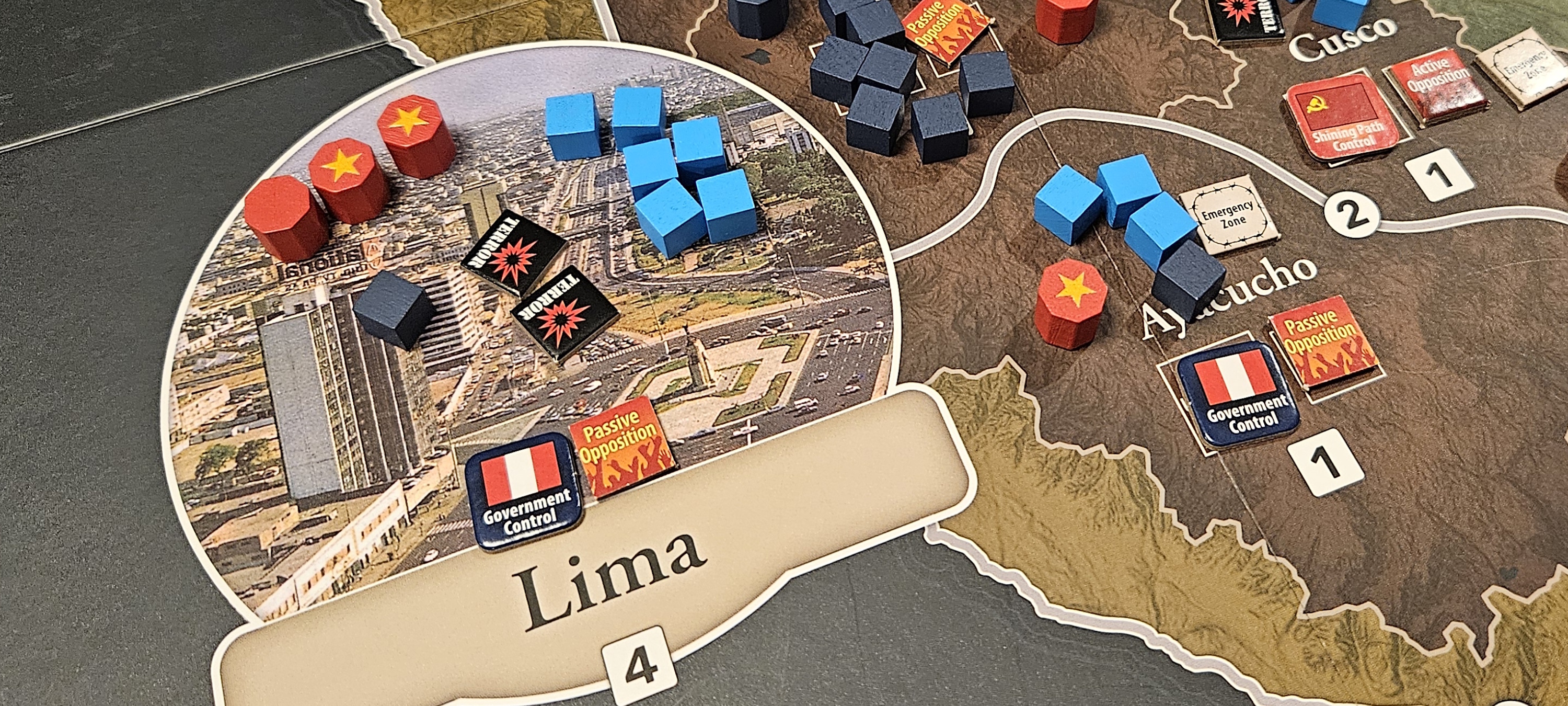
The contrast between urban and rural environments is again emphasized.
This entire armory of double-edged swords provides Peru with quite the volatile mix, one where even stable situations aren’t wont to survive for very long under rival scrutiny — or even one’s own attempts to remain in power. As with the other scenarios designed by Rangazas, both in The Guerrilla Generation and The British Way, the main question on my mind is how closely this represents the situation that developed historically, not only in terms of events that actually occurred, but also as a possibility-space for investigating the reasons why these insurgencies and government policies succeeded or failed.
Peru, it should be noted, is a tricky case. Much of the Government’s material support against the Shining Path came not from the United States, but the Soviet Union; its earlier military dictatorship was both nationalist and left-leaning before a successive coup shifted its comportment rightward; and then there’s the eventual self-coup by President Alberto Fujimori, a political earthquake that only receives a cursory mention on an event card. The limited scope of its portrayal in The Guerrilla Generation elides many of those complexities.
To be clear, I’m not pining for some wishy-washy bothsidesism. At times, the Peruvian Government was brutal. So was the Shining Path, uncommonly so, departing from every other Latin American insurgency by exceeding government casualties over the course of the conflict. Personally, the most interesting figures in the conflict are the rondas campesinas, who often struggled to chart a course that would assure them the greatest independence not only from insurgents but also from government oversight. The scenario limits them to markers of expanded Government combat efficiency in the highlands, which short-sells the difficult position they found themselves in. It would have been nice to see their struggle represented more thoroughly.
Then again, none of this is anything new. Wargames have long struggled with the question of how to portray atrocity. More often than not, designers opt to omit them altogether. With the COIN System, Rangazas inherits a model that was crafted to demonstrate approaches to counterinsurgency, only to later deepen its ideological ambitions. For the most part, Rangazas has proven himself capable of overcoming the system’s limitations to reveal the particulars of a wide range of conflicts. But with Peru, the cracks are showing, and they’re ideological more than procedural. Its version of the Shining Path is so inherently corrupt that its essential activities are attended by considerable downsides, while the Government may elect to curb its more vicious impulses and instead focus on civilian outreach. One side has very little agency; the other, an improbable amount.
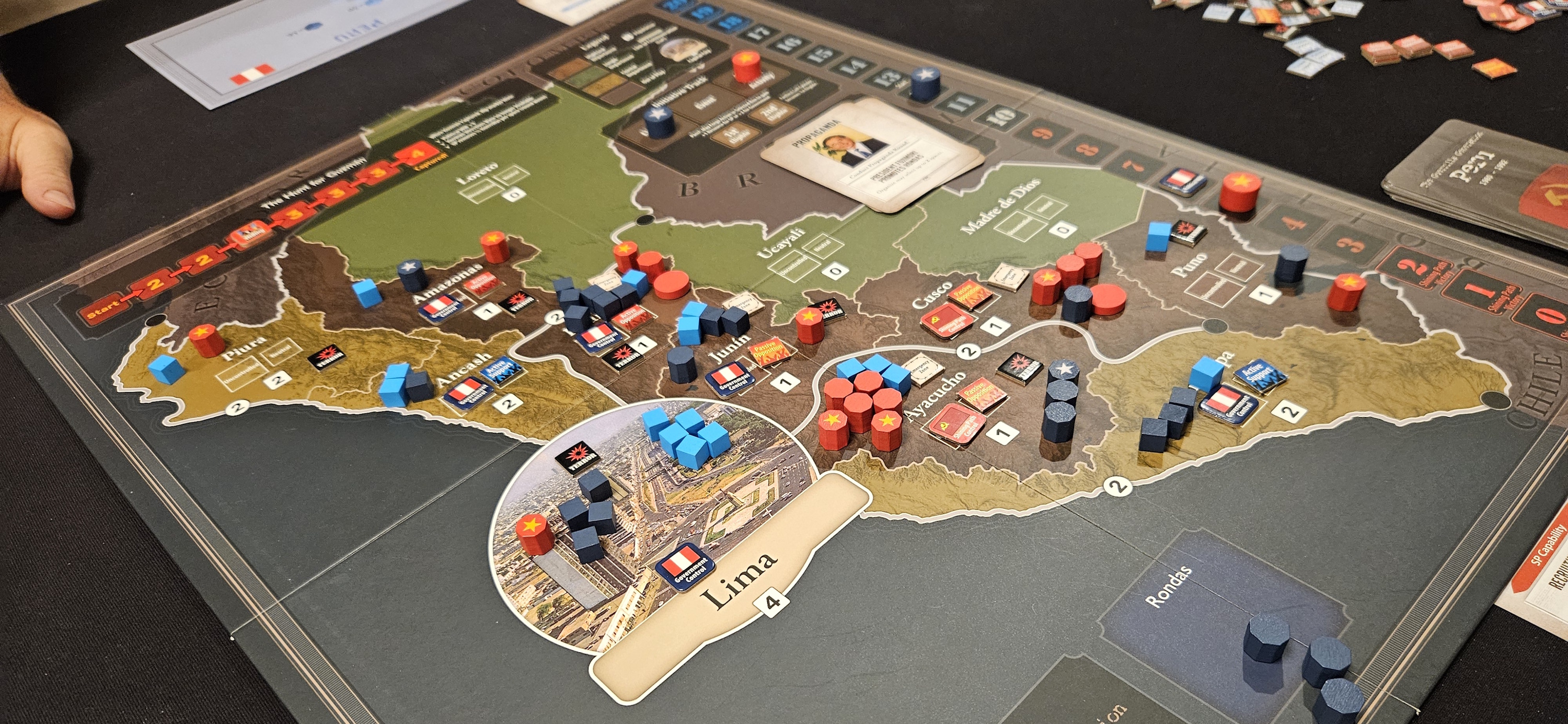
In this alternate history, the Shining Path has dominated the entire country.
What emerges, then, is more descriptive than exploratory. As a scenario, it demonstrates how the Shining Path raised funds through drug trafficking and rural councils, how the country’s impoverished state made it possible for them to squeeze the government toward bankruptcy, how it struggled to spread the revolution into population centers, and how its centralized command was both a source of strength and its ultimate downfall. As for the Government’s reflexive atrocities against indigenous populations, its political infighting, and its vacillating support for the rondas… well, that stuff is mentioned on event cards, if not quite as explicitly modeled.
On the whole, what emerges is a sound, if incomplete, sky-high snapshot of an insurgency that is still technically operative today, if dramatically reduced in strength and territory. And next time, we’ll see the script flipped as a revolutionary government faces an anti-communist insurgency with considerable foreign backing.
A complimentary copy of The Guerrilla Generation was provided by the publisher.
(If what I’m doing at Space-Biff! is valuable to you in some way, please consider dropping by my Patreon campaign or Ko-fi. Right now, supporters can read the next installment in my series Talking About Games, this time tackling the topic of what makes a good list! Naturally, the piece includes a list.)
Posted on July 9, 2026, in Board Game and tagged Board Games, COIN Series, GMT Games, The Guerrilla Generation. Bookmark the permalink. 7 Comments.


I’d love to hear you interview Rangazas once you’re done reviewing these – particularly to dig into the historical limitations you’re highlighting here. Would be very interesting to hear his response.
My goal is to have him on the podcast. I haven’t talked to him about it, so don’t take it as a given, but I’ve always hoped to chat with him after wrapping both TBW and TGG.
That sounds great! Hope it works out.
My impression is that Shining Path’s dysfunctional behavior – and its ultimate rapid collapse – was largely dictated by its nature resembling a religious sect, a cult focused on the revered leader.
I’m certainly no expert, but perhaps that significantly limits the scope of plausible “what if” alternate histories.
It does – it would offer a whitewashed version. But even with this set of Ops and SAs the Shining Path don’t *have* to terrorize the countryside as their only route.
Pingback: Liberation Ludology, Part Three: Nicaragua | SPACE-BIFF!
Pingback: Liberation Ludology, Part Four: El Salvador | SPACE-BIFF!