The Shortest Nineteenth Century
According to one of my uncles, the terms “right” and “left” derive from the fact that conservatism is correct while liberalism is wrong. You know, because we say “that’s right” to mean “that’s correct” and “that’s left” when we’ve suffered a serious brain hemorrhage and don’t remember how words work.
In actuality, the right/left divide comes to us from the French Revolution of 1789, when the members of the National Assembly who supported the Ancien Régime would sit to the king’s right, while those in favor of the revolution sat to the left. Presto blammo: a rubric that would confuse dumb uncles for the next 240 years.
Still, it’s a helpful formulation for the rest of us, if often an overly simplistic one. When I introduce the five factions from Laurent Rix’s exceptional Revolutions: France 1820-1880, I lay them out from right to left. All the easier to explain their objectives. Often, players appreciate this gesture, especially for the factions in the middle, whose aims might seem alien to our modern minds. And some people say you can’t learn history from a board game.
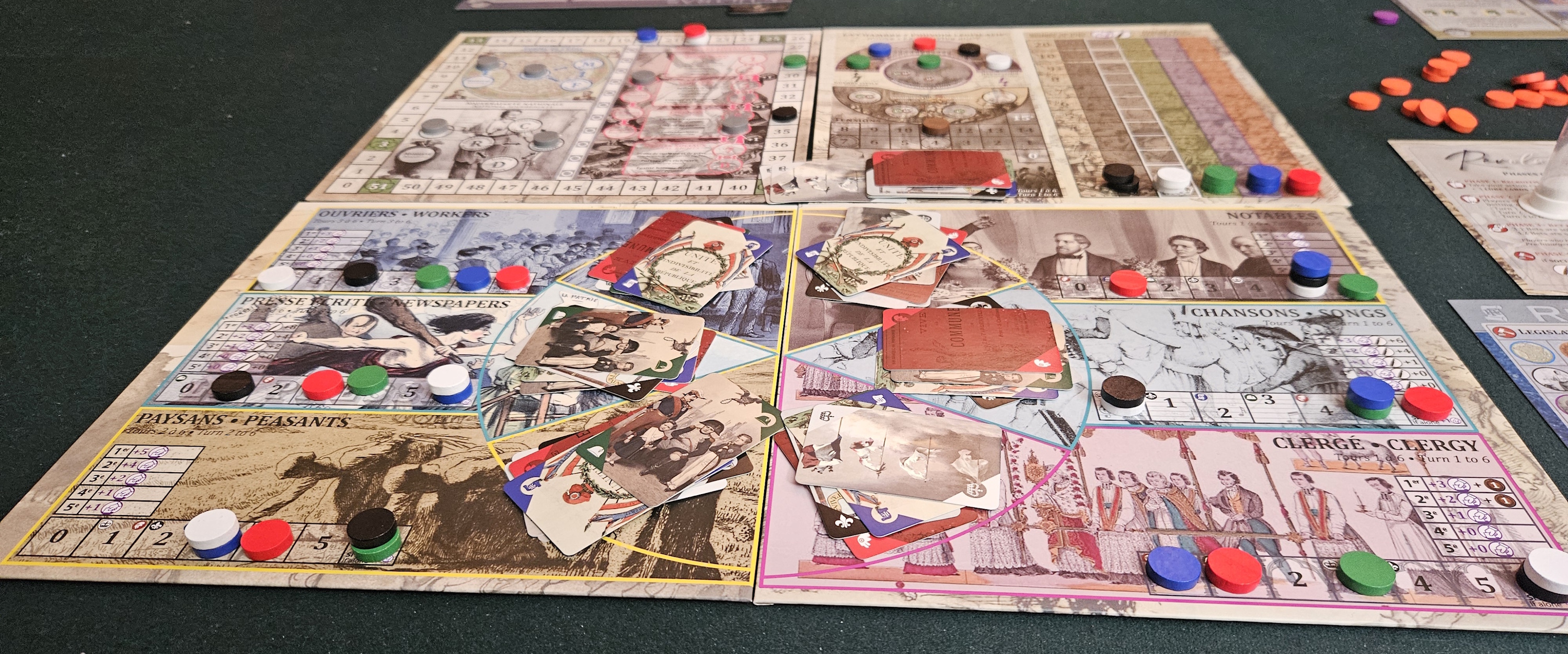
I play on a big board with my wife.
The second thing I usually explain when teaching Revolutions is the timing of the whole thing. There are certain dates that stand out in the memory — the existence of the 1812 Overture is a good reminder that the game begins after Napoleon’s removal from power, but not everybody has internalized that particular mnemonic. And it makes sense that not everybody in my very American group would recognize this particular string of dates. 1820 to 1880? What even happened in there?
Why, these are the middle decades of the Long Nineteenth Century! Which is to say a whole lot happened, but it isn’t the sort of stuff that’s often taught in history classes in the United States, where Manifest Destiny and the Civil War loom large over everything else.
In our case, Revolutions casts us as five major factions, all of whom seized and held some measure of power over those six decades. Even if, for one of them, the furthest expression of that power was limited to two months in Paris.
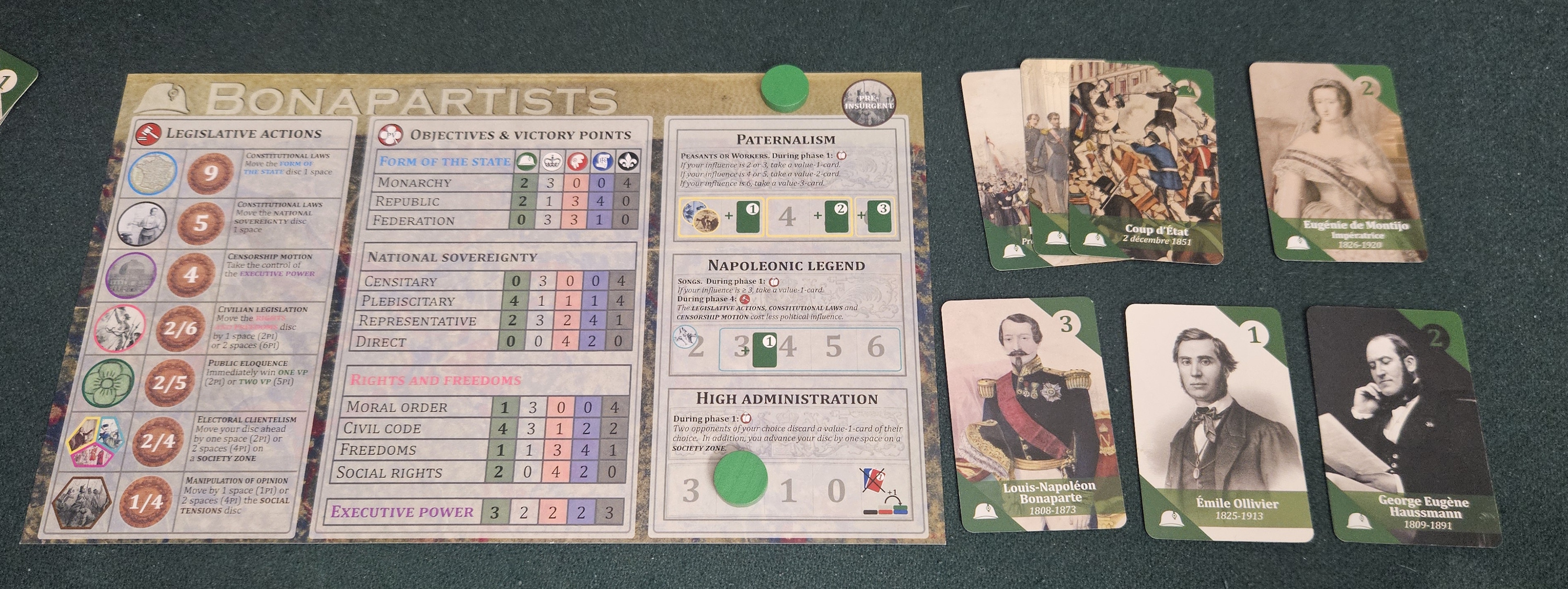
Each faction has their own objectives and perks.
Thus, our dramatis personae, from right to left:
First we have the Ultras, who are, as their name suggests, rather extreme in their dedication to a reconstituted monarchy and suppression of everything the previous revolution and eventual empire stood for.
A few centimeters to their left stand the Orleanists, willing to fly the Tricolor and speak the revolutionary tongue, but still invested in tradition and moral order.
The cult-of-personality Bonapartists make up the middle children of this family squabble; they appreciate a good monarch, but only when it’s their own guy on the throne, and will allow a few concessions to modern liberalism while also brutally suppressing it.
The Republicans are next, with their lofty ideals about freedoms and voting, not to mention a willingness to engage with urban populations and newspapers.
But even they pale next to the more extreme Socialists, who are about as far away from our starting point as it’s possible to get without earning a thinkpiece from the Atlantic about how they and the Ultras are really the same at heart.
Now that the cast has been listed, it’s time to… well, to debate, mostly.
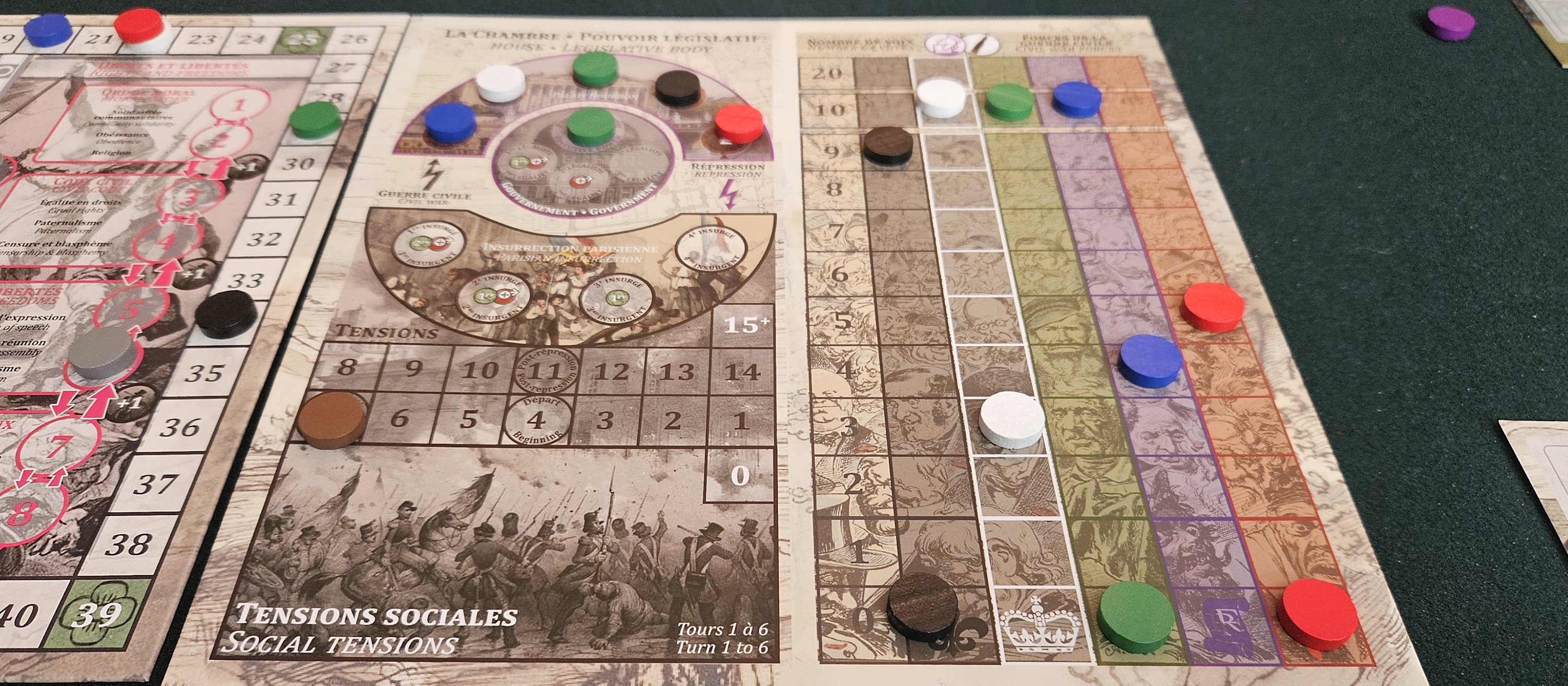
Sometimes you tally votes… and sometimes you count bullets.
What makes Revolutions special is the way Rix covers six decades of history, both legislative and revolutionary, without missing a beat. As board games go, this is a longue durée history that teases out the unlikely alliances, concessions, and sometimes bloodbaths that marked those years.
Most of the time, your faction wants to secure votes. Let’s say you’re a brash young Republican in the middle of a reconstituted monarchy enforced by a foreign Coalition. What exactly is your recourse? Early on, your goal will probably be to secure some measure of legislative power. So you curry favor, both on the table by bidding influence cards to various sectors of French society, and above it by trying to persuade your natural allies — the Socialists for now, but also the Bonapartists and maybe Orleanists, especially if the Ultras have spent too long on the throne — that it would be prudent to make a few adjustments to how votes are cast, who receives representation, or which privileges will be granted to citizens. Together you create a voting bloc, earn some political influence, and then squabble over whether to flex your limited power to enforce a plebiscitary or representative government.
But then, disaster. After all that effort, perhaps the Ultras will veto your motion. They’re quite happy with the vote going to the richest landholders, thank you very much. But this veto sets the streets of Paris into a flurry. Now, with social tensions on the rise, you begin to agitate.
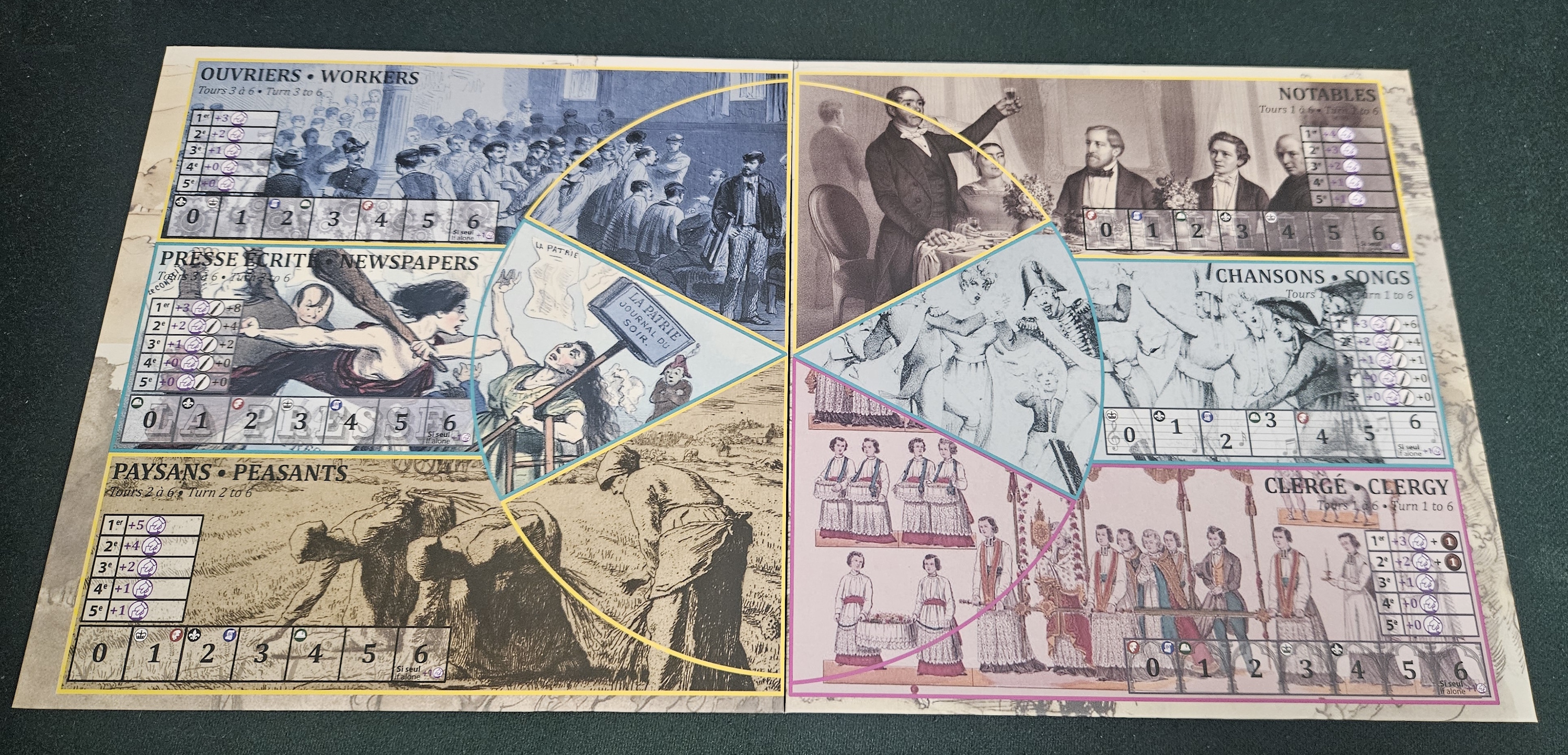
The six sectors that can eventually be manipulated for political advantage.
Over time, the political landscape undergoes seismic transformation. Rural populations become reachable. Newspapers begin to carry the public voice even more resoundingly than song. The working class begins to wake up to the fact that it’s a whole deal. Did I mention that Rix has folded the century’s gradual urbanization into his game? It’s quite the thing to behold. When Revolutions opens, the only people who can really be influenced are the notables and the clergy, and you can bet they aren’t taking calls from anyone grumbling about freedom of religion. But over the course of ensuing decades, new sectors open up, throwing the old order into a disarray from which it will never recover.
To be clear, Revolutions is never whiggish. Progress isn’t the straight line some would have us believe. When the peasantry enters the game, they’re hot for more Bonapartism, for the glory of the old days, not for equal representation. Newspapers, like tavern songs, can be written by gray-haired reactionaries as well as by sexy young revolutionaries.
Still, it becomes increasingly difficult for monarchism to keep its cold fingers wrapped around the national throat. There’s an arc here, even if it doesn’t have a foreordained slant.
So you agitate. Eventually, the frustration of the population boils over into a full-blown conflict. Now factions are forced to pick sides, either sidling up to the established order in hopes of earning a concession or two, or joining the revolutionary bandwagon in an attempt to reshape society more dramatically. Like everything else in Revolutions, these are handled slickly. Tallying votes is as easy as checking everybody’s position on the game’s six tracks; counting manpower is much the same, with a few extra steps for those who are willing to erode their popular support to throw additional bodies at the problem. Revolutions are tense, but they’re never complicated.
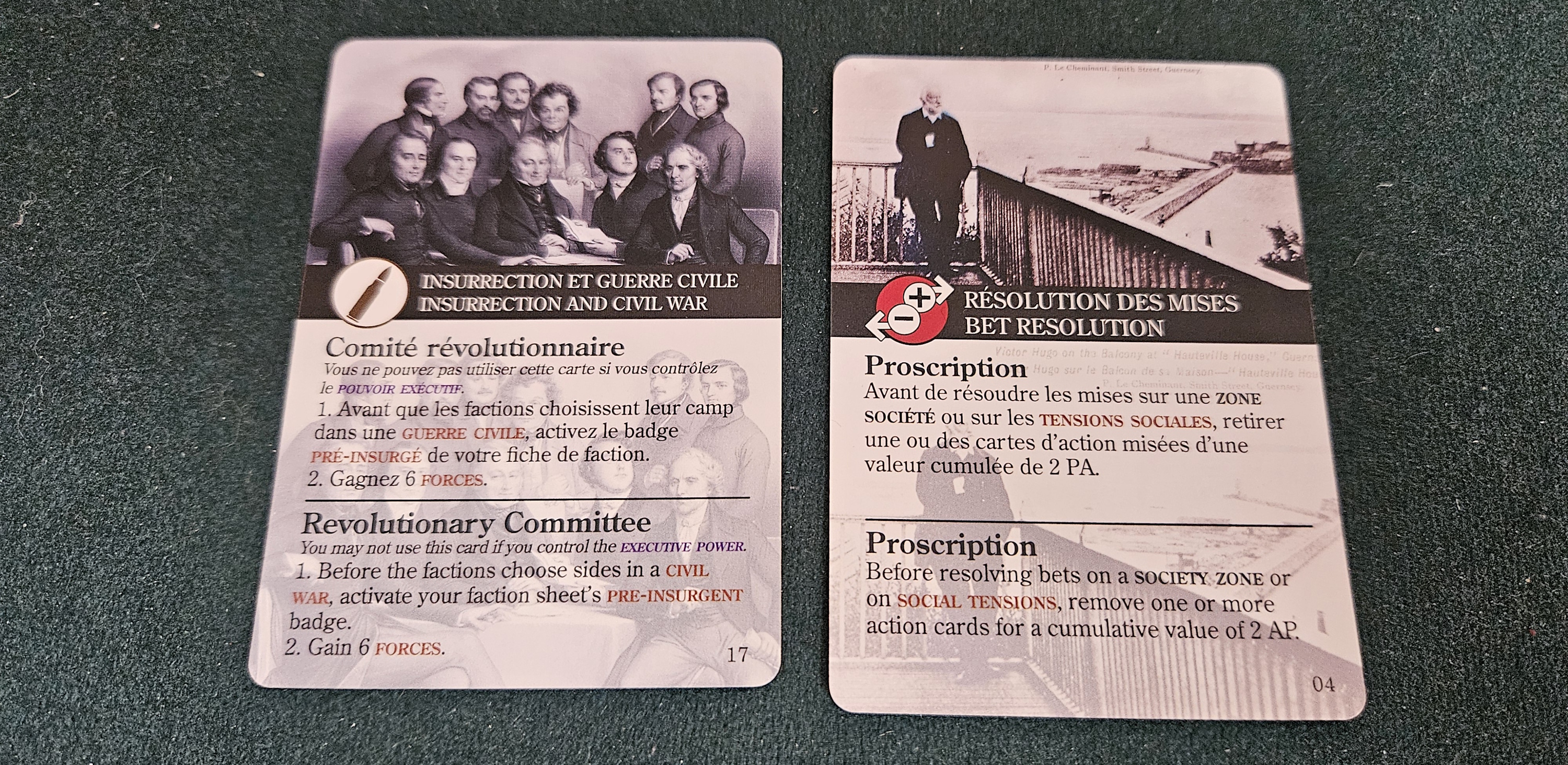
Event cards are optional, but add a lot to the experience.
Playing Revolutions is an illuminating experience. It calls to mind a few other titles, exemplars like Geoff Engelstein and Mark Herman’s Versailles 1919, with its uncomfortable alliances and shifting priorities, and Alex Knight’s Land & Freedom, about partners whose petty squabbles are so urgent that they argue themselves to death rather than combining to face a superior threat.
Like those games, Revolutions takes place in subtle theaters. One might even call them abstract. There are no battlefields here. Your successes and failures are measured on tracks, both those that measure your appeals to France’s social spheres and those that gauge the current status of national sovereignty and which rights are held by the people. Wars are a question of numerical superiority. Whichever side has the bigger number wins. Simple. Functional.
For all that, it’s gripping from start to finish. Rix imbues his social model with little eurekas. In our last session, we saw uncomfortable coalitions form, especially when factions who wouldn’t normally deign to spit on their rival’s flaming culottes were suddenly brought together to oppose a runaway tyrant. We also saw the peasantry undergo a shift in attitude after dear leader sacrificed them so casually to quell the next uprising. We watched as newspapers shifted from suspicious new media, the tool of republican rabble-rousers, to another appendage of the moneyed class. We observed how the erosion of rights could be accomplished in steps so that the populace only grumbled a little at a time.
Meanwhile, these occurrences required very little overhead. Like many new-wave historical titles, Revolutions prides itself not only on its model of culture in transition, but also on ease of play. For the most part, gameplay consists of bidding cards, tallying votes, and then spending influence to enact changes. Or, when that doesn’t work, mustering your forces for a bash in the streets of Paris. There are subtleties to these processes, but they never tip the scales into unnecessary chrome. Instead, the rules get out of the way, letting you focus on which side of the latest political headwind you want to tack into.
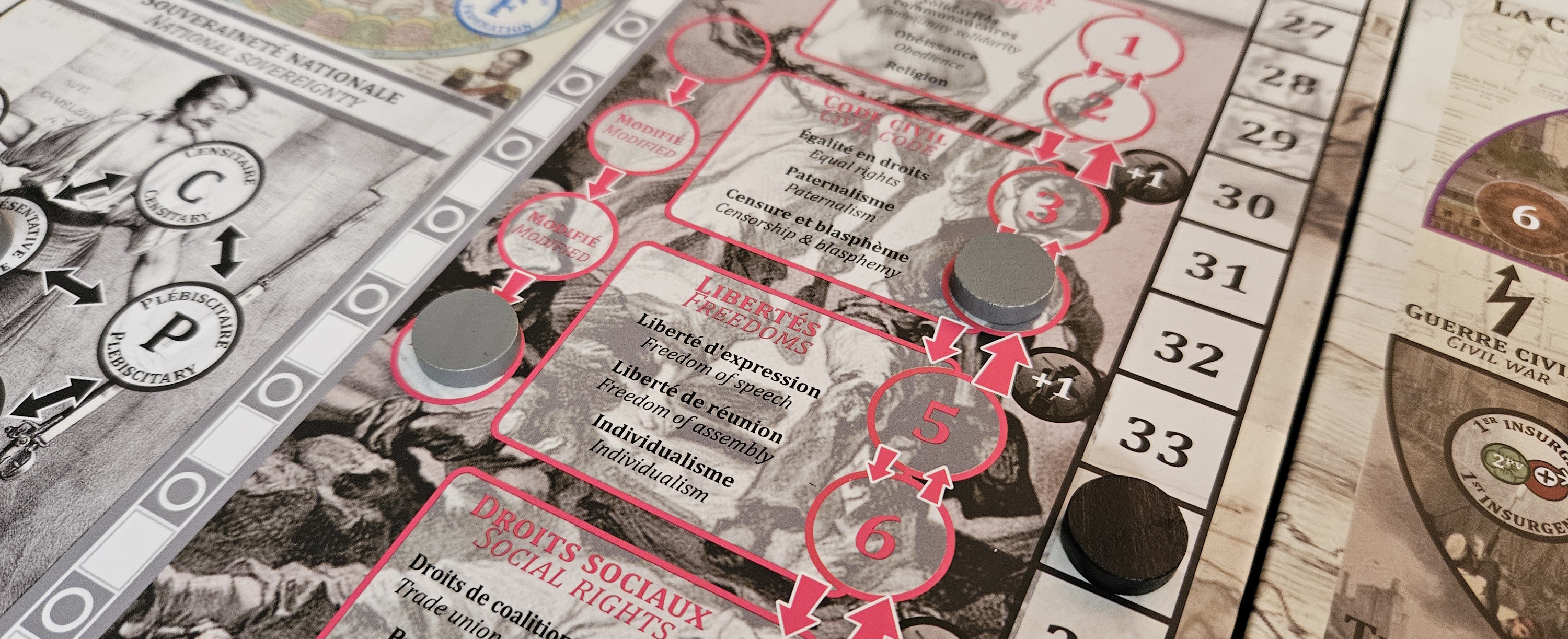
Keep pushing! Never stop pushing!
All told, Revolutions: France 1820-1880 is one of the finest examinations I’ve ever seen of a new society struggling to be born. In many ways it’s a game about not only history, but the way history is formed, the way people begin to see themselves as agents of history and authors of history, the way ideas are transmitted or obscured, the way change is enacted or smothered. It’s about the many birth pangs and postpartum twinges that accompany any transformation. Hopefully, it’s a reminder that the world can be recast into a new shape yet again.
A complimentary copy of Revolutions: France 1820-1880 was provided by the publisher.
(If what I’m doing at Space-Biff! is valuable to you in some way, please consider dropping by my Patreon campaign or Ko-fi. Right now, supporters can read the next installment in my series Talking About Games, this time tackling the topic of what makes a good list! Naturally, the piece includes a list.)
Posted on August 12, 2026, in Board Game and tagged Board Games, Fellowship of Simulations, Revolutions: France 1820-1880. Bookmark the permalink. 13 Comments.


Very intriguing, and what a unique time period to cover in a game.
It really is!
Very exciting that the game seems to have grasped so fully the movements of French society over that fascinating period of history! Thanks Dan for this review.
Thanks for reading!
I listened to the Revolutions podcast on the French Revolution, so I feel like I need to play this to cash in on all that background that I’m sure I can barely remember! Thanks for covering this – it sounds fascinating.
What’s wild is that this game covers multiple seasons of Mike Duncan’s Revolutions podcast. Season three is the 1789 Revolution, which is really background information. But then season six covers the Bourbon Restoration and the June Revolution (basically the game’s first two rounds), season seven covers the 1848 Revolution (probably happens somewhere between round two and three), and season eight covers the collapse of the Second Empire, the birth of the Third Republic, and the Paris Commune (the rest of the game in rapid-fire). It’s wild how much Rix has packed in there!
A synonym for left used to be “sinister,” so that might be the origin of your childhood assessment of politics.
Being in the USA, it looks to me a bit awkward to buy. Fellowship of Simulations’ online store lists the price only in euros, which I think translates to about $80; but Noble Knight lists the MSRP as $117 (and sets its own price at $106).
FoS’s site has some language about free shipping to Europe and North America that suggests that’s an introductory (temporary) offer.
This is the second (2025 or 2026) edition, the first apparently having been published in 2022.
The publisher’s age recommendation, I gather, is 14+, suggesting an ‘advanced’ or ‘heavy’ work; but Moaideas listed 15+ for Mini Rails, which I think is fairly reckoned as being in the ‘medium-light’ tier of most “German school” family games.
Per BGG, it’s for 3 to 5 players, with a duration of 90 to 150 minutes.
Hi Dan,
thanks for another fantastic review of a game I would have surely missed if not for you. I’ve just put down an order for it.
What happens at lower than 5 player counts? Are the other factions controlled by a bot?
And habe you tried any other games from the fellowship of simulations? Just looked at their catalogue and for example wars of religion also looks very interesting.
On a completely different note: will you ever do a redesign of your website so that it’s responsive? I am always struggling on my mobile…
Thanks for everything!
At lower player counts, certain factions get dropped entirely. Not really a problem at 4p, but I’d be concerned at 3p.
This is my first game from Fellowship of Simulations, I’m sorry to say! They also sent me Vendée 93, but I haven’t gotten it to the table yet. My two-player wargaming space has been preoccupied with The Guerrilla Generation.
As for the site… I’m sorry to hear it isn’t very responsive! Not sure what to tell you about that one. I’m not a web developer, so I wouldn’t know where to start with either redesigning the site or diagnosing why it slows down for some people but not others. If someone has an idea, I’m all ears.
We had our first play yesterday. It was fantastic. Thank you so much for the recommendation! I’ve written my thoughts here (https://franken.social/@frankie_flowers/117208278867914423) if you’re interested, but it adds nothing that you had not written better. Its a bit sad that you’re only on twitter and not mastodon 🙁 , i would love the added interaction without fascist ownership.
Responsive means that it automatically scales and changes the layout based on the screen size of the machine accessing it, so you can read and view it as well on your mobile as on a desktop computer. Depending on the theme you’re using for wordpress, there surely should be a setting but don’t bother just for me.
Good thoughts!
I’ll just note that I haven’t posted on Twitter in a long time. I’m mostly on Bluesky these days.
As for WordPress themes, the problem is that any change inevitably breaks a thousand little things elsewhere. I’ve tried in the past and the results were catastrophic. Maybe I’ll take another look. However, I don’t pay for CSS editing privileges, which makes the problem all the more intractable. I don’t make enough money from this stuff to support that sort of lavish expenditure.
Pingback: Liberation Ludology, Part Four: El Salvador | SPACE-BIFF!