Flapjacks, Magic Tricks, & Sputtering Torches
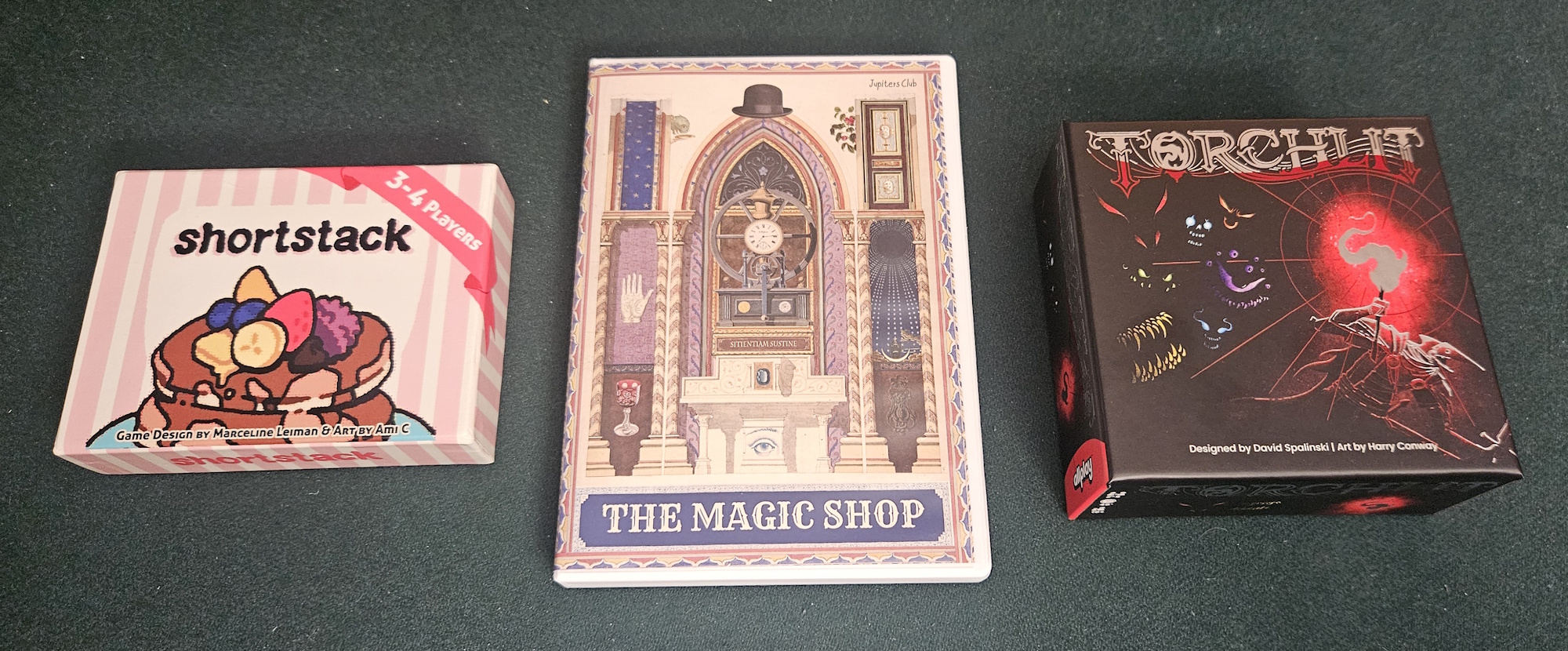
All I play anymore is trick-taking games. Fortunately, it’s an uncommonly smart genre. Today I’m covering three titles that highlight both the format’s breadth and what makes trick-taking one of tabletop’s most enduring pastimes — and one of its meanest.
In other words, these are trick-takers for jerkwads. Compliment intended.
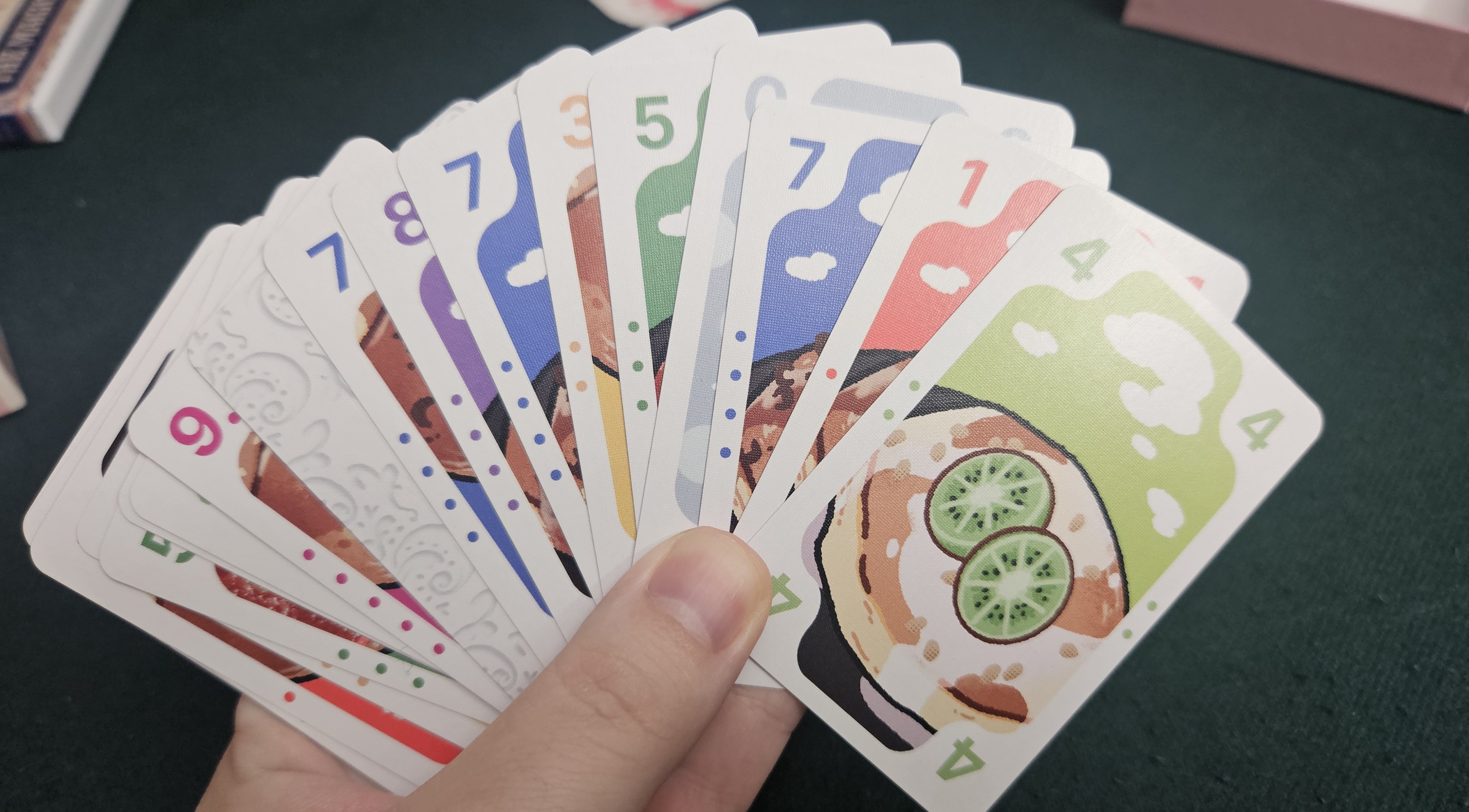
I am not gonna review eating 18 pancakes.
Shortstack
Marceline Leiman has been busy. After the success of High Tide, it seems like her designs are popping up everywhere. (Pro tip: Dino Racer has the juice.) Most recently, Shortstack has been making the rounds.
To begin, your hand is massive. Nine cards, then a “napkin” (also a card), then nine more cards. The reason for this division becomes clear right away. Rather than playing a single card, every trick is built from two separate components, one from the left side of the napkin and the other from the right. The first card’s number becomes the “suit” while the second becomes the “rank.”
Simple enough, and a wrinkle that constitutes the entire sub-genre of domino trick-takers. But two things set Shortstack apart from the pack. The first is that “perfect pancakes” — those where the rank and suit are identical — are outright winners. You’re still required to follow suit if possible, but your dichotomous hand makes it easier than usual to claim tricks at unexpected moments. This produces quite a bit of flexibility, important for claiming high-value tricks that will likely award a point at the end of the round.
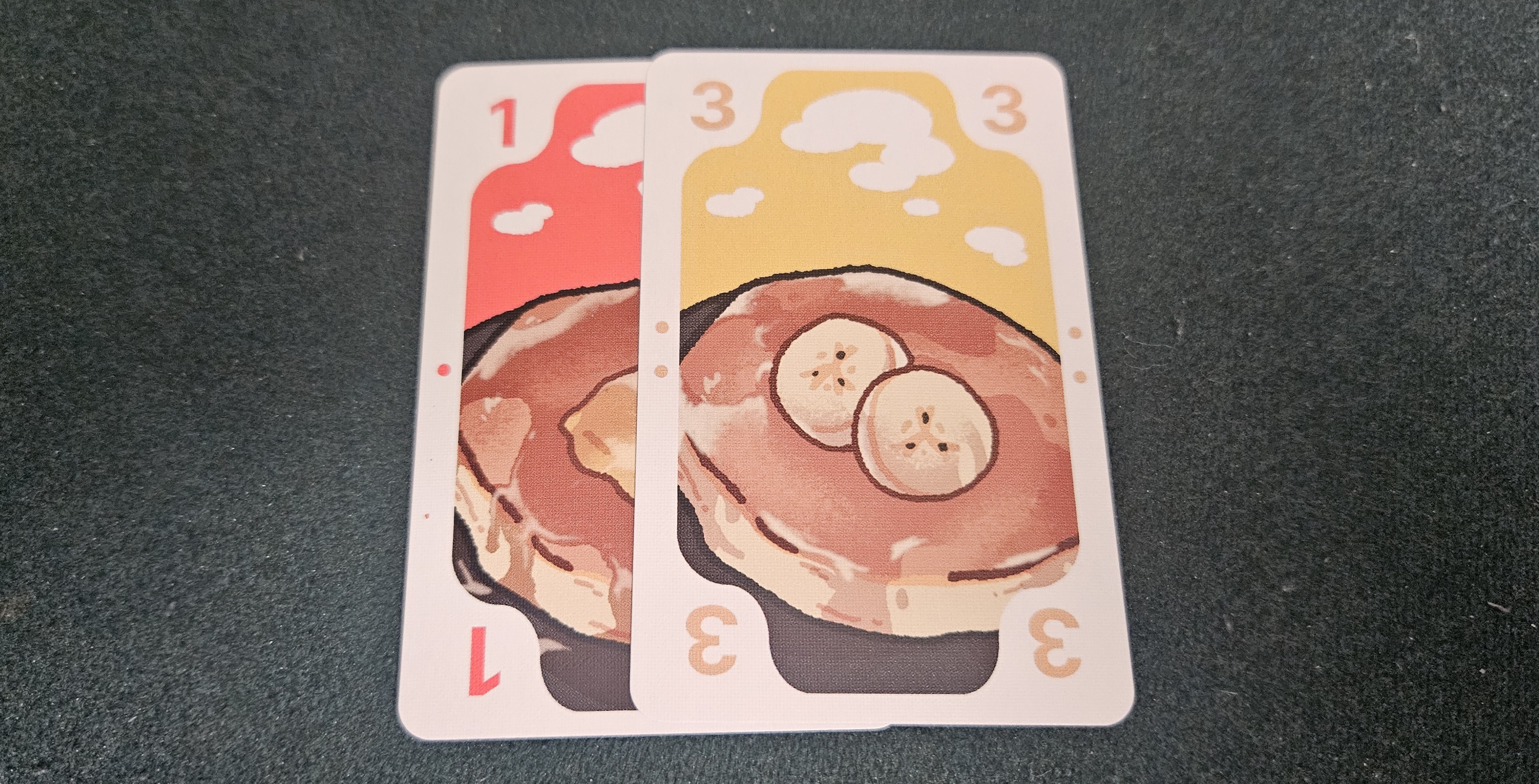
Now that’s more acceptable.
The other thing that’s different about Shortstack is even more impactful: if you eat too many pancakes, you’re gonna hurl. Leiman is too polite to actually state this outright, but we’re professional translators of subtext round these parts. If you take too many tricks, all your pancakes are “thrown out” (read: barfed), you score nothing, and everyone else at the table earns a point. Presumably because they’re laughing at your misfortune.
This alters Shortstack from straightforward into a nasty affair indeed. Your flexible hand makes it easier to claim tricks, but also offers little opportunities to nudge an opponent into chowing down on too many pancakes. It always seems like there are two or three rounds too many. While it’s technically possible, in the three-player game at least, to get through a hand without ejecting all that batter across the table, it isn’t likely.
The result isn’t my favorite short-form trick-taker; personally, I would rate this one alongside Nebular Colors, which I appreciated without wanting to come back to. But it’s still a simultaneously charming and vicious little thing. Like Marceline Leiman herself, perhaps? I couldn’t tell you. I’ve never met her. But when she keeps producing such digestible razor blades, one starts to wonder.
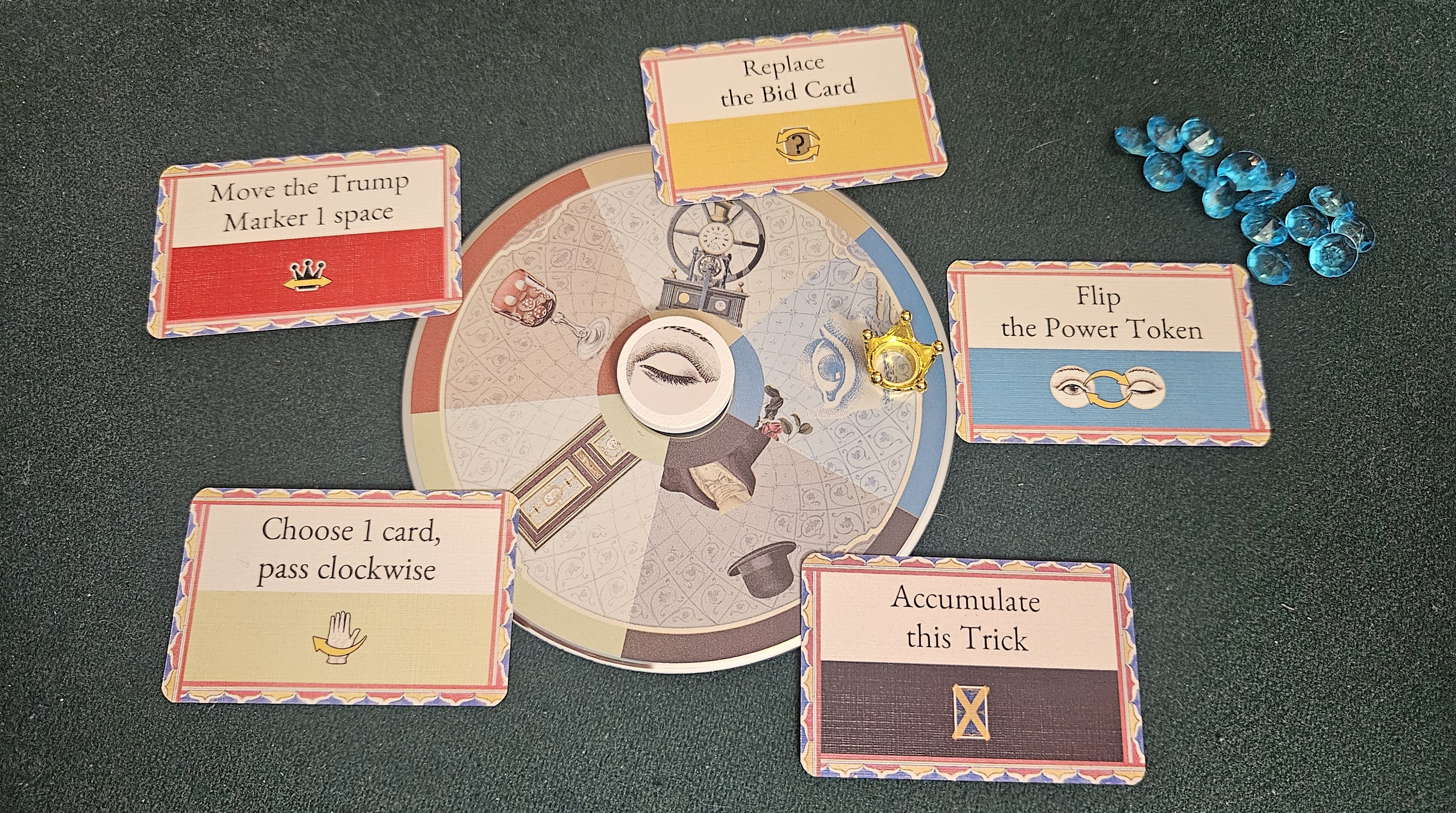
More games should use CDs as soundtracks and play surfaces.
The Magic Shop
More games should come in DVD cases with soundtracks on compact disc. Even better, those discs should double as game boards. Even bettah, those games should be adaptations of short stories from the turn of the century. And not this century. The one before that.
The Magic Shop, designed by Reader on Jupiter, calls to mind their previous title The Man Who Was Thursday not only for its packaging and soundtrack, but also its fascinating approach to adaptation. In this case, the work being reimagined is H.G. Wells’ 1903 short story “The Magic Shop,” and much like the story’s father and son, we’ve stumbled into a shop, found ourselves trapped, and must now accomplish increasingly bizarre feats of endurance and navigation in order to leave. Basically, it’s a 19th-century IKEA.
While it’s tempting to spend this entire time discussing the game as an adaptation, which is utterly delightful in its impressionism, capturing the whimsy and some measure of the story’s menace without recreating even a single narrative beat, we’re here to talk shop. For the most part, The Magic Shop’s trick-taking is relatively straightforward. You want to win tricks, but only as many as you’ve contracted. Your bid matches the rank of whatever card you devote at the start of the hand, but in a gesture of goodwill every card also allows a bid of either three or zero on its reverse side. In practice, this usually means shooting for either three tricks or none at all.
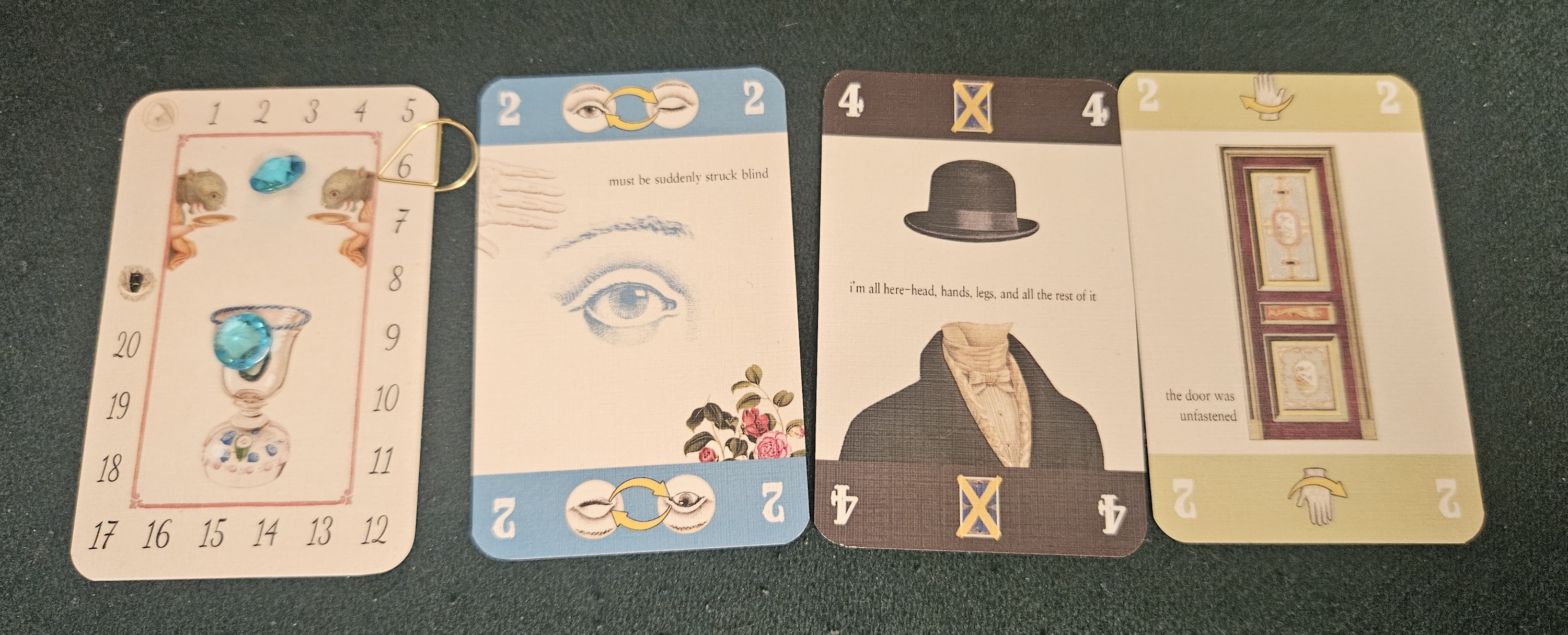
As with Thursday, everything about this game is gorgeous.
Here’s where it gets wacky. Whenever a trick is taken, the winner also gets to perform a magic trick. These are tied to the suits, which limits what the winner is permitted to cast. Furthermore, while the winner is always free to use the suit of their own card, they also have the option of using any of the cards played into the trick — but only if they take a “thirst token” that awards additional points to any rival who meets their bid for the round.
As for the actual magic tricks, these give The Magic Shop much of its flair. One of them changes the trump suit; another flips an eye token so that low ranks now outclass high ranks. Perhaps the meanest is the one that forces everybody at the table to pass a card clockwise, perfect for ruining bids. This can be ameliorated by the suit that lets you swap out your bid for another card from your hand (phew!), although this can be summarily wrecked by the one that forces the current trick to “accumulate.” This means that rather than awarding the trick, it instead sits off to the side to be claimed by whomever takes the next one. And yes, multiple accumulations can be strung together. Ever wanted to win four tricks at once? Probably not when your bid is set at three and you’ve already taken two.
You can probably already tell that The Magic Shop is a highly tactical trick-taker; its merger of exacting contracts and ongoing flux makes for quite the ride. I’m convinced it’s possible to play well, but I’ll be damned if I know how. Once again, I love what Reader on Jupiter is doing, but there’s really no separating my affection from the game’s aesthetic, approach to adaptation, and general mischief. Those who fear chaos really should avoid this one at all costs. Personally, I dig it.
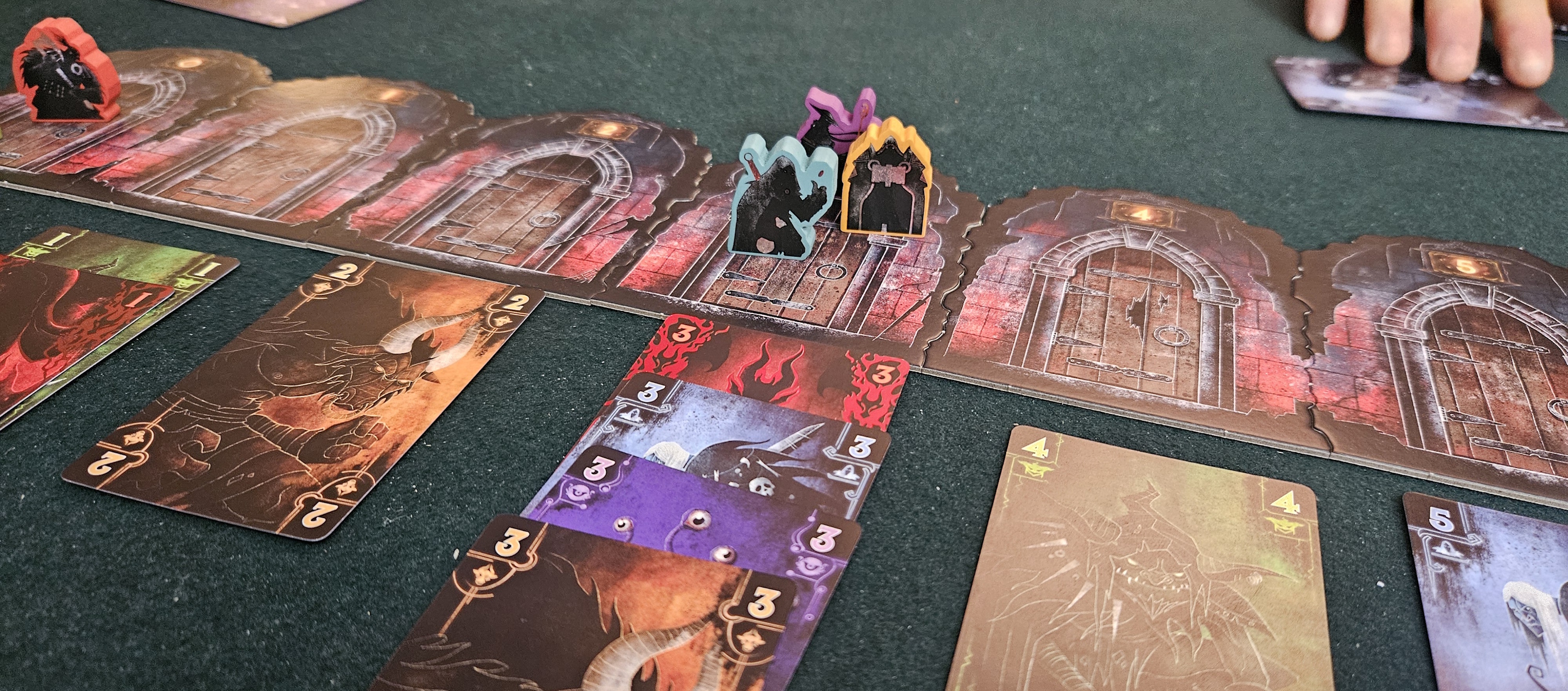
It feels like we’ve been here before…
Torchlit
Speaking of chaos, David Spalinski’s Torchlit is one of those games that first appears entirely uncontrolled. Don’t be deceived. This is a highly strategic trick-taker. It’s just that there’s room for some truly cruel plays, usually as a result of some jerk deciding you need to be taken down a peg.
Here, those jerks are adventurers. Dungeon delvers. Ruin ransackers. Your goal is to march into the current dungeon, earn some gold, and march out again. Gold mostly comes from looted corpses; at the end of the hand, every monster on your space is worth a coin. Two coins, if we’re talking about dragon cards.
Wait, there’s more. At the start of the hand, you flip one of your cards face-down. This is your torch. Yes, it’s a — say it with me — contract bid! If you wind up on your chosen room, you earn some extra money. If not, your torch is added to its designated room, where it awards any other adventurers the gold instead.
Making matters significantly harder is the way you move through the dungeon. The winner of each trick moves forward… and so does anybody whose card rank matches theirs. So while it’s possible to piggyback on a hero’s success, it’s also possible to get piggybacked. As in, hauled up on a rival adventurer’s and dragged kicking and screaming past the room you bid on. Like you’re some kinda hobbit being taken to Isengard.
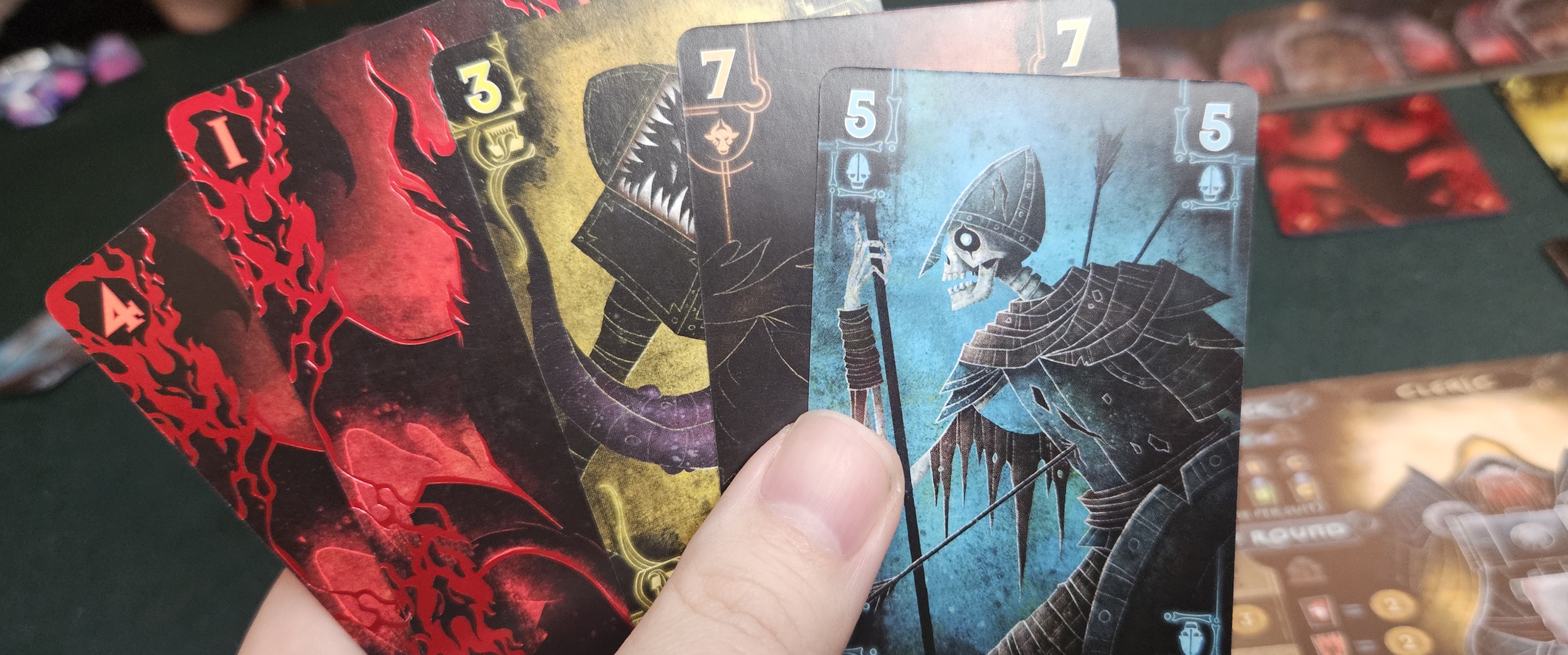
These monsters sure are sticky.
Meanwhile, the rooms are populated by monsters according to the cards that were played into the current trick, but they’re doled out by whomever deployed the lowest rank. This means there are two games going on: the death march through the dungeon as decided by the winner, but also the local cash piñatas as seeded by the loser. Unless those two happen to be the same player. Then that punk gets to decide everything. Which is entirely possible, especially if somebody sweeps a trick by winning with a low dragon card.
All told, these contrasting imperatives give Torchlit its venom-tipped fangs. When I wrote about its self-published version a while back, I argued that it was very nearly a hybrid trick-taker, as much about your position on the board as about the tricks themselves. The intervening years have only deepened that impression. Torchlit is something like a push-your-luck game, except it’s less about luck and more about dodging and/or taking advantage of your fellow dungeon divers. The new edition by Allplay is incredibly handsome, making it more widely available to those who aren’t able to gobble up the latest indie darling.
Of today’s titles, this is the strongest. Honestly, it might be one of my favorite trick-takers of the past few years. But make no mistake, it’s every bit as nasty as the others. It may not include regurgitated flapjacks or unexpected magic tricks, but there are plenty of little barbs to dig into your rivals’ plans. Between this and the similarly jerkwaddy Chasing Shadows, Spalinski is on a roll.
Complimentary copies of Shortstack, The Magic Shop, and Torchlit were provided by their designers/publishers.
(If what I’m doing at Space-Biff! is valuable to you in some way, please consider dropping by my Patreon campaign or Ko-fi. Right now, supporters can read the next installment in my series Talking About Games, this time tackling the topic of what makes a good list! Naturally, the piece includes a list.)
Posted on August 13, 2026, in Board Game and tagged Allplay, Board Games, Jupiters Club, Mossy Lane, Shortstack, The Magic Shop, Torchlit. Bookmark the permalink. 3 Comments.


I love Torchlit! Have recently revisited it in my latest blog post on Wednesday, and now I feel I need to play it again.
I love Magic Shop and Torchlit. Now I gotta try Shortstack! Seems great.
I would have loved Torchlit, but it’s a game totally dependent on the last hand without any ability to anticipate anything. Seeing all his early round efforts reduced to nothing because the leader played a 2 (like you) gives me this back taste of “all this for this?” I like the chaos of Skull King and Schadenfreude, but in a game that wants to be computational like this, it’s unwelcome. Finally, it’s totally subjective but I much preferred the previous artistic direction of the first opus printed too few.