The Man Who Was Today
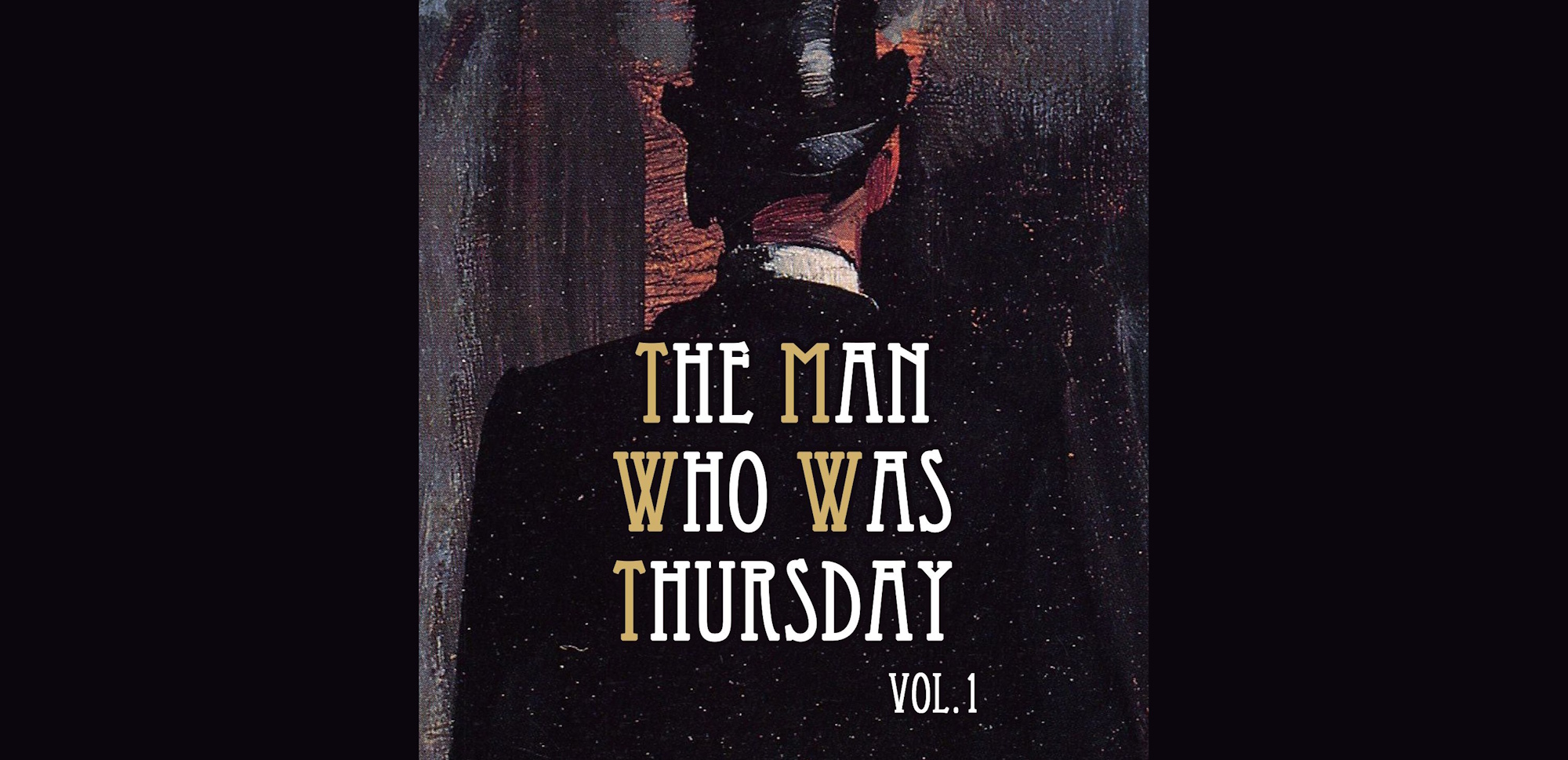
I wouldn’t go as far as to say that G.K. Chesterton’s The Man Who Was Thursday saved my life. Probably it would be more accurate to say it built my life. The novel arrived at a pivotal moment in my adolescence. I was seventeen. Dumb with hormones, dumb with culture, just plain dumb. Still deciding who I was. Who I was going to be. I found it through the unlikeliest of sources, snippets of text in the video game Deus Ex, and felt like an investigative researcher when I obtained a copy from the bookstore I haunted like a ghost that summer.
The Man Who Was Thursday is also a board game. A very unlikely board game. Created by a designer from South Korea who goes by the nom de ludens Reader on Jupiter, it arrives folded within twin DVD cases. Arrived. Past tense. It’s profoundly out of print, although its author claims there will be another use for the system sometime in the future.
Honestly, it isn’t the system I’m interested in. It’s the adaptation. This is the board game version of a book that was one of the cornerstones in building who I am today. I cannot see it impartially. Only intimately, like an old friend straining to express something important. Straining to express a revelation.
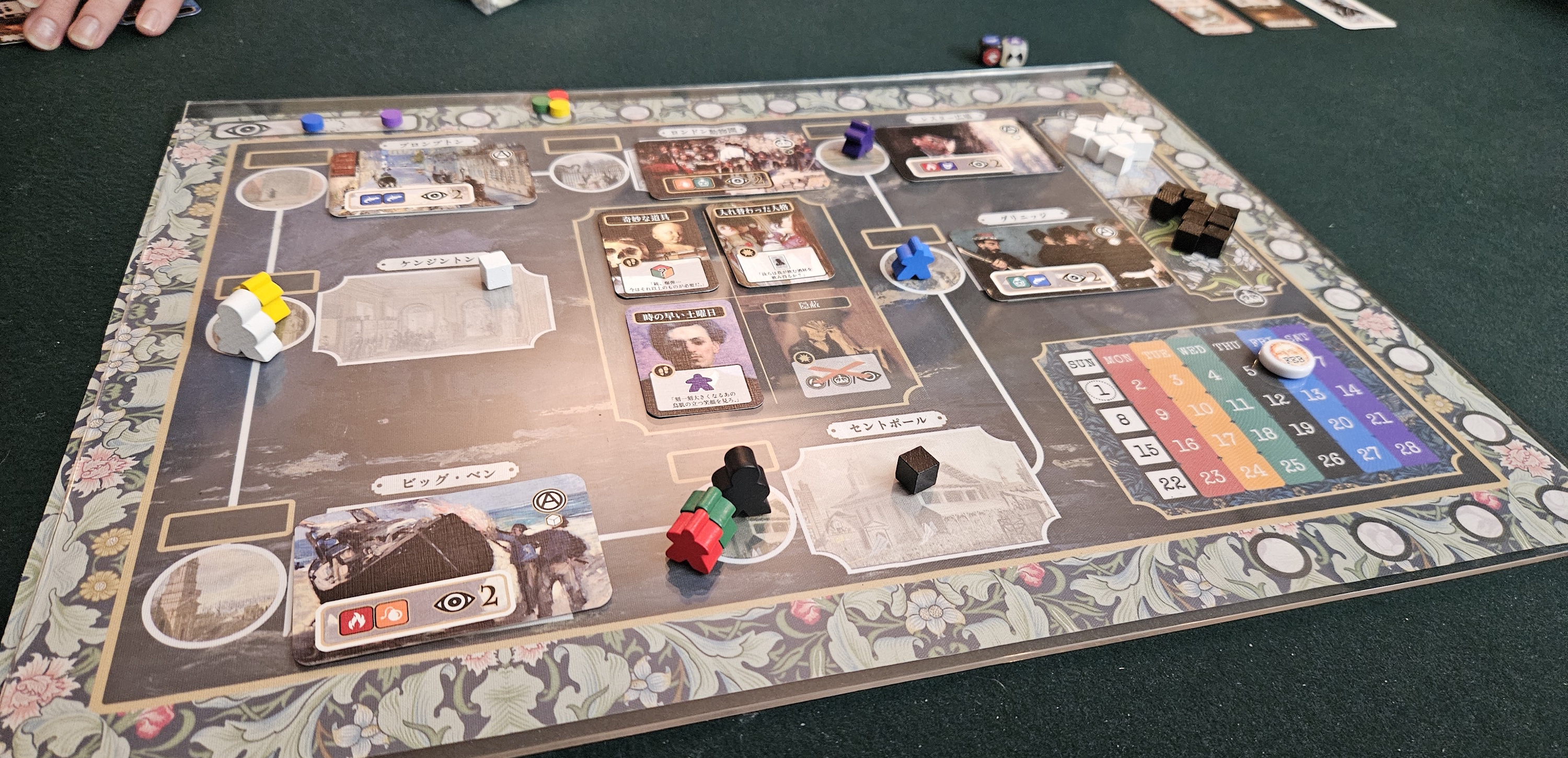
The perilous streets of Europe.
It begins with the conspiracy.
Written in 1908, when Chesterton was yet a Protestant, and in the period when anarchists and nationalists alike flung bombs at monarchs, a vocation that would soon spark the War to Begin All Wars, The Man Who Was Thursday opens with an undercover policeman, Gabriel Syme, on a quest to stop a council of bomb-throwers from completing their most daring, most damaging undertaking yet.
He is elected to the position of Thursday. That is, one of seven members of the anarchist committee. The committee is headed by Sunday, a monstrous, massive presence who seems unbeatable at every turn. Syme is initially shown as dashing and clever, worming his way into the anarchist committee through poetic debates, mistimed oaths of secrecy, and inflamed speeches. Seated before Sunday, he is transformed into a sweating plaything, certain that the anarchist of anarchists sees straight through him.
It’s a tale of isolation, at least in part. Thursday is one of those stories that reflects the eye of the reader. Some have argued that it’s the antecedent for the coming storm of espionage thrillers. The critic Adam Gopnik argued that it was the turning point between the earlier nonsense fantasies of Lewis Carroll and Edwin Lear and the latter horror fantasies of Franz Kafka and Jorge Luis Borges, the moment when the fever dream grew truly nightmarish. More than one theological treatise has argued that it’s a retelling of the Book of Job, with its senseless morality. It’s easy to see why. The world of Thursday is broken, pessimistic, heavy with suffering.
And at its heart is a man who doesn’t see a path through to the end. Or, in my case, its heart is a teenager on the verge of adulthood, flirtatious with fascism but honestly too sensitive for jackboots, with an ear for the numinous but too questing to be considered faithful, and only barely smart enough to know he doesn’t know a single damn thing worth knowing.
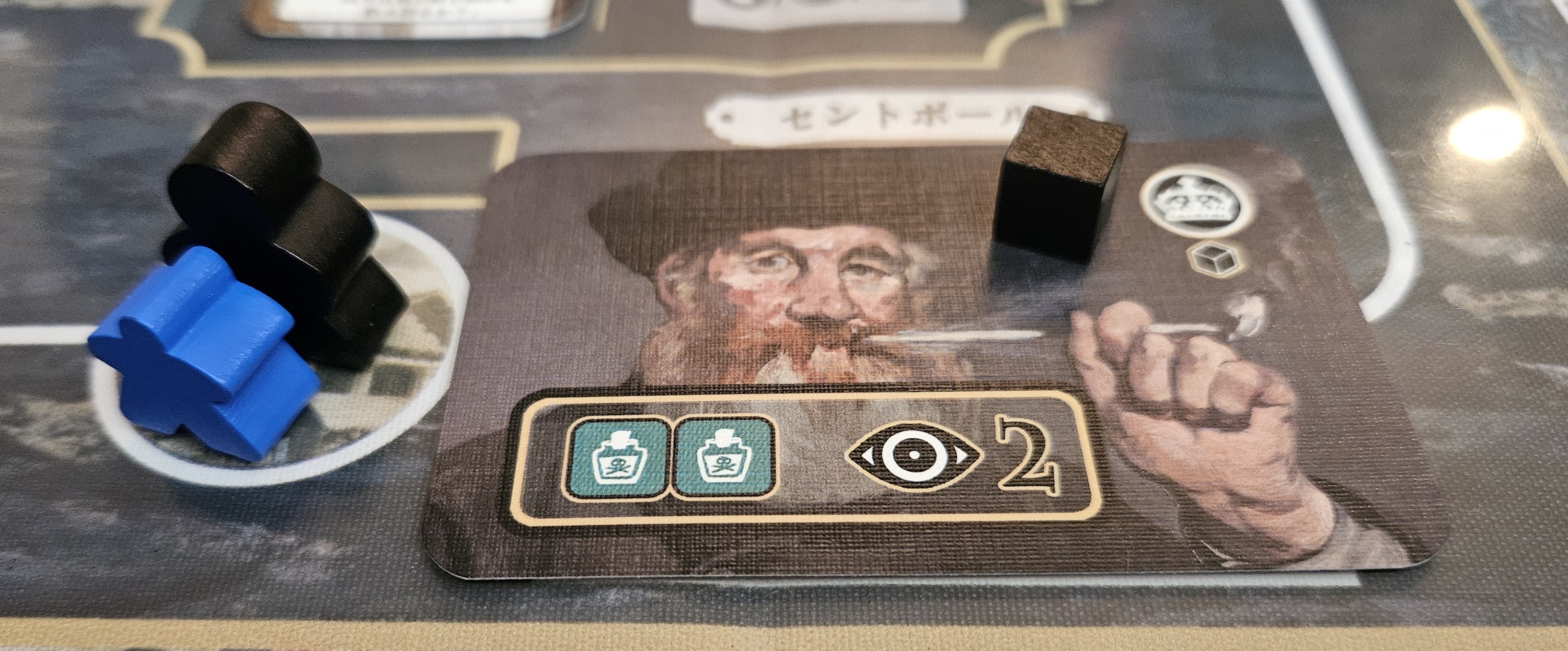
For the good of humankind, we’re gonna poison this guy.
Adaptation is one the most difficult arts of all. Partly because, when done well, it will be invisible.
Thursday the board game adapts Thursday the novel by thrusting players into a tangle that they can only vaguely see the outlines of. Everyone is a member of the Council of Days with a double identity. The first of those identities is visible, an objective to fill the spaces of the board with some number or color of cubes. Perhaps you’ll be tasked with placing a bunch of anarchist cubes, or entrusted to make sure there are more police cubes than anarchists in as many spaces as possible, or even instructed to sow chaos by commingling white and black across the entire board.
Your second identity, however, is concealed. This is your position on the Council of Days. Perhaps you’ll be purple, Saturday, or red, Monday. The only options barred to you are Sunday, the avatar of anarchy, and Thursday, representing the police.
These dual identities are never far from mind, tied as they are to the game’s victory conditions. Your first goal is accomplished by undertaking missions that add cubes to the board. But your second, that of your hidden identity, requires you to steer clear of those same missions lest you fall under suspicion. This functions as a tiebreaker, but ties are common enough that your relative standing can never be neglected, causing players to go out of their way to keep their player token clear of any major plots.
This is made doubly challenging by the fact that you never command your avatar directly. Instead, your current token is determined by a calendar that shifts forward in response to everybody’s moves. You’re Monday, but today is Wednesday, so rather than moving your red piece, you’re given control of green. Along the way, you pick up Friday (blue) to fling a bomb at some minister, causing green and blue to gain suspicion, but also leading everybody at the table to suspect that your real identity is tied to neither of those colors. The calendar ticks forward three days because you moved three spaces. The next player glares at you because it seems like they’re always moving Saturday.
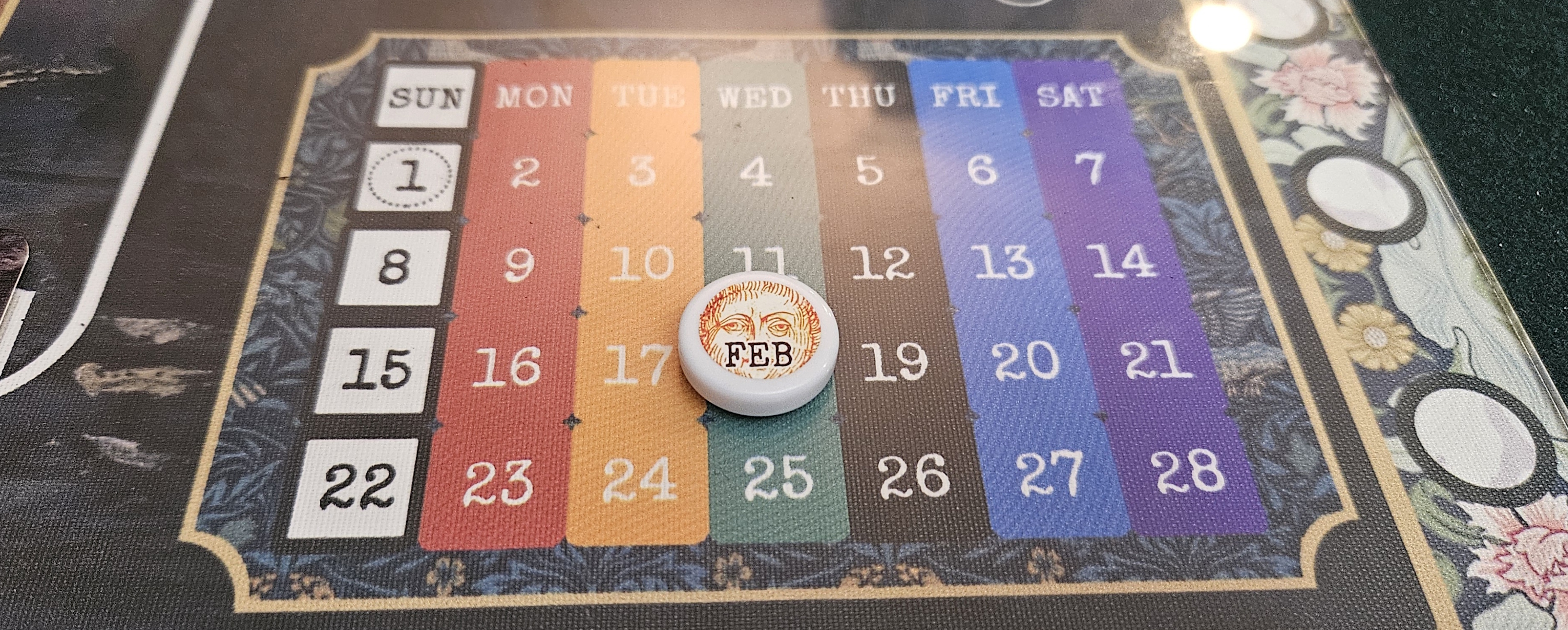
The timekeeping calendar is lovely.
Out of the corner of my eye, I can regard the game with some sliver of critical impartiality. There are flaws here. Missions are accomplished through a combination of dice faces and token colors. Theoretically, this forces players to make do with what they’re given, some combination of whichever color the calendar has assigned them this turn, the colleague they pick up en route to their mission, and any dice results and/or bonuses they have handy. But missions are too easy to complete, rendering entire portions of the design vestigial. There’s an option, for instance, to lay low rather than to complete a mission, cooling off some suspicion or tweaking the position of previously placed cubes. But this is rare, an outside exception, especially the first few times the game hits the table.
Similarly, the objectives struggle to find their balance. Some, like the one that sees you filling spaces with the maximum three cubes, are far easier than those that pit anarchy and the police against one another. With some experience, the gameplay opens up. You learn how to speed up the calendar when you’re ahead, or use the bigger Sunday and Thursday tokens to alter the outcome of a mission, or take advantage of the game’s many special abilities to alter the game from its icon-matching core into more of an area control contest. The Man Who Was Thursday can be played well, can overcome certain of its limitations. But even at its best, it remains a flawed system.
As an adaptation, it fares better. There’s still an incompleteness to the presentation here, as one might expect of a board game, which by its nature presents a snapshot rather than a definite narrative arc. This is, in a sense, the middle act of Thursday, the conspiracy of isolated individuals, after Syme’s infiltration but before the absurdities begin to overwhelm the tale. I’m reluctant to spoil any details, itself something of an absurdity for a novel that’s nearly 120 years old, but… well, that’s on you. Sorry. You’ve had your entire life to read it.
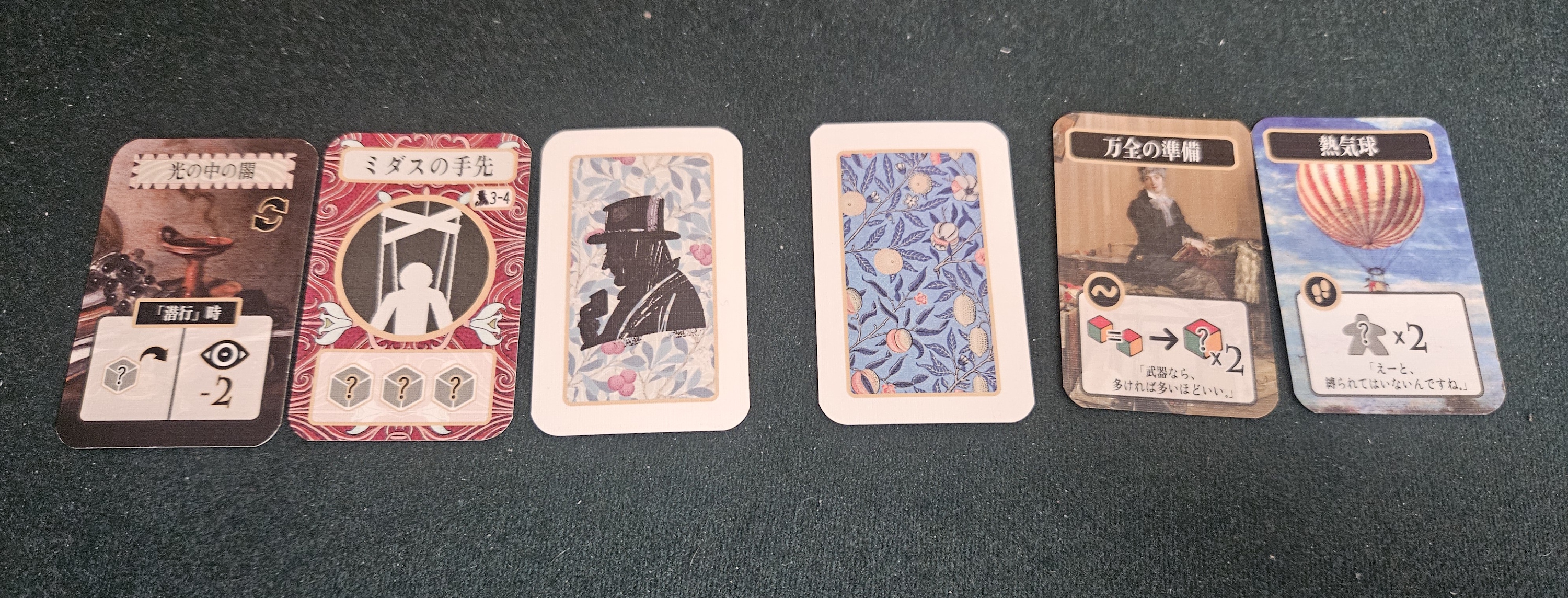
The question of your identity is always under investigation.
The novel gradually transforms, shedding its guise as a political spy thriller. For a time it becomes a meditation on isolation and the power of companionship, with Syme discovering that the various members of the Council of Days are all undercover policemen like himself who have been set against one another. In its final chapters, it shifts into the cosmic realm of Job’s behemoth and whirlwind, Sunday fleeing atop an elephant, then via hot air balloon. When the conspirators at last corner the anarchist of anarchists — a state of affairs that sees him at the height of his power, not laid low as one might presume — they grill him. Why have they suffered so much? Why must everything on earth contend against every other thing? Why does even God hide His face?
This is when Syme, at the moment of theophany, understands. The suffering is also the justification for its own existence. If only the wicked suffered, then their complaint against God would be correct in labeling Him a tyrant. It’s only in the wildness of suffering, in its untamed nature, in the way the lion might gaze lazily at you or consume you, in how every living thing is pressed into service as an anarchist, that true goodness becomes possible.
Do I buy it? Eh. About as much as I buy any explanation for why we suffer. Okay, that isn’t true. I buy it more than any prosperity gospel. But I bought it as a teenager. I bought it, and decided that we were indeed heroes disguised as anarchists, everyone alone, everybody hurting, and that, as Chesterton wrote, the best we could do was to try to find the people who were hidden like us and make allies of them. In his words, “There are no words to express the abyss between isolation and having one ally. It may be conceded to the mathematician that four is twice two. But two is not twice one; two is two thousand times one.”
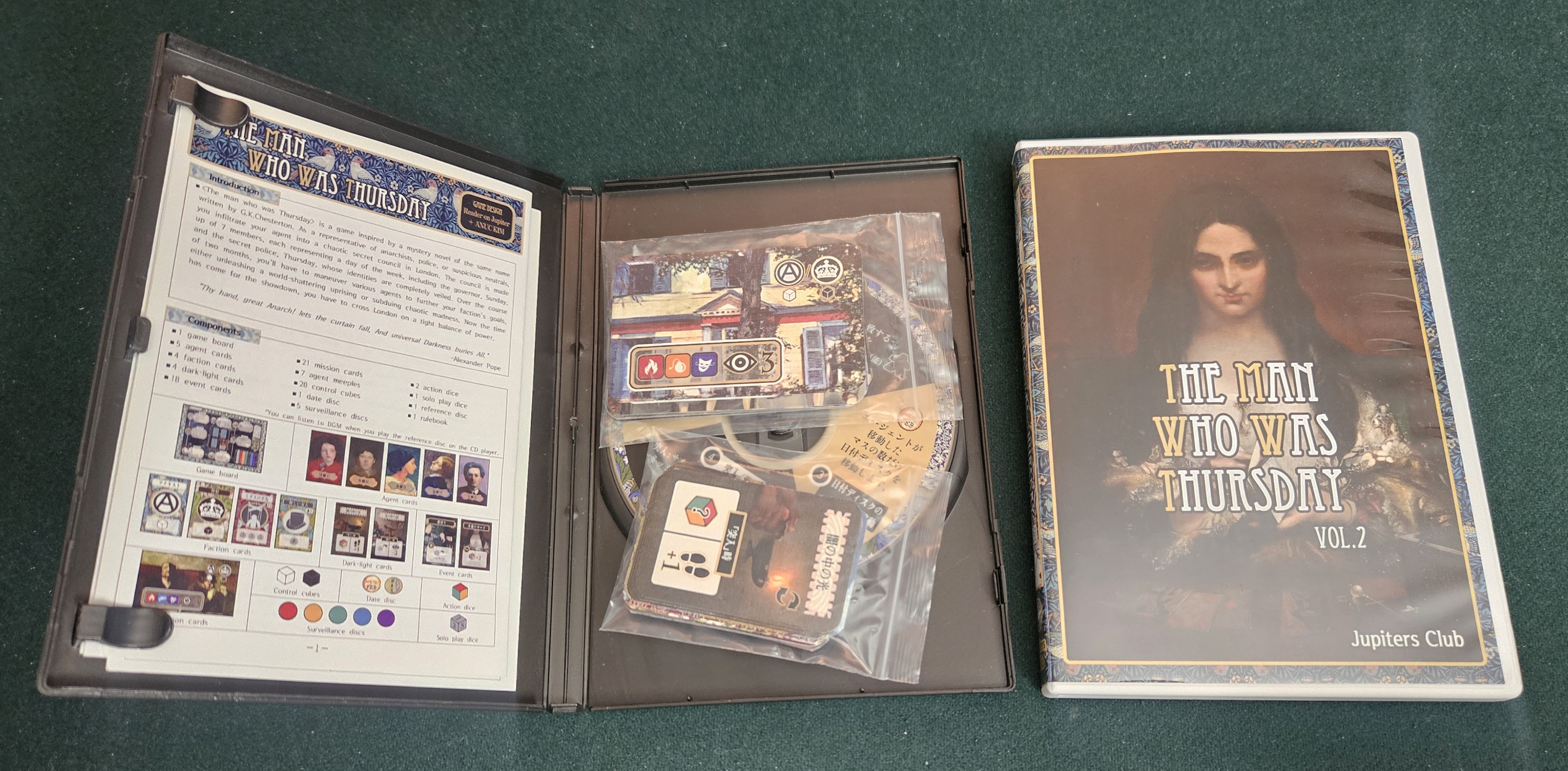
What a strange, wonderful artifact this is.
This version of Thursday doesn’t arrive at that final confrontation. It remains quagmired in the issue of concealed identity. It’s entirely possible, even likely, that players won’t know one another’s color until they arrive at the game’s conclusion.
But it succeeds in its own confrontation, that moment when everyone’s identity is revealed and any ties are broken. This parting of the curtain is a delight, all the preceding machinations suddenly laid bare. And, by extension, it succeeds in the small moments of relief it provides. When someone at the table eases the suspicion cast on your pawn. When a fellow trailing player collaborates to break someone’s winning state. When at last the game is tallied and packed away and we return again to the table, free of the magic circle, no longer strangers, once again friends.
A complimentary copy of The Man Who Was Thursday was provided by the designer/publisher.
(If what I’m doing at Space-Biff! is valuable to you in some way, please consider dropping by my Patreon campaign or Ko-fi. Right now, supporters can read the next installment in my series Talking About Games, this time tackling the topic of what makes a good list! Naturally, the piece includes a list.)
Posted on June 11, 2026, in Board Game and tagged Board Games, Jupiters Club, The Man Who Was Thursday. Bookmark the permalink. 18 Comments.


The novel The Man Who Was Thursday was highly formative for me growing up, too, and Chesterton remains so. What an audacious adaptation! Thanks for this tantalizing review, Dan. Yes, when it comes to the isolated finding allies, two is indeed two thousand times one…
Thanks for reading, Alf! I’m completely unsurprised to learn that you’re a fellow Thursday fanboy.
Gavrilo Princip was not an anarchist, but a Bosnian nationalist.
(My father wrote a thesis on the subject, but turned down a job offer from the CIA and instead went on to seminary.)
Of course you are right! I was confused for a second, because that’s one of those details I definitely know, but yeah, I wrote that in the dumbest possible manner. I’ll clarify. Thank you, sincerely, for pointing out my brain-fart!
I too was fascinated by TMWWT as an adolescent, though maybe not to such an extent, intrigued by the intrigue and enthused yet baffled by the growing bizarreness of the narrative. It is a profound book, not because it understands but because it expresses something of the abyssal magnitude, opacity, and depth of the human condition… But I never fathomed it with as much clarity as you show in your review, and I’m glad there are other books to read as well!
Me too!
So I’ve been going through Chesterton’s works right now, or at least his essay collections on Project Gutenberg. I devoured Orthodoxy/Heresy when I was in college. The Ball and the Cross stuck with me when I read it a while back. I remember reading The Man Who was Thursday and thinking a) it was on to something and b)it was a fever dream. So to see a board game of this makes me feel both respect for the audacity, but also baffled. Like the core idea makes sense as a game concept, but also it seems a disservice to the book to divorce it from the rest of the themes, as well as the fact the rest of the guys eventually team up.
I am very pleased to discover that the book is available in the Kindle store for 51 cents – or 99 cents for the illustrated centennial edition. Looks like I found my next fiction read.
If you read it, I would love to know what you think!
There’s also a version that’s free on Audible if you’re a member. So, I’ll attempt a listen soon, tho I suspect it may be a bit too byzantine to follow with just my ear and not my eye.
It shouldn’t be too tough to follow! I recall the writing being relatively straightforward, if also quite pleasant on the eye.
I love all things Chesterton, hopefully someone makes a game out of The Napoleon of Notting Hill.
It could be you!
How did you manage to get your hands on a game that was only available between 2023-2024? Where’d you get a copy?
I reached out to the designer, who was so kind as to send me a copy. They’re apparently a reader!
“An ear for the numinous, but too questing to be considered faithful” is a spectacular line. Really excellent, and not solely because it begs the reader to identify that quality within themselves.
Thanks for the kind words!
Pingback: Flapjacks, Magic Tricks, & Sputtering Torches | SPACE-BIFF!