Best Week 2016, Overlooked!

Like the slow release of a long-held breath, Best Week 2016 has begun. For the vast majority of the internet, this is old news, to be expected, and all’s well now that it has arrived. For the rest of you, the first-timers and late-goers, we welcome you to the most objective, least biased, most correct of any Best List in the history of this year. Five days, 40 games, only the best.
Today we celebrate the games you probably didn’t play — only worse, you probably didn’t even hear about them. These are the short geniuses in a tall crowd, the unsung heroes in a battle of choirs, the board games with insufficiently-staffed public relations departments.
Big vs. Small

The greatest programmed movement games are nearly always the ones that go all-in on their own eccentricities, mitigating the frustration of planning out everything in advance by casting themselves as exercises in silliness. In Space Alert, that means your star-charting astronauts are afflicted by the space-bends or mere panic; if they should stumble down the wrong corridor or slam the incorrect button when the klaxons are blaring in their ears, who’s going to blame them? In The Dragon & Flagon, your adventurers are blind drunk after a tough dungeon run, so a swing’n’miss is the expected order of things. And the train-robbery-gone-wrong of Colt Express is at its best when the train thunders into a tunnel and your banditos resort to slugging blindly at whomever happens to be standing nearby.
The point is, these games work best when things are going south. Since roughly half of a player’s time in a programmed movement game will be spent screwing up, why not make screwing up the best part? This is gaming as a gag reel. It must be about spinning in circles, wrestling for control, failing to get anything done. Success must be a revelation, as grounded in chance as in anything else. And above all else, your game must be funny.
Fortunately, Mechs vs. Minions understands this principle down in the marrow of its bones.
The Space-Biff! Space-Cast! Episode #7: Welcome to the Sandbox
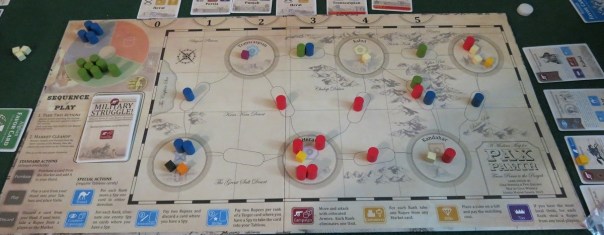
For the first time ever, the Space-Biff! Space-Cast! is all about Dan Thurot’s uncertainty about Cole Wehrle’s paternity, the definitions of sandbox games, as well as a number of Great Games, from Pax Pamir to Pax Renaissance and An Infamous Traffic. Great Games: in these hands alone, that’s a pun intended only for the cleverest of humans. Perhaps you’re among them. Perhaps.
Schwarze Kapelle
“There remains an experience of incomparable value. We have for once learned to see the great events of world history from below, from the perspective of the outcasts, the suspects, the maltreated — in short, from the perspective of those who suffer. Mere waiting and looking on is not Christian behavior. Christians are called to compassion and to action.”
_____—Dietrich Bonhoeffer, 1906-1945, Letters and Papers from Prison
Black Orchestra is one of those rare games that revels in the hopelessness of its situation. Wallows in it, more like. As one of the conspirators bent on overthrowing Adolf Hitler — whether you’re a civilian businessman or politician, Abwehr or Wehrmacht officer — your chances are, as was the case in the real-life Schwarze Kapelle, nearly hopeless. It’s less an exercise in excitement and explosions, and more a game of waiting, of chewing your fingernails until they’re raw, of walking the line between playing it cool under pressure and taking foolhardy risks the instant an opening presents itself.
By way of example, let me tell you about three plots to assassinate Hitler.
Here I Stand II: Renaissance Gone Wild
![In Old French, "Renaissance" translates roughly into "before [they] knew to look straight at the camera."](https://spacebiff.com/wp-content/uploads/2016/12/1-header-renaissance-which-is-kind-of-a-big-deal.jpg?w=604&h=240 "In Old French, \"Renaissance\" translates roughly into \"before [they] knew to look straight at the camera.\"")
Let’s say you’re making a game about the Renaissance. Not merely a slice of it. Not patronage of the arts, the rise of science, Florentine or Venetian city councils, Reformation and Counter-Reformation, trade routes and the tension between East and West, or the exploration of the New World. I mean all of it. The entire thing. The whole loaded ball of wax. Where do you start? Where do you finish? Perhaps most importantly, who are you, the player?
Pax Renaissance is a game with aspirations no less grand than capturing the entire ideological struggle of the Renaissance, the churn of ideas about religion, state, art, science, law, and every other little thing that produced Western culture as we now see it. Which isn’t actually all that surprising, given its pedigree. Both Pax Porfiriana and Pax Pamir were ambitious games as well, functioning as statements and simulations and playthings with equal mettle. This is the broadest topic yet for the Pax series, however, and it wouldn’t be hard to imagine the entire thing going up in flames as surely as Girolamo Savonarola’s attempt at governing Florence.
And yet, while Pax Renaissance is forced to make a few compromises in service of its gameplay, the final result is nothing short of a triumph.
New Ecuador
I think maybe the reason the Android universe of Netrunner and Infiltration functions so well as a setting is because it’s pretty much just a dim mirror of ourselves. Strip away the last few filaments of privacy, make corporations even more faceless, empower hackers to be even weirder and more frightening, and there you have it: the future. The space elevators and robots hardly even register.
Then again, my day-to-day doesn’t include negotiating with people who might want to foster deadly diseases in the beachside district in order to up their bottom line with their shareholders. More’s the pity. Hopefully we catch up to the future sooner rather than later.
The Great Eight?

It’s simultaneously a delight and a bit jarring to see one of Todd Sanders’ games in an actual published box. A delight because Todd Sanders has been one of the most prolific creators of print-and-play games over the last few years, nearly all of them provided free of charge for anyone with a printer and some scissors to slap together and enjoy, and it’s great to see him receiving the recognition he deserves. As always, his designs are crisp and unique, conveying a sense of place with a sort of carefree ease. That goes for both the gameplay and the visuals.
And the jarring part? Well, because the title LudiCreations chose to publish was what you might call a “lesser” Sanders, a perhaps too-simple game called They Who Were 8 that doesn’t quite live up to the bulk of Todd’s work.
Stuck in An Infamous Traffic

Every time I’ve taught a group of friends how to play An Infamous Traffic, Cole Wehrle’s sophomore design and a sort of thematic follow-up to his astounding Pax Pamir, we reach a point where someone lets a nervous chuckle slip out. After explaining our role as British opium sellers, forcing our product on a nation whose authorities would very much rather we leave them alone, I begin describing the game’s take on supply and demand. We’re the supply, crates of dried poppy latex from India bumping around the holds of our ships. And the demand? Well, we’re that too. By inserting smugglers and missionaries into the workings of the Qing Dynasty, we spread the word and create an enthusiastic population of buyers.
It’s the missionaries that do it. Where I live in the heart of Zion — Mormon country to outsiders — a large quantity of young men and women serve eighteen-month to two-year church missions. For the most part, these are well-meaning acts of service and devotion. Those obnoxious pairs who knock on your door and smile a little too wide? That’s them. They’re also the ones mending fences, working in care centers, and going caroling in August. To that service-oriented mindset, the idea of peddling an addictive substance — other than the opiate of the masses, depending on your perspective on the matter — is nothing short of appalling.
An Infamous Traffic is a game with a lot on its mind. And one of those things is that certain trades pollute everything they touch, no matter how well-intentioned the people engaged in it.
Scrolls Have Never Looked More Obsolete
Whether it was the first-century legend of Si-Osire saving Egypt from an Ethiopian magician or Ajani Goldmane whomping on Jace Beleren (confession: I had to look up those last two names), wizards with twenty hit points have been throwing down since hit points were wearing cloth diapers. And so it shall be again and forever, all this has happened before and will happen again, the wheel has turned once more, et cetera.
In some ways, Codex is no different. Sure, victory means razing the enemy base rather than pummeling a wizard, but one only has to spend about five minutes in its presence before realizing that this is yet another take on those irascible Dueling Wizards. That’s five minutes if you’re a bit slow. Everyone else will note the similarities in under forty seconds.
And yet, Codex is one of the most wonderfully slick games I’ve played all year. Nothing about it is strictly new, but every last brass button has been polished to perfection. And in this case, it’s all about tempo. Tempo, tempo, tempo. Say it until it means nothing. Only then will it mean anything again. Tempo.
The Space-Biff! Space-Cast! Episode #6: Vast Asymmetries

In the November 2016 episode of the Space-Biff! Space-Cast!, join Dan Thurot and Brock Poulsen in a discussion about asymmetry in games, fluctuating mic levels, and Vast: The Crystal Caverns with the game’s developer and producer, Patrick Leder!
As a sidenote, Vast: The Crystal Caverns is currently on Kickstarter for its second printing, and will fund until December 18th. You can find all the details over here.

 SPACE-BIFF!