Forget the Flippers
It wouldn’t be an exaggeration to call Steven Aramini one of our hobby’s finest designers of small-format board games. Whether we’re talking about microgames like Sprawlopolis and Ancient Realm, or Fliptown, still perhaps the finest flip-and-write game ever designed, Aramini has a keen talent for compressing big ideas into small packages.
Flip Voyage, then, is his followup to Fliptown by way of Nemo’s War — although in a rare Aramini miss, this one surfaced too quickly and contracted the bends.
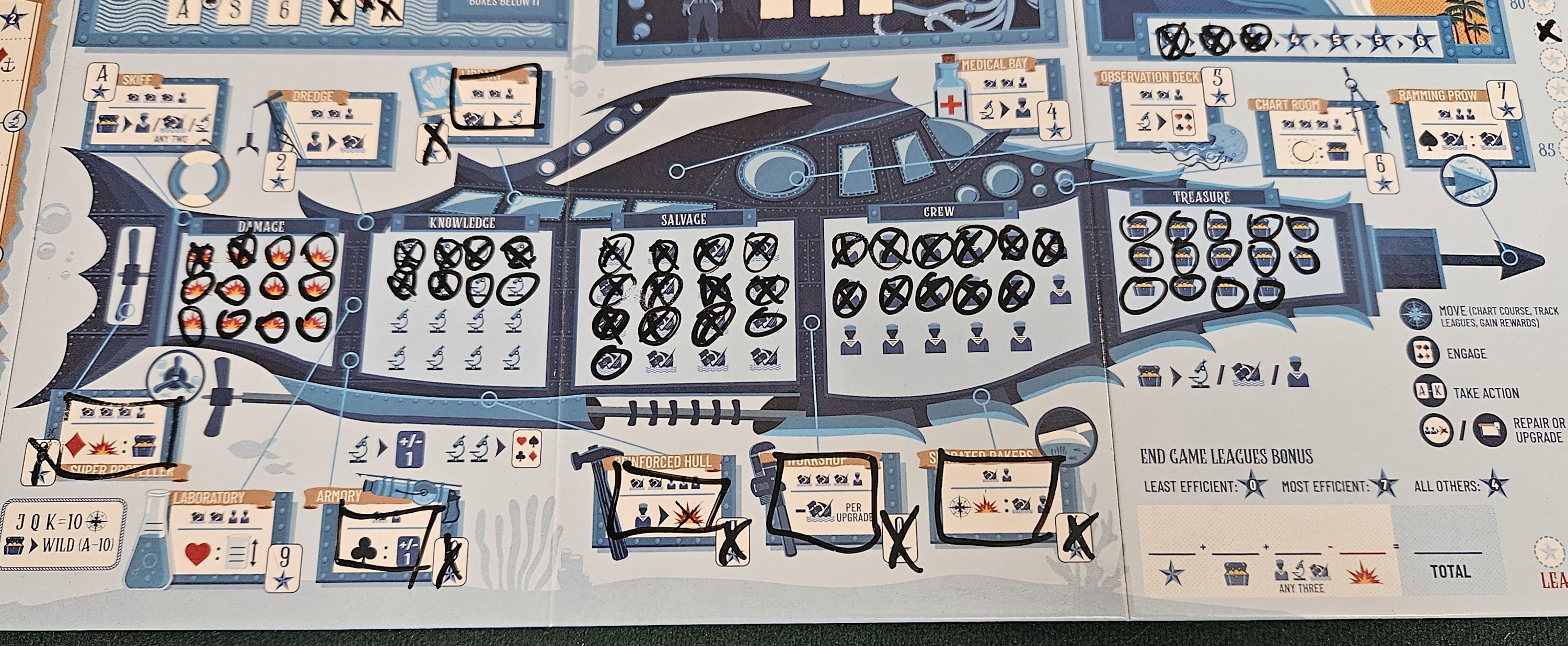
We all live on an ordinary blue submarine.
If you’ve played Fliptown, the basic conceit behind Flip Voyage will be familiar, if perhaps also baffling in its pared-down nature. Like that game, Flip Voyage is a combo-heavy flip-and-write that sees everybody at the table — whether one player or fifty, with the box providing enough dry-erase boards for four — turning three cards at a time from an ordinary deck of playing cards. Everyone uses that trio according to their own individual goals and position, and then, after awkwardly signaling to one another that they’re done, moves onto the next set. For our signal, my group has taken to sticking up a thumb. That or asking Geoff whether he’s wrapped up his turn, because eighty percent of the time he’s the last one anyway.
In Fliptown, the template was straightforward enough, while still offering a range of options. You would choose one card for its suit, to indicate which of four activities your cowboy would undertake that turn. Another card offered up its rank, setting the strength and/or destination for that activity. The final card became part of a poker hand, an ongoing bid to earn extra points and cash at the conclusion of five flips. Since everybody knows poker hands, from movies if not from personal experience, the relative value of each splay was given an intuitive value.
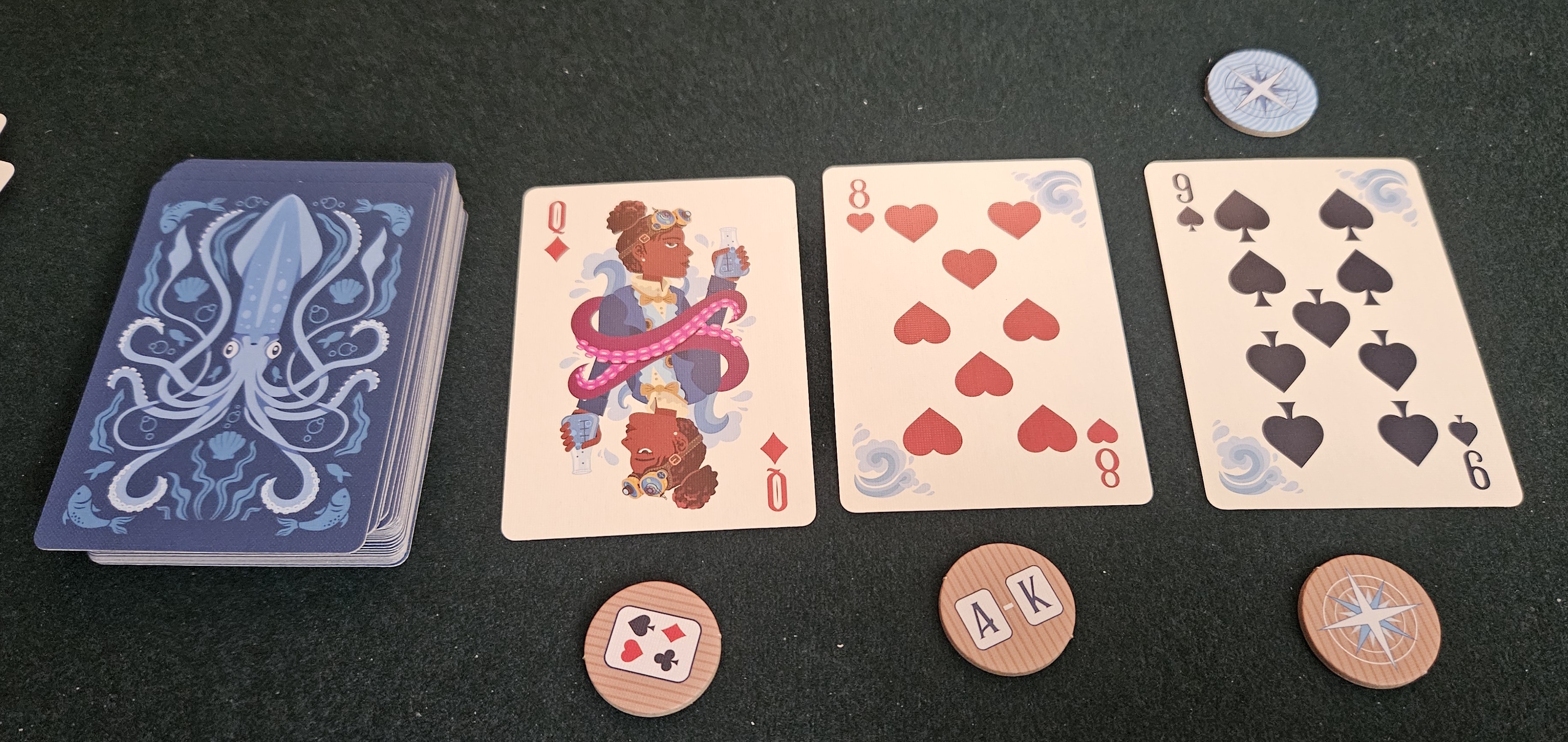
Three cards are revealed at a time. How will you use them?
This time around, the value of any given card is more wishy-washy.
For one thing, there are no poker hands. That’s fine. Fliptown was a cowboy game. Per contractual obligation, every cowboy game must feature poker. Flip Voyage, though, is about journeying under the sea in a submarine based on Captain Nemo’s / Jules Verne’s Nautilus, undertaking such anti-colonial activities as sinking imperial vessels and liberating captives from slaver camps.
As such, while two of each round’s three cards are spent undertaking those activities, that final card is instead used to travel across a simple grid map. These journeys are both critical, setting the tone for each trio of cards, and somewhat disappointing in their straightforwardness. Certain spaces award stars — points, basically, here called “notoriety” — while others incur damage to your vessel. Various lines can be crossed to earn resources, and there are ports where weighing anchor earns you a free action in one of the game’s four suits.
The gist is that you take your chosen card’s rank and travel that many spaces, generally steering across stars, avoiding damage, and ensuring you halt in a spot that will permit one of those free actions. Meanwhile, criss-crossing the map is a surefire way to earn extra resources, but you’re also lightly incentivized to keep your journey pacey thanks to a “most efficient” award doled out at the end of the session. Coal is expensive, I suppose.
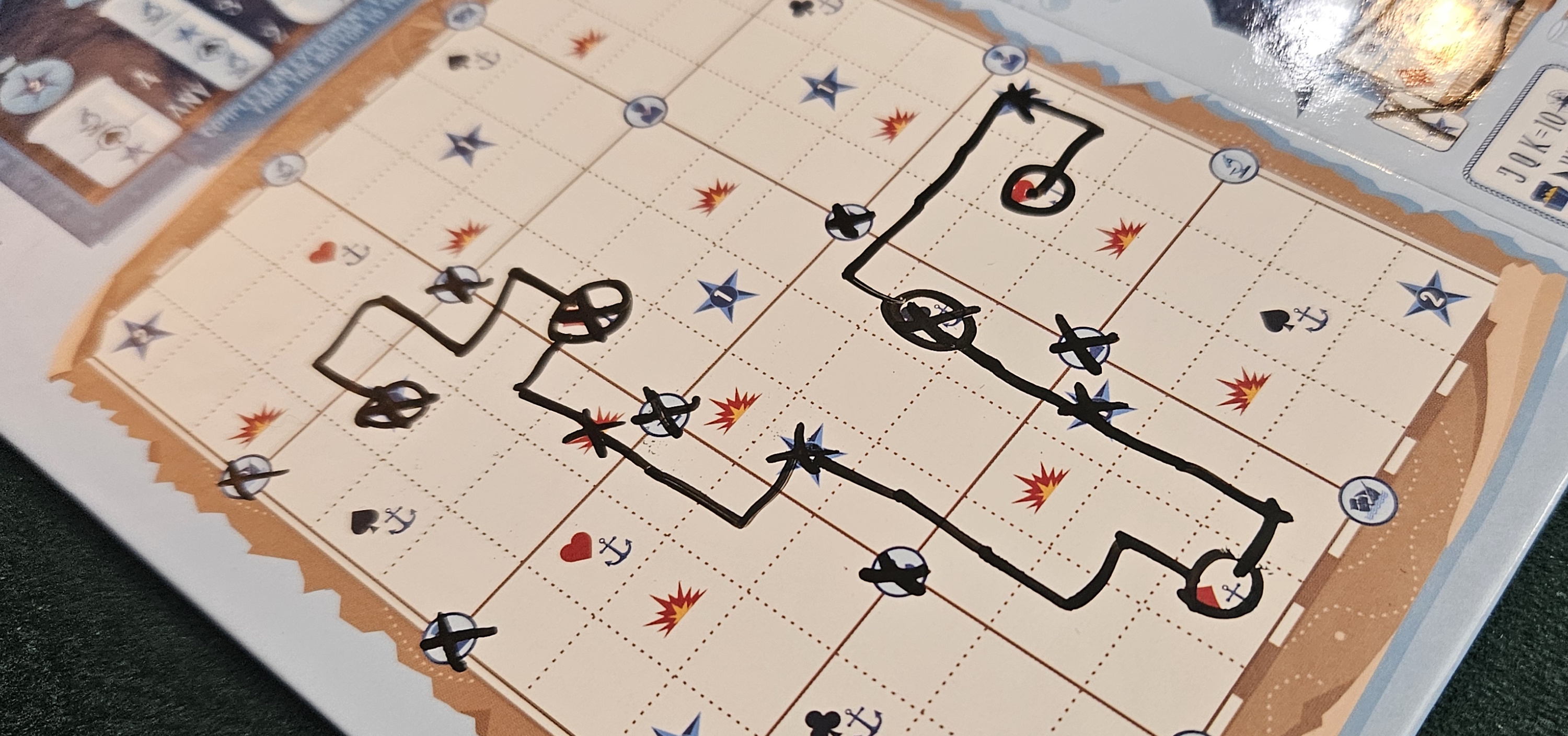
Charting your course.
Perhaps I would have felt more kindly toward Flip Voyage’s voyaging had I not recently played three different titles that handled navigation so much more cleverly, but the map is never as interesting as it could have been. Damage is easily avoided, while the ease of pulling U-turns and adjusting your current range with a spent resource both serve to eliminate any hard decisions. For the most part, the toughest part of navigation is remembering to tally how far you moved on the score track.
The activities, meanwhile, are considerably easier than those found in Fliptown. There’s a tonal quality to the distinction. In Aramini’s former game, each activity was pitched as a wager, requiring players to decide how far they wanted to press themselves in an attempt to secure greater rewards. By contrast, the activities in Flip Voyage are considerably blander.
As before, there are four, each corresponding to the deck’s French suits. Using a heart takes you to the science lab, where you must fill beakers in rank order. Next door is the warfare track, where spending cards will punch holes in imperial warships, either earning salvage or damage. Diamonds are for adventure on the ocean floor to retrieve treasure or damage. And clubs are for raiding slaver camps, liberating new crewmates or, again, taking damage.
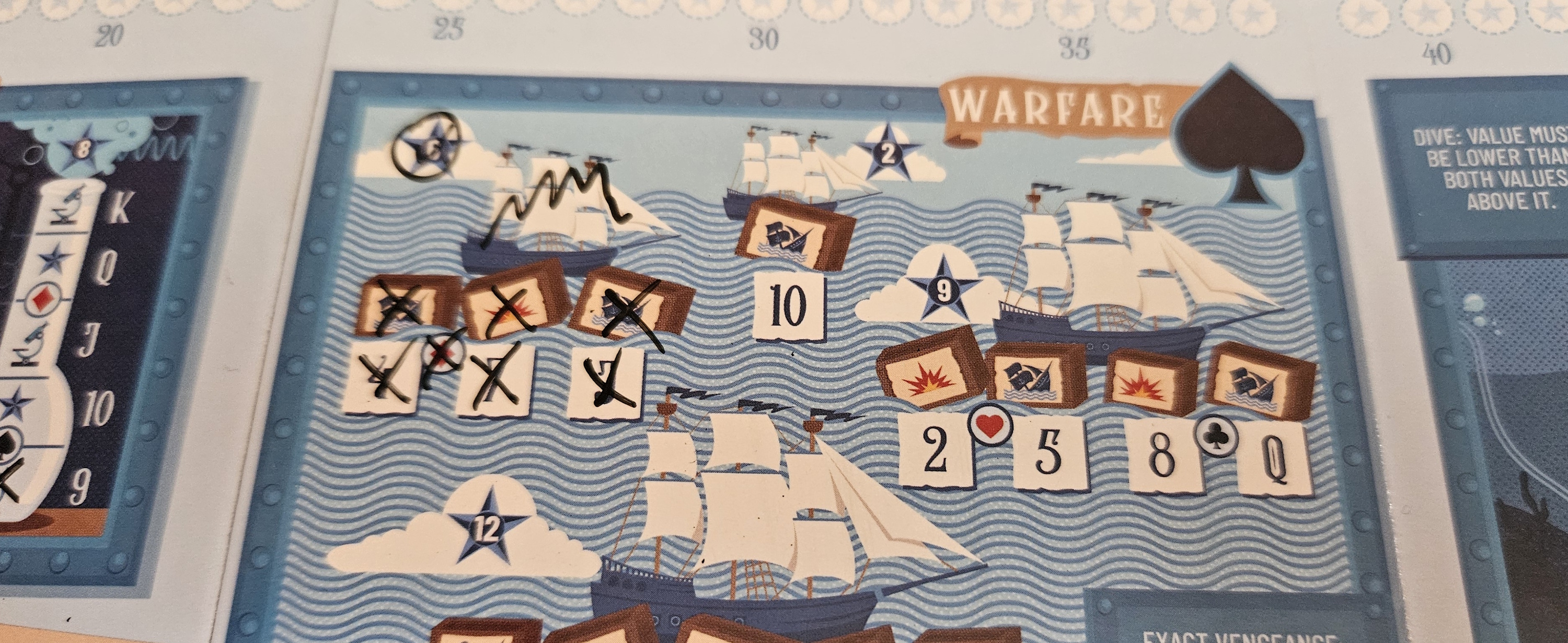
Sink to the bottom… without me.
If you couldn’t tell, there’s a lot of taking damage in Flip Voyage. Three of four activities will ding your Nautilus Jr. in some way or another, and there’s no skipping a turn to loot graves like in Fliptown. This has a flattening effect on the game. There are fewer peaks and troughs than before. Instead, you’re usually guaranteed some upside to go with your downside, or vice versa. A resource here, a scratch there, bit by bit, until the game concludes and everyone tallies their score.
There are upgrades to consider, little perks that adjust your activities. Some are formidable, like the serrated rakers that encourage you to steer into damaging spaces on the map or the super propeller and ramming prow that earn extra resources from their related activities. But a number of upgrades are surprisingly dull. Oh, the dredge lets me turn crew into salvage? The library turns salvage into research? Sorry, I nodded off. I hate to keep resorting to contrast, but these are a far cry from the shops and hotels of Fliptown’s tumbleweed town.
It’s possible to consider these alterations in a generous light. Fliptown had moments of profound chance, especially when two players attempted to, say, rob a stagecoach on the same turn, an endeavor that required both highwaymen to draw their own card to determine their success. Flip Voyage is less beholden to Lady Luck. Apart from the trio that opens the turn, there are no flipped cards here. I’m sure there are those who prefer their flip-and-writes to limit their luck to inputs rather than outputs, to borrow Geoff Engelstein’s delineation between flavors of chance.
I’m not one of those people. The beauty of Fliptown was its willingness to allow both modes. You could push your cash into the center of the table by sticking up trains, speculating on land, and chasing bounties. Or you could keep to safer trails by mining gold, riding duster, or robbing corpses. Even without the inclusion of random outcomes, there was so much to do that every session felt like a fresh adventure. After about one and a half plays, Flip Voyage has shown all it has to offer.
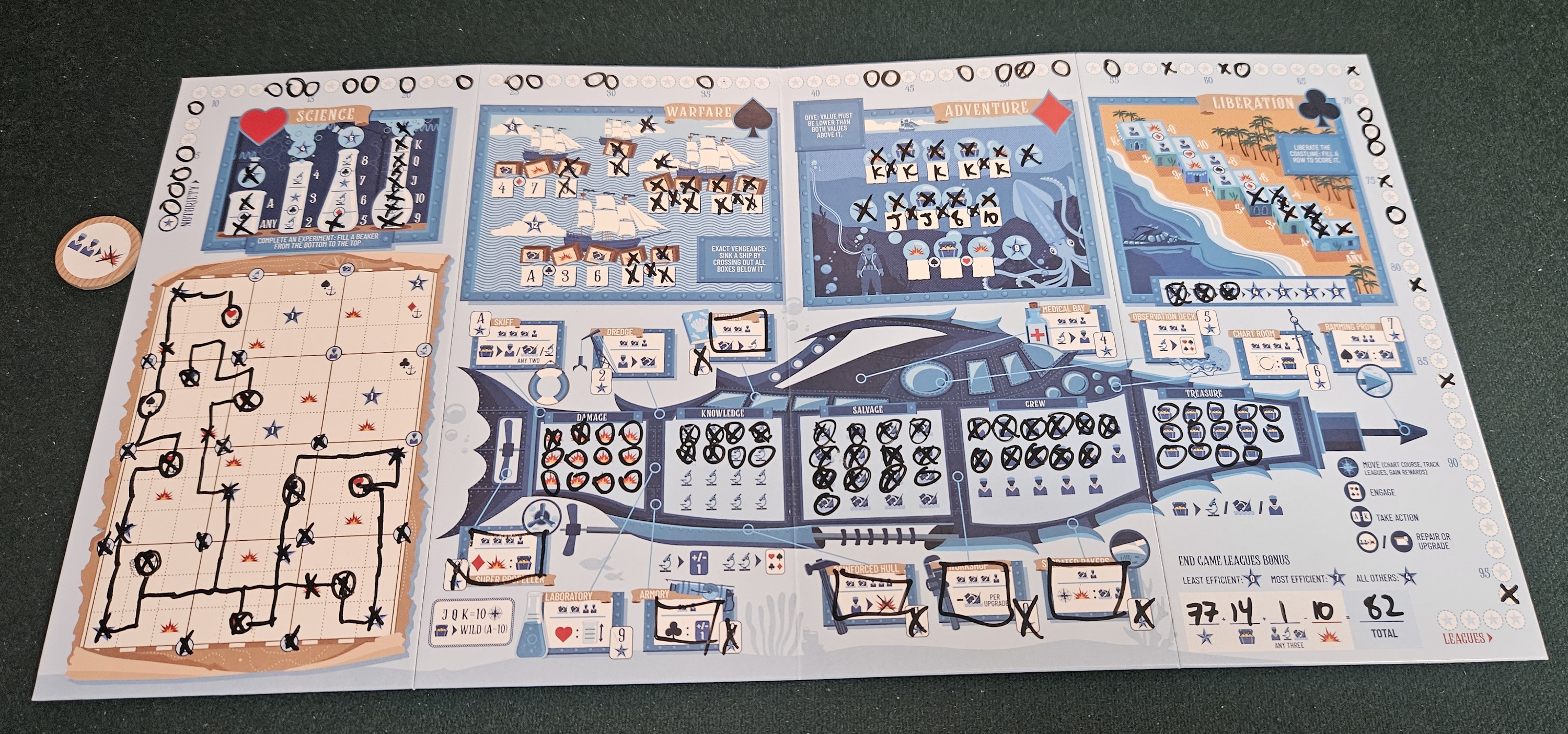
Ahh, a marked-up board.
Still, the process of filling in the board is enjoyable enough. That’s some faint praise, I know, but it would be a lie to say that this game is devoid of its pleasures. Figuring out how to put those cards to use is still a strong core for such a game.
But twenty thousand leagues is a great distance to cover under such pressure, and this hull has sprung more than a few leaks. There are plenty of better options, including many designed by Aramini. To quote Captain Nemo, “Oh Almighty God! Enough! Enough!”
A complimentary copy of Flip Voyage was provided by the publisher/designer.
(If what I’m doing at Space-Biff! is valuable to you in some way, please consider dropping by my Patreon campaign or Ko-fi. Right now, supporters can read my first-quarter update of 2026: the best board games, movies, books, and more!)
Posted on June 1, 2026, in Board Game and tagged Alone Time, Board Games, Flip Voyage, Write Stuff Games. Bookmark the permalink. 4 Comments.


I recently played both and I preferred Fliptown but the missus preferred Fliptown Voyage because she liked the map. I think had she played more route building games she’d have been less enamoured with it. It’s a very good and clean design, a lot easier to teach and pick up, but personally I liked the fact that the three cards felt more deliberate when one was for the poker hand than choosing two cards for value and one for suit that the map causes. It feels less satisfying as a design conceit
Yeah. I don’t think it’s unreasonable to prefer Flip Voyage. It’s definitely the cleaner design. But I miss Fliptown’s open range, both gameplay- and setting-wise.
Is the map travel mechanically limited at all? Like, having to move in a straight line, or having the suit of the card determine the direction you head in (or a direction you can’t)? If it’s completely free “move X steps based on your card’s rank”, that is a bit hollow sounding.
Nope. Free move. The only restriction is that you can’t immediately backtrack, but crossing your trail is fine.