Therapeia Infernalis
The first time I opened up to a medical professional about some childhood trauma, it was like surgically excising a living thing from behind my breastbone. That experience — the galloping pulse, the ventricle-deep ache, the sensation that something alive and malicious was digging in its claws to stay rooted — made it easy to see how one might disavow ownership of those emotions and assign them to supernatural entities. Demons rather than one’s own untilled memories.
That, it seems, is the connection being made by Judson Cowan as well. Personal Demons is Cowan’s chaser to the successful Deep Regrets. Where that game used fishing for eldritch horrors as a stand-in for, well, deep regrets, Personal Demons is about calling demons to your own private summoning circle in order to dispel them. Or to confront them? To host a tea party for them? Look, it may be an apt metaphor, but it isn’t always a perfect one.
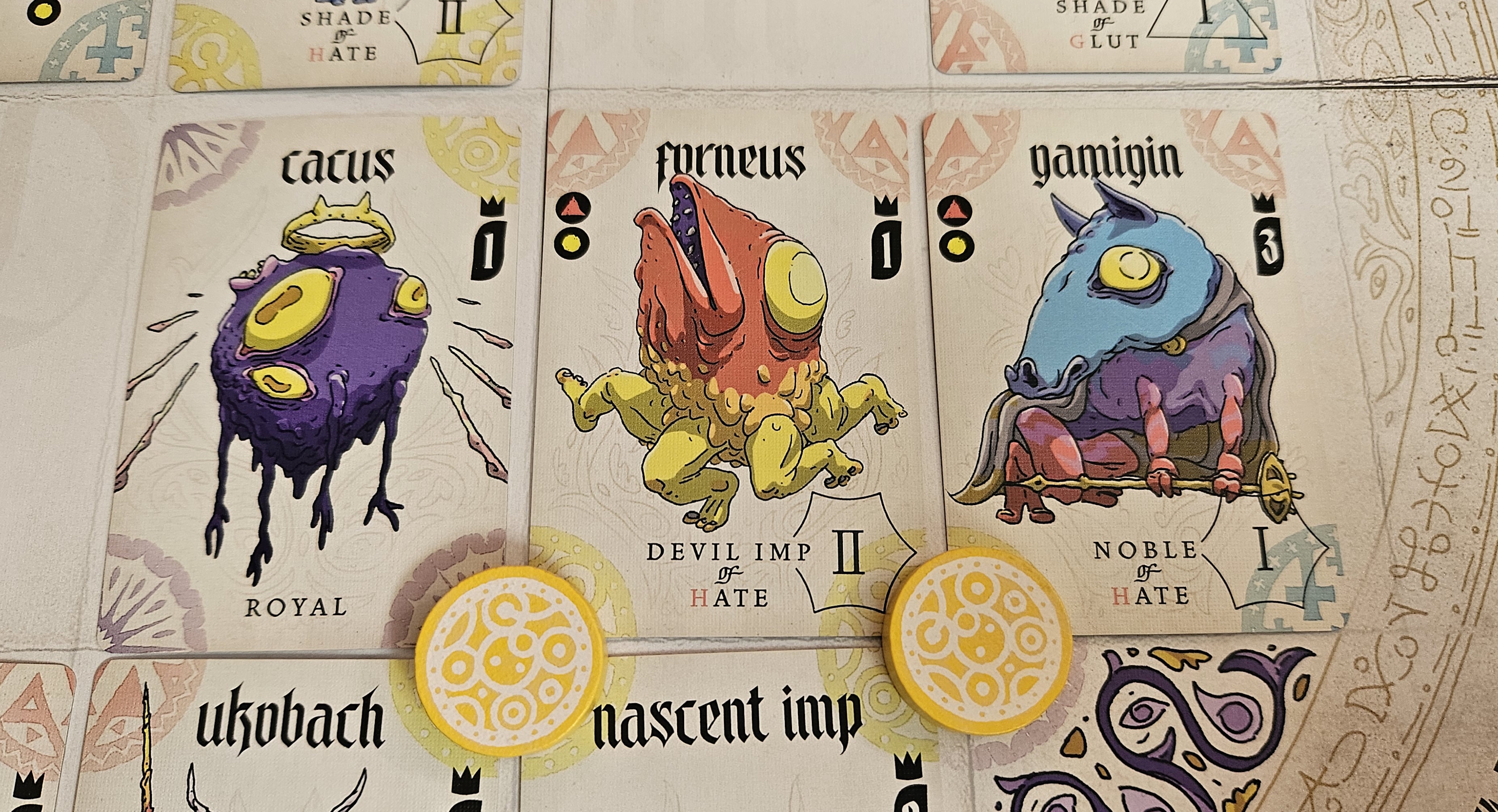
Check out the squishy li’l guys responsible for my bad behavior.
Here’s how to summon a personal demon.
Pick a card. This is a drafting game, so a fresh hand of cards will always be there to offer its selection of underworld beasties. Take care to pick the right one. Some require a certain number of seals, little colored tokens that sit within your circle, before they can be birthed into our world. All confer their sin of choice, hate or want or glut, so be sure to select the one you’re currently attempting to sin-max.
Once picked, you need to decide where in the circle to summon it. The main concern here is the demon’s corners. There are three colors to consider — four with the wild color that can match with anything — each mapping to liminal, infernal, and abyssal seals. If the corners of four cards line up, you stamp a seal on it. This is useful for summoning tougher demons, but also for scoring every adjacent demon. Which means it’s your main objective. Seals beget points and then are broken, flipping to their cracked side rather than remaining pristine and white. Fortunately, even cracked seals can be used for summoning further demons.
Right away, though, Judson pulls a few tricks that make Personal Demons a little more interesting than it would have been otherwise. After putting a demon on your board, you’re also allowed to take an action. These cost some amount of sin, hence the gluttony and hatred, but allow you to place other cards. The smallest are fragments. These cost only a few morsels of sin and confer a tiny card that occupies only half of a slot, hopefully pairing with demons like partners at a dance. For a greater fee, royals appear, usually offering a bunch of wild-color seal matches.
And then, for the greatest fee of all, you can summon a huge demon. Maybe even a colossal demon. But we aren’t ready for that yet.
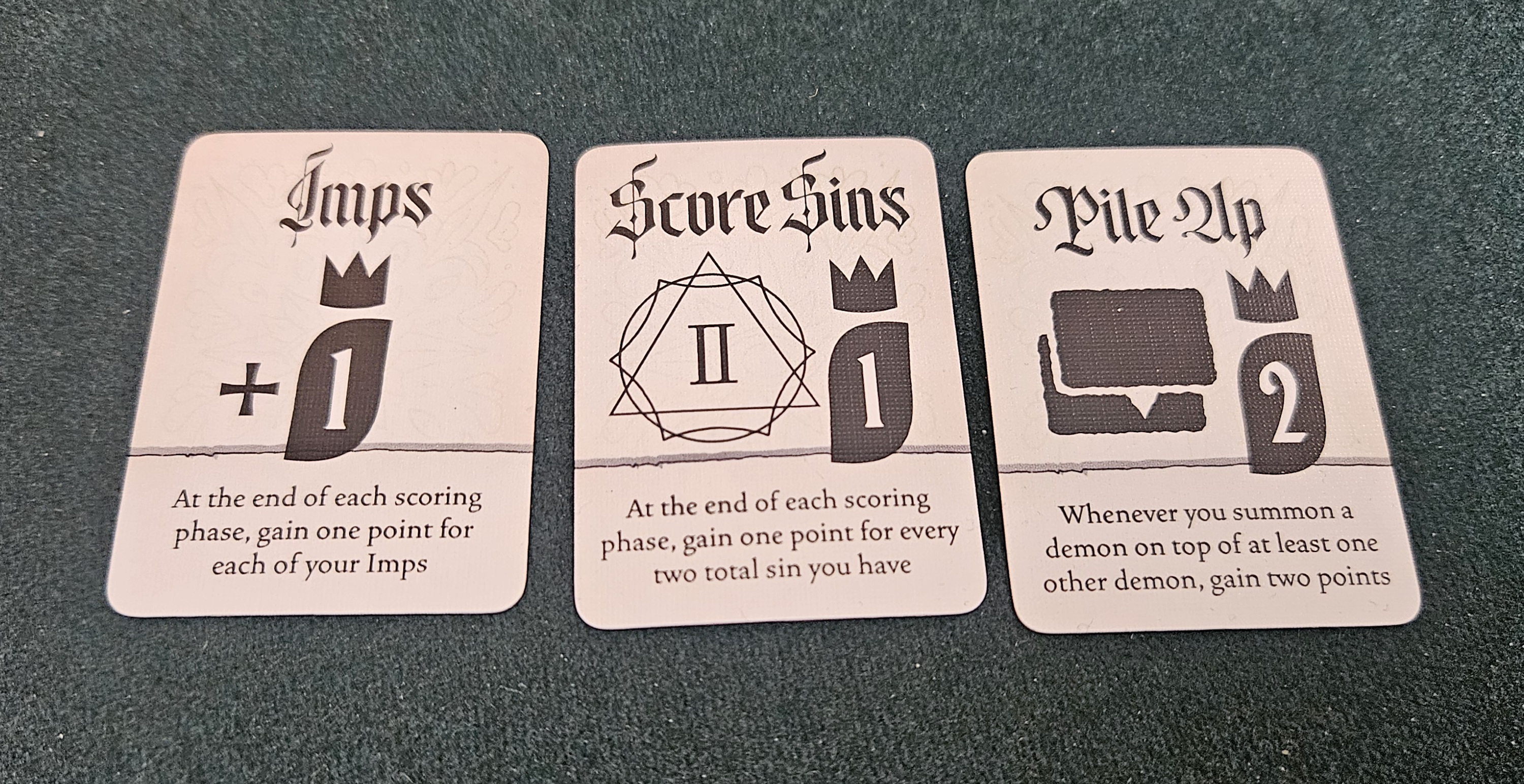
Confidence cards provide a range of abilities.
After the success of Deep Regrets, it seems like Cowan has gotten this stuff down to a science. Much like how that game found its audience partially by leaning into its fish-oil aesthetic, Personal Demons is full of the squicky and squamous. The same goes for the game’s underlying metaphor. Deep Regrets was a bit hand-wavy about the relationship between the sea, chthonic aberrations, and one’s leaden heartaches, but it worked thanks to a certain earnestness, not to mention the fact that it wasn’t especially judgemental. Maybe it helped that winning was often reliant on having as many regrets as possible, not keeping them under control.
Here, the tools of your infernal therapy are plain enough, but drawn with enough gusto (and gothic lettering) that it sells the idea without banging it into a migraine.
First, everyone begins with a fear on their board, an obnoxious card that takes up space, awards very few points, and only has seal markers on two of its four corners. You can confront this fear at any point, but doing so once you’ve filled your summoning circle with enough of the right seals awards a heap of points. So whatever your fear, whether existential (death, irrelevance) or faintly silly (clowns, bees), it tends to stick around. Digging its claws into your soft tissues until the right time.
Is there a right time? Should that fear be confronted now? Or can it wait a while, hanging around until you’re ready? I wish I knew. Maybe there isn’t a single correct answer. That’s the game, man.
Meanwhile, players also draw special cards that offer new abilities. These are called courage cards — a bit cloying, in my opinion — and they appear at regular intervals, such as at the conclusion of the round or whenever somebody confronts a larger demon. There are scoring perks in there, and freebie seals, and some let you rotate certain demons upside-down to better match their seals.
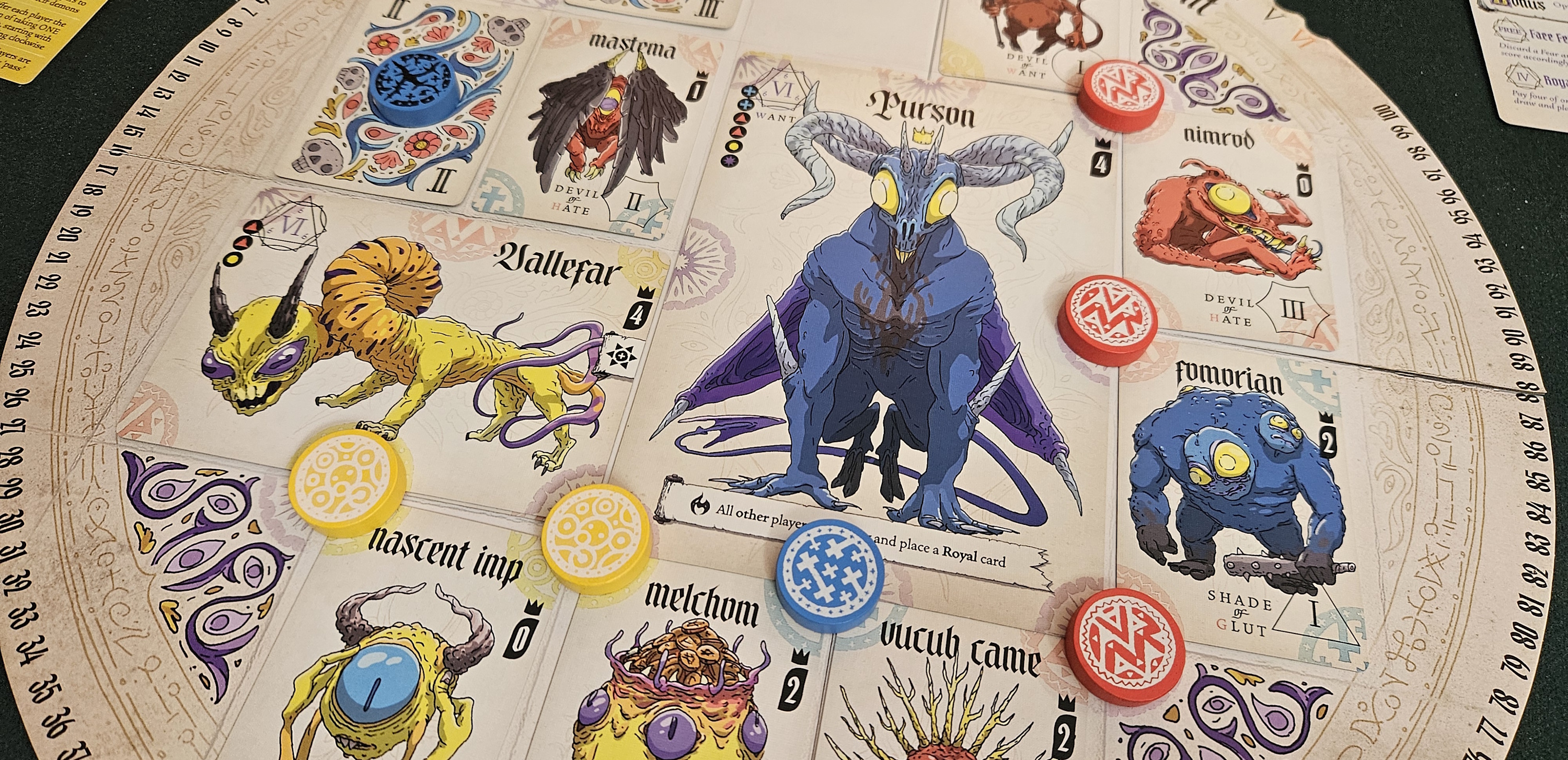
Larger demons must be placed over ordinary demons.
The game’s biggest moments, of course, are when those larger demons plop onto the field. They’re expensive, both in terms of seals and expended sin, and can only be placed atop a foundation of other demons. There’s probably some metaphor at work, about how the work of facing down one’s demons is done bit by bit, rather than all at once. Then again, I’ve been accused of reading too deeply into these things, so don’t mind my speculations. Sometimes a demon is a demon. (More often, it’s epilepsy.)
It’s an interesting game. At every level, really. The card-placing puzzle is solidly done, and it captures the joy of amassing a menagerie of ugly fellas. Every placement is accompanied by real tradeoffs, especially when it comes time to burn off some sins. For all that, I wonder how quickly it will wear out its welcome. It doesn’t have infinite depth, and it isn’t long before its demons are reduced to the backdrop for its seals and sins. My first play was enthralling. My third, which saw me filling out a “perfect board” with every single seal placed, was markedly less so.
What interests me more, I suppose, are the simple processes it produces. Personal Demons is methodical. Repetitive. Every round assigns somebody to act as the group leader. They walk the table through the steps. Choosing a card. Placing it. Flipping it face-up, naming its sins, stamping it with a seal. I’ve sat in therapy circles, both as a participant and as a volunteer, and there are connections to the summoning circles of old. The words we say. The mantras. The prayers. The dark things that are brought up out of the soil. The purifying fire, hot enough to burn. The glimpses into the abyss. None deeper or blacker than the hole within the self.
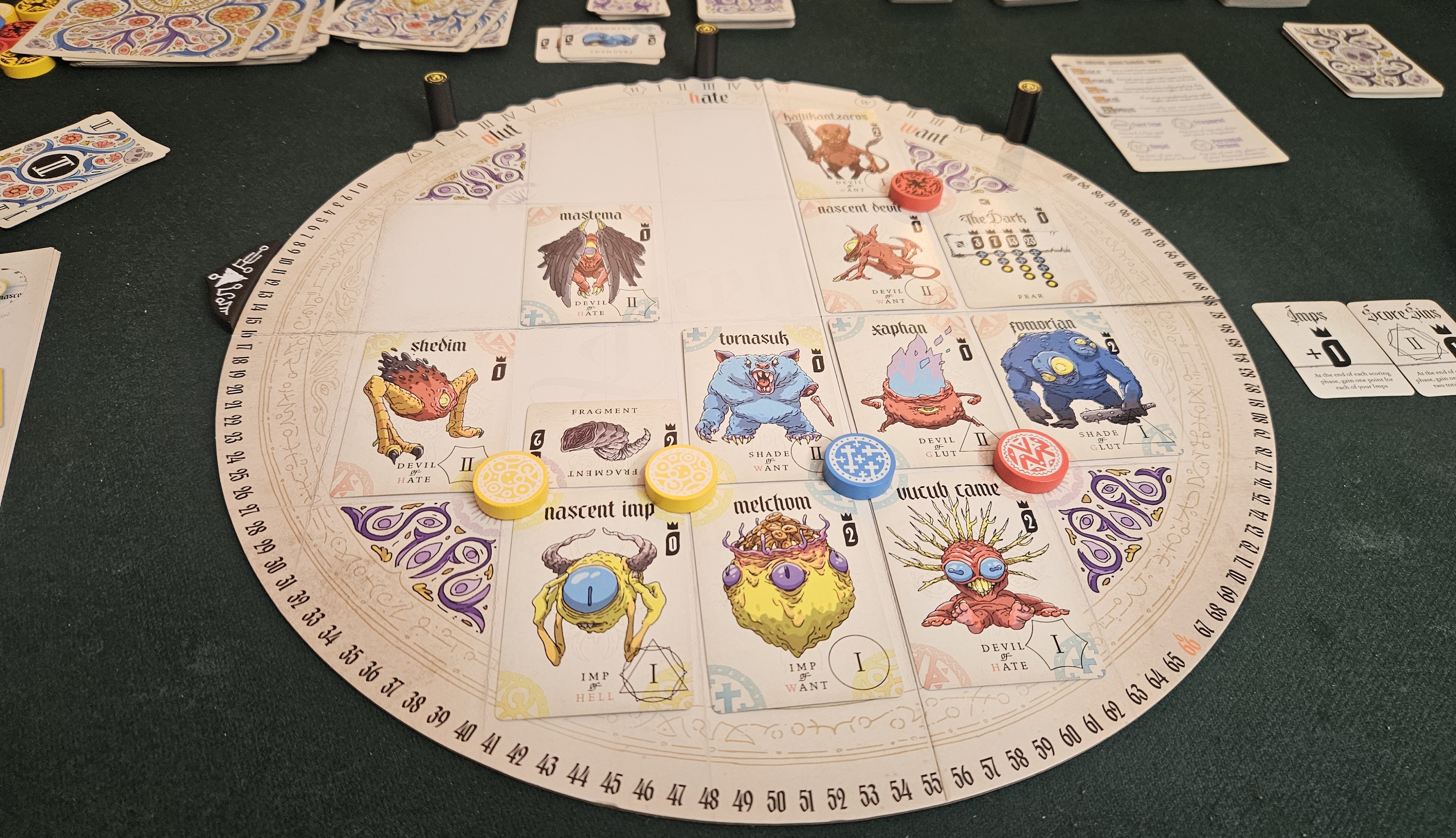
I’ve been told the final boards won’t be quite so bump-prone.
Does Personal Demons bottle that magic? I think so. A little bit. In its rhythms. In its good-natured acknowledgement that this stuff is painful, but that it can be darkly funny, too. We’d rather imagine a teeming world under our feet than recognize our own face in the puddle. What’s that old joke? A man would rather write the Démonomanie than go to therapy. Personal Demons tells us we can do both. Jean Bodin would have thrown a fit.
Or maybe it’s just a pretty good card-drafter and symbol-matcher. That’s fine. In such a case, I’ll always have the butt-demon. His lemony backside roundly scandalized my daughters. Now I’ll put the box back on the table and tilt it so they’ll catch sight of his dimples in the morning. When they’re older, I’ll repay my mischief by funding their therapy.
A prototype copy of Personal Demons was temporarily provided by the designer/publisher.
(If what I’m doing at Space-Biff! is valuable to you in some way, please consider dropping by my Patreon campaign or Ko-fi. Right now, supporters can read my first-quarter update of 2026: the best board games, movies, books, and more!)
Posted on July 3, 2026, in Board Game and tagged Board Games, Personal Demons, Tettix Games. Bookmark the permalink. 1 Comment.


Pingback: No (Okay, Some) Ragrets | SPACE-BIFF!