Dive Tables
Here’s something you probably didn’t know about old Dan Thurot: I’m a scuba diver rated for search and recovery. There aren’t many of us here in the desert, which is probably why I receive unexpected calls to dredge the ponds of local golf courses whenever there’s a Silver Alert. Thus far, I have declined these requests. Those waters are, like, four feet deep. That’s a job for snorklers. Or a tall guy with hip waders.
Instead, I mostly use this as qualification to comment on scuba stuff. That cave rescue in Thailand? Legitimate. The roll-and-write shenanigans of Aquamarine? Um. Okay, look, Aquamarine isn’t the most robust scuba simulation. But as another print-and-play title from Postmark Games, it’s a worthy followup to Voyages.
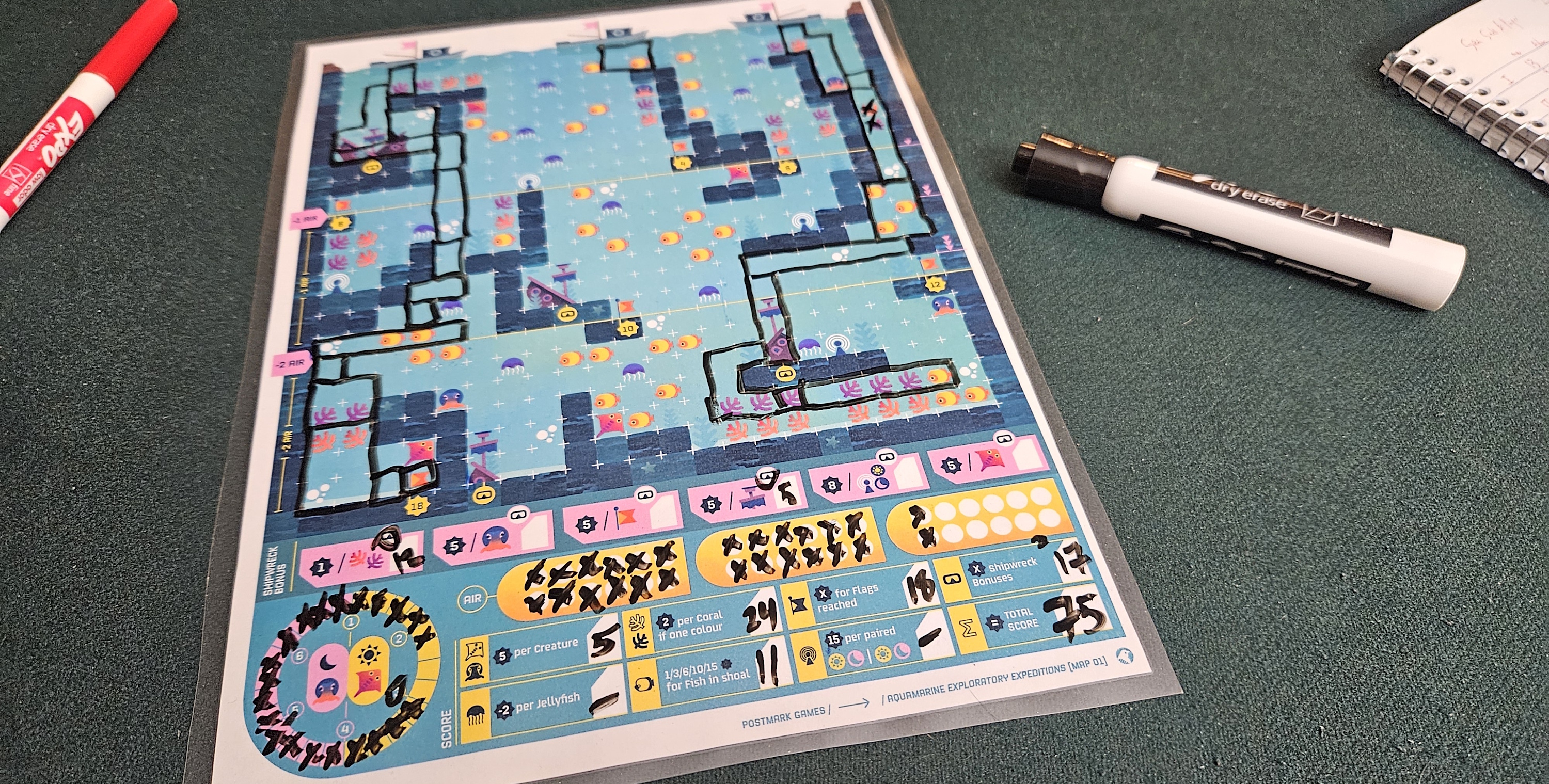
This is exactly what scuba diving is like.
Like Voyages before it, Aquamarine is a dice-heavy game of movement, positioning, and exploration by Matthew Dunstan and Rory Muldoon. Unlike that game, Aquamarine is played with two dice instead of three. What will those loony bastards think of next, a movement game that uses only one die?
(Since I’m late to the party, the answer is “Yes.” But that’ll have to wait till next time.)
As before, the gist of Aquamarine is elegant in its simplicity. You roll the dice, then use one of them to move your diver. Here those movements are represented as enclosed boxes. Enclosing something — some coral, a school of fish, a stinging jelly — means scoring it when the game ends.
Of course, it couldn’t be that breezy. Dunstan and Muldoon are all about encoding necessary and enlivening limitations into their print-and-plays.
In this case, the first of those limitations is that you only have access to one die out of that rolled pair. Bigger rolls mean bigger enclosed areas, but that also means depleting oxygen equal to the difference between the lower and higher die. So while it might be tempting to use that 6 rather than the piddly 2, covering the larger area means hoovering up four units of precious oxygen. Making matters tougher, deeper dives consume more air, adding time pressure right when the sea’s aquatic life is at its most interesting. Similarly, you’re constrained in which shapes you’re allowed to draw. Mostly long rectangles rather than jagged freeform polyominoes, although there are moments of squiggly liberation that emerge whenever doubles are rolled.
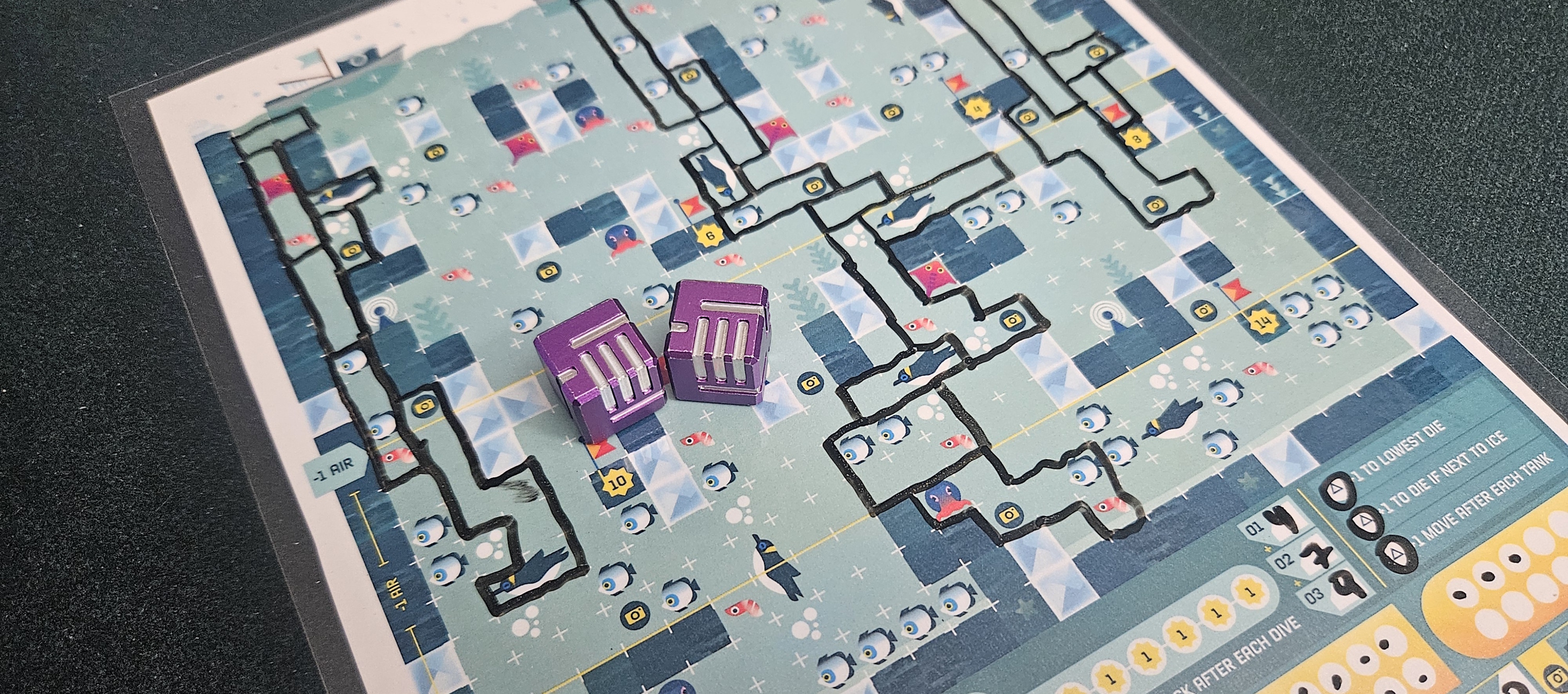
Weird aluminum dice not included.
These triplet pressures are the shared system underpinning everything in Aquamarine. Much like the headings in Voyages, everything arises from those constraints. Travel too fast or linger too long at depth, and your waning oxygen will force you to start a new dive. Paint yourself into a corner with your shapes, and you might find your next move taking you in the wrong direction.
From there, the game’s selection of maps tinkers with the formula. As before, the inaugural outing sets the template. Schools of fish are worth increasing amounts of points as more of them are enclosed in a box; certain creatures only emerge during daylight or nighttime hours, requiring you to parcel out your time accordingly; special beacons and flags reward those who travel to the corresponding depths.
But there’s tremendous variety within that blueprint. My personal favorites are found on the second map and fourth map. In the former case, undersea caverns can be readily explored during daytime, but at night gradually deplete a limited stock of flashlights; meanwhile, researching sharks and giant squids ticks you up along a selection of bonus tracks. And in the latter, arctic ice threatens your air supply, but snapping pictures of frolicking penguins and icon-improving shrimp can net scores of points that keep ramping upward.
This time around, there are troughs to accompany the peaks. In particular, two of the maps — a double-sheet deep-sea excursion and a fossil hunt in ancient waters — are too persnickety for my tastes, asking the player to make minute adjustments that don’t always play well with the need to ration air or count spaces.
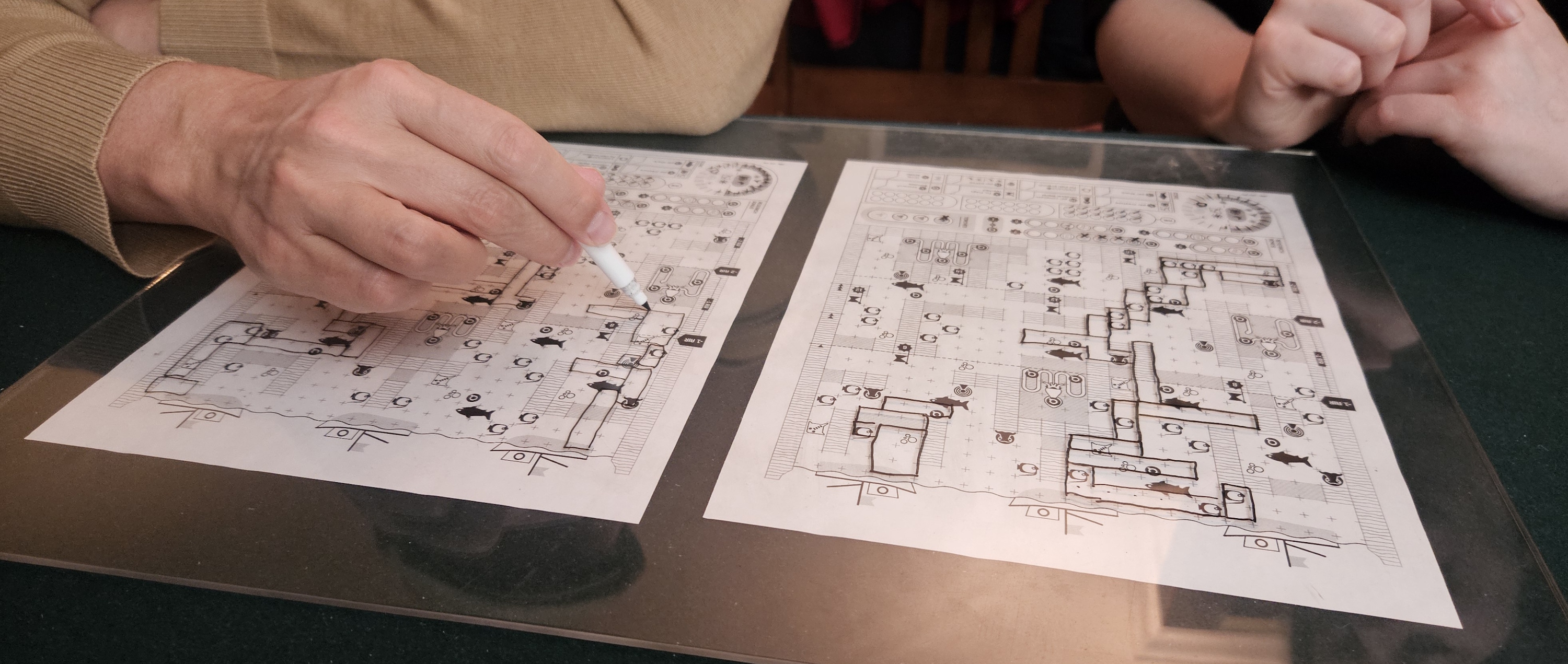
As before, low-ink options are included.
Some of that has to do with the inherent limitations of the game’s movement system. Where Voyages — and our next installment — are more freewheeling with their range allotments, maneuverability in Aquamarine is downright torpid. Unless you’re starting a fresh dive, each box must attach to the previous one. This makes total sense, but also keeps the game more snugly straitjacketed. If I were a generous man, I’d call it more bite-sized; but because these are aquatic adventures — and because I’m not a generous man — they instead come across as suffocating, at least sometimes.
But while Aquamarine is the flimsiest of Dunstan and Muldoon’s roll-and-move trio, it’s hardly a poor example of the form. If anything, it’s another testament to how much can be accomplished with a sheet of paper, a pen or pencil, some lamination or a plexiglass, and dead simple rules. When the game slips into its groove, it’s immensely satisfying.
Especially in multiplayer mode, it should be said. That’s another shortcoming imported from Voyages. Here, the solitaire rules are disappointing, asking you to reach certain depths. Child’s play. The real challenge lies in sitting across from one to ninety-nine partners and seeing who can wring the most out of those shared inputs. In that mode, there’s nothing quite like glancing smugly (or despairingly) at a fellow player’s sheet to see where your routes departed. Who veered parallel to the ocean floor to preserve oxygen, who ventured much on the outcome of future rolls, who spent their dive observing shockingly large schools of fish. Or, in my case, who got stung by a bunch of jellyfish because they thought they were pushing themselves to more rewarding depths, only to tap zero on their dive meter. I’ve never gotten the bends in real life, but I’m pretty sure my diver in Aquamarine has made some testy ascents.
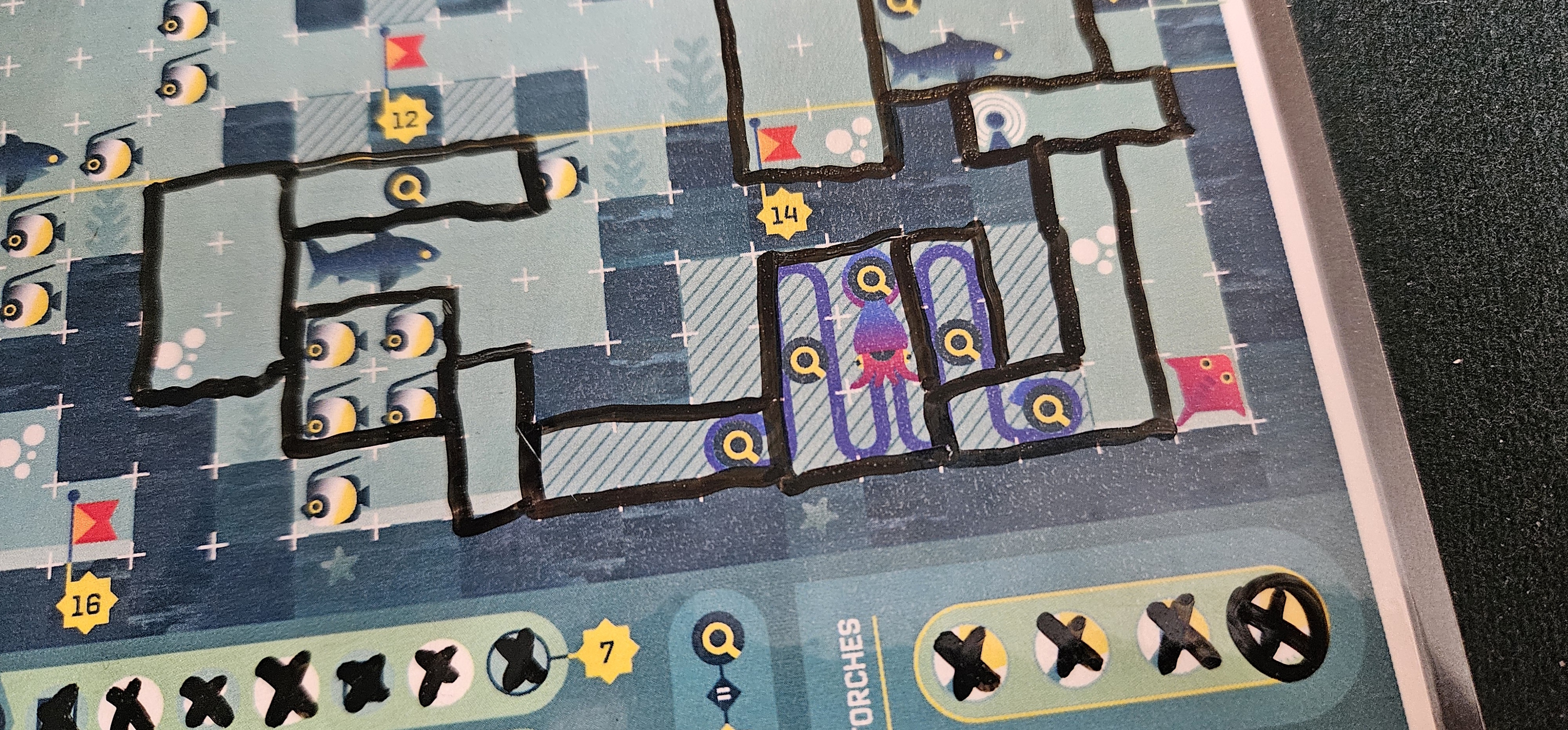
I’m making new friends down there.
In short, Aquamarine is a mixed experience compared to its peers, but to evaluate it solely as a comparison misses out on what makes it such a rollicking time. I prefer Voyages; I prefer Waypoints. But given the option between Aquamarine and nothing, this is still exactly what I want from a print-and-play game.
Access to the files to print Aquamarine was provided by the publisher/designer.
(If what I’m doing at Space-Biff! is valuable to you in some way, please consider dropping by my Patreon campaign or Ko-fi. Right now, supporters can read my first-quarter update of 2026: the best board games, movies, books, and more!)
Posted on May 11, 2026, in Board Game and tagged Alone Time, Aquamarine, Board Games, Postmark Games, Print and Play. Bookmark the permalink. 11 Comments.


Way to go Dan. All the best gamers are SCUBA divers. Whilst you are PADI qualified, I am BSAC-British Sub Aqua Club (Open Water Instructor-Adnavced Diver), but I was shocked / impressed when I read you were Search and Recovery qualified. BSAC don’t have this as a specific training course because skills like this (wreck diving etc) are encompassed in general progression.
In the UK S&R means something very different. Police divers are the only people I know who have this skill set and that is because it refers to the recovery of human remains. Having said that, a diver from my club found himself with his SCUBA gear in the wrong place at the wrong time by Brighton pier (South of England) and ended up being asked by a Life Boat crew to fill a body bag at 10m under the pier. A truly awful job.
After a quick search I see you are qualified to recover ‘stuff’ like anchors and Scooby Doo treasure chests which is alot more palatable and I can see why you would say no to dredging silt for golf balls.
Which is a long preamble to SCUBA diving board games. In my experience I have never found a good one, in fact they have all been dire, from their references to oxggen tanks (or bottles) , flippers, goggles and fighting sharks. My latest horror encounter was Thesauros which had divers having to roll dice to kill the local sharks to collect treasure and having their haul collected by helicopters. It cost more to ‘invent’ a lobster pot than SONAR and new kit was flown out to Zodiac inflatables which could be in permanent residence on a reef.
I have a SCUBA design of my own which has nbeen in development for over 10 years. It’s not easy balancing underwater games.
I’ll look forward to your scuba game! This one is, ahem, more on the “helicopter treasure” end of the spectrum than anything accurate, which I’m sure won’t come as a surprise.
what sort of logistics are we talking about regarding transparencies and marker setups? Any tips? Suggestions for best experiences if I pick up a PnP title you’re reviewing?
My setup is simple enough: I own one plexiglass square that’s not quite big enough for most folded-mat wargames, and plenty of dry-erase markers.
But there are resources available for a better setup. Most of the public libraries around here allow color printing, either for free (up to a certain page count per month) or for a very reasonable fee. Some even have lamination machines. I’m still investigating those options, but that’s how my friend Rob did the printing and laminating on most of the sheets in these images.
Apart from that, you need some dice. But everyone has some dice.
roger!
Pingback: Touch Grass (Metaphorical) | SPACE-BIFF!
Pingback: Combat Results Postcard | SPACE-BIFF!
Pingback: Forget the Flippers | SPACE-BIFF!
Pingback: Scribbly Koalas | SPACE-BIFF!
Pingback: Fifty-Two-Card Squick-Up | SPACE-BIFF!
Pingback: Space-Cast! #58. Postmarks | SPACE-BIFF!