Class Reunion: Euphoria

It’s been thirteen years since the original release of Jamey Stegmaier’s Euphoria: Build a Better Dystopia. I would say it doesn’t feel like thirteen years, but I’d be lying. Between the pandemic and five or six successive generations of board game iteration, it’s been an eternity. Long enough for a retrospective, certainly.
Speak of the devil. Euphoria: Essential Edition is a remake of the original game, plus some of the stuff from the expansions, minus a few love handles and splotchy moles. Let’s see how the old dystopia has held up after all these years.
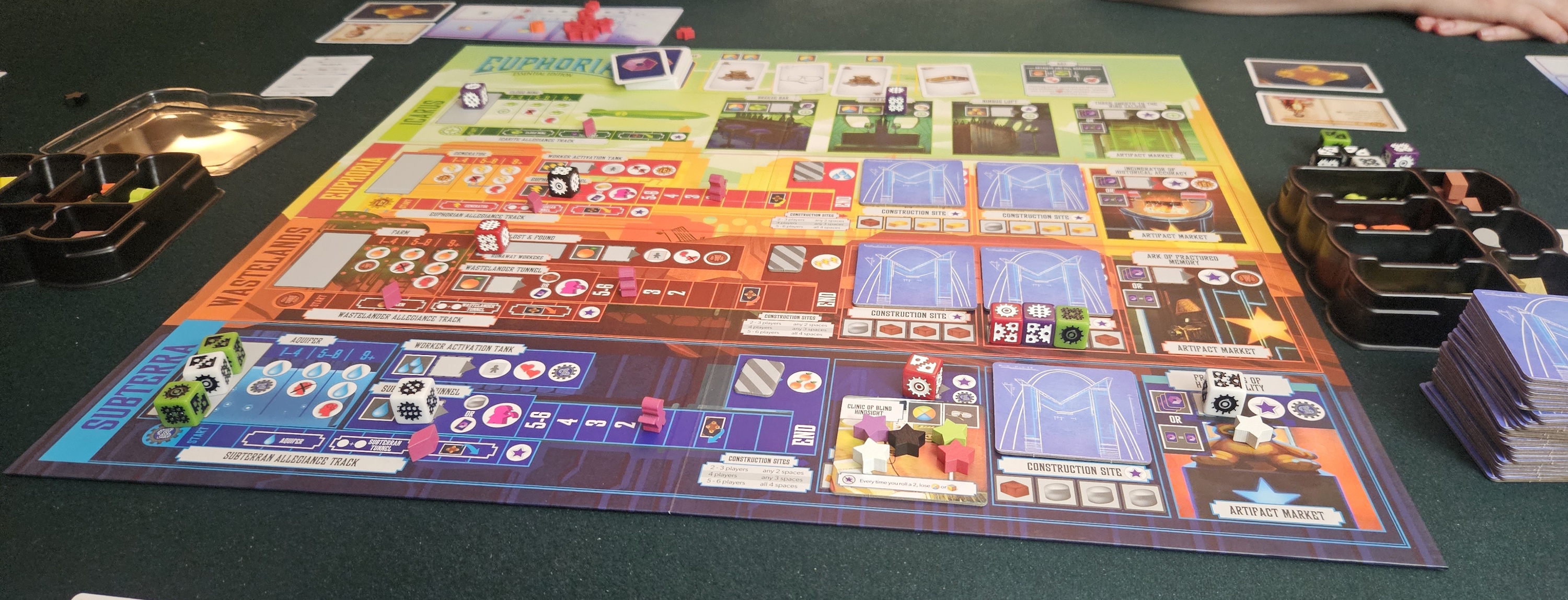
The new board, not quite the same as the old board.
Short version, there’s rebar showing through the concrete.
As before, Euphoria is about your efforts to thrive in a dystopian society. Relatable. Maybe that’s why the intervening decade hasn’t flown by. But I digress. In Euphoria’s case, that dystopian society is divided into four strata, each offering different spaces for your workers to run errands. There are the Euphorians, folks who generate electricity by marching on hamster wheels, Wastlanders who labor in orange groves, Subterrans who pump water through the cracked bedrock, and Icarans… Icarids? Icaruses? Whatever. These guys cook future-meth for keeping everyone’s workers drowsy and compliant.
The status of those workers is never far from mind. At the time of the original game’s release, rolling dice to determine the relative knowledge of one’s workers was a clever touch. If nothing else, it functioned as one of the hobby’s earliest meta-commentaries on the blank slate that was the worker-placement worker. Roll too high, and one of your workers gets wise to the situation and flees from your grasp. Roll too low, and…
… and there’s no penalty for rolling too low. What you really want is to roll doubles. That way, you can spend some morale to place an extra worker, earning two turns in a single go.
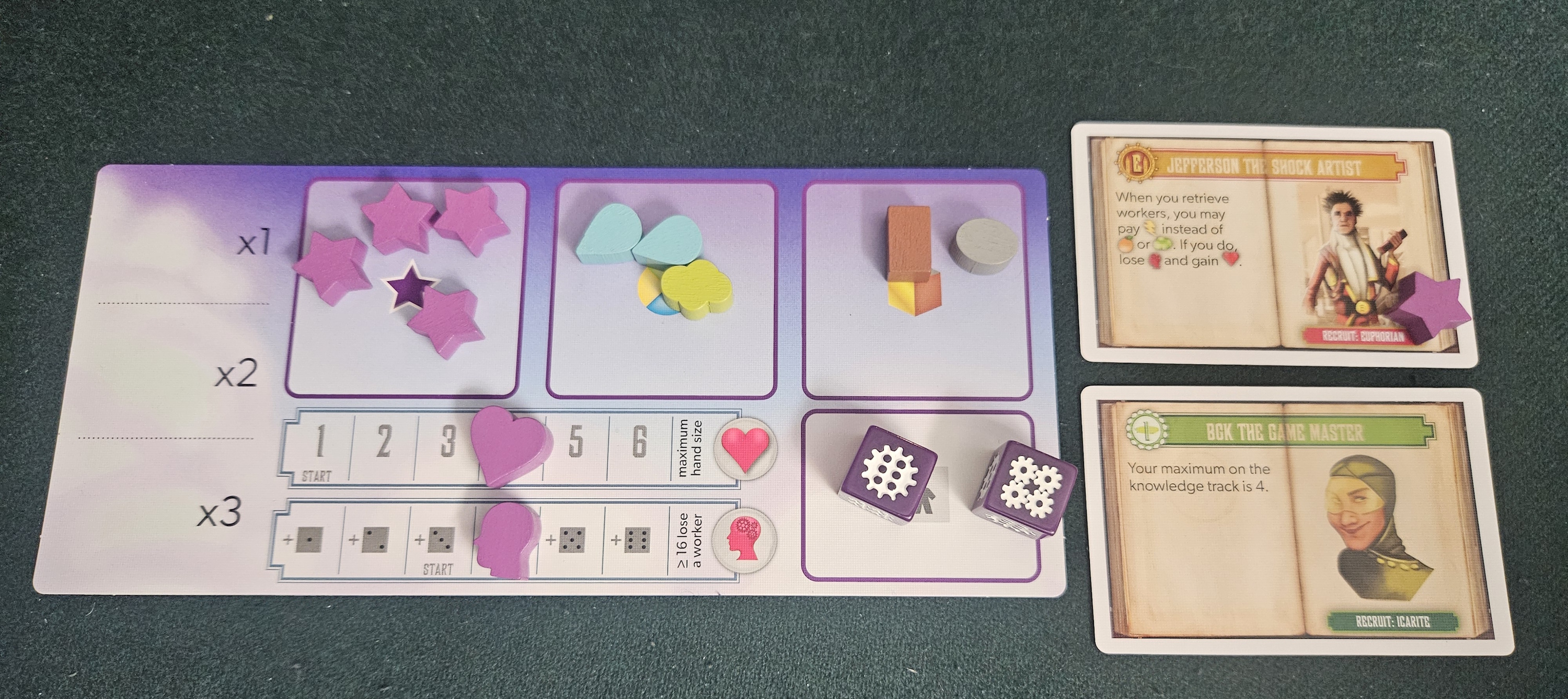
Euphoria: meek in the streets, freak in the spreadsheets.
At the time of the original game’s release — there’s a phrase I’ll probably say more than twice — it was easier to overlook the chanciness of the whole thing. Sure, rolling high means losing a worker, and rolling doubles means earning a twofer. But rolling low, I suppose, means you can send a worker to one of the game’s resource production zones without worrying about them learning the shape of their culture. Except, wait, that’s another benefit for rolling low. Darn it.
Okay, so Euphoria is full of luck. Always was, still is. The problem isn’t so much that luck is the sole determiner of whether you succeed, but rather that it’s just enough to prove frustrating. As a genre, Eurogames included more chance in 2013 than they do today. Personally, I miss a bit of chance. But in general, those earlier forms of chance were about mitigation. Even placing towns in Settlers of Catan was about spreading around the odds so that you’d always earn something. In Euphoria, the system feels out of place, and not only among the determinists of 2020s nu-euros.
But let’s set that aside. How has the rest of the game borne the timelapse?
Again, the short version is that it works perfectly well, but never quite eases its grandfatherly creaks and groans. Most actions are tit-for-tat resource conversions. First you send a worker to a resource generator to earn one or two commodities. Then you send them to a tunnel to spend a commodity for a building block. Maybe you spend a wad of commodities for an extra worker. Then you build special markets, which let you exchange commodities, blocks, and artifacts for stars, the game’s victory condition. Repeat. Repeat. Repeat.
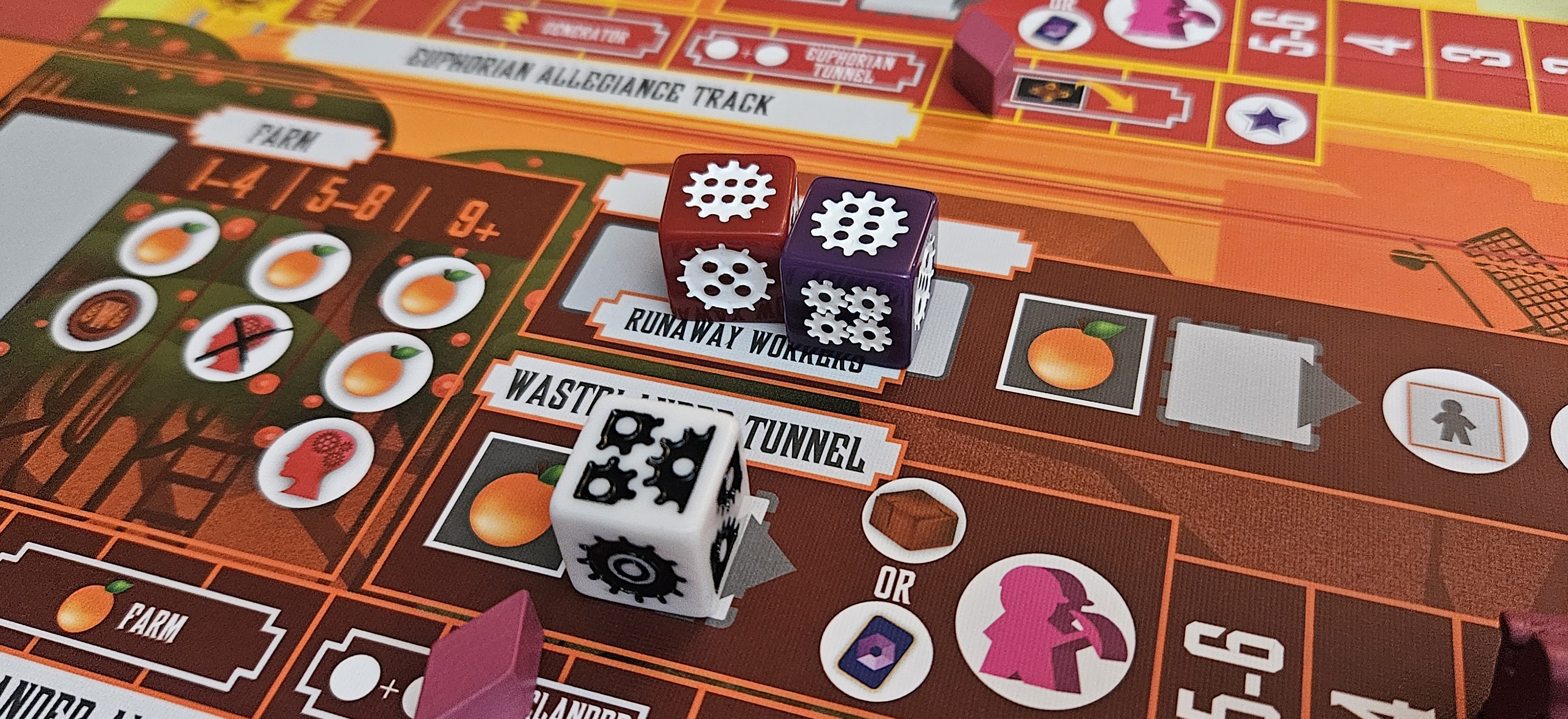
“Runaway workers” sure is a loaded term.
It doesn’t help that the Essential Edition sometimes comes across as more of a Pruned Edition. The board is more legible, but has shed the original map’s sense of place. Just look at that perfect goofball illustration. The new map feels like a spreadsheet setup for a spreadsheet game. Which is fine, as those things go. This is a resource-conversion worker-placement game, after all. You could even make the argument that this new edition has shed the original game’s pretense, including the ethical dilemma cards that, let’s face it, didn’t always add much to the game systems-wise. But, again, they mattered to Euphoria’s sense of place, the notion that players were being forced to compromise their values in order to get ahead. Thanks to the intervening years, a few subtractions, and this updated visual design, it’s easier than ever to see the wires and mirrors behind the illusion.
The remaining good parts are still as good as ever. For example, those markets. As before, building a market means spending a bunch of building blocks, not to mention putting your laborers in a holding pattern until other players join in. This created a certain degree of cooperation, one that could be turned against you at a moment’s notice. Having even a single worker hanging around at a job site is a real sacrifice, fostering opportunities for players to bicker and cajole. That’s great.
Furthermore, the markets themselves are nasty little things. When built, every player who didn’t contribute to its construction is forced to suffer a penalty until they pay a penalty at the new market. Sometimes these are negligible; other times they pose biting impositions that must be rectified as soon as possible. Or even both at once. The Theatre of Endless Monotony reduces how many commodities you earn, but only to a minimum of one. The Institute of Orwellian Optimism treats all your 1s and 2s as 3s when it comes to checking your dice for thoughtcrime. The Courthouse of Hasty Judgment makes it harder to spend artifacts for stars. That sort of thing.
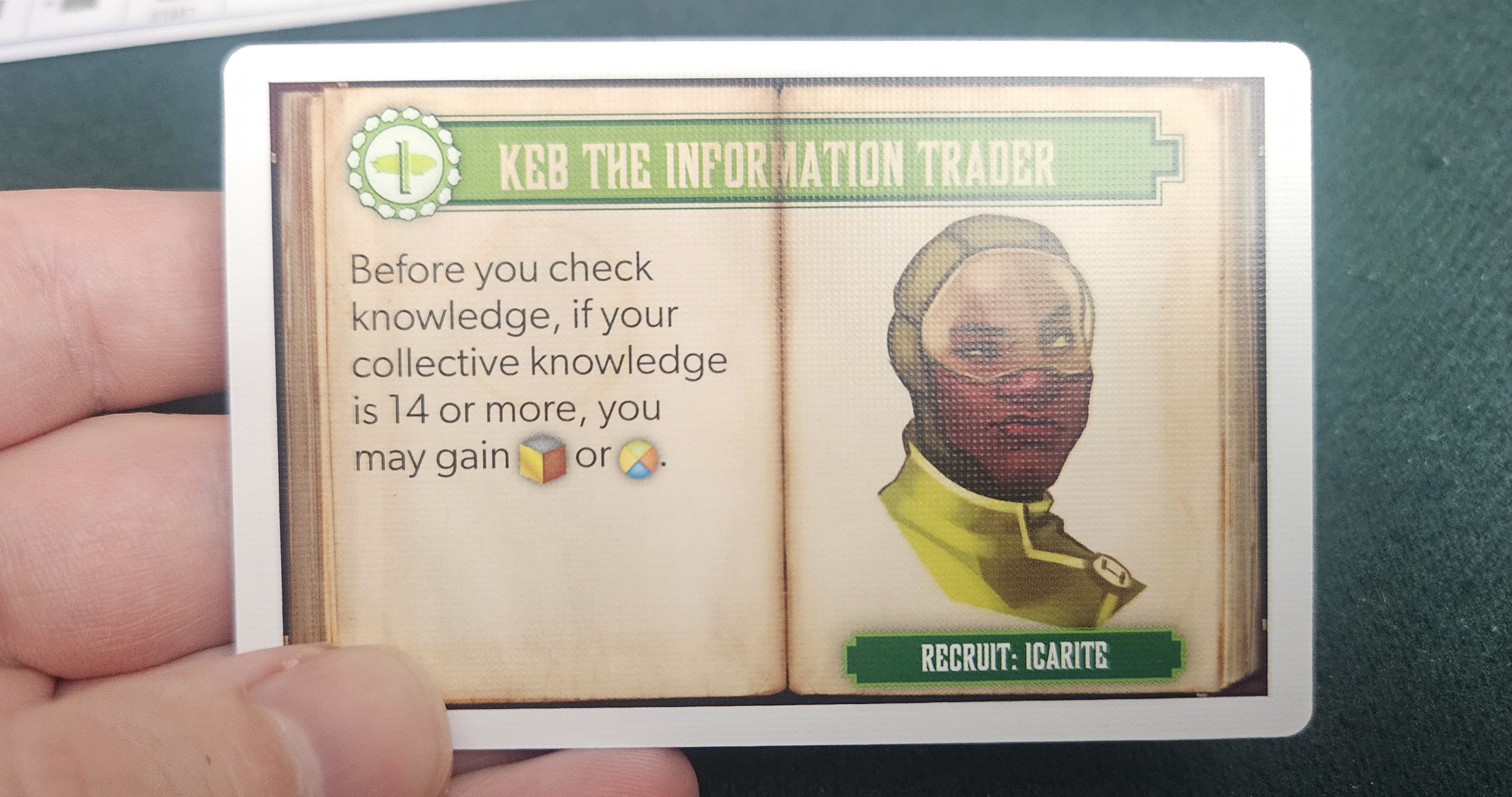
This guy is a cool dude.
There are some real whoppers in there, too. In one case, we revealed the Apothecary of Productive Dreams. This market prevents some players from sending workers to Icarus. At all. Which effectively locks them out of a full quarter of the board’s spaces. Worse, buying into an already-built Apothecary requires bliss, the very same drug peddled by the Icaroopsies. Not only were some players locked out of Icarus territory, this locking-out was effectively permanent. Was this a fair turn of events? Hardly. But it was interesting. Textured, we might call it. Abrasively textured, sure, but it was refreshing to play a game that would offer such overt penalties rather than ensuring everything ran smoothly all the time.
Between these and the heaps of recruit cards, there’s always something happening on the board. Some market being constructed (or ruining your day), some recruit tweaking the rules to your benefit, some haggling over at the construction site. That’s all great.
The downside is that it never quite breaks free of its shackles. Board games have largely moved on from worker placement, at least in such a straightforward cube-pushing sense. And Euphoria always feels like cube-pushing. Every segment of its dystopia is more or less identical to its peers. The same resources exchange rates. The same methods for hampering one another. The same costs at the artifact markets. And now those four segments are placed side by side so you can see just how closely they align.
In a sense, the Essential Edition is a worthwhile experiment because it highlights just how far game design has come over the past decade. But it’s only a worthwhile experiment for me, a total sicko for how board games change and develop over time. For somebody looking to spend their hard-earned cash, there are better options out there. If I’m going to place dice-shaped workers and suffer random consequences, I’d much rather play Connie Vogelmann’s Apiary, and that’s limiting our selection to titles from the same publisher.
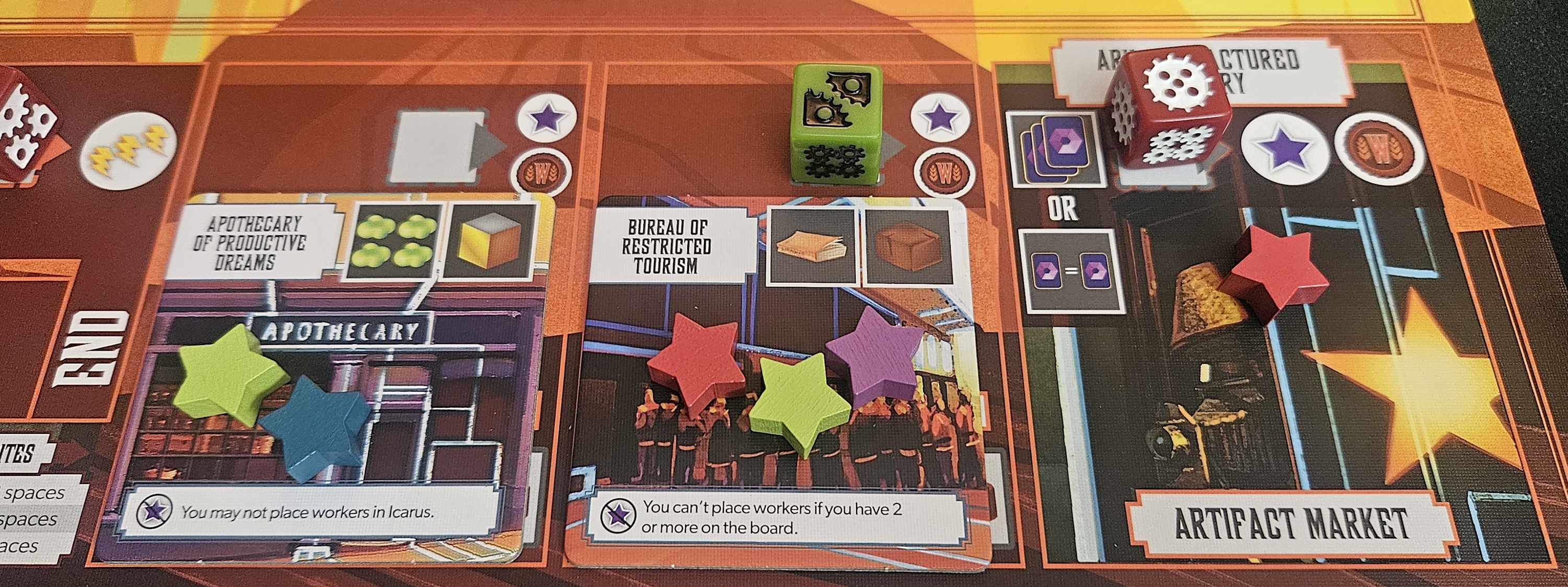
E:EE is full of little textures. Some of them are abrasive.
Because Euphoria has been left behind. By board games as an iterative artform. By our hobby’s collective taste in the role of chance. By an Essential Edition that leaves some of its most interesting ideas in the dustbin. By a culture that’s grown weary of dystopias.
Speaking only for myself, I think it’s time to tunnel through to the other side.
A complimentary copy of Euphoria: Essential Edition was provided by the publisher/designer.
(If what I’m doing at Space-Biff! is valuable to you in some way, please consider dropping by my Patreon campaign or Ko-fi. Right now, supporters can read my first-quarter update of 2026: the best board games, movies, books, and more!)
Posted on May 26, 2026, in Board Game and tagged Board Games, Euphoria: Build a Better Dystopia, Stonemaier Games. Bookmark the permalink. 5 Comments.


I am baffled that Stonemaier is just muting the beautiful and thematic game boards into “streamlined excel sheets”. Original Euphoria had a wonderful board. As did Viticulture (now turned into Excel sheet of Bordeau). As did Libertalia. Stonemaier just loves plain muted mechanism boxes.
I’m on the fence on this one. Missed the first iteration and with a Stonemaier Champion discount and the promise of the brand’s “playability”, I might spring for a copy.
Wooiee! Having held on to an original copy/expansion without playing it at all, even solo, I was quite looking forward to renewing my efforts to get others involved but it sounds like they would not appreciate the opportunity unless they have only been playing Stone Age for the last 10 years.
Quite keen on Chris’s viewpoint about the board as I hadn’t looked yet. I received the update pack but the board had been damaged. Bubble wrap envelopes are somehow the distributors trans-Tasman shipping method of choice which ignores the historical damage anything coming from Australia has to endure. So now I will have two undesirable boards, yeah!
All the best.
Euphoria random rolls were something that make it avoid the first time round. Guess they did not think it warranted revision, even if i feel the game should have gone in the direction of Apiary (of course that would create competition in their catalogue). Now, what they did to the board almost feel sacrilegious, the old one was marvelous.
Pingback: Clammy Scythe-on-Expeditions Action | SPACE-BIFF!