Wingspan for Mandy
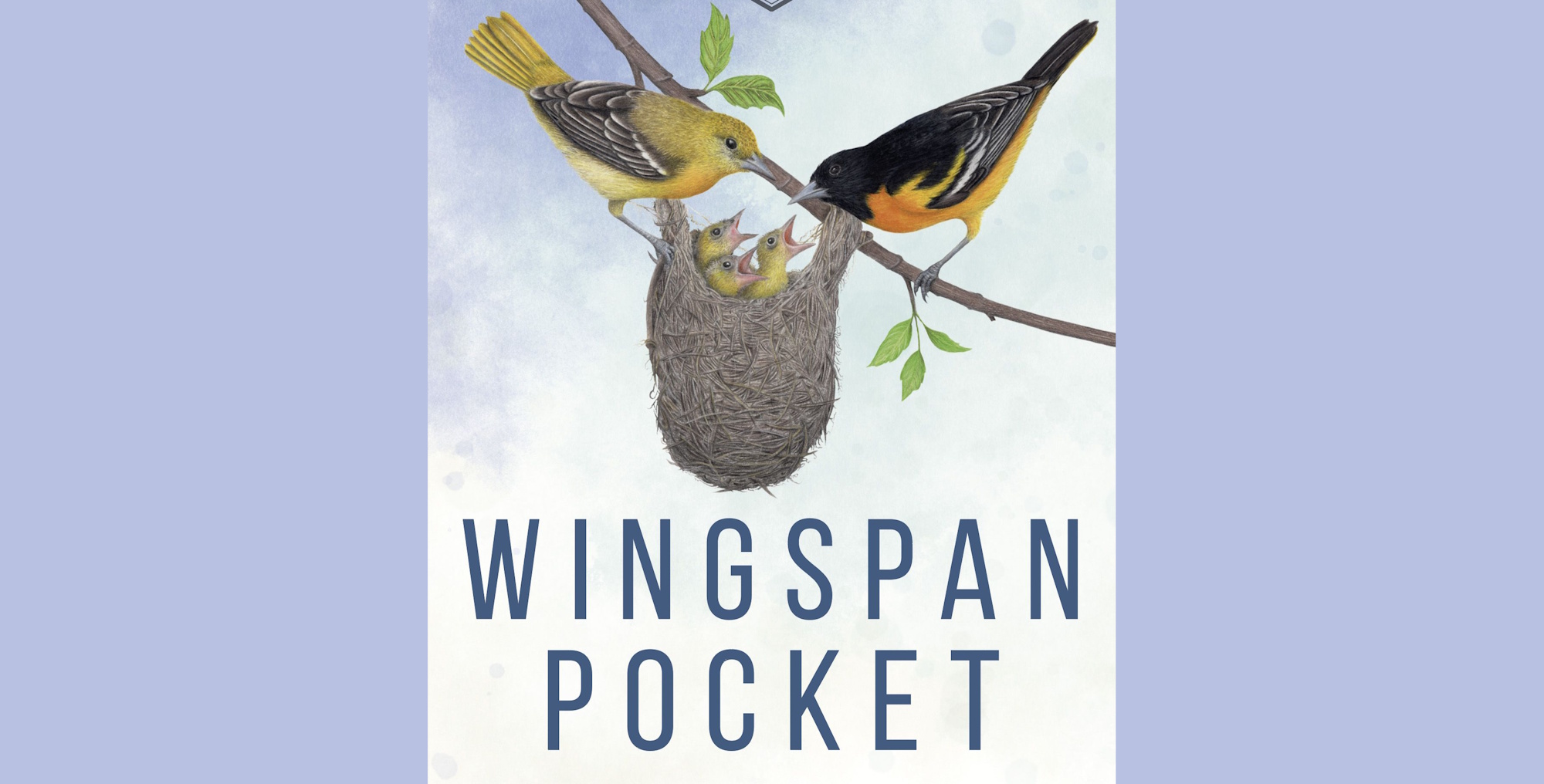
“Wingspan but smaller, simpler, and shorter” isn’t half-bad as pitches go. That’s precisely the niche Wingspan Pocket carves out for itself. In every way that matters, this is Wingspan, Elizabeth Hargrave’s 2.6 million bestseller, all birds and combos and speckled eggs, but slimmed down to a blue-footed booby’s webbed footprint.
I’m convinced that it might even be better than the original. For the doubters, it’s certainly shorter.

A compact, single-tiered tableau of birds.
Like the best exercises in compressing a game to a more portable version, Wingspan Pocket captures the appeal of the original while also nipping and tucking the experience down to its most essential components. Gone, for example, are the player boards. Gone is the dice tower; it would look silly without any dice. Gone are the resource tokens, traded for the reverse side of each card, adding decisions to the market by way of shuffled grains, worms, fish, and berries.
The remainder represents Wingspan at its most essential. The cards, of course, as those are the main feature. You can’t have Wingspan without the wingspans. The speckled eggs have also returned, occupying as much box space as the cards themselves. Where would Wingspan be without the eggs? According to Wingspan Pocket, nowhere anybody wants to be.
Between the cards and eggs, Hargrave recreates the magic of the original game at a fraction of the size. It’s an impressive exercise in minimalism. Where the original game could occupy upward of an hour to play — maybe longer with the wrong player count and indecisive players — this one hovers closer to thirty or forty minutes. The slimmer card pool doesn’t even feel like a limitation thanks to how the cards regularly randomize between their resource and bird sides.
That same trimness goes for the rules as well. Wingspan could occupy quite a bit of tabletop real estate. The biggest difference with the pocket version is that the original game’s three tiers have been reduced to a single row. Thanks to the market, it isn’t quite small enough to squeeze onto your average in-flight tray table, at least not without some overlap, but it could fit comfortably atop a hotel desk or picnic table.

The market offers cards as both birds and food sources.
One’s collection of birds, meanwhile, is handled with tremendous ease. If anything, it now feels closer to the exploration from Connie Vogelmann’s spinoff title, Wyrmspan. Using a wooden feather to mark your place, you walk from left to right, triggering each bird in turn. The first card is always your nest. This allows you to either play a new bird, lay a few eggs, or draw a pair of cards from the market.
From there, each bird gets its moment with the feather, and this is where the game shines brightest. The cards have been streamlined from Wingspan’s previous incarnations, pruned of end-game scoring abilities and rulebook-flipping outliers. Instead, there are two mainstays: activation abilities, which trigger when you land on them with your feather, and ongoing abilities, usually in the form of discounts.
In both cases, their effects are crisp and legible. Of course, this forthrightness serves a greater purpose, encouraging everyone to build a strong tableau. While Wingspan Pocket is more easygoing than its parent, it’s no slouch as a race to wring as many points as possible from a maximum of six birds. There are micro-economies to manage, usually revolving around eggs, a healthy hand, and maybe some tucked cards. Certain actions, like laying eggs or picking up some meager offerings from the market, feel like miniature defeats when the right birds might allow you to get them for free. I was also pleased to see that predators had returned, letting players hunt cards from the market based on their relative wingspans. It’s notably simpler, but there’s still room to tinker. Or to glare jealously at what your rivals have built to work with.

Optional objectives further shake up the formula.
For some, this streamlining may prove overly enthusiastic, and I doubt it will do anything to persuade the doubters. The closest analogue is a single round of Wingspan. There are optional goals, but these are triggered once rather than swapped out across the game. That single tableau of six birds is slender, theoretically capable of bringing the game to an end within a half-dozen rounds. At times, I was surprised at how quickly a session concluded.
But I take this as a good sign. At no point did Wingspan Pocket overstay its welcome. It was akin to a friend dropping by to return a tupperware from the other night, chatting for a few minutes on the doorstep, and then leaving before the conversation had a chance to grow stale.
To be clear, I’m not trying to damn Wingspan Pocket with faint praise. It isn’t good only because it only inflicts itself for a few minutes. It would be good at twice the duration. It would be good if it were three times this size. It would be good if it were Wingspan.
Far more than that, however, it’s good for the way it preserves its core experience for a new audience. My seven-year-old is smitten with Wyrmspan for its dragons, but our draconic sessions require me to two-hand the whole thing while she breaks ties between the decisions I’ve presented to her. Wingspan Pocket, by contrast, is fully within her control. There are elements she’s grappling to fully understand; for all their simplicity, these birds still require some degree of skill to combine. But she can trace her row from side to side. She can translate the icons into a functional language. She can identify which birds are affordable or beyond her immediate reach. She’s playing the game on her own, rather than half-spectating.

My seven-year-old loves it.
That’s no small thing. As someone who has loved Wingspan and its offshoots since its release seven years ago, that’s the kernel of this game’s appeal. It cuts across boundaries. It’s slight enough that it doesn’t take major headspace to play, but offers just enough density that someone can dig in and build something truly monstrous. It’s gentle and affirming, yet carries sharp enough talons to let a raptor rip into a sparrow.
Wingspan Pocket preserves that. In many ways, it does something better. Where the original game required upkeeps and phases and a rulebook that traumatized a famous actor, this is Wingspan as a bird gliding motionless in the sky, elegant and at ease. We don’t see the work that went into its effortless glide. We don’t see the long evolution of pneumatized bones. We don’t see the rapid flapping that lets it take flight. Nor do we see the hardscrabble hunt for calories.
That, to me, is what Wingspan Pocket represents. This is a mercilessly developed and hawkishly fine-tuned experience. It works as a race between falcons or as a lazy Sunday activity with downy fledglings. I think I prefer it to the original. Now do the dragons, please.
A complimentary copy of Wingspan Pocket was provided by the publisher.
(If what I’m doing at Space-Biff! is valuable to you in some way, please consider dropping by my Patreon campaign or Ko-fi. Right now, supporters can read the next installment in my series Talking About Games, this time tackling the topic of what makes a good list! Naturally, the piece includes a list.)
Posted on July 7, 2026, in Board Game and tagged Board Games, Stonemaier Games, Wingspan, Wingspan Pocket. Bookmark the permalink. 10 Comments.


I am so excited for this. My family likes Wingspan a lot, but some of our family members struggle with the long play time and some of the rules. This seems like it will be perfect. Thanks Dan!
Sounds like a perfect fit, then!
Great review! I wonder if you’ve played Reforest. It felt (in most superficial but also in some substantive ways) a bit like Wingspan the Card Game, but about growing a forest rather than collecting birds. One of the clever things that game did was use the plant cards as the cost of playing other plant cards. Wingspan Pocket, with its different food costs on the back, sounds like an exciting evolution of that idea.
I have not! Would you recommend it?
Very much! Technically plays up to 4 or 5 players, but it’s a phenomenal solo game. It’s a beat-the-target-score solo game, with the target score determined by the specific cards dealt into the deck for that particular session. The higher scoring plants you have access to that game, the higher your target score is. It’s pretty slick.
But if you look for it, look for the original game rather than the Old Growth expansion. There’s something about a medium-weight-hand-management-engine-building-game-in-a-tuck-box-of-cards that the added complexities of the expansion, with its larger box, doesn’t improve on.
Thanks for the recommendation! I’ll keep my eyes open for it.
looking forward to playing this when energy or time is low in supply. Completely agree, bring on the dragons next!
I’m glad to see that the same illustrators were employed. Their work appealing to me much as does that of the masterful Roger Tory Peterson presented a temptation despite understanding that the original game would probably wear out its welcome in terms of the kind of thing I like.
That this development retains provision for up to five players is another feature I appreciate. It’s part of why Viticulture is another Stonemaier release on my list of potential acquisitions.
Wingspan didn’t agree with me. Probably ate too many eggs.
Wyrmspan Pocket please.