Touch Grass (Metaphorical)
Voyages, the first of Matthew Dunstan and Rory Muldoon’s single-sheet print-and-play roll-and-write games, used three dice. Aquamarine used two. Waypoints continues the trend by using a single die.
That’s cool in its own right. But that isn’t what makes Waypoints special. What makes Waypoints special is the way it handles the movements generated by its rolls. Where those other titles — and let’s face it, most board games — featured straight movements, point to point, A to B, nearly every move in Waypoints is the sort of move you might actually make while traversing an open space.
Here, I’ll show you.
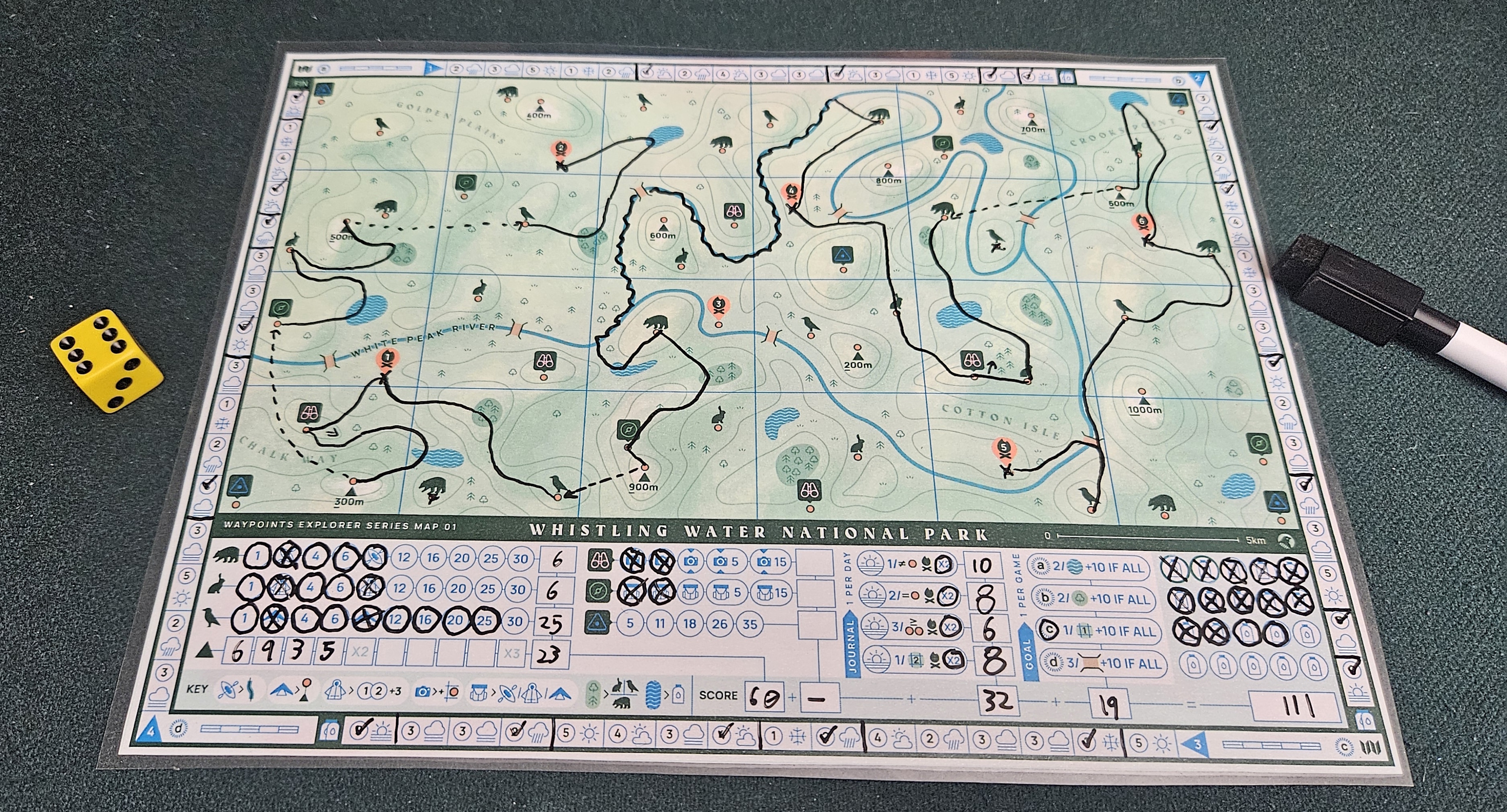
A glimpse of the first map and the many places it might take you.
You’ve taken the Internet’s advice to touch grass. And with gusto, because rather than go to the park or something, you’re opting for a four-day wilderness expedition. Hopefully you aren’t prone to hay fever.
The gist behind Waypoints is that every turn you’re allotted some number of movement points. The number itself depends on the weather, and isn’t as simple as rolling the die and moving as far as it indicates. Instead, your roll shifts you forward along a track and reveals the current turn’s weather for everybody at the table. Inclement showers or storms might confer only a single pip of movement, while sunny afternoons offer a full five points. You also have a limited supply of water, which can be spent to stretch yourself to greater distances.
Every move begins and ends at a waypoint. When the game opens, that’s a campsite. Turn by turn, that might mean a wildlife site, a peak, a hot spring, a scenic overlook, or any number of other destinations. There are plenty to discover, and across the game’s five scenarios there’s a fair bit of variety. Along the way, you might swing by special features, like water sources or forests, but these aren’t waypoints, just side destinations on your way to the main thing. If you can’t reach another waypoint, that’s fine, but it means you’ll be stuck at your starting point pumping some extra water instead of moving anywhere at all.
As for those movement points, they’re spent by crossing lines. Latitude and longitude? That’s a point. Elevation? Another point. A long-distance trek involving multiple map segments and lots of hiking up and down ravines? That’s possible, but you’ll probably need a decent stretch of good weather. That or guzzle tons of water.
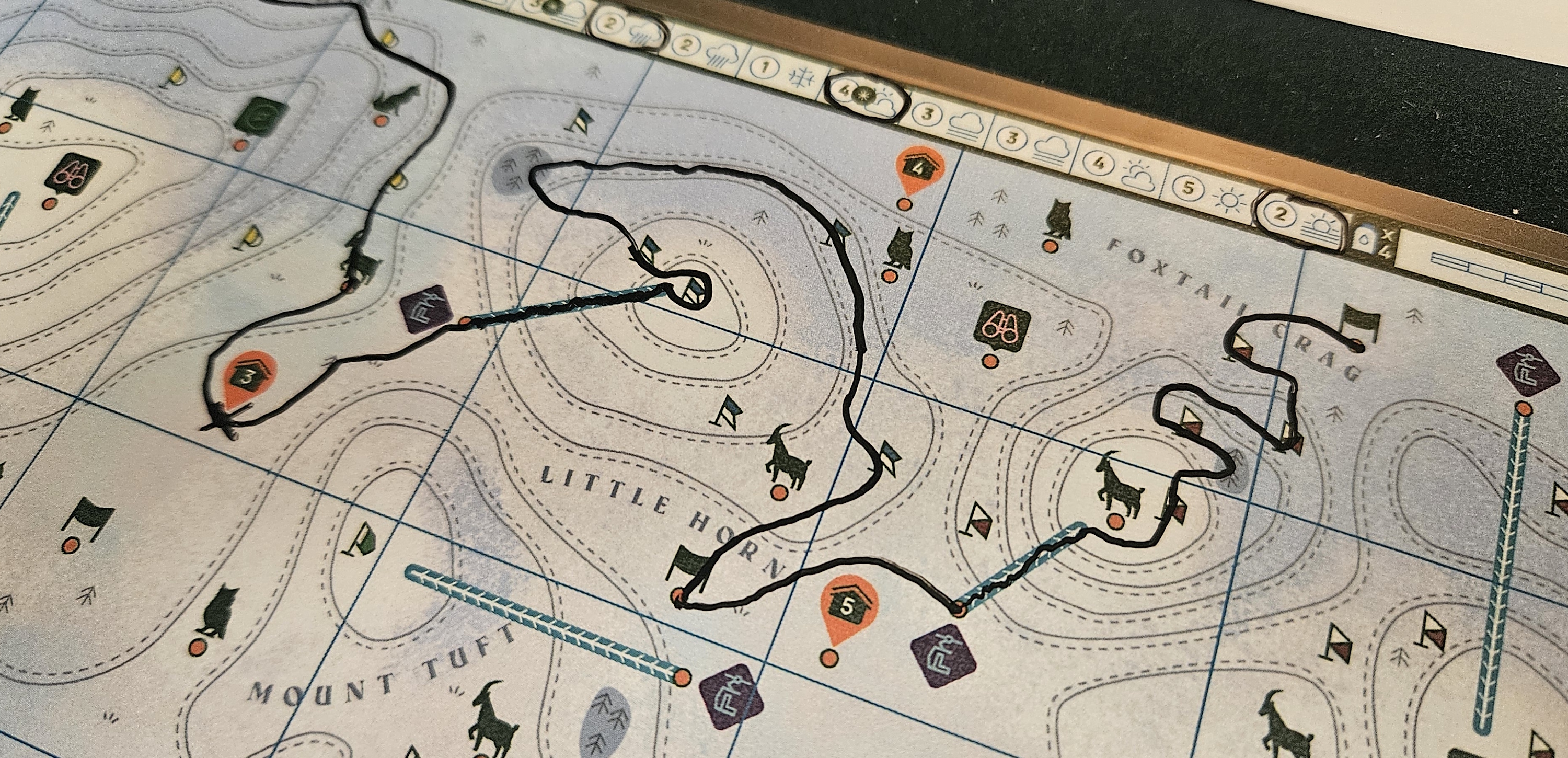
Each map prioritizes a different skill.
Very quickly, these inbuilt limitations give your movements a certain naturalistic beauty. Rather than dealing in straight lines, as the crow flies, Waypoints challenges you to think like a gravity-bound creature. You’ll scurry along ridges, stick to gullies between rises, find open stretches of flat ground for traveling long distances, march up inclines in short spurts.
Of course, saving energy is only half the game. You’re here to see things. And the things most worth seeing outdoors are liable to be hard to reach. There’s a balance to be struck, then, between conserving your strength and pushing yourself to see the best sights.
But the result is a creativity of space, energy, and distance that’s rarely expressed in a medium as literalistic and rules-bound as board games. Often, the best route will be circuitous, the one that loops the long way around a peak. Or one that swings down a hill to collect some water, across a meadow to investigate a forest, and then around and up an incline where you’ll deploy a hang glider to soar to your next destination.
Because of course there are special abilities. In the first map, you quickly avail yourself of hang gliders and kayaks for covering great stretches of the outdoors. On other maps, your tools might include climbing ropes, cable cars, bicycles, snorkel gear, dinghies, ski lifts, or ferries. This produces fresh conundrums for each scenario. More impressively, these differences are also visible in the lines you draw on the map. In the desert, you tend to travel in spurts, sticking to shade or rationing your movement around the great canyon bisecting the map. On the ski slopes, shuffling upward is more difficult than gliding downhill, resulting in sharp rises followed by sweeping, switchbacked movements that visit feature after feature before arriving at the turn-concluding waypoint. In Waypoints, your mode of transportation is written directly onto the page, visible in the sweep of each route.
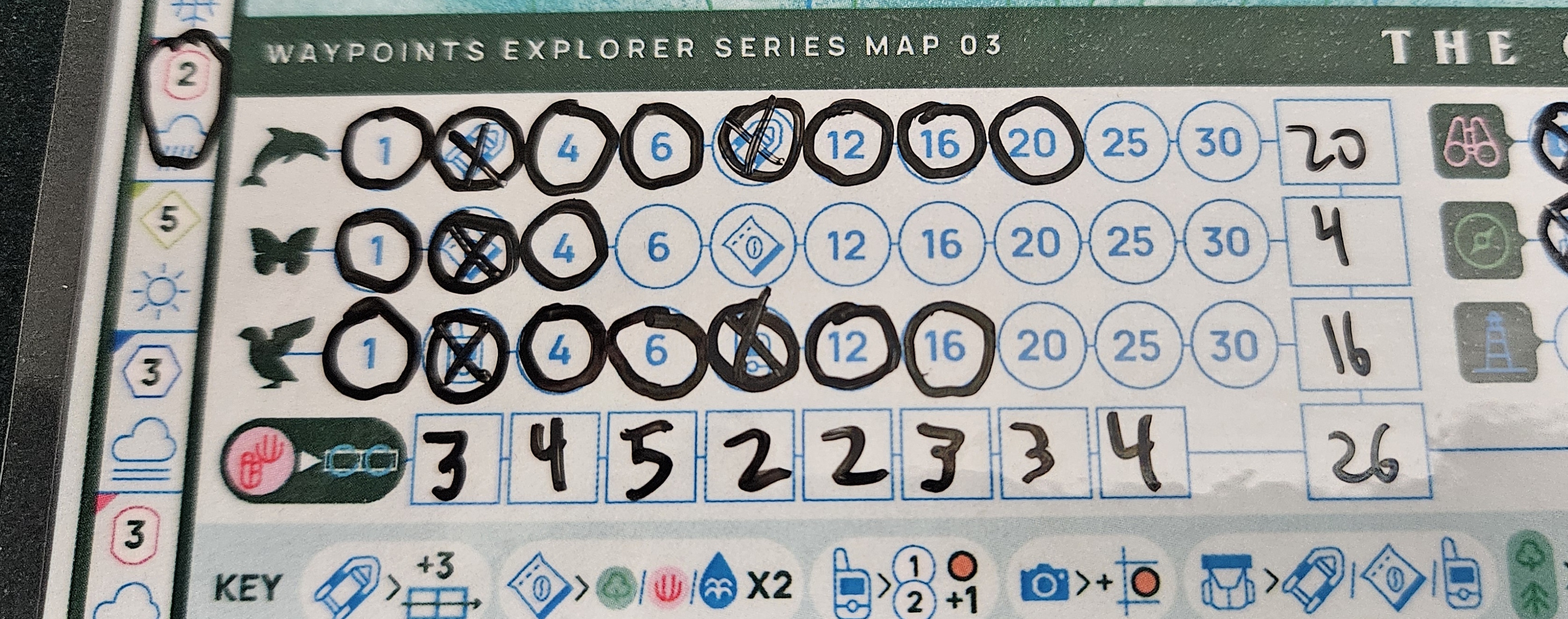
Meeting wild animals confers a wide range of benefits.
Like the previous entries in Dunstan and Muldoon’s movement trilogy, Waypoints is heavy with scoring opportunities. Fortunately, also like Voyages and Aquamarine, the scoring is interesting at all points.
The main commonality between maps is wildlife. There are always three types to see, and apart from occasional oddities — on the coastal map, the majority of my dolphin sightings occur in forests — it’s rewarding to watch your appreciation tick upward, earning not only points but also additional tools to make traversal easier. Beyond that, maps grow more playful. In one, reefs earn additional points later in the day, creating a situation where you’re incentivized to visit them late, but not so late that you get stranded when the day unexpectedly comes to its end. In another, you parcel out slugs of whisky between visiting local breweries or slogging through lochs in search of monsters.
Perhaps the one sour note is yet another repeat: the solitaire mode is a letdown. As with Voyages and Aquamarine, this is one roll-and-write that’s far more interesting to experience with other human minds. The problem is that the solo objective is incredibly easy in a vacuum, asking you to ensure that you conclude each day at a campsite. When that’s your primary objective, it’s a thing easily accomplished.
With fellow trekkers, the real goal is to wring every last point out of an imperfect day. Some hikes will be cut short, the caprice of the dice only offering a small handful of turns before the sunset brings your trek to a close. Others might even go long, your hiker hovering around a natural concluding point, only to find themselves distracted by extra sights. Regardless, there’s something satisfying about facing challenge after challenge, feeling like everything is going wrong, only to look at a rival’s sheet to discover that, you know what, your journey was rather remarkable in the end.
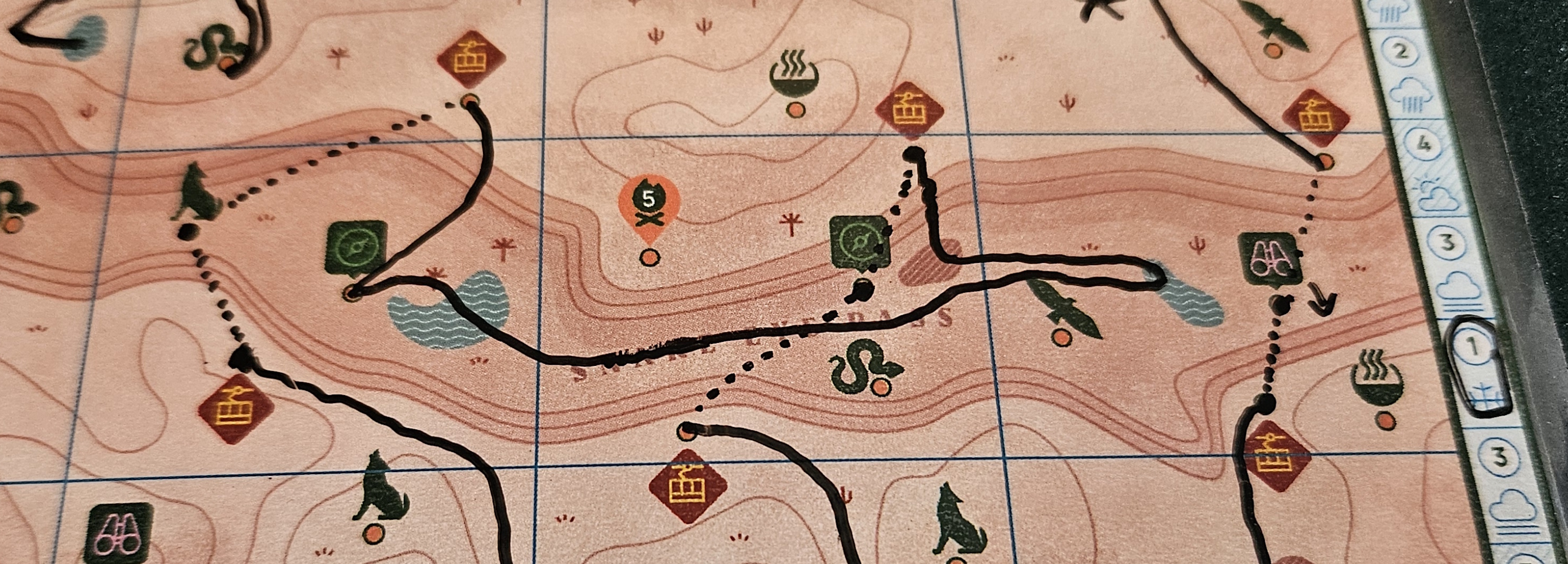
That time I scaled the Grand Canyon eight times in a day.
That’s the last great thing about Waypoints. In the minute between scoring and erasure, you get to look back on this thing, this little journey, and behold what you’ve accomplished. The strange loops, the reversals, that time you got stranded at a lighthouse for the night. The stories this game tells are small and gentle, but that’s also what makes them worth tracing one last time. This is no battle. There are no foes to vanquish. Only you, a fellow player or ten, and the routes you penned onto a map.
It’s a rare game that lets its players be so expressive. That Waypoints does so much with a sheet, a pen, and a die is nothing short of wonderful. I liked both Voyages and Aquamarine; against all odds, this one outdoes both of them at their best.
Access to the files to print Waypoints was provided by the publisher/designer.
(If what I’m doing at Space-Biff! is valuable to you in some way, please consider dropping by my Patreon campaign or Ko-fi. Right now, supporters can read my first-quarter update of 2026: the best board games, movies, books, and more!)
Posted on May 18, 2026, in Board Game and tagged Alone Time, Board Games, Postmark Games, Print and Play, Waypoints. Bookmark the permalink. 7 Comments.


Waypoints is probably one of my most-played games of the last years. Every summer, sitting in front of our tents, I play this with my kids. They get so caught up in the hike that they forget to play for points. We do kind of play it solitaire and don’t care who wins in the end. But it feels like we were on a hike together. My kids even discuss where to meet up. “Are you going up the river? I’ll meet you at site 4.” It’s a wonderful gaming experience. I completely agree that there are few games that look as good when you’re finished. The funny thing is, my kids almost enjoy wiping the laminated sheets as much as drawing on them. Which is good, because after hiking with the pen, we usually pull on our boots on hike for real. A pure family game.
Thanks for another great review.
What a lovely family tradition! Thanks for sharing, kakapo.
Pingback: Combat Results Postcard | SPACE-BIFF!
Pingback: Forget the Flippers | SPACE-BIFF!
Pingback: Scribbly Koalas | SPACE-BIFF!
Pingback: Fifty-Two-Card Squick-Up | SPACE-BIFF!
Pingback: Space-Cast! #58. Postmarks | SPACE-BIFF!