Mandelbrot’s Game of Life
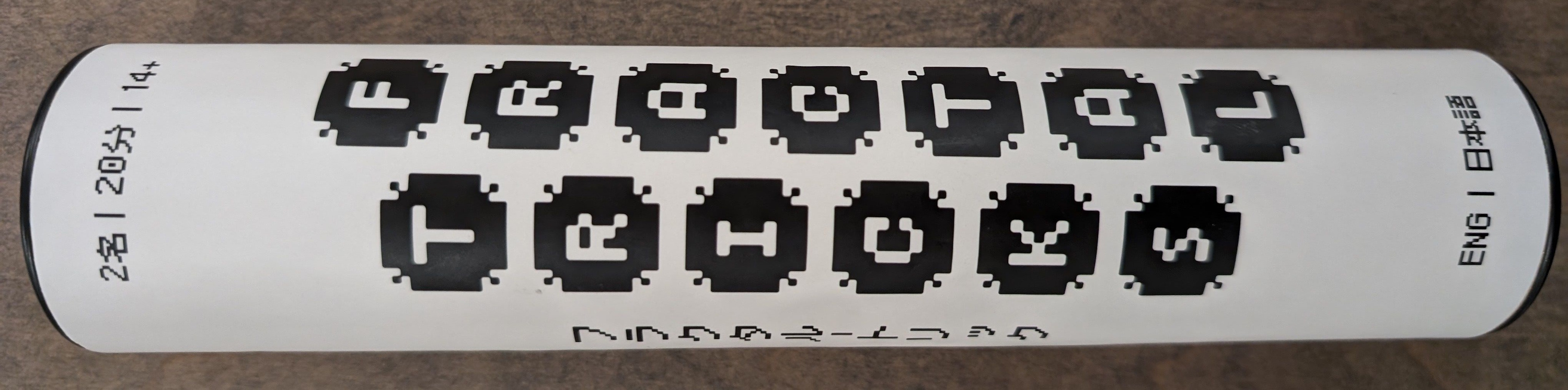
The Tokyo Game Market has long been a hotbed of innovation, especially where trick-takers are concerned. Sometimes the games don’t work entirely as intended, but, hey, that’s what it takes to transform the world one small iteration at a time. The bricks of the forum weren’t laid in a day.
Case in point: Fractal Tricks, the hybrid trick-taker by Jason Lee, doesn’t always function to specifications. Oh, sometimes it does, and in those moments it’s one of the tightest two-player trickers I’ve seen. But even at its worst, when one participant is rumbling the other — or more often, when both players are still fumbling through the implications of their moves — it’s still an engrossing look at how much remains to be discovered in this eldest of genres.
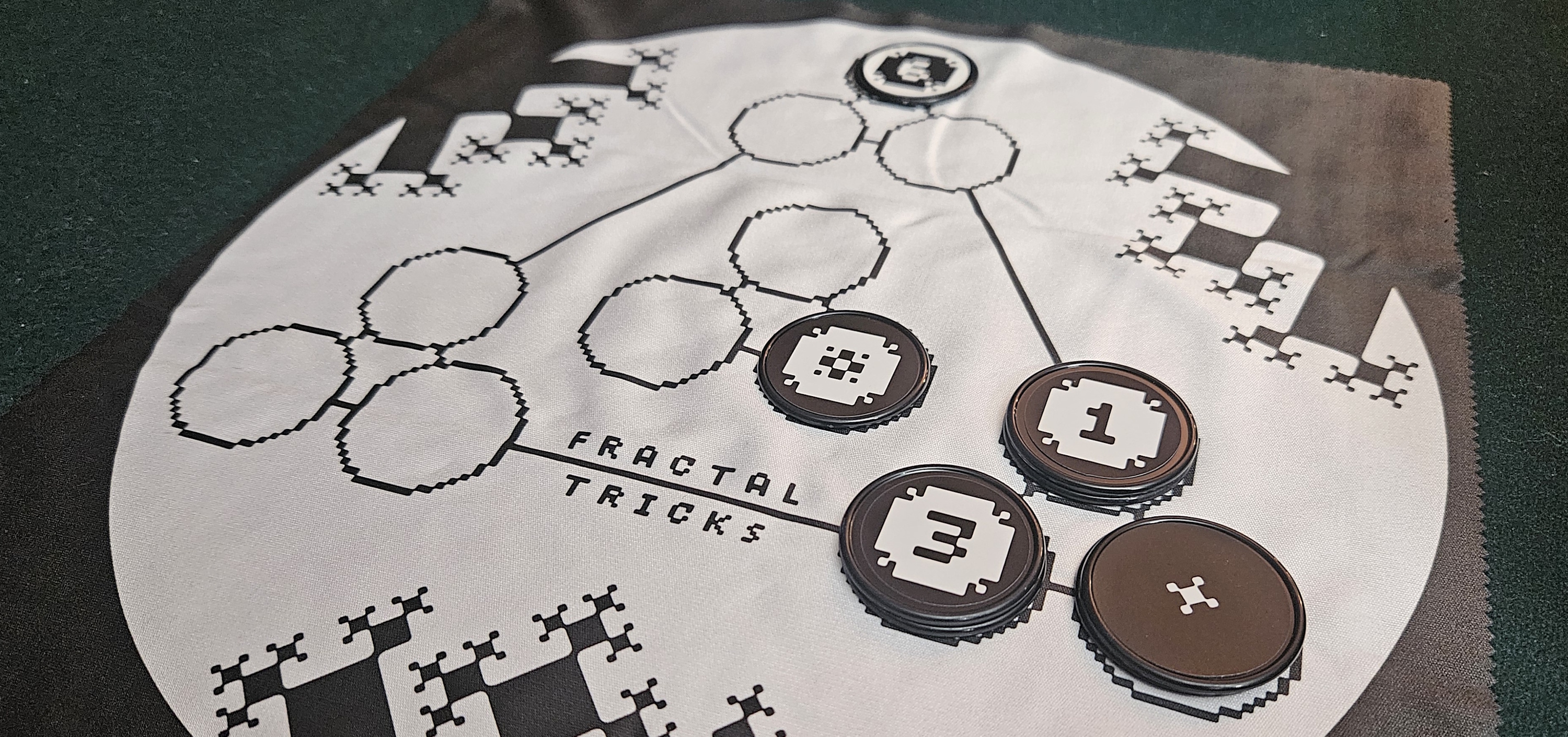
From this simple set of rules, infinite complexity shall be born…
It begins with some simple rules. There are only two suits. Black on white, white on black. Technically black on white on black and white on black on white, but let’s not get carried away. There’s also a mat. Three connected segments, each comprising three spaces, plus another segment in the middle.
As I’ve noted, this is a trick-taking game. For the most part, the rules are familiar. One player places a chip. Their opponent then responds with a chip of their own, sticking to the same suit if possible. High rank wins.
Except there are… adjustments that must be made. First of all, not all tricks are equal. Normally the high rank wins, but if the two chips have different suits, then the low rank takes it. Oh, and there are one or two exceptions to the must-follow rule. For example, if both chips sum to a total of nine, you can use the opposite suit, unexpectedly changing the calculus from high to low.
Secondly, the import of these tricks is hard to understand right at first. The participants in Fractal Tricks are no ordinary players. They’re cosmic forces. One of them, Cosmos — who I usually just call Order — indicates their wins on the mat by keeping the chips face-up. The other, Chaos, flips them face-down.
As soon as one of those little triangles has been filled in, the winner of the set places a corresponding victory chip in the middle of the board. To give a concrete example, if I’m Cosmos and I win two of those three tricks, the corresponding chip will therefore be white-on-black. If you win, now it’s a darker hue. Around we go, filling in all three sets of three tricks, nine in total, until the entire board is filled.
But flipping as many tricks as possible to our side isn’t our ultimate objective. Our real goal depends on our side of this entropic conflict. Cosmos wants to match a pattern on the edges with the one in the middle. Chaos wants to prevent that. Whichever side accomplishes their goal then claims the victory chips in the middle — but only the ones that correspond to their color.
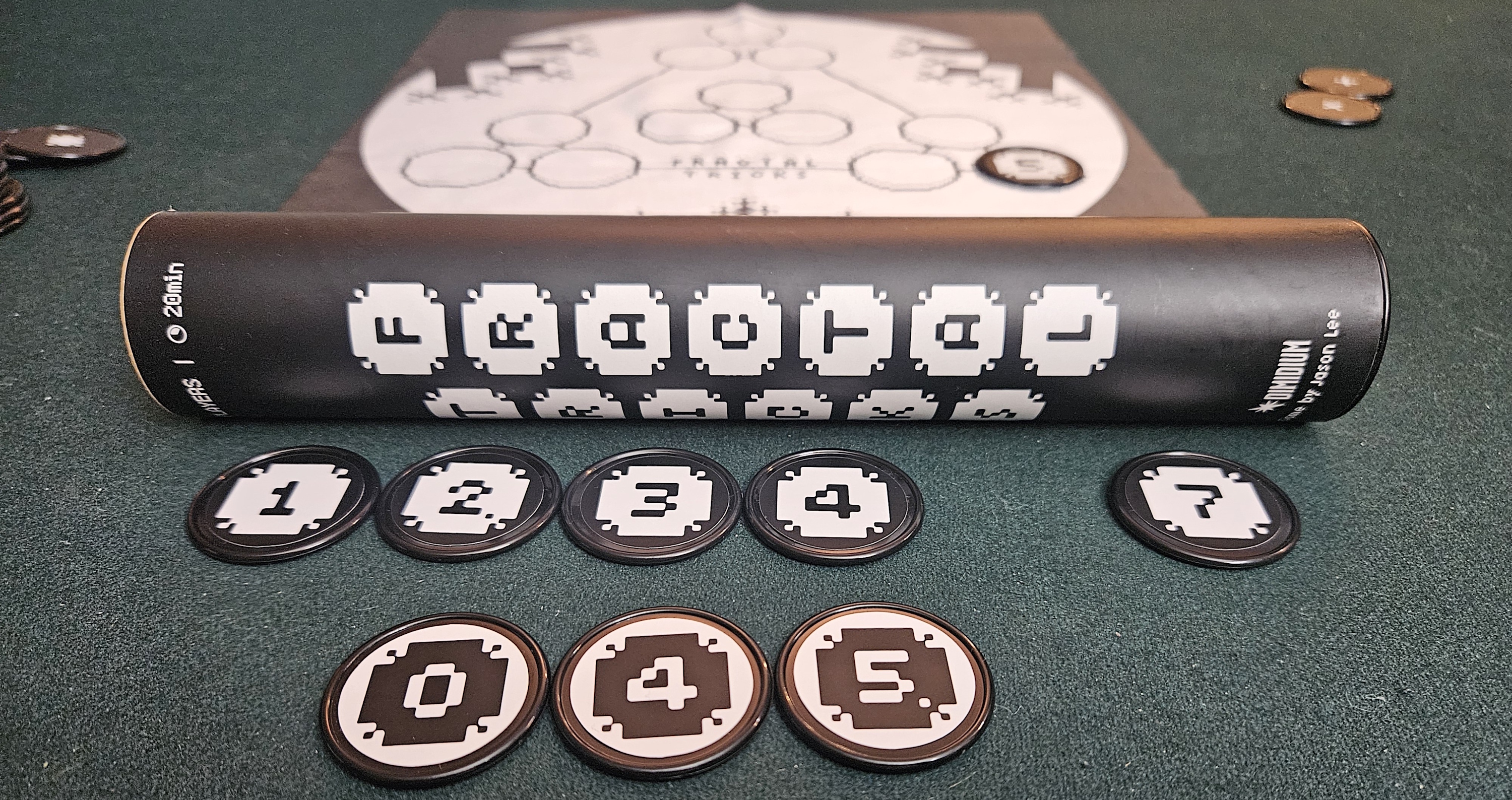
Hiding my chips from my opponent.
It’s a bit of a mind-burn, not to mention difficult to describe in text. Here’s the gist: one side wants to create a pattern, the other wants to prevent it.
Which very quickly sets the tone for the entire game. Early on, it’s tempting to win every trick. But as any seasoned tricker can tell you, trick-taking is often about the tricks you decline to take just as much as it’s about those you claim. That’s never been truer than in Fractal Tricks. The battleground is created on the fly according to your successes and failures, thrusts and feints. Often, winning a trick is the worst possible thing you can do, smothering a potential pattern in the cradle. Or, sure, breathing life into its lungs if you happen to be on the side of entropy. And the stakes only grow higher as new patterns form at the edges, gradually informing the one at the mat’s center.
To be clear, this is one of those titles that really demands repeat play. Its first session is a curiosity. Its second sees the rules begin to click. But it’s only on the third, fifth, tenth that its tactical breadth becomes apparent. With only those two suits and twenty chips, the game’s “card”-counting is as easy as it gets, paving the way for cautious play and bitter moments of zugzwang. But from that simple ruleset arises unexpected and emergent outcomes, especially as hands are increasingly depleted. There’s nothing quite like deliberately losing a battle so you can win the war.
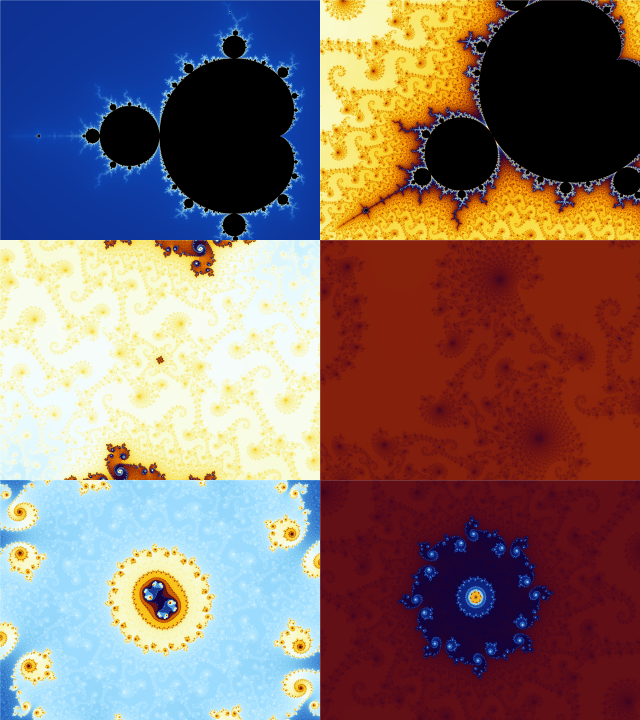
Simple rules begetting boundless emergence — it tickles me to see a game embody its central conceit so fully. Focused on only those nine input cells, Fractal Tricks swoops in like it’s examining the Mandelbrot Set. Here those rules can be manipulated, but never quite broken. Which makes for a tense standoff indeed.
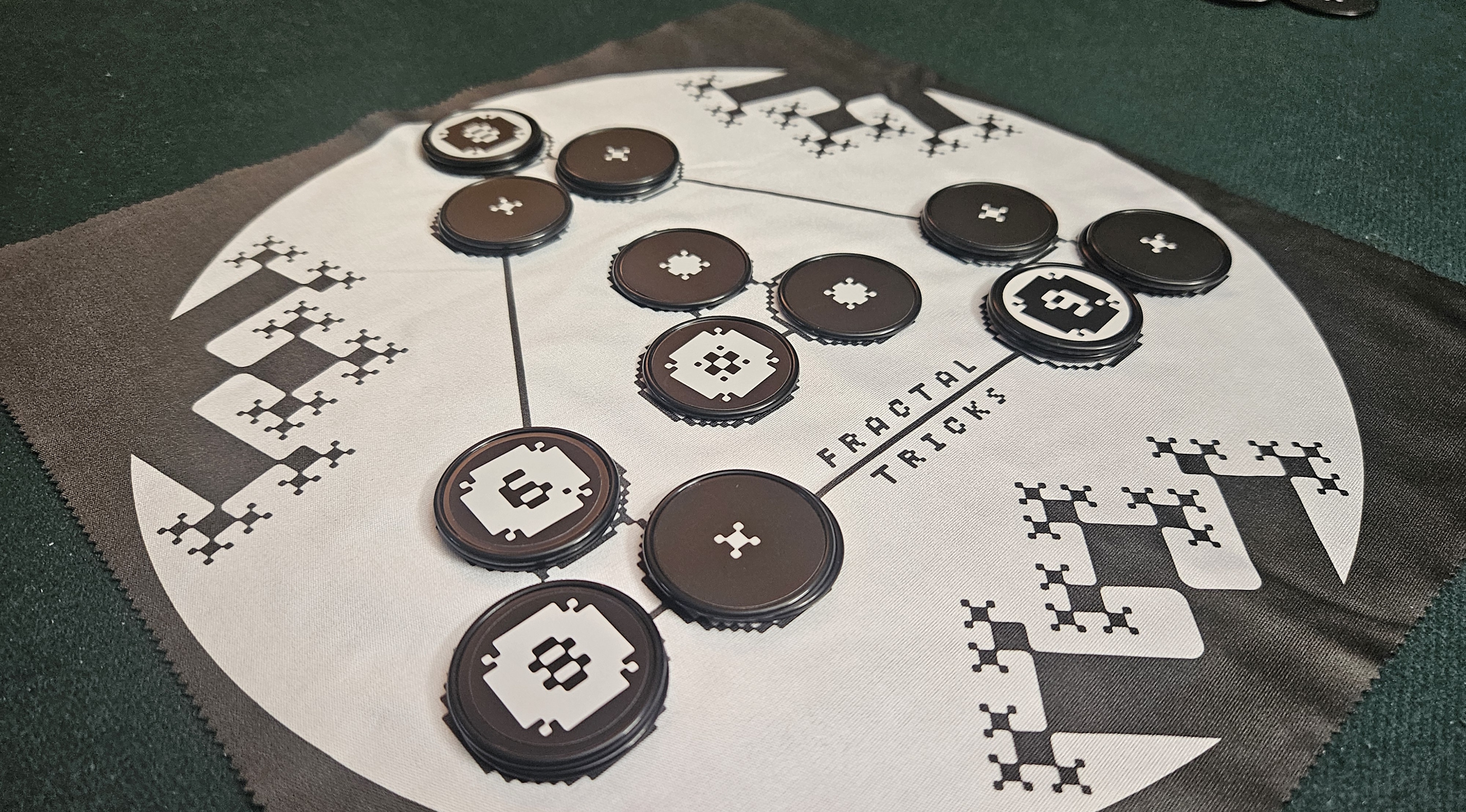
Pop quiz: Who scores? And how many points?
Like I mentioned at the beginning, Fractal Tricks doesn’t always work as intended. This is entirely a user error, a failure to really grasp both the game’s possibilities and its boundaries. But it’s a common error, a forgivable one, one that bears making and remaking.
I wouldn’t have it any other way. Even in the middle of a flubbed session that concludes after two brief rounds when one player bodies the other, Fractal Tricks is fascinating to handle. With some experience, it opens up. Or perhaps it undergoes magnification. Whatever the specific operation, the result is a game that’s simple on the surface, roiling in the depths, and eager to lure its participants ever deeper.
A complimentary copy of Fractal Tricks was provided by the designer/publisher and carried across the ocean by a different designer/publisher.
(If what I’m doing at Space-Biff! is valuable to you in some way, please consider dropping by my Patreon campaign or Ko-fi. Right now, supporters can read the next installment in my series Talking About Games, this time tackling the topic of what makes a good list! Naturally, the piece includes a list.)
Posted on June 23, 2026, in Board Game and tagged Board Games, Dimidium, Fractal Tricks. Bookmark the permalink. 5 Comments.


This game scares me.
Oh no! Why is that?
It’s brain-burniness…
Haha, fair enough.
Is the title of this review supposed to be a reference to John Conway’s famous ‘Game of Life,’ a 2D cellular automaton created in the 1970s?