Realishpolitik
Politik is one of those games I wish were more fantastical, which isn’t a ding on the game but rather a reflection of the slow-motion dystopia we have come to inhabit. Designed over the course of more than a decade by Jonathan Klabunde and Lukas Peregrine, Politik is the story of nation-states that use ideologies as cudgels, wage shadow wars over the airwaves, and spend lives like discontinued currencies. When its pretentious old men play at running the world, we are the counters they shove around the board. And they aren’t even bothering to hide it anymore.
Perhaps more relevantly, it’s also a mashup of new and old ideas, a flawed but enthralling piece that’s tough to learn but rewarding once the work has been put in.
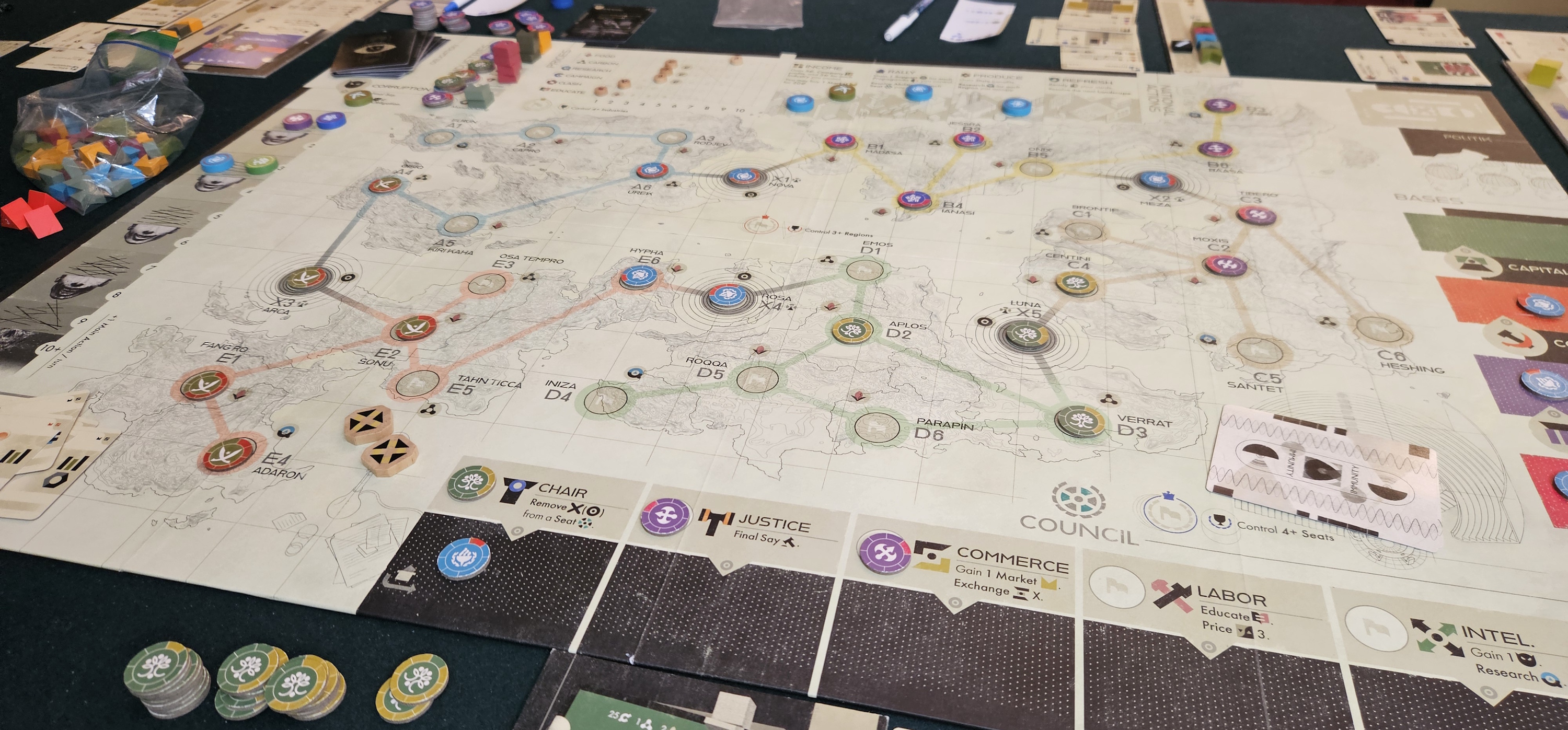
Our influence spreads across the globe.
Set in a world not unlike ours, Politik begins sometime after a collapse — capitalized, articled, and adjectived as The Great Collapse — has riven the political scene into a near-total vacuum of little states with hardly any defensive capabilities, a fragmented global economy ready to be pieced together by vulture corporations, and a handful of ascendant nations hungry to gulp down the whole bowl of noodles.
Right away, Klabunde and Peregrine put their best foot forward by asking players to select which of those nations they will command. Politik isn’t a narrative game, but it excels at weaving together little strands of story, and the first filaments of those yarns are the nations themselves. These introduce the basics, drawing everybody in with those first snippets of ideology. There’s Libris, marked with the gyroscope and the torch, indicating itself as a state that tries to walk the line between radical education and propagandistic unity. If that sounds too care-bear, there’s Gran Santi, all intimidation tactics and steely wit, or Indoverra, its honor culture clashing with an oath of poverty.
More than colorful nouns, these statements bear in-game import, providing a single starting propaganda card that dictates the nation’s opening ability and ideological tendencies. Indoverra’s honor culture, for example, means that conflict is the principal driver of their national research, not to mention that they’ll be shoring up their support of fascism as political ethos. If instead they select that oath of poverty, they become communists who can use their surplus goods to manipulate the markets. Libris, when leaning into their more humanistic impulses, closely links education and research. When they focus on unity, they earn icons for each of the game’s ideologies — capitalist, statist, communist, and fascist — marking themselves as hopeless centrists, but also effective at parlaying popular support by speaking out of both sides of their mouth.
Nation selected, everybody now gets down to the serious business of cobbling together a functional global power.
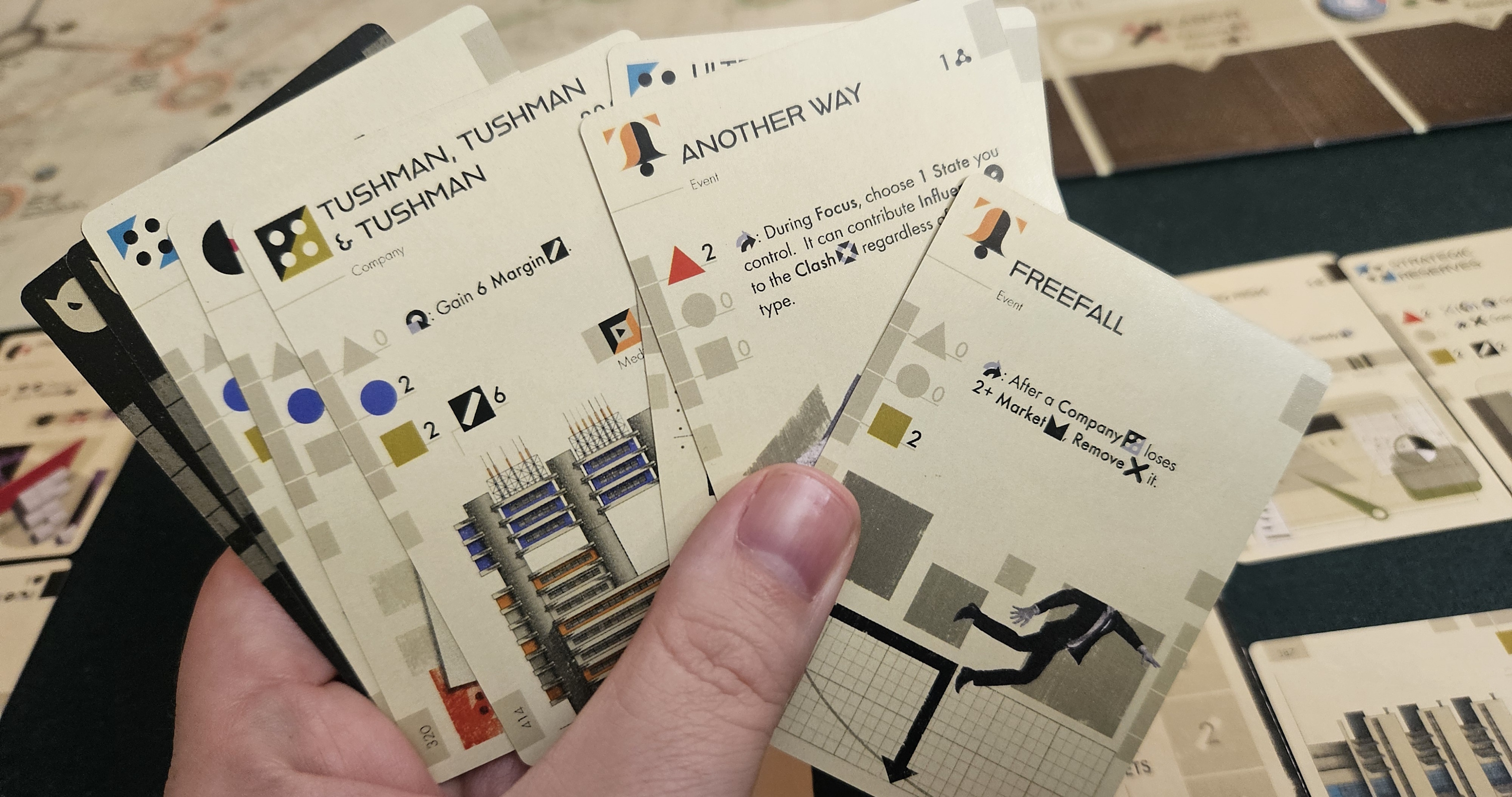
The art style is brutal and chilly, which is exactly right for this project.
This is much easier said than done. For one thing, everybody at the table is a hurdle on everyone else’s road to global domination. For another, Politik is about building a powerful tableau where the central components of that tableau aren’t especially amenable to being hammered into a self-sustaining engine.
Drawn at random, there are 450 cards in the deck, only a fraction of which will be seen in any given session. For all their variety — and it’s impressive how many concepts the game covers — Klabunde and Peregrine throw us a few bones. First, there’s the art. Evoking the Bauhaus, every card is hand-drawn with shapes and splashes of color that speak to its ideological function. Companies, the game’s primary method for securing resources and bullying markets, are sprawling brutalist edifices. The assets that transform them into even greater consumptive engines are more abstract, showing blueprints or term sheets or inventions. Propaganda cards are suitably ideological and colored according to their tendencies. Events, the game’s fire-and-forget attacks, might as well be printed on a poster and wheat-pasted to a concrete wall.
As with the nations, these cards are dense with iconography. Those icons come fast and heavy, and it takes a good few minutes to learn their exact phraseology. At that point, however, they become the game’s beating lifeblood, an expressive language that allows for impressive depth.
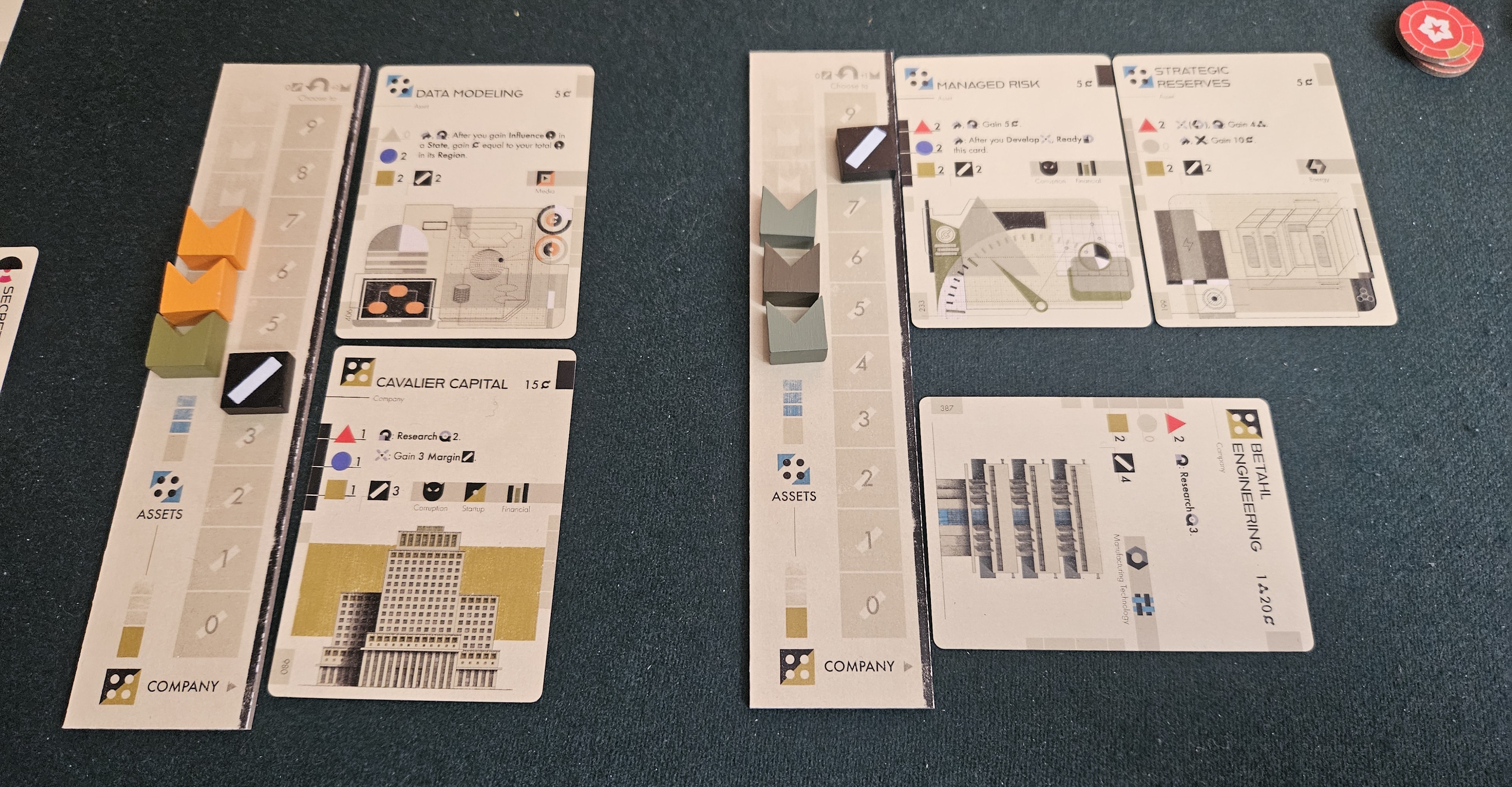
Companies are an essential tool for any horrible nation.
Take companies, for example. Most players will begin by founding their first firm, a process that requires a sideboard for tracking that company’s profit margin and market shares. What makes these companies interesting to handle is not only their newfound ability, but also their inborn limitations. I might set up Drundlworks, a company that can simultaneously conduct research (translation: draw cards) and improve its own margin (translation: get stronger). But Drundlworks is starkly limited to manufacturing, which means all its expansion will be wasted if I can’t diversify into other markets.
Okay, so I need to add an asset. I’m holding two. The first, Private Security, will expand Drundlworks into the humanities sphere. That’s great! Now Drundlworks can enter a new market, and it gains the ability to use its personal army to bolster our strength on the map. The hangup is that Private Security requires a certain degree of corruption to attach to a company, the cost of deploying this world’s equivalent of Pinkertons to police our states. Since I’m inadequately corrupt, I might settle for Joint Ventures. This expands our company into the financial market, which is good, although unfortunately the financial market is currently dominated by a rival. But at least our Joint Ventures will give Drundlworks some money-making potential, not to mention a negotiation icon, good for breaking ties in our favor.
By now a few things should be apparent. First, Politik is a densely knotted game. Every element touches every other element. It isn’t enough to stare at your own tableau. Success requires knowing who owns what.
And furthermore, knowing how those things can be broken or pillaged. There’s a mercantilist core to the way Politik’s scales are balanced to zero. In the game’s early stages, this is most apparent on the map, where states threaten to change hands early and often. I invade, you counter-attack. That’s the nature of the beast. It isn’t even necessary, in this age of hybrid warfare and jet aircraft, for our nations to be neighbors. Crud, I don’t even need to invade with actual forces. The right burst of noise from a broadcast station might be enough to fatally undermine a space on the map.
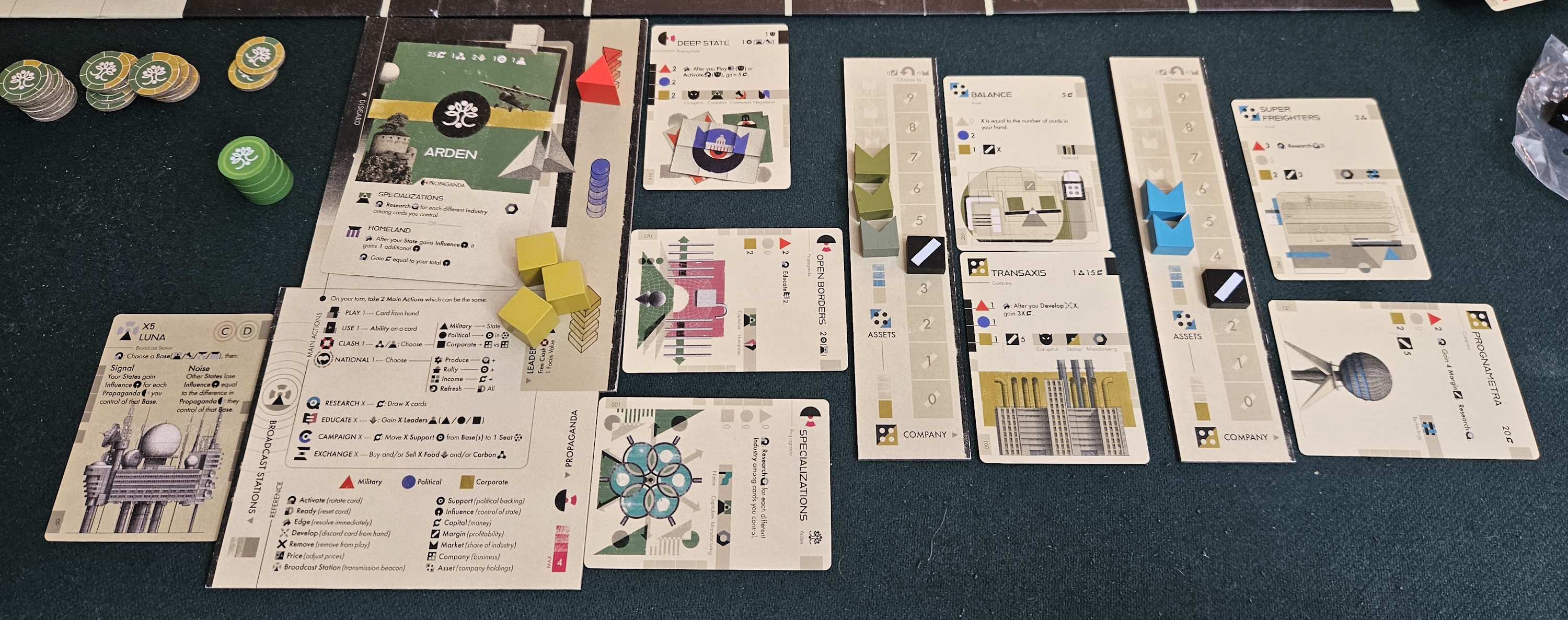
Broadcast stations, propaganda, and multinational corporations are the tools of your trade.
The game’s other domains are similarly imperiled. Companies can raid one another, their respective margins becoming an analog for military might and their market tokens traded in place of geography. There’s nothing quite like a late-game swing when one of the session’s oldest companies suddenly loses their market dominance to some upstart.
The same goes for council seats, the game’s representation of political might. Earlier I mentioned ideology tokens. These eventually come to represent support for seats on the global council, each of which provides its own benefit. Chairing the council lets you veto someone’s position; the board of commerce can secure the best market shares for their own nation; the defense seat grants immunity to those pesky propaganda broadcasts. And so forth, each conferring its own advantage. But these positions are shaky. All it takes is a well-timed clash, a few solid cards tossed out for their political modifier, and suddenly the player who was sitting pretty on the board of justice is out in the cold.
Despite their similarities, these domains — the territorial, corporate, and political — are distinct enough that they warrant their own approaches. Conquest on land is piecemeal, but can be bolstered or undermined by propaganda. Market shifts are as seismic as the markets. Political strength takes a long time to build but can be altered in an instant.
In each of these cases, players are encouraged to expand, but always to think through the repercussions of their newfound girth. This is probably my favorite element of the design. Expanding your territory means stretching your forces thin. That’s normal enough. But expanding in the corporate world means temporarily bottoming out a company’s margin, leaving it open to attack. Expanding on the council means there’s more room for somebody to swoop in and claim what you’ve so carefully built.
This isn’t to say you won’t expand. Indeed, there’s no winning without expansion. Victory in Politik is a tense thing, contingent on claiming enough “power grabs” in the game’s three domains. Each power grab requires a majority, whether on land, the corporate world, or on the political council. This initially seems impossible, especially in sessions with three or four other players. In practice, it’s a deft little piece of design, one that puts players within reach of an objective, only to snatch it away.
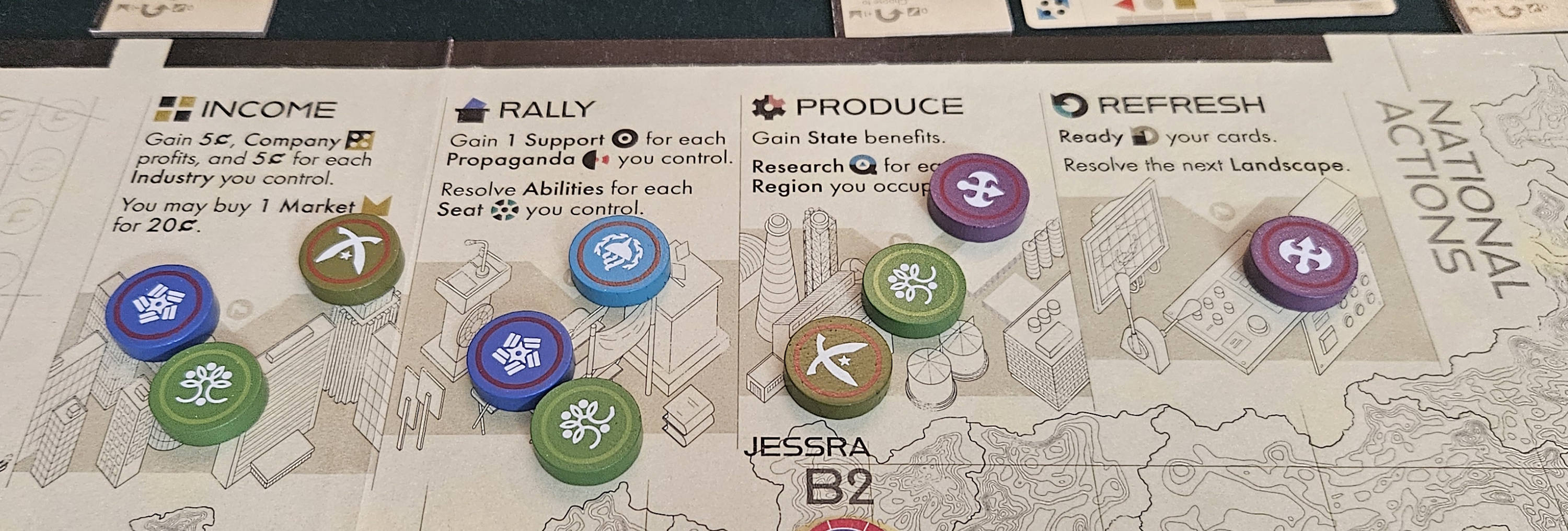
Some actions are more involved than others.
Even more cleverly, the way power grabs are handled makes them more viable once somebody has already secured one. There’s a limit, you see. If I obtain a power grab via conquest, I’m done, I hold that objective, there’s no longer a reason for me to keep all that territory. I mean, sure, there’s a reason. Raw resources, all that. But the victory condition has been wrapped on my end. My focus will now shift to the markets or the council. I might put up a token defense of my empire, but it won’t be as diligent as it might have been otherwise.
To some degree, this can result in a sticky status quo. If everyone is firing on all cylinders, it’s possible for the game’s length to grow indeterminate. Politik is only short when played inattentively, and since victory is tied to outright (if temporary) dominance, collaborating players can pull a leader back from the brink. Not always, and not reliably, but the threat is there. The game contains no version of the deeds from Inis, those little tokens that gradually deteriorate the game state away from its center to ensure that somebody eventually succeeds. It’s all or nothing, and there are plenty of ways to wrench a would-be dictator down from the throne.
Fortunately, the threat of stagnation has thus far remained theoretical. In my experience, the game’s innate swings have been enough to keep it moving toward a conclusion. It isn’t uncommon to suffer setbacks, and the clarity of the game state makes it easy to point out when somebody is getting a little too big for their britches. But my sessions have hovered at the three and a half hour mark, long enough to be satisfyingly fatiguing but not so long that anybody started into cussing. Cussing in earnest, anyway. Cussing is mandatory in such a game, but there’s cussing and then there’s cussing.
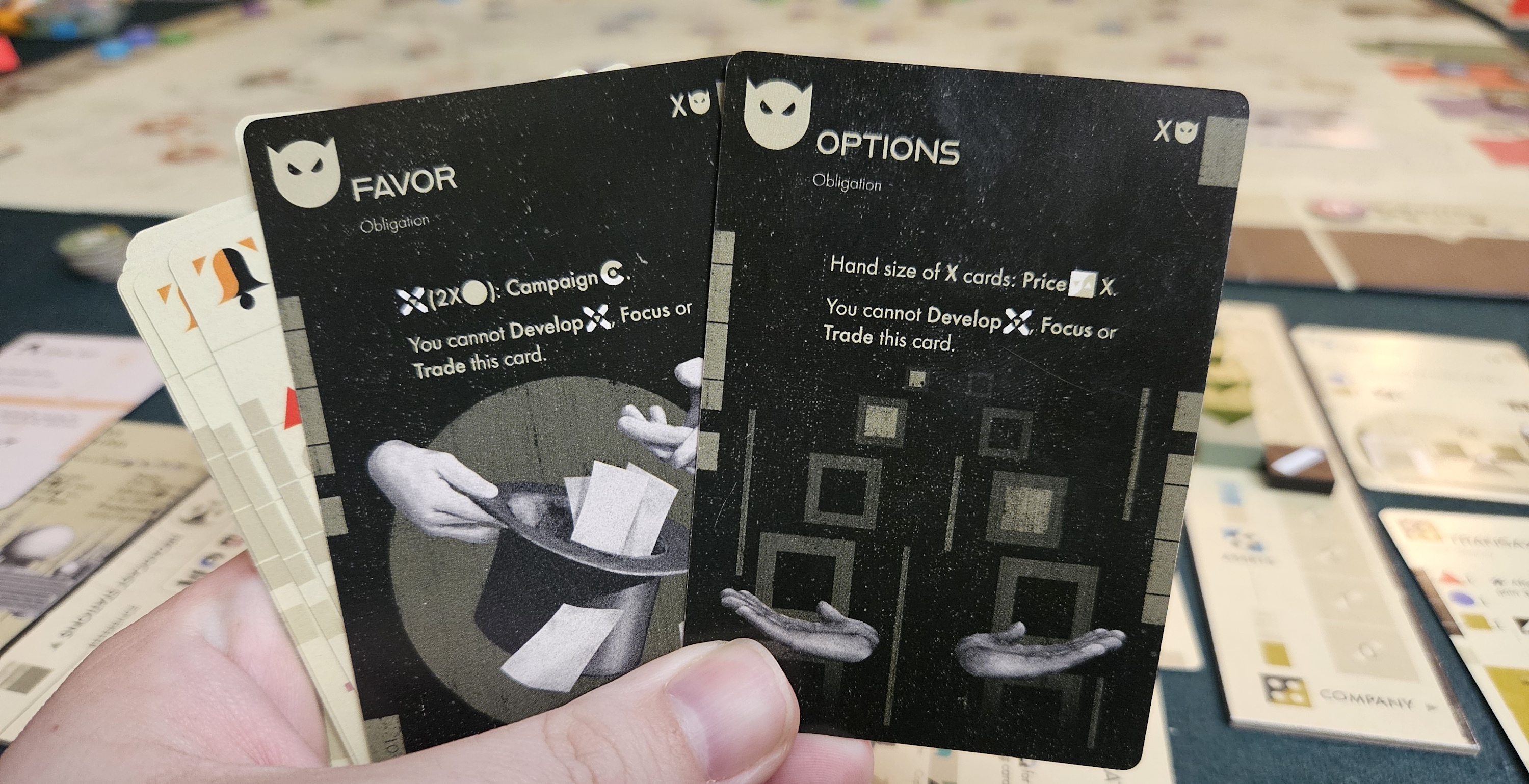
Corruption is powerful but also dangerous.
There are other little touches I can’t help but appreciate.
Like how your resources are tallied on paper rather than with tokens. At first this throwback seemed musty. Eventually it won me over, if only because it’s possible to leverage a company into some truly impressive profits, and I’d much rather just write “89” on a piece of paper than manhandle another stack of tokens into its proper change the way Hegemony inflicted on me again and again.
Or there’s the corruption system. Certain cards increases your corruption level; others require a degree of corruption before they become playable. But rather than leaving this as a mere threshold, Klabunde and Peregrine tack on another system that’s perfectly evocative of the way elites trade patronage only to entrap themselves in weird cabals. The gist is that each step on the corruption track forces you to draw an obligation card. When deployed at the right moment, obligations produce tremendous rewards. Then again, you don’t know what you’re about to draw. Some are harder than others to play, resulting in a black mark hogging up precious space in your hand. You thought you might owe some cash, only now you’re listening to Peter Thiel bray on about how high-visibility vests for warehouse workers are the antichrist.
Or there’s the way Politik takes place in an alt-history that has somehow produced the best and worst of our own recent past. This is a dark game, packed with ideologies of convenience and wars of plausible deniability and a global council whose flag is probably a giant hand choking the entire planet. Far from portraying itself as lurid — or worse, as aspirational — Politik adopts a tone of warning. Every so often, a card will reveal some effect that brushes up against our lived reality. A think-tank. Drone strikes. Data vaults, industrial farming, international monetary funds. The many little tools that make a state, that make surveillance, that can be bent toward absolute control. Just as they combine and slot together in Politik, so do they combine and slot together in our world. It might seem a bridge too far to call the game thought-provoking, but there are enough ideas floating around here — and time enough to fill between turns — that I found myself provoked anyway.
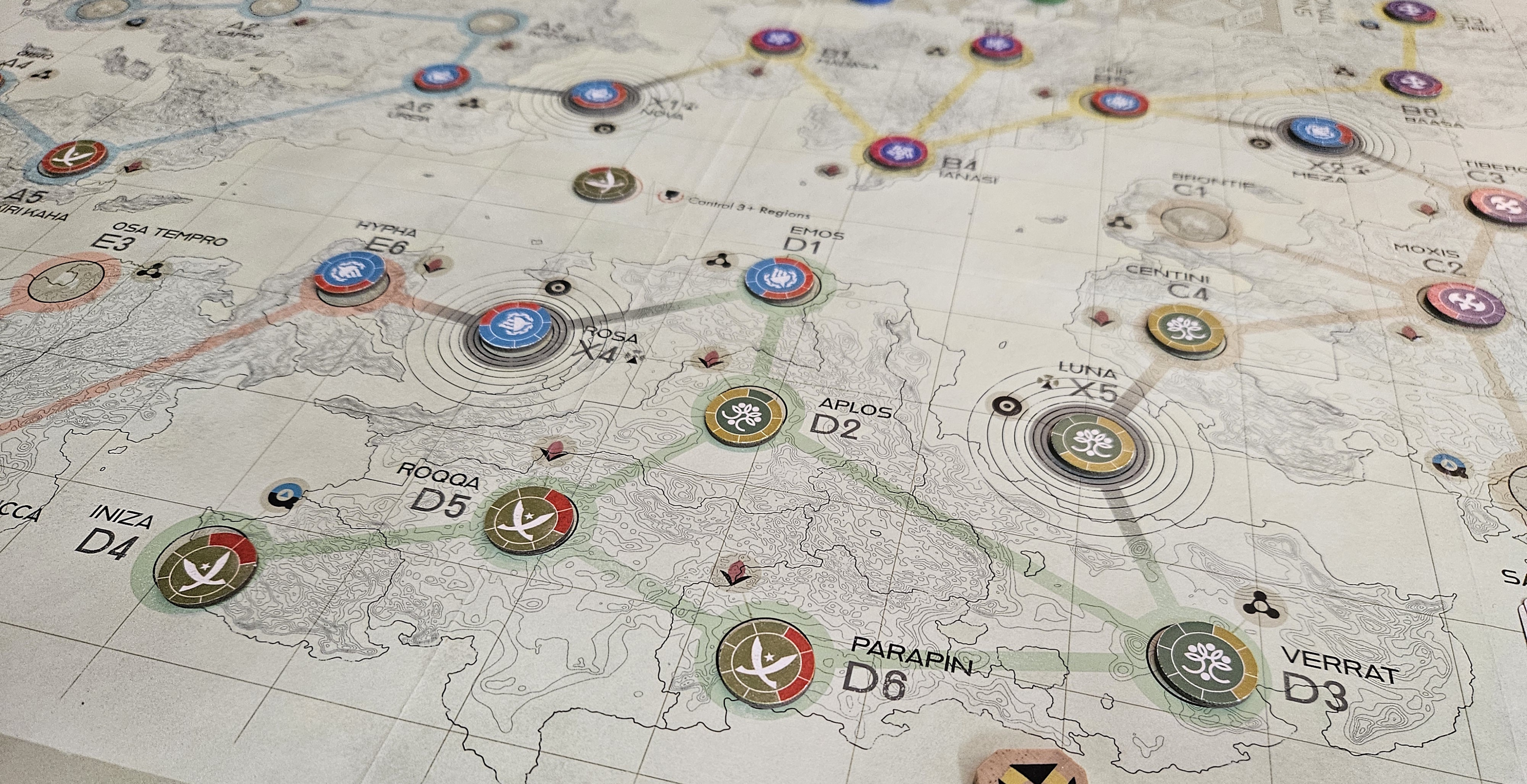
Sending out our tunes on the airwaves.
Ultimately, Politik is a peculiar beast. Its rules are convoluted. Its iconography takes some deciphering. It can run long. When somebody achieves their final power grab, it isn’t uncommon to hear someone breathe an unquiet “Thank goodness.” And not necessarily the winner.
But it’s also interesting and abrasive and spiky in exactly the way that most modern board games are not. It calls to mind some of my favorite games, but never too proximately. It reminds me of the Pax series in its broad noosphere, the sheer breath of what it invokes, with a directness that those games lack. It recalls Inis in its inter-player squabbles and collaborations, The King Is Dead in its oppressive tie-breaker considerations, but with harsher bristles and more granularity than either of those titles. Any number of tableau-builders, but with hostile cards that buck at being hammered into easy shapes.
Mostly, it makes me want to keep trying to rule the world. Not the real world. Only the loveless want that. But this shadow version of our world. It makes me want to be the horrid bottomless wretch determined to possess more than I already have, to spend a few hours in the company of these broken cards that can accomplish so much, to glare at the ruins of my plans and plots, to grasp and fail, and to be all the bitterer and emptier for the attempt. And then to step back, free of the circle, and laugh about how so-and-so pillaged my company for the privatized remains of the university system. Now that’s a game.
Politik is on Gamefound right this instant. A prototype copy was temporarily provided by the designers/publisher.
(If what I’m doing at Space-Biff! is valuable to you in some way, please consider dropping by my Patreon campaign or Ko-fi. Right now, supporters can read my first-quarter update of 2026: the best board games, movies, books, and more!)
Posted on June 30, 2026, in Board Game and tagged Black Yeti Games, Board Games, Politik. Bookmark the permalink. 6 Comments.


i have long wondered at the question of game duration as a peculiar issue in board gaming. On the one hand, some fascinating games have proven that the most epic and broad experiences need space and time, and only by lasting past the 3-5 hour mark can they truly achieve that depth. On the other hand, game duration is not just a purely static question of having a group that has the time to sit x hours to play a game. Invariably, as you said, fatigue sets in, and right as the the curve mentioned above shoots up, this new curve plunges. It might be why my search for the perfect game feels like looking for that unicorn that would achieve breadth without duration. Certainly, the 90-300 minutes “warning label” on this one proves to me that this cannot be that elusive creature. I might still add it to the Feudums and Hegemonies of my collection there to gather dust – the star type.
I don’t mind long games, and honestly three hours isn’t that long. But my overall attention span for a board game has definitely decreased along with the hobby’s appetite for longer experiences.
Really glad to see your take on this.
The art style immediately draws me in and I have a crew that enjoys nebulous and dense games.
I still have problems with the thought of the scratch pad for resource tracking (I understand counters wouldn’t work, but still wonder if there is another solution). There is also the concern of stagnant/stalemate or if the game ends up lasting longer than it would be welcome.
Yeah. It’s a game that comes with a few caveats, that’s for sure.
I’m fascinated by this game and the convo I’ve seen around. One thing that peaks my interest is it’s wide player count. Have you tried it at 2? How does it fare? For this complex games I usually struggle to get a bigger number of players and feels like this one asks for that bigger crowd.
thanks for the preview, lovely read as always.
I’ve tried it at two player counts: 3p and 5p. Honestly, it worked quite well at both, but I very much preferred the higher count. That probably isn’t a surprise. What I will say, though, is that it still felt very functional and interesting at 3p. It’s just that it lacked that vibrant interaction between players, with everyone tugging at whomever had taken the lead. But I wouldn’t call it a disappointment or anything.