Fifty-Two-Card Squick-Up
Thus it came to pass that Postmark Games graduated from dice to cards. After some of the finest print-and-plays in recent memory — after Voyages, Aquamarine, Waypoints, and Scribbly Gum — I suppose we were overdue for a title where the input isn’t limited to six sides.
How about fifty-two random numbers instead? Using nothing but an ordinary deck of cards, which surely you have lying around the house somewhere, 52 Realms: Adventures generates an entire dungeon dive. In a vacuum, it’s quite the accomplishment. If only vacuums weren’t so chilly.

That pebble is me. It is I.
It begins with a dungeon. Or maybe it begins with a menu of items. On the surface, 52 Realms: Adventures is about exploring a dungeon. Ostensibly, your objective is to reach the final chamber and slay the boss monster therein. Really, though, it’s to reach the highest score possible, accumulated one loot card at a time.
As with their previous titles, designers Matthew Dunstan and Rory Muldoon plumb their system to its maximum depth. It’s truly impressive how much mileage they cover with just a single deck of cards. The deck, you see, governs everything. A single card might indicate the monster you face when stepping into another room, tallying their health pool and type. As battle unfolds, additional cards become instructions for said monster: how hard it hits, whether it slinks away to heal, the amount your attacks are reduced by when it raises its limbs in defense.
Those same cards also become the tools your hero utilizes to overcome the dungeon. When placed to the side of your character sheet, a card’s suit indicates an item, whether a generic potion for the basic starting heroes, a vial of dragon blood for someone more masochistic like the Fell Knight, or ingredients in an Alchemist’s pouch. Beneath the sheet, the cards are instead transformed into “equipment,” a catch-all term for what are really your action cards and the closest thing the game has to experience points or leveling up.
The function of cards isn’t limited to enemies and equipment. It’s also the game timer, ticking away one card at a time, punishing your hero for every enemy they spend too many rounds grappling with and every detour on the path to the boss chamber. Aces become events, nasty surprises that exhaust your equipment or inflict wounds.
And, of course, there’s loot. Loot is dull on its own, a face-down pool that determines the lion’s share of your score. In a game that packs its corners with interesting tidbits, a scoring pile is almost surprising in its deficit of pizazz. Call it a necessary evil.

There are plenty of heroes to use.
For the most part, Dunstan and Muldoon pitch their delves as miniature races. Your goal is to slay the boss while amassing a minor fortune, but the constant depletion of the deck means there isn’t time to dally. It isn’t actually that difficult to conclude a scenario, provided you beeline for the exit. But anyone who’s played even one video game can tell you that heading straight for the final room is a surefire way to miss out on all the stuff that makes these things worth experiencing. Hence the game’s core tension. Sure, it’s possible to race to the end and secure a safe but measly score. But it’s more rewarding by far to push yourself to the absolute limits, spending resources like crazy and never pausing for breath, only to watch in despair as your efforts are rewarded with the boss peeling a few too many cards off the deck.
Glancing at the ratings for 52 Realms: Adventures, one of the more common complaints is the system’s chanciness. To be sure, those fifty-two cards produce quite a range of outcomes. Unlike the and-then nature of Dunstan and Muldoon’s roll-and-move titles, where a flub means a lower score rather than a premature game over, it isn’t uncommon for a delve to terminate thanks to a few too many injuries. Which reminds me: Cards also represent damage values. Absorb too many hits and you die.
Personally, the game’s long odds aren’t one of its problems. If anything, the possibility of an early grave is a suitable nod to the game’s roguelike roots. Sometimes the first three monsters you meet are face cards. Sometimes the rewards they offer are barely worth collecting. Sometimes you draw two aces in a row. That’s the nature of the beast. It helps that a full session only lasts twenty minutes. That includes a stretch break. I can handle a loss that comes three minutes into a session.
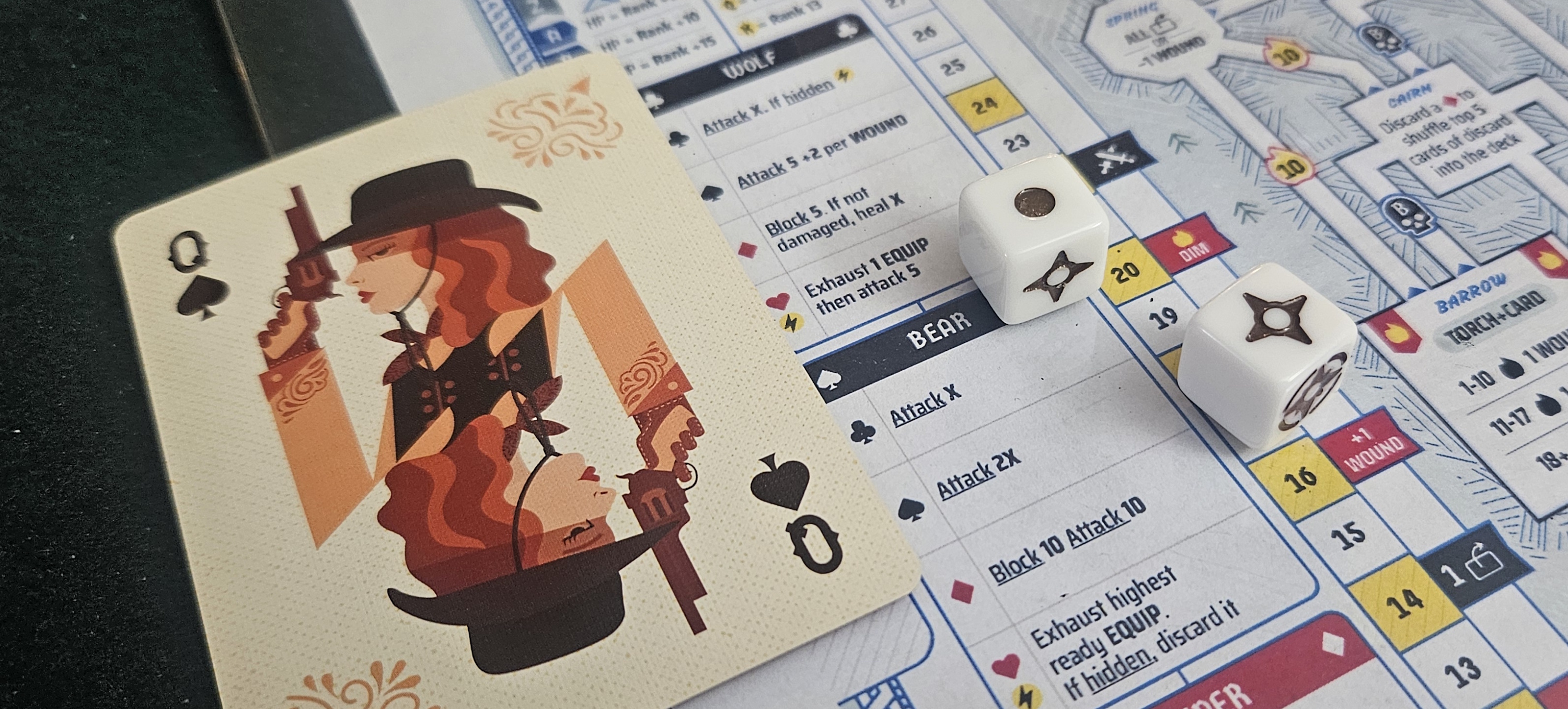
Enemies are randomly generated.
What I miss, though, are those earlier games’ shared nature. Don’t get me wrong, I enjoy solitaire games. But while Voyages, Aquamarine, and Waypoints included solo modes, they shone in multiplayer, everyone at the table utilizing those shared inputs to see where their private adventures took them. By its nature, 52 Realms: Adventures is solitaire-only. I’m sure someone could bash this thing into a shared mode, but it would be a wonky solution. There are simply too many card-flips, too many cases where a theoretical extra player would desynchronize with their partner.
Without that partner, 52 Realms: Adventures is nice for a visit, but doesn’t really compel me to return over and over again to maximize my score. The problem lies in the dungeons themselves. There are four in all, but the way they function lends them to feeling like two separate games that use a single system. The first two are linear with branching paths, your hero marching relentlessly toward the boss chamber, backtracking forbidden. This gives those dungeons a choose-your-own-adventure feel, choose A or B, left or right.
The latter two are more interesting, in no small part because they widen the one-way lanes to proper two-way corridors. One, a clockwork labyrinth, allows your adventurer to approach the central chamber only to boot them back out to the periphery. The other, a watery cathedral, is slowly flooding, its rising waters granting advantages but also empowering the local beasties. In both cases, the player is given more freedom, with little side objectives that might pad their score or beef up their hero for the final encounter.
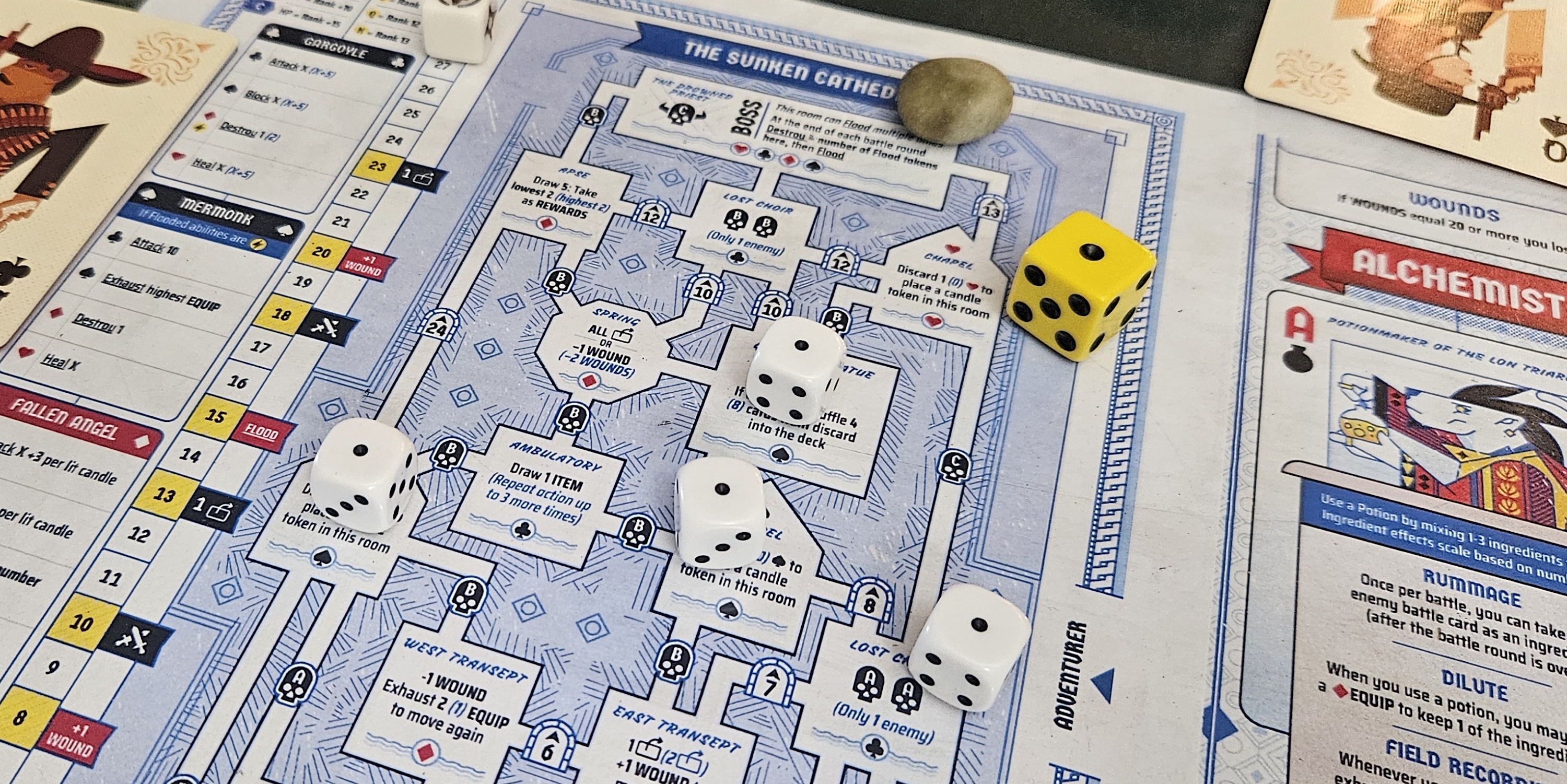
Two of the dungeons are especially interesting.
Even so, 52 Realms: Adventures never quite feels as elegant or freeform as those earlier Postmark titles. The game’s innate chanciness means that one score is hard to differentiate from another. Sadly, the game declines to provide a target. Is 48 a good score? How about 67? It probably depends on the map, or maybe the hero. But where Dunstan and Muldoon’s earlier efforts allowed players to compare their outcomes, here I’m tabulating a number that exists only in that aforementioned vacuum. Barring many repeat plays, that is. And the core gameplay loop isn’t strong enough to bring me back for more than two or three wins per map.
This squeezes the game into an unfortunate corner. It’s interesting to look at, and I’m duly impressed by the system. But I also wish it had been a little more ambitious, whether by letting multiple players share a challenge or by producing a fuller-fledged adventure. Good for a delve or two, but for now I’ll keep my feet warm by the fire.
Access to the files to print 52 Realms: Adventures was provided by the publisher.
(If what I’m doing at Space-Biff! is valuable to you in some way, please consider dropping by my Patreon campaign or Ko-fi. Right now, supporters can read my first-quarter update of 2026: the best board games, movies, books, and more!)
Posted on June 29, 2026, in Board Game and tagged 52 Realms: Adventures, Alone Time, Board Games, Postmark Games, Print and Play. Bookmark the permalink. 3 Comments.


I KNOW THOSE DICE! Seafall! The game I most love to hate. Such cool ideas, such poor execution. My dice live on as distraction pieces in the Mafia de Cuba box.
I was determined to put SeaFall to some good use! XD
Pingback: Space-Cast! #58. Postmarks | SPACE-BIFF!