Gods in All Their Fickleness
Ah, Veiled Fate. It’s been a while since we encountered IV Studio’s game of spurious divine parentage. At the time, it was dearly close to becoming a favorite, but its shortcomings were sufficient that the possibility was as scuttled as my own Olympian provenance. Now the team behind the original game — Austin Harrison, Max Anderson, and Zac Dixon — have revisited the concept via not one but two separate titles.
Today, we’re looking at the one that recasts the whole thing as a lane-battler. What could possibly go wrong?
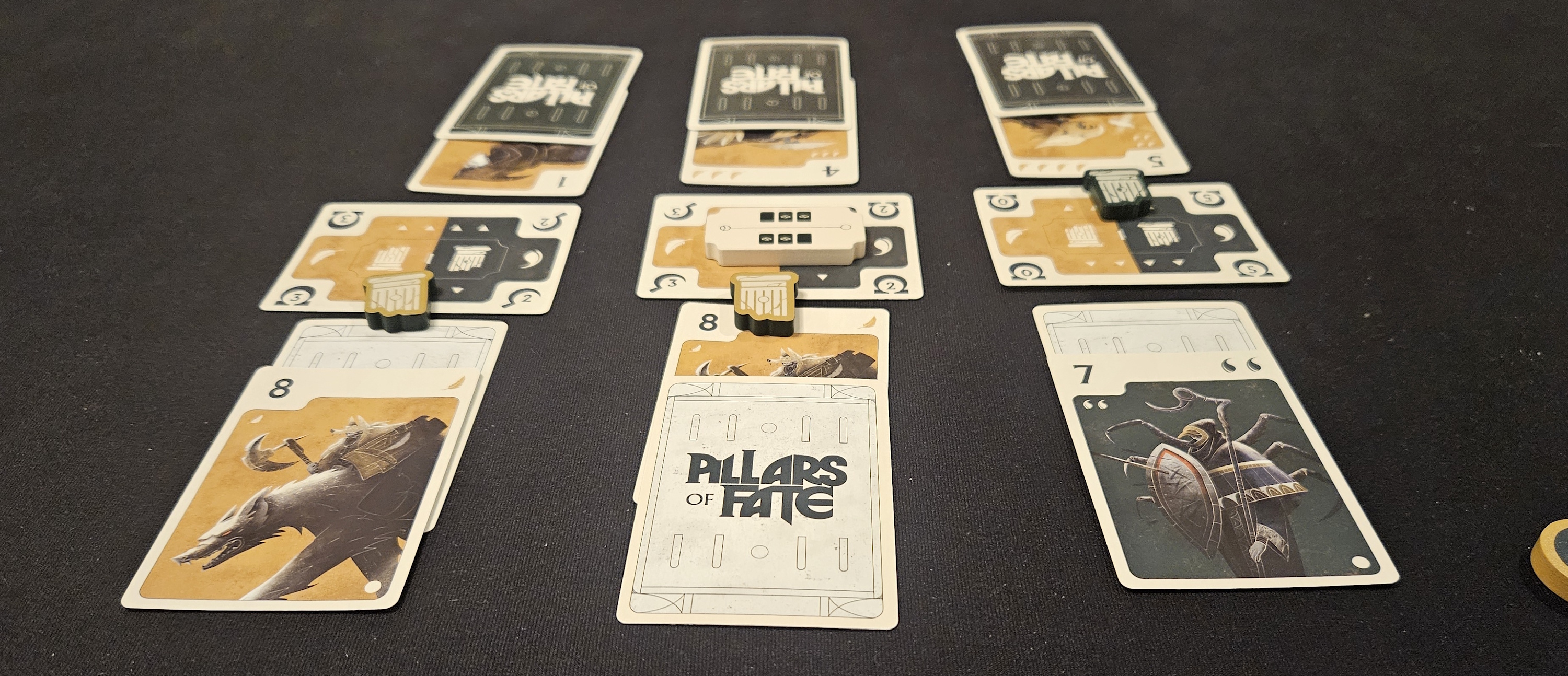
I think the lanes are the pillars.
The first time I played Pillars of Fate, it seemed like a stroke of genius. Maybe two strokes of genius folded together into an omelette of genius.
The idea is wonderfully simple. There are three lanes between players. Each lane has two separate scoring values. In all cases, one is higher than the other. Most of the time, the distance between them is so great that the lower range dips into negative points.
Into these lanes both would-be divinities play cards whose strength determines which side wins the contest. Obviously. So far we’re evoking, what, every lane-battler? What’s less obvious is that those cards also determine which scoring value the lane will trigger. Play feathers, the game’s symbol for its “light side,” and that’s the scoring that’ll be awarded to the stronger player. Conversely, a greater number of scorpions means the stronger player will earn the points on the “dark side” of the card.
To be clear, there’s no hard correspondence between “light” and positive points or “dark” and negative points. It’s entirely possible that feathers will spell negative points and vice versa. This introduces the first and most notable of a few graphical issues. Namely, that the points themselves are not color-coded. Whether feather or scorpion, light or dark, positive or negative, the points are rendered in the lane’s neutral hue. In our experience, it’s a missed step that bore rotten fruit on more than one occasion, making the lanes that much harder to read. And, in some cases, to reach the conclusion of a round and realize we’d made an early misstep in our understanding of a particular lane’s stakes.
Oops. Oh well. That’s on us, I suppose. Back to the grindstone.
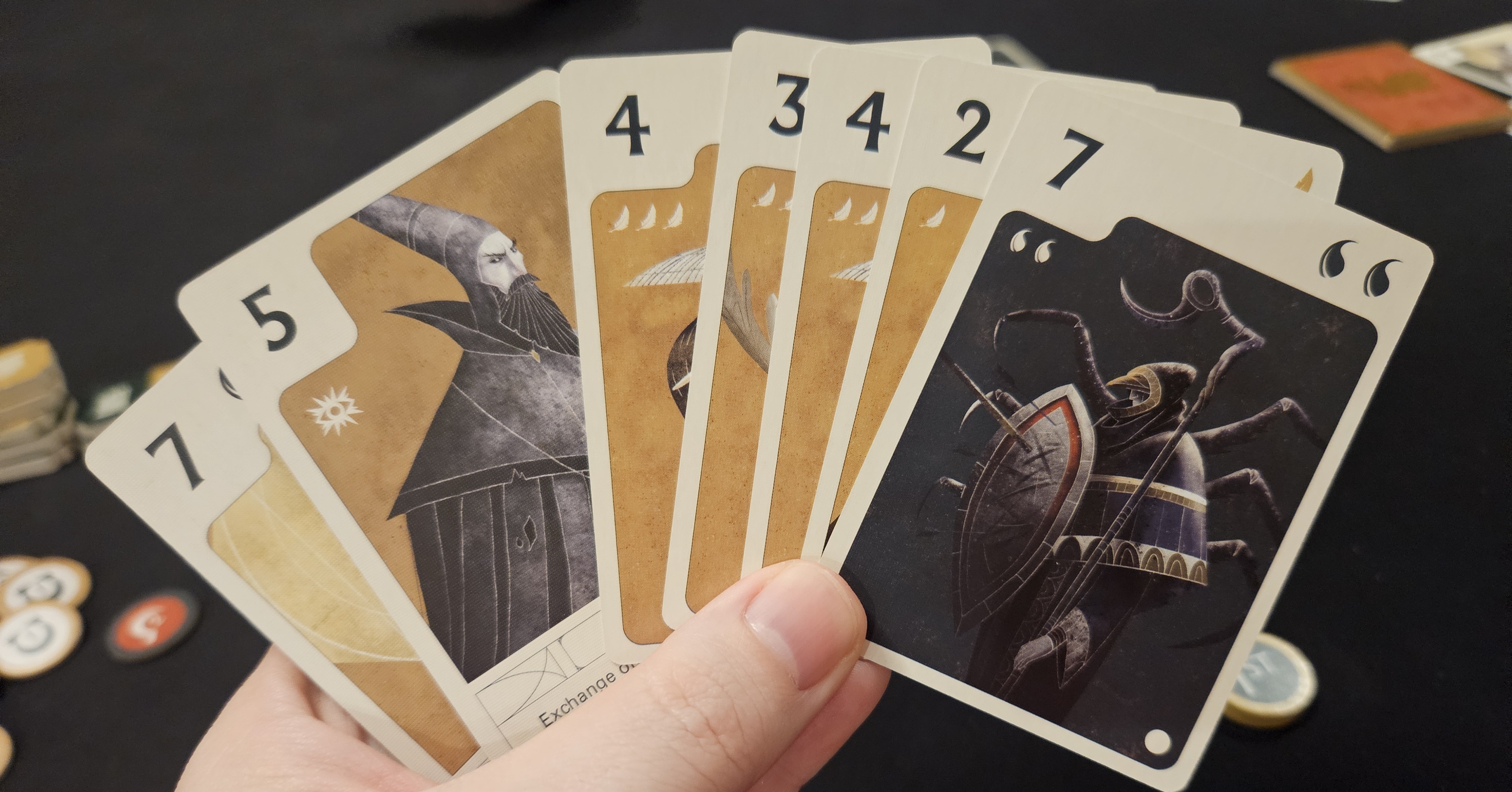
Most cards are simple: strength and suit.
Over the course of three rounds — more epically entitled “ages” — those spills of positive and negative points veer back and forth. Sometimes you win a coup, others you find yourself toppled from heav’n’s lofty pillars.
Again, it initially feels genius. There’s room for subtlety. Each lane can accommodate a face-down card per player, allowing both sides to conceal their motives. Is your opponent trying to win that lane with their best cards, or nudging it toward a negative scoring value in the hopes that you’ll invest all your strength there instead? Most cards are straightforward strength values and feather/scorpion icons, but their possible range — as low as one strength, as high as nine — is enough to ensure some major swings.
And then there are the demigods. There are twenty of these special foil-embossed cards in all. (Although only their backside is so visibly rendered, another misstep of design that makes them a little harder to pick out from the crowd than I would have preferred.) Both players receive three at the beginning of the game, and then, after swapping a couple, can only deploy one per age.
As you might expect, the demigods are potent indeed. There’s the Mother of All, a real jerk who awards ten points if you lose all three lanes in an age — a blow that’s significantly lessened if by “losing” you really mean “your opponent just received thirteen negative points.” Or Naka, a demigoddess who has to be played face-up, but allows your other two lanes to hold two face-down cards instead of only one. So much for your rival’s headspace. Others are dead simple, like Vesper and Penance, both of whom have zero strength but so many feather or scorpion icons to single-handedly determine the status of a lane.
Despite this potency, not every member of this demipantheon is equivalent. Some cards are harder to utilize than others, and how. One, Hadria, dings your opponent five points if they win that lane, but boasts a hefty seven strength, forcing you to measure your other deployments carefully. The Steward alters the scorpion/feather composition of lanes bordering his holy self, but not by very much. These cards are still powerful if deployed smartly, but can also threaten to detonate in your face, making them as mercurial as Hercules was a family man. (Too soon?)
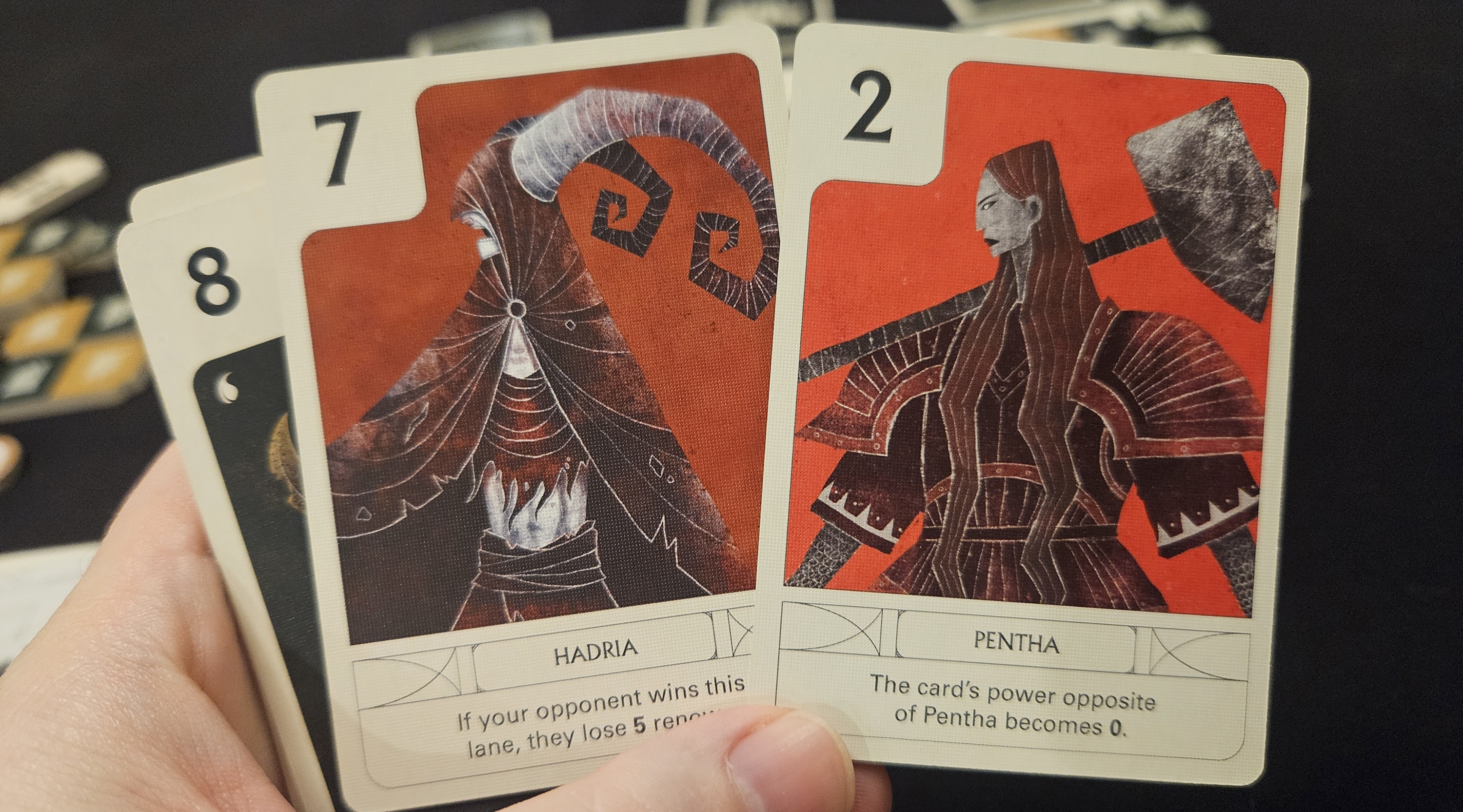
Demigods upend the usual rules.
This probably sounds good. Smart. Possessed of a spirit of genius. It did to me as well.
But there are problems, and not all of them are as minor as the game’s graphical omissions. Take, for example, the way cards are parceled out. Both sides have an identical deck of 32 champions, the little non-demigods that make up the bulk of your army. As noted earlier, the range on these cards is extreme. Some have strength as low as one. Others stretch up to nine. And while there’s some correlation between a card’s strength in battle and its capacity to manipulate the value of a lane, this isn’t always the case.
Put another way, Pillars of Fate is unusually subject to the vagaries of the draw. Missing out on a high card or two can prove disastrous. And that goes double if you find yourself poorly armed and holding the first-player token. Because let me tell you, going first in Pillars of Fate is the pits. Every turn leaks another crucial missive to your rival, letting them play reactively and with such precision that each and every one of your moves becomes Sisyphean. Play a card, watch it get countered. Play a card, watch it get countered. Fill a lane, watch your opponent take their sweet time responding. Really, you’ll almost certainly fill all three lanes in advance of your opponent. This often proves disastrous.
And there are none of the mitigating systems that have found their way into other lane-battlers. There’s no ability to withdraw a bad hand, as in Jon Perry’s Air, Land, & Sea. John Clowdus’s Omen: A Reign of War fills its war-torn cities with so many special units that they’re effectively all demigods, producing wild swings that can’t be entirely countered. Even The Old King’s Crown, itself a freshman design by Pablo Clark, understands this problem, asking players to assign cards to their lanes simultaneously rather than let trailing players repeatedly one-up the leader.
The result is a lane-battler that feels bad as often as it feels brilliant. That makes its face-down cards such potential swings that they’re agony to reveal at the age’s conclusion. That generally goes to whomever held the first-player token least. Somebody will, by the way. Hold that accursed token the least. The game is three ages long, remember. Even something as small as a fourth age might have mitigated the worst of the game’s imbalances.
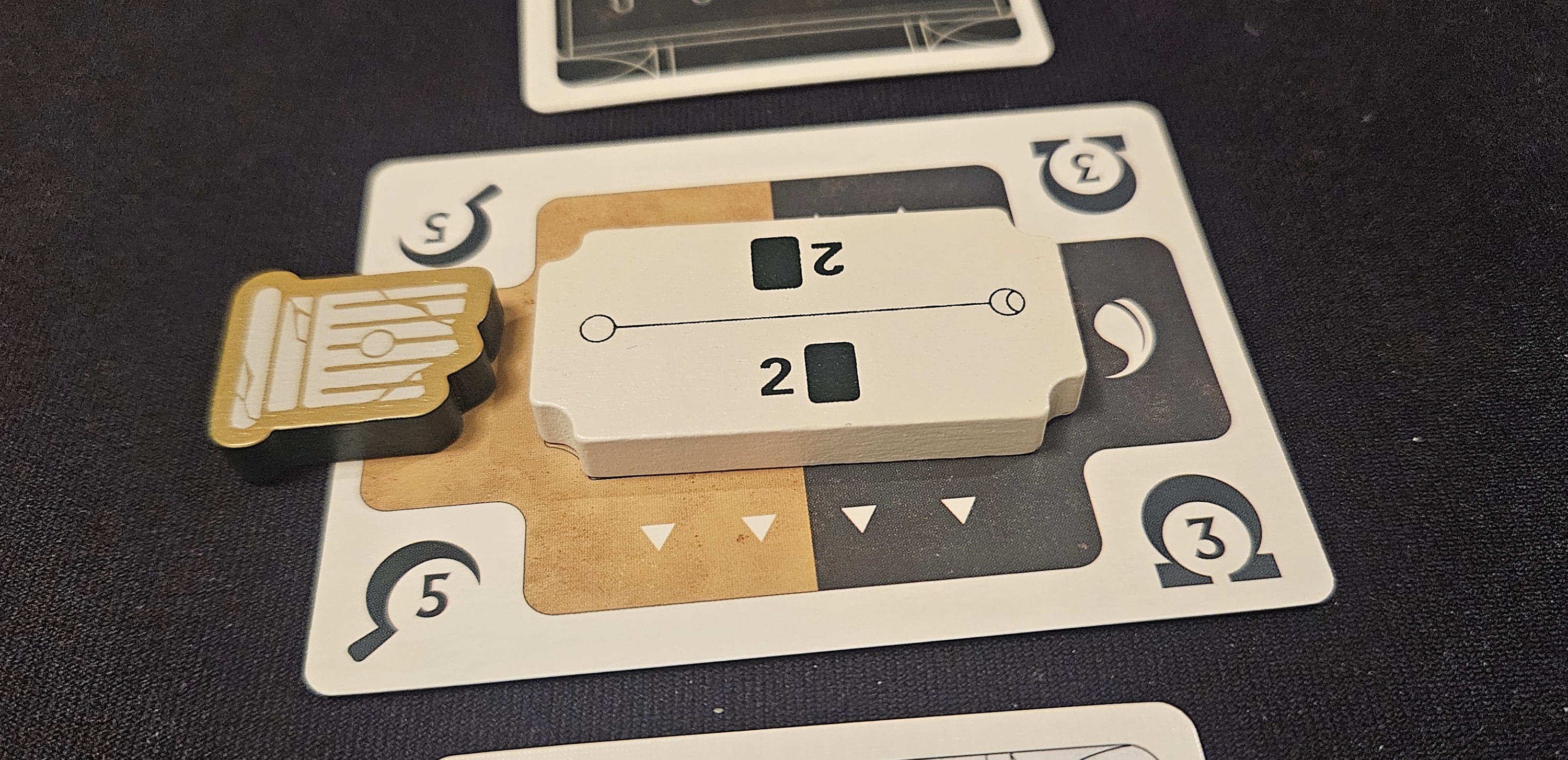
The components are lovely.
To be clear, these issues don’t ruin Pillars of Fate. The game’s smartest touches are still present and accounted for. In particular there’s the way lanes can be manipulated to turn a rival’s momentum against themself, the points-tallying equivalent of judo. Oh, you’ve deployed your most strong-armed champions to this distant battlefield? Oops, the only prize here is a cornucopia of spoilt meat. In those moments, the game shows itself at its most devious.
At some level, I even feel the same way about the demigods. I wish they had been a little more level, ability-wise, so that some weren’t such obvious picks compared to their siblings. But the game’s restraint in only allowing one per side per age is noteworthy, keeping the contests a little tighter than they might have been otherwise. Sure, the huge gap in their strength — in all units’ strengths — makes outcomes a little harder to preempt and keeps the game’s fickleness intact. But when things are going right, those become strengths rather than frustrations. It’s just hard to know which way the game will go.
My greatest reservation, really, is that there are so many excellent lane-battlers right now. I’d rather play any of the titles I mentioned earlier. I’d rather play Compile. I’d even rather play Riftforce or An Empty Throne. It doesn’t help that Pillars of Fate somehow misses out on its predecessor’s potential. You aren’t a god pushing around progeny. You’re a big dude with an army of your own. That’s fine enough, but as another stab at what made Veiled Fate so interesting, it travels toward an entirely separate heading, and a much less interesting one at that.
Okay, here’s one way in which Pillars of Fate recaptures that spark. If you remember Veiled Fate, you might recall that sometimes its contests were determined by the flip of a coin or the turn of a card. There are no coin-flips in Pillars of Fate, but the wildness of those champion decks and the testiness of its demogods often results in a similar caprice. After all this time, one’s fate might still hinge on whether they’re holding the right cards. And a first-player token.
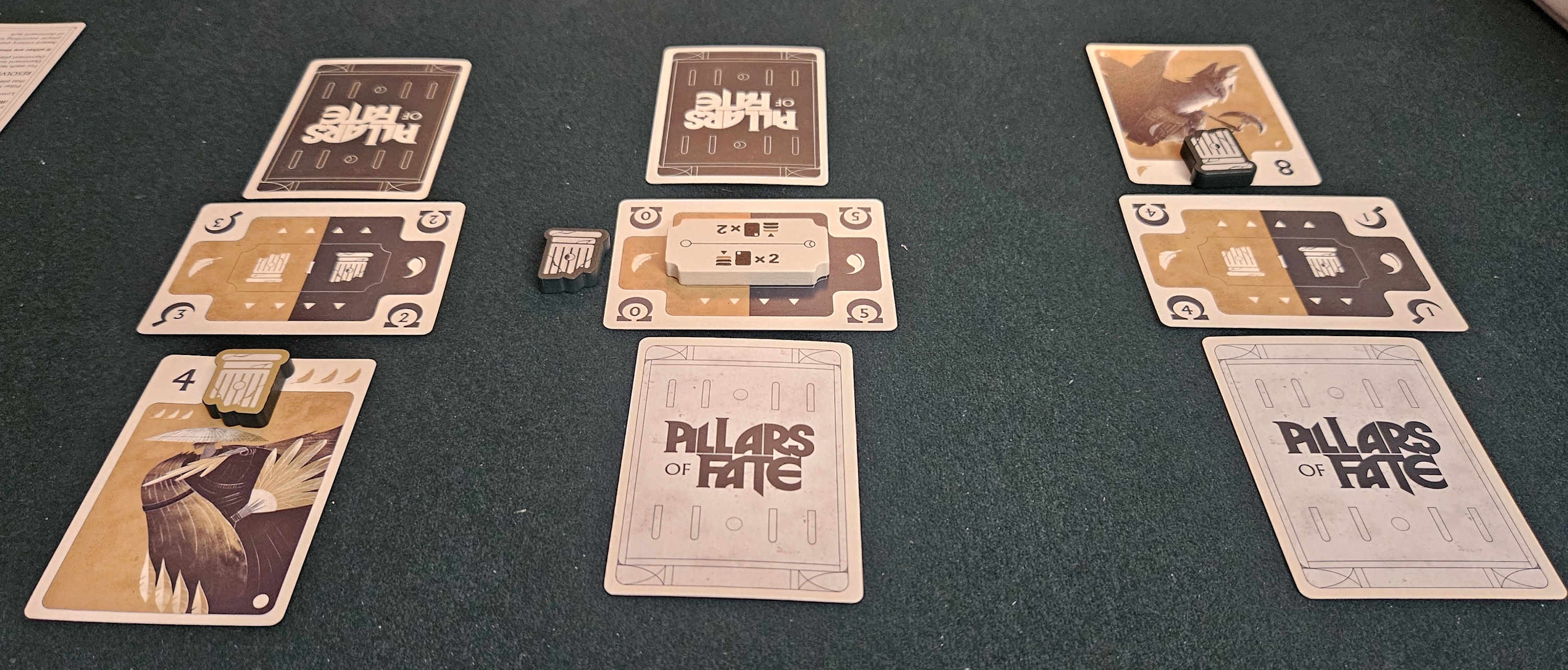
In the early stages, most cards tend to be concealed.
Here’s the good news: Pillars of Fate isn’t alone. Its sister title, Scales of Fate, offers another attempt to make good on the promise of Veiled Fate. We’ll take a look at that one tomorrow, but I’ll tip my hand right now: that one got it right.
As for this one… well. Despite its flashes of brilliance, sometimes even a genius can prove more trouble than they’re worth.
A complimentary copy of Pillars of Fate was provided by the publisher.
(If what I’m doing at Space-Biff! is valuable to you in some way, please consider dropping by my Patreon campaign or Ko-fi. Right now, supporters can read my first-quarter update of 2026: the best board games, movies, books, and more!)
Posted on April 20, 2026, in Board Game and tagged Board Games, IV Studio, Pillars of Fate. Bookmark the permalink. 1 Comment.


Pingback: Nepo Demibabies | SPACE-BIFF!