Bite the Big One
I live in the shadow of the Wasatch Mountains. Have for nearly my whole life. Out-of-towners sometimes voice their apprehension when they first visit our cordillera, when they see the way our cities and suburbs are hemmed in by walls. The mountains, they say, seem precarious, like they could topple onto our heads at any moment, burying us under a thousand tons of limestone and quartz monzonite. Jokingly, I inform them that the real danger of the coming tectonic collapse — not the little shakes we sometimes get, but the Big One, the one we’re a millennium overdue for — is that it will kill us from below. The ground will liquefy and carry us downward, the ancient tidal basin finally sweeping us out to an inland sea that died with the mammoths.
Cysmic, the board game by Jason Blake, gives me that feeling. When I hefted it onto the review stack next to my computer desk, my wife wondered aloud if it would topple and crush me. It isn’t the largest board game I’ve ever owned; that would be the 22-pound Ogre, the one with the team lift warning printed prominently on its side. But it’s the one that feels most like an Ozymandian temple to excess. Its map is sprawling. The frame that holds the hexes comes with hidden magnets to lock everything into place. The plastic constructs are so phallic that they make me uncomfortable. Among its many dice, there’s one for gauging your character’s crisis of conscience. It’s so gargantuan that it’s become a game-night joke. Nothing could justify this sprawl.
I kinda dig it.
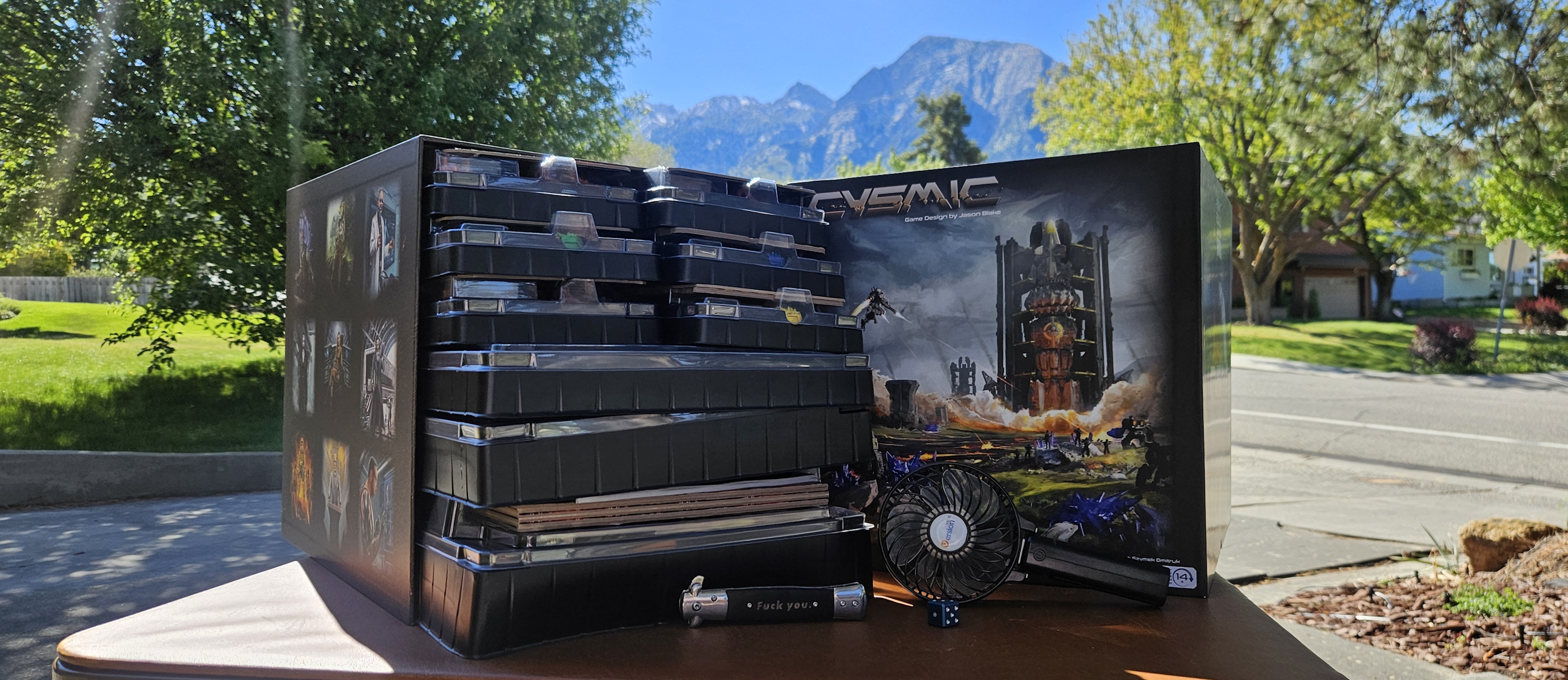
Cysmic next to a few everyday items.
I want to set the scene. Both of the scenes.
In the distant future, humanity has settled an exoplanet. Pretty cool. Only it turns out that we repeated our past mistakes, squatting on territory that means us harm. This planet, you see, is tectonically unsound. Seismic. Cysmic. (Ohhhhh.) At some point in the near future, the crust of this world will flake away like the film coating an uncleaned oven. When that happens, the eruption of magma and steam will render anything above unlivable.
Not unlike the Salt Lake Valley, come to think of it. Mostly, I just don’t. Think about it.
Which is precisely the problem. Cysmic is unexpectedly redolent of Sol: Last Days of a Star, Ryan Spangler’s parable about climate collapse hastened by its victims, and Meltwater, Erin Escobedo’s cautionary tale about how nations set themselves aflame for the sake of spiting people whose existence has little bearing on their own. Of course, these titles could not be further apart, production- or intention-wise, but the parallels are there for the taking.
All, for instance, are about a looming crisis that their games’ factions are urgent to hasten. Because that’s the crux of the matter. Our goal on this planet is to escape by reconstructing one of the old colony ships that bore us here. But rather than cooperate to ensure everybody gets a seat on the ark, we now usher in our own destruction. We crack the mantle to get at the minerals that will shape the colony ship’s hull; we shatter the crust with our ordnance; we erect tracked megastructures that unfasten fault lines like zippers. Every action we undertake in service of survival steals a pinch from the hourglass.
Where Sol’s telling of this parable was poetic and Meltwater’s was bitter, Cysmic settles for frickin’ awesome. If those games offer the somber foretellings of the Book of Revelation, Cysmic is the Doof Warrior rendition. Let’s get this party staaaaarted, it hollers, jets of flame washing over the audience.
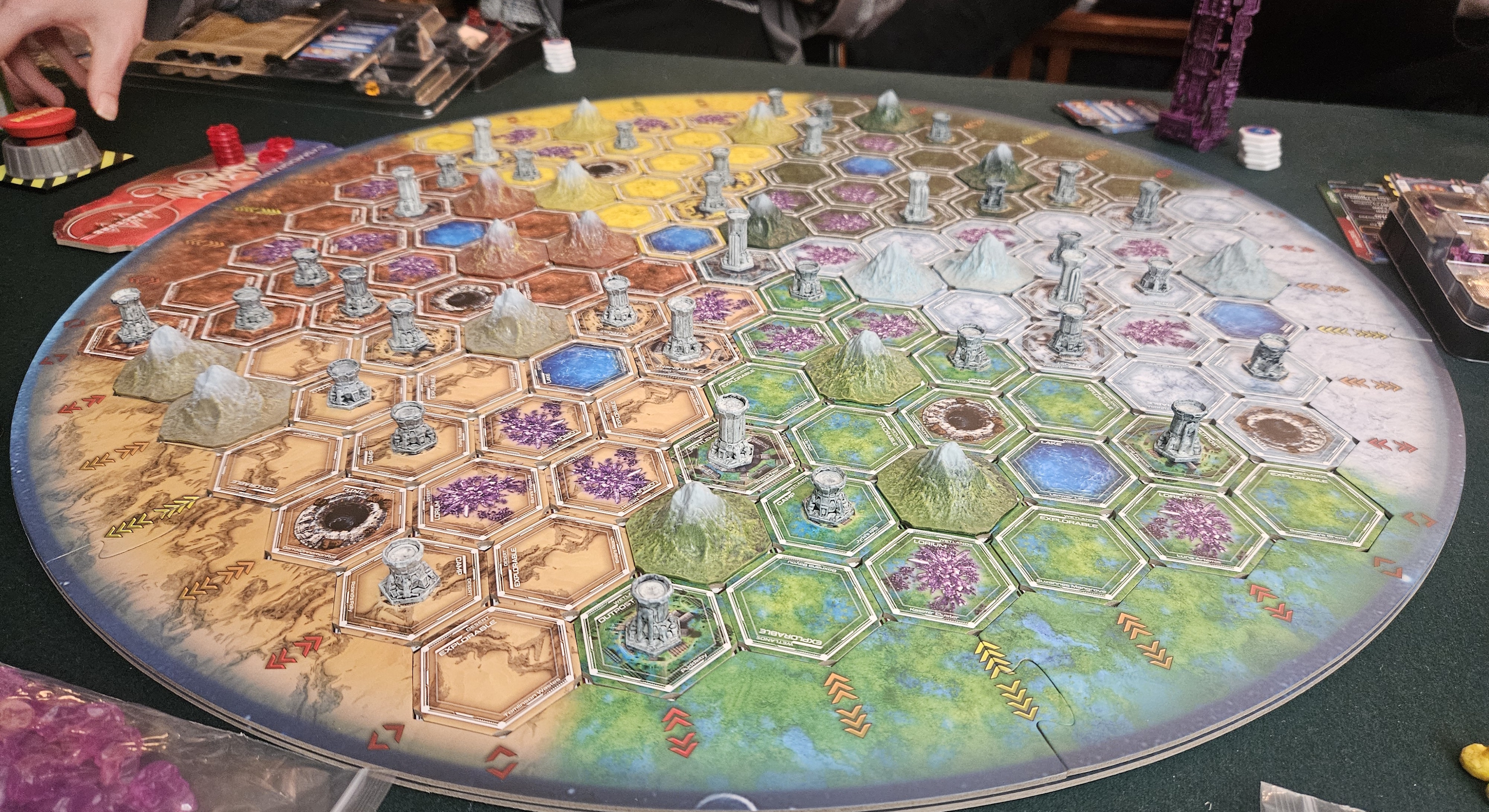
The map is ridiculous.
That’s the narrative scene. The second scene begins on the physical tabletop.
I worry about waste. Not as often as I ought to, probably. Compared to junk mailers and Happy Meal toys and oil wells set alight by incautious tyrants, board games are a drop in an ocean of muck. At least, I tell myself, they’re preservable. I donate some of them, and sell others, and buy secondhand when I can, and try to ensure that they go to homes where they will be appreciated and not wind up in some landfill after only one or two plays.
Cysmic defies that self-soothing rubric. The map is so massive that my group laughed uncontrollably the first time we set it up. Again, it isn’t the largest board game to ever take up real estate on my table, but it’s perhaps the most of everything else. Those frames, with their little magnets underneath the cardboard. The tiles, crafted with fingernail-thick nubs at their corners to make them easier to pry up. The plastic mountains, which called to mind the earliest printings of Runewars, back before Fantasy Flight decided to use cardboard overlays in place of three-dimensional topography.
The miniatures. Goodness, the miniatures. Some of them are actually mini. Others, like the spires that hold the components inside your colony ships, an affectation that’s a nice bit of visual design on the one hand but also a physical obstruction of the battlefield on the other, are so large that they veer into self-parody. If you saw this thing on a sketch show, you would swear this wasn’t a real game. Ha ha, we would say, look at the silly nerds, with their jokes about Windows 11 and their board games that defy common sense. Those towers are not merely phallic; they are penises, swollen like Cormac McCarthy’s sunset, like Daniel Plainview’s erupting pumpjack, almost rhapsodic in the baldness of their representation.
To some degree, this clutter is extraneous to the tale Blake wants to tell. It’s so big, for one thing, that many of its rumblings hardly matter. The first time the mantle collapses to reveal the planet’s glowing lifeblood, odds are that the catastrophe won’t come anywhere near you. A settlement falls in, countless lives are lost, but only in theory. There are other settlements to claim, other veins to mine. The scars are mere obstructions, easily bypassed or flown over. Might as well fire up some extra rockets. Charge some lasers. Drill baby drill.
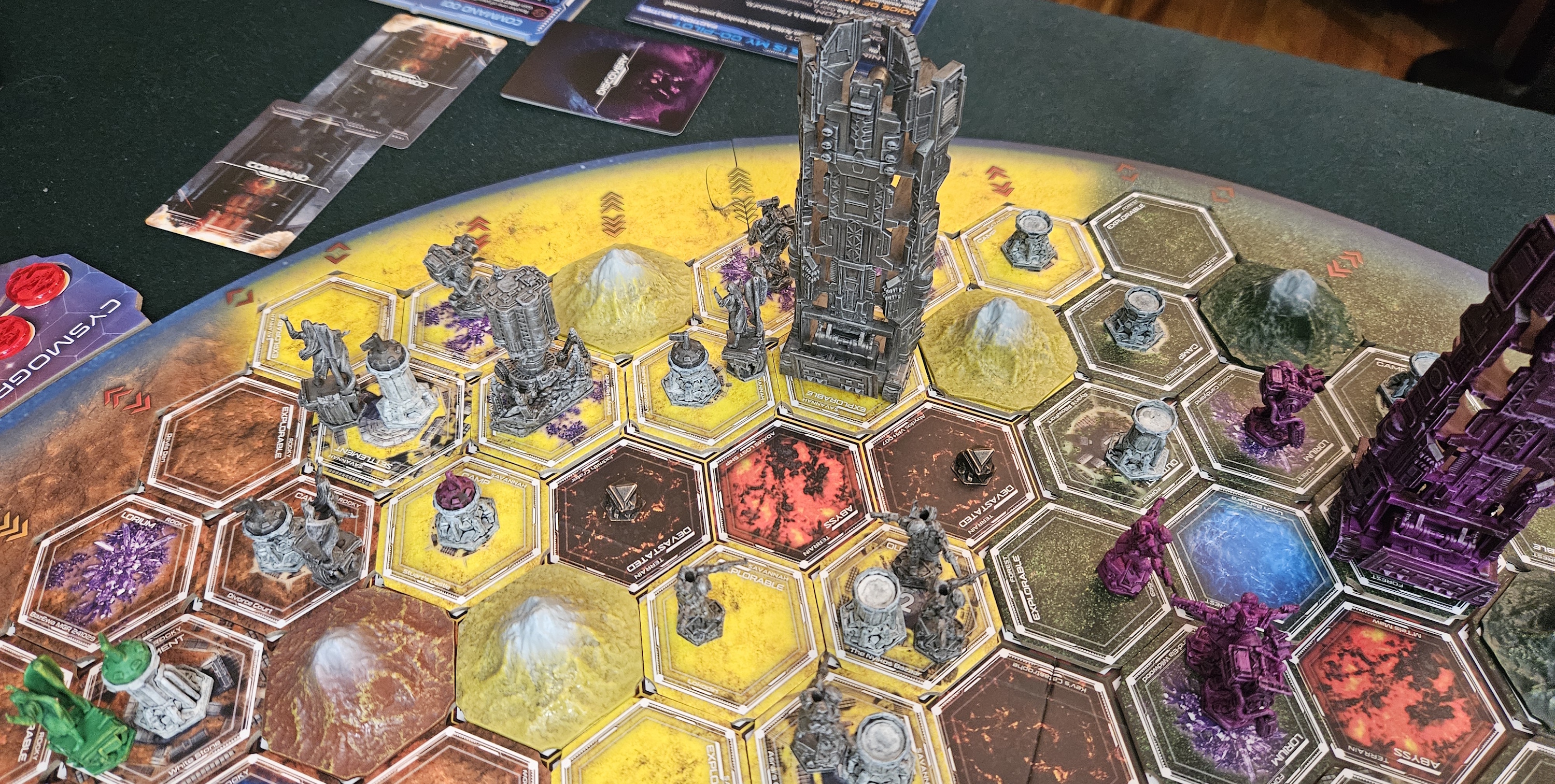
Battle lines begin to form. Soon they’ll fall apart.
Then again, this is also the point. Because Cysmic, in addition to head-banging through the apocalypse, does have something to say about how the proverbial frog gets boiled. One collapse is nothing. Two is nothing. Five is nothing. But a dozen? Now we’re cooking. Like the frog in the pot. Like the settlements that have just fallen into mile-wide sinkholes. Like our troops, those without early warning detection systems, who have gone hurtling into the abyss.
Let’s back up. For a game of such sprawling proportions, Cysmic is surprisingly smooth to play. Each turn sees you selecting a card that activates some segment of your apocalypse-realizing faction. Often, this means triggering a type of unit. There are diplomatic Speakers that are indispensable in the early days and more vestigial once the oven reaches temperature, Soldiers for shooting things, Miners and plus-sized Harvesters for mining minerals, and big jump-jet equipped Powermechs for blasting enemy columns. Other cards resolve all the battles you’ve set up over the previous turns, launch negotiations and cyber warfare, recruit or upgrade troops, the works.
The most transformative card is the one that activates your colony ship. This inevitably collapses at least one hex as your giant launchpad shifts position, squishing troops and cities under its treads and leaving fiery destruction in its wake. This is also an opportunity to attach modules to your ship, provided you have the resources and blueprints to do so.
Despite this clarity, turns aren’t as straightforward as choosing one card among many. In addition to selecting which card to activate, you also choose one that will disappear beneath it. This card is out of the rotation for the time being, depriving you of an entire class of unit or some crucial activity. Sure, there are ways to cycle spent cards back into your hand before the end-of-round refresher, but it speaks well of Cysmic that you’re asked to make tough decisions early and often. These choices aren’t as profound as, say, the hand drafting in Inis or Blood Rage, but they tend to be more significant than the eldritch upgrade paths of Cthulhu Wars.
This positions Cysmic squarely in the middle of the Ameritrash spectrum, somewhere between the poles of “cerebral/political” and “beautifully stupid.” Before long, it touches on both extremes. And while its performance in either arena is accomplished to greater or lesser effect, it always returns to those core tradeoffs between cards. This does wonders for the game. At a glance, you can tell how likely it is that a rival will respond to an incursion with a counter-attack, whether a target can shift a particular unit out of your reach, when the next tectonic collapse will take place. None of this information is foolproof. There are too many special abilities and action cards and faction perks for that. But it’s enough to communicate some sense of possibility, a probability waveform that can be surfed to your advantage.
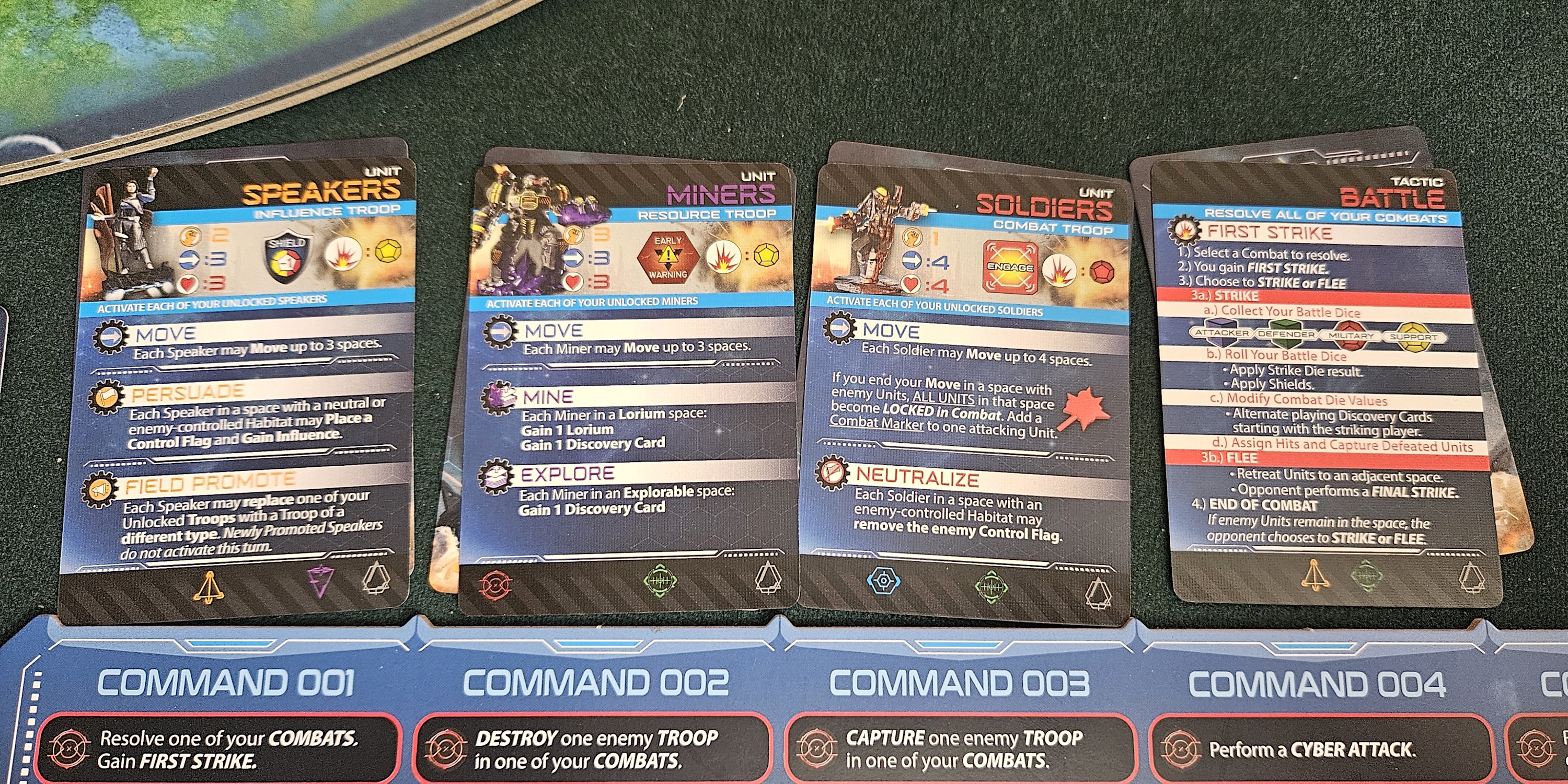
The command system asks hard questions about your priorities.
So let’s look at those poles.
At heart, Cysmic is a contest of equal-opportunity aggression. Your goal is to complete your colony ship before anybody else, an objective made significantly harder by the absence of blueprints for all six of the necessary modules. Each player has sole ownership of one such module, meaning the only way to complete your ark is by prying the blueprints from their possession.
Fortunately, the blueprints of the far future apaprently come as shareable zip files. There’s no need to be too possessive; your possession of a blueprint does not preclude my ownership. The rub is that nobody is going to hand out their propriety information willingly. There are therefore two ways to gain access to a faction’s data. One, you can steal it via cyber crime, a finicky action that’s one of the game’s many underdeveloped appendages, but a noteworthy one all the same. Or two, engage in battle to kidnap some of their troops for use in a blueprint-for-prisoners exchange.
The implications are far-reaching. The good part is that everybody needs to attack everybody else, at least a little bit, in order to capture enough units to swap for those blueprints. If anything, a few early attacks might render a particular neighbor more or less negligible, which can be a huge relief when you share a border. Once you hold my blueprint, there’s no reason to attack me anymore, barring some late-game stalling for time.
On the other hand, this diminishes some of the game’s other elements. The map, for example, isn’t especially interesting, which is saying a lot when it depicts an entire planet crumbling under the strain of mech battles and mountain-cracking mineral extraction. There’s no reason to hold any territory in particular. One settlement is as good as another, resource veins are interchangeable, troops come and go, and entire flanks might collapse thanks to a random pull from a bag. With no sense of permanence, there’s nothing like a battle line, and the inviolability of your colony ship means there’s nothing to protect.
The closest dudes-on-a-map analogue would probably be Kemet, but one cleared of cities or temples. There’s plenty of territory out there, even a few choke points, but all that landscape provides very little reason to care about one tract over another. As the planet falls apart, it’s possible that some areas will become more valuable, but our sessions tended to conclude before such an eventuality was realized. The result is round-robin aggression, everybody targeting whomever they haven’t yet stolen blueprints from, with very little concern for anyone else.
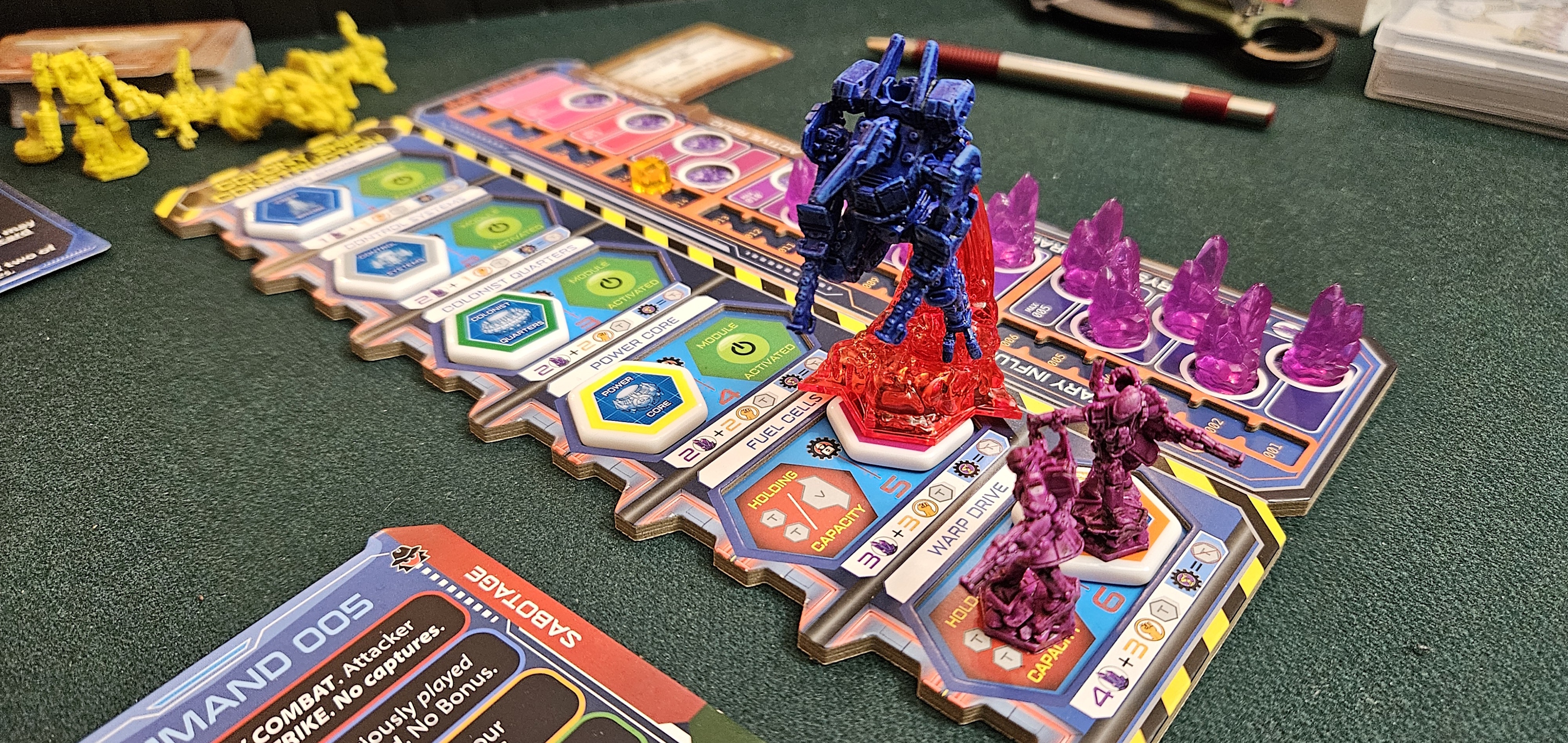
Prisoners can be exchanged for blueprints.
The good news is that these aggressions are enjoyable enough in their own right that it isn’t as though Cysmic is going through the motions. Battles are punchy, if a little too concerned with different dice types and attack modifiers, and it’s always possible that a gunfight will accidentally split the world at the seams. There’s a little bit of everything in there. Dice, of course, with varying shades for combat and noncombat units; cards, for modifying rolls and maybe springing a nasty surprise; unit and faction abilities, just in case you thought you were getting off easy. Despite this abundance, resolution is reasonable, never reaching Forbidden Stars duration, which is great for the game’s play length if not for any prospective bathroom breaks.
Maybe the biggest highlight is the faction system. Like everything else in Cysmic, there are heaps to choose from, and in place of the expected mealy-mouthed plus-one perks, each team offers something transformative and meaty. One of them adds adjacency to every single space next to a mountain or lake, effectively letting you teleport anywhere at will. Another seizes control of any settlement anywhere on the map at the start of each turn. A third takes their turn at any point in the round — and I mean any point, treating the usual turn order to forced obsolescence.
What’s wild is that these are only the first of those factions’ abilities. Each offering has three or four whoppers. And there are more than twenty-five factions in all, each with their own distinct advantages and playstyles. The only real downside is that they all have dork-ass meme names like Path of the Wrighteous, Moving Mao Tons, or Kriss of Death. Receiving a diplomatic missive from uplifted psychic housecats is one thing; that the kittens have named their faction Cat-Aclysm gives off a real cringe vibe.
But, look, restraint is not Cysmic’s watchword, so why would Blake rein in the puns? Everything here is the board game equivalent of an extra order of mozzarella sticks. The handfuls of dice. The units you probably won’t field. The sheer variety on display. There’s even a clacky launch button that serves precisely zero in-game function, but which I very much intend to keep when I pass the game along to somebody else.
And, of course, there’s that most emblematic of all components: the conscience die.
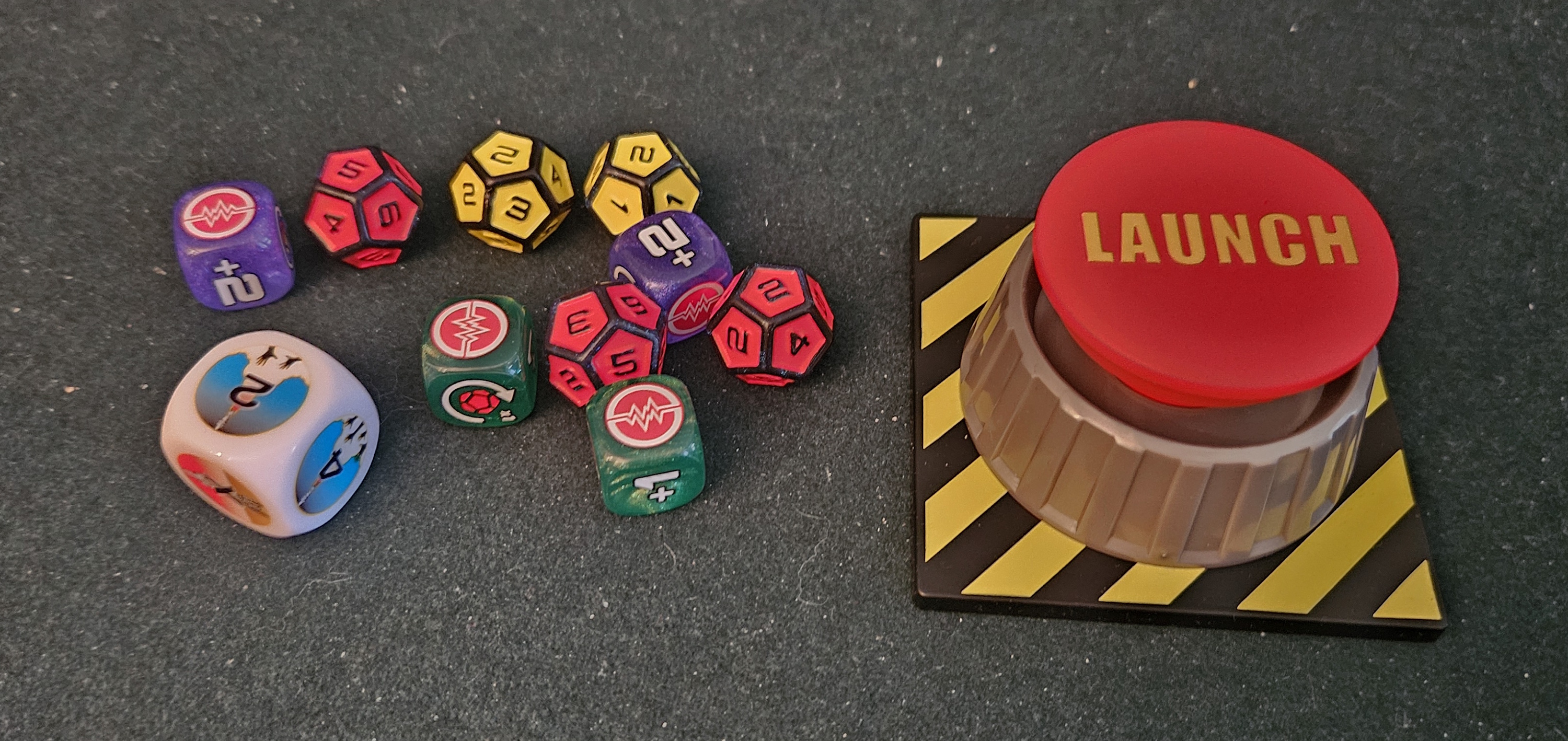
Roll the dice. Smash the button. Search your conscience.
To my utter tickling, this final hexahedron serves an indispensable purpose. When at last the planet has been strip-mined, when the blueprints have been assembled, when the modules have been stuffed into your colony tower, the game is still not complete. Now it’s time to blast off for the stars and leave the rest of these suckers behind.
Except you might not be ready to hit the red button. It all depends on the conscience die. When the time comes, you roll and compare its result against the troops you still have on-planet. All the miners and troops stationed in the dust, all the diplomats persuading those neutral settlements that you have their best interests at heart, all the prisoners still waiting for freedom. The conscience die reveals how many you’re willing to leave behind. If there are fewer out there than the roll, you leave. Kaboom.
But if not, you stick around and attempt to evacuate more bodies, more lives. With the right resources, you can try the roll again next turn. Without them, you’ll have to wait for the end of the round when your cards return to your hand.
Either way, Cysmic has done the unexpected. It has grounded the moral cost of its conflict. In incredibly shaky terms, yes. In a way that rewards losing units to cave-ins and enemy assaults. In a way that makes the anthropogenic horrors visited on its planet and peoples seem all the sillier. But in terms that, imperfect as they are, most historical wargames don’t even attempt, and which — and I say this in all seriousness — we would laud in a game with a more solemn setting. Because even here, as the world collapses toward its molten core, sometimes the cost is too high. Sometimes you can’t bring yourself to make the hard choice. Even if you happen to be a battle-hardened jerk named Minnesota Killjoy.
(Yes. That is one of the game’s factions. Save me.)
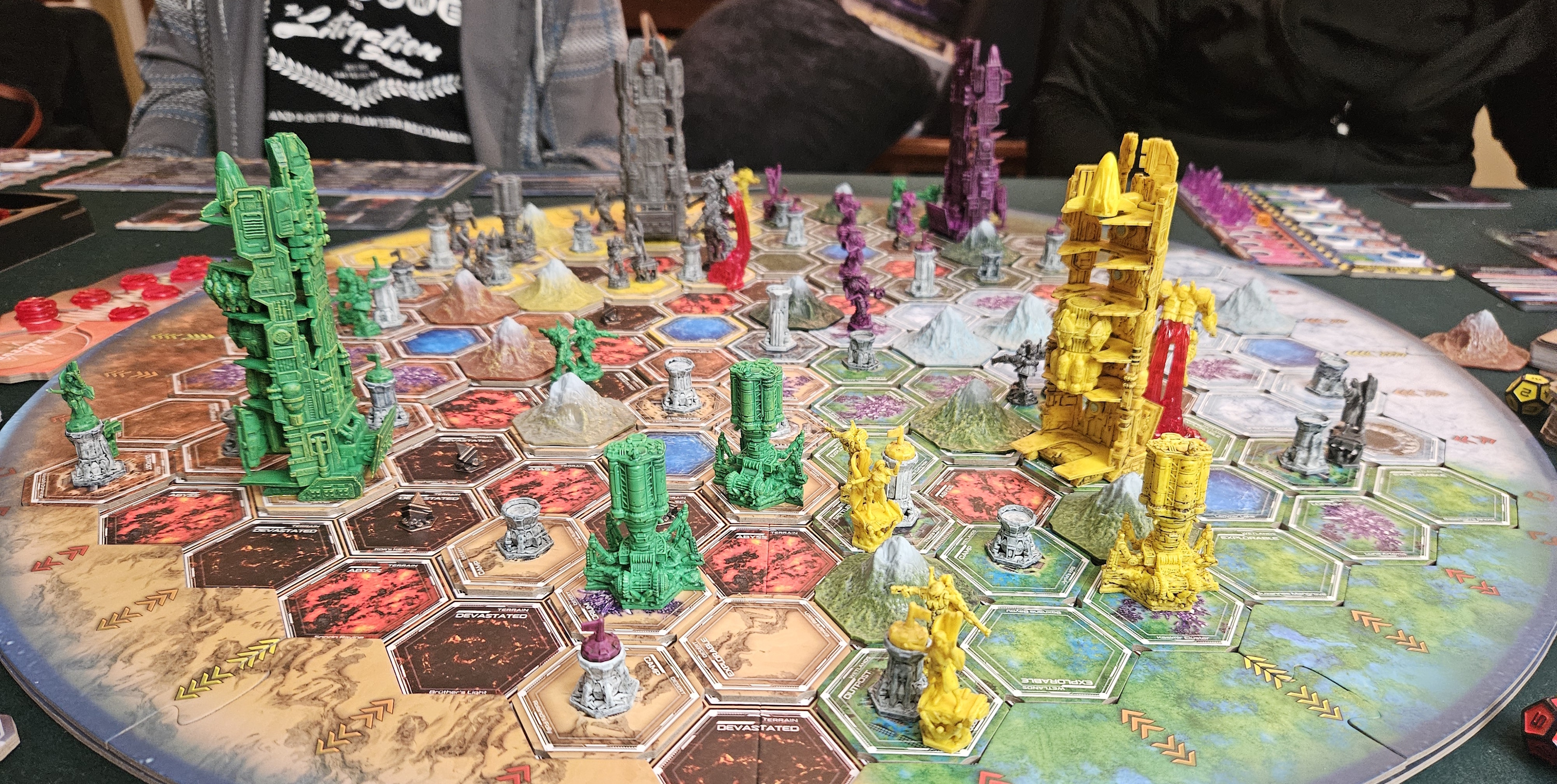
Ah. Ludicrous.
This, I think, is what sets Cysmic apart. It’s too big. It could have been pruned down. It doesn’t need quite so many alternative modes. The mountains could have been cutouts. The launch towers could have been a little less, ah, engorged. There didn’t need to be magnets all over the place.
But it’s also a huge cry from the crowdfunding trash that gives miniatures-heavy games such a bad name. Unlike some of those titles, maybe even unlike the majority of them, Cysmic is a game one would actually opt to play. And more than that, it’s an earnest experience, one packed with exciting battles, a landscape undergoing disaster, a race to survive at all costs.
It even has shades of meaning in its human-hastened collapse, one that feels all too timely. Here in the desert of Utah, a billionaire has announced a 40,000 acre data center that will triple the state’s power consumption. The stated reason is national security, a digital arms race against China. This despite the professionals at the local universities pointing out that we don’t have the water, don’t have the heat allowance, don’t even have much of a Great Salt Lake anymore. Will our elected officials make a saving throw on the conscience die before they bake us to death? I hope so.
For a board game, that’s the sort of thing that makes us say it’s punching above its weight. When it comes to Cysmic, the aphorism feels wrong. Let’s instead say it’s punching at precisely its weight. Fine: maybe a little under.
A complimentary copy of Cysmic was provided by the publisher/designer.
(If what I’m doing at Space-Biff! is valuable to you in some way, please consider dropping by my Patreon campaign or Ko-fi. Right now, supporters can read my first-quarter update of 2026: the best board games, movies, books, and more!)
Posted on May 19, 2026, in Board Game and tagged Board Games, Cysmic, Star Reach Games. Bookmark the permalink. 12 Comments.


For anyone reading this wonderful review for my game Cysmic, if you found yourself being curious about where to get your own copy of Cysmic, there are surplus copies for sale at the original Gamefound campaign page.
https://gamefound.com/en/projects/star-reach-games/cysmic
Thanks so much for reading and thanks to Dan for the entertaining review, as always! I’m honored to have Cysmic join the pantheon of Space Biff Reviews!
Jason
Thanks for sharing the link, Jason!
I just ordered on the basis of this review (the game otherwise wasn’t even on my radar).
I hope you love it!
Great review and the game sounds like a hoot!
Thanks!
Awesome review as always 🙂 I’m not one for massive games, so I know I’ll never be getting this, but sometimes the massiveness has purpose, and I feel that here it does – in all its excess, in all its American-style cringe-level over-the-topness, it is able to combine fun and meaning. Kudos to the designer for being able to make his intangible creation (very) tangible!
It really is a remarkable realization of a person’s singular vision.
Are you really Getting Into Knives?!? I work for Outdoor Edge just a state away in Colorado. Check us out if you haven’t already! I can hook you up with a sample or something. 😉 http://www.outdooredge.com
Yep! Or, well, I’ve always been A Little Bit Into Knives, but for whatever reason I’ve been lately More Into Knives. Looks like you have some cool stuff over there!
Seriously tho, lmk if you’d be interested in me sending you something. I’m “hoojeebo” everywhere, so you can reach out on like BGG if you want. I’m the warranty guy and I love sending people free knives!
I thought about it and decidedly don’t need another knife. Got any Sporks?