Combat Results Postcard
Battle Card is as apt as descriptions get. Designed by David Thompson and Nils Johansson, this is the fourth project in the Postmark Games lineup. Like its earlier peers — Voyages, Aquamarine, and Waypoints — this is a print-and-play title that can be produced with functionally zero budget. Unlike those projects, however, Battle Card is billed as a wargame on a single postcard-sized sheet.
That’s true enough. With a few dice and a smidgen of experience to help interpret the rules, Battle Card covers six engagements from the Second World War. And their format is indeed very small, highlighting some real resourcefulness on their designers’ part in compressing battles and even campaigns into ten-minute experiences.
But unlike those other titles, Battle Card is a mixed bag. I’ll give an example.
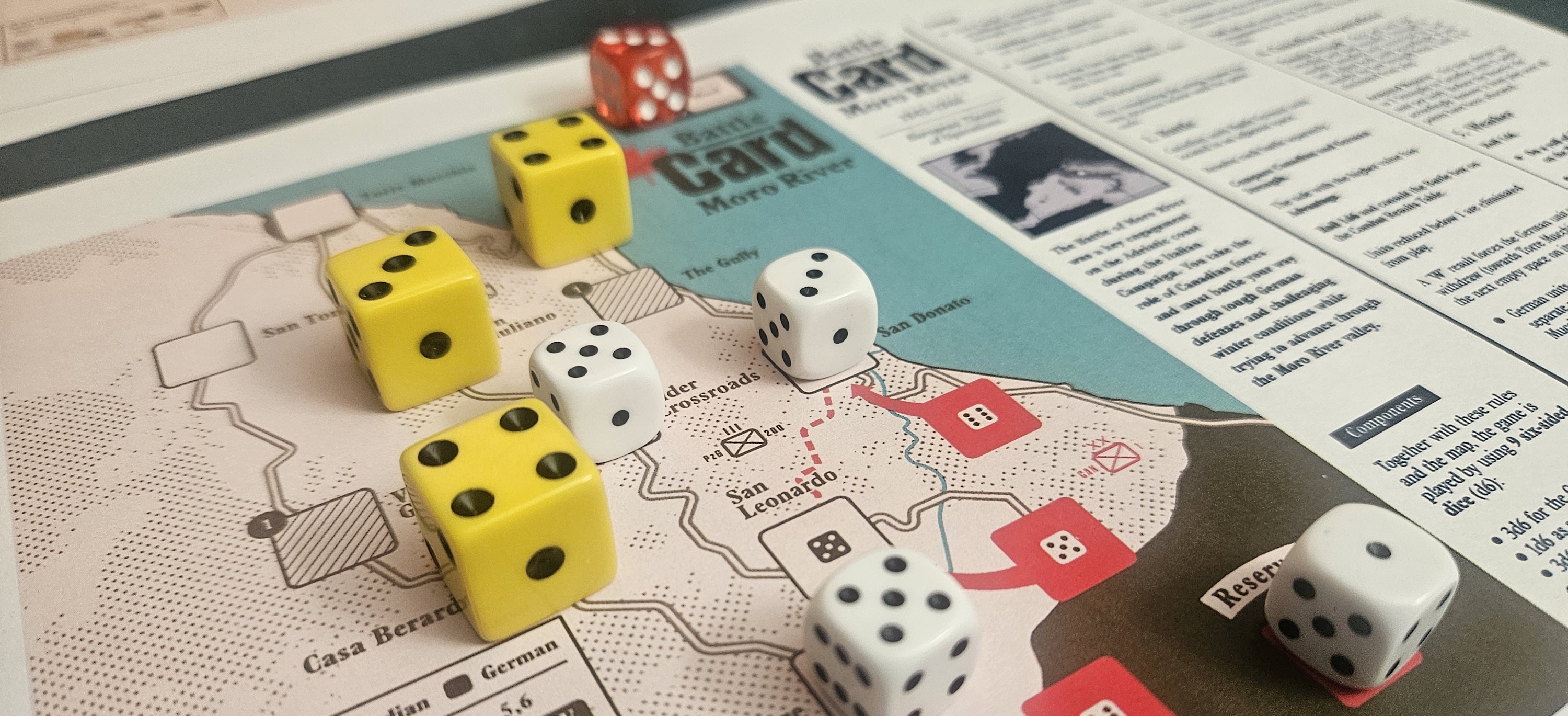
Rock on, Canada.
The second of Battle Card’s six scenarios sees Commonwealth forces waging a fighting retreat against Imperial Japanese troops shortly after the attack on Pearl Harbor. Over the course of two months, these forces staggered their positions along the Malay Peninsula, gradually ceding ground in an attempt to withdraw a portion of their forces. Historically, the campaign was catastrophic for the Allies, revealing Japanese air superiority and rapid infantry. (Mounted on bicycles!)
In Battle Card, the situation isn’t much better. Dice represent the armies on both sides, with their pips indicating their current strength. These armies engage in battle — determined by the roll of another die — and shift positions along the twin roads along the peninsula.
Here, the situation is relatively static. As the leader of the Commonwealth forces, your options mostly revolve around when to retreat, whether to defend your position or mount a counterattack, and which units to gradually pull back toward Singapore. No matter the outcome of any individual roll, the game has been fixed, much as it was historically. It isn’t a question of whether the Japanese will overtake your position, but how swiftly.
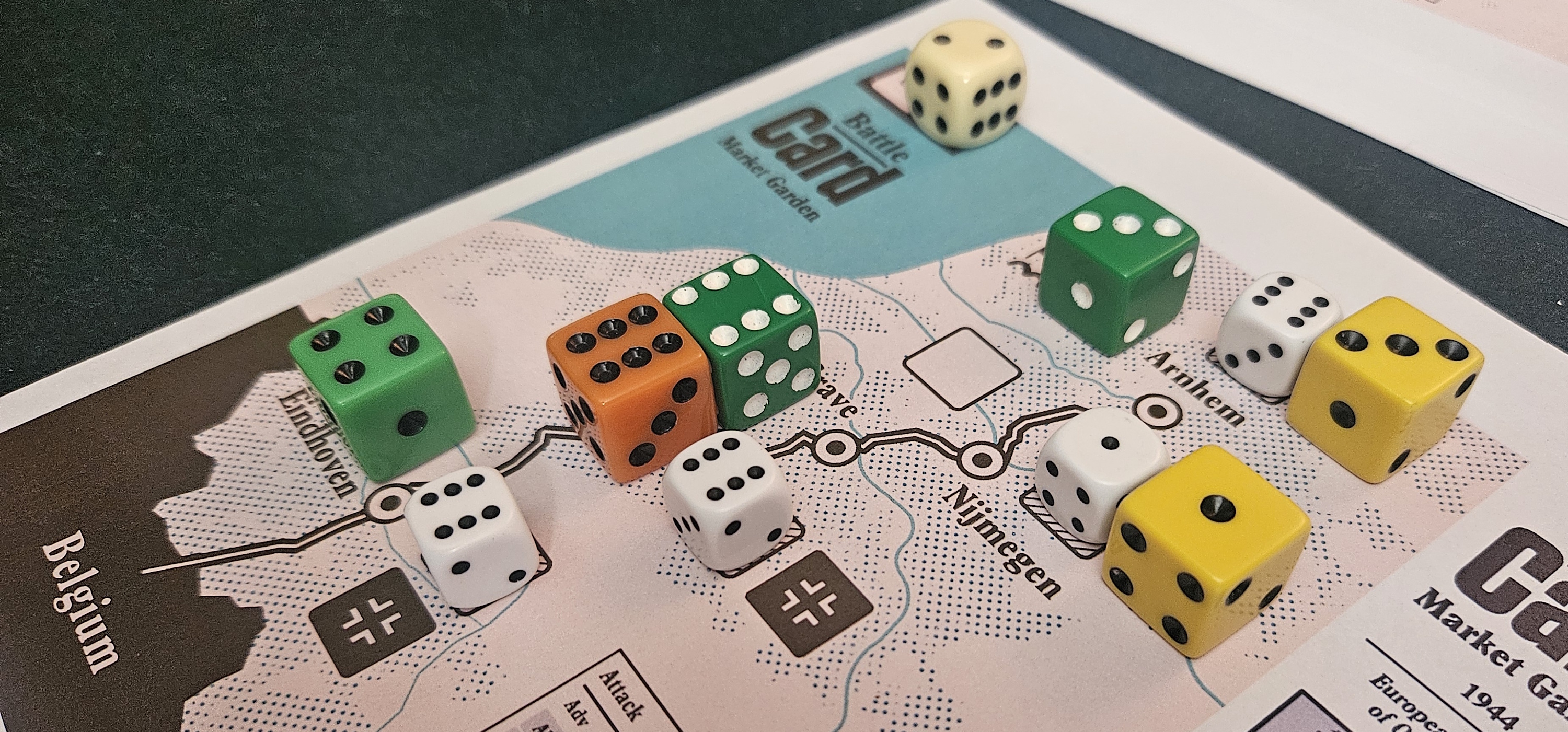
The Market Garden scenario is ostensibly a demo, but it’s fiddlier than those that come afterward.
What follows is a strong indication of both the system’s strengths and weaknesses. Your choices, such as they are, are as bite-sized as the game’s footprint. Retreat or hold; defend or attack; withdraw a die along a road. The roll-offs are governed by small combat results tables that factor in whether one side has an advantage — meaning one side’s die has more pips than that of their enemy. As advertised, it’s fast. And, to its credit, the minimalist design does lend some sense of the geography and the central conundrums of the conflict.
In this case, your objective is to withdraw three pips to Singapore, and the way to accomplish this goal is closer to a puzzle than anything offering operational flexibility. Either you stick your troops behind the right line in the sand or you don’t. Either you withdraw in time or you don’t. Either you make high enough rolls or you don’t. No matter the scenario, this is more or less how Battle Card functions. There’s a solution here. That solution still requires the bulk of the rolls to go your way, but that’s the solution, and there’s no deviating from it. Perhaps most damningly, once you’ve uncovered that solution, there’s really nothing else to see.
Yes, yes, I’m the guy who wrote that replayability is overrated. But there are slender games and then there are slender games. Battle Card is the latter. Each play lasts between five and ten minutes. Scenarios are also compact, as befits a game called Battle Card, meaning there aren’t many subtleties to any given fight. If you don’t figure out the trick on your first play, you’re bound to have a strong suspicion heading into your second. After that, it’s really a matter of getting the right rolls.
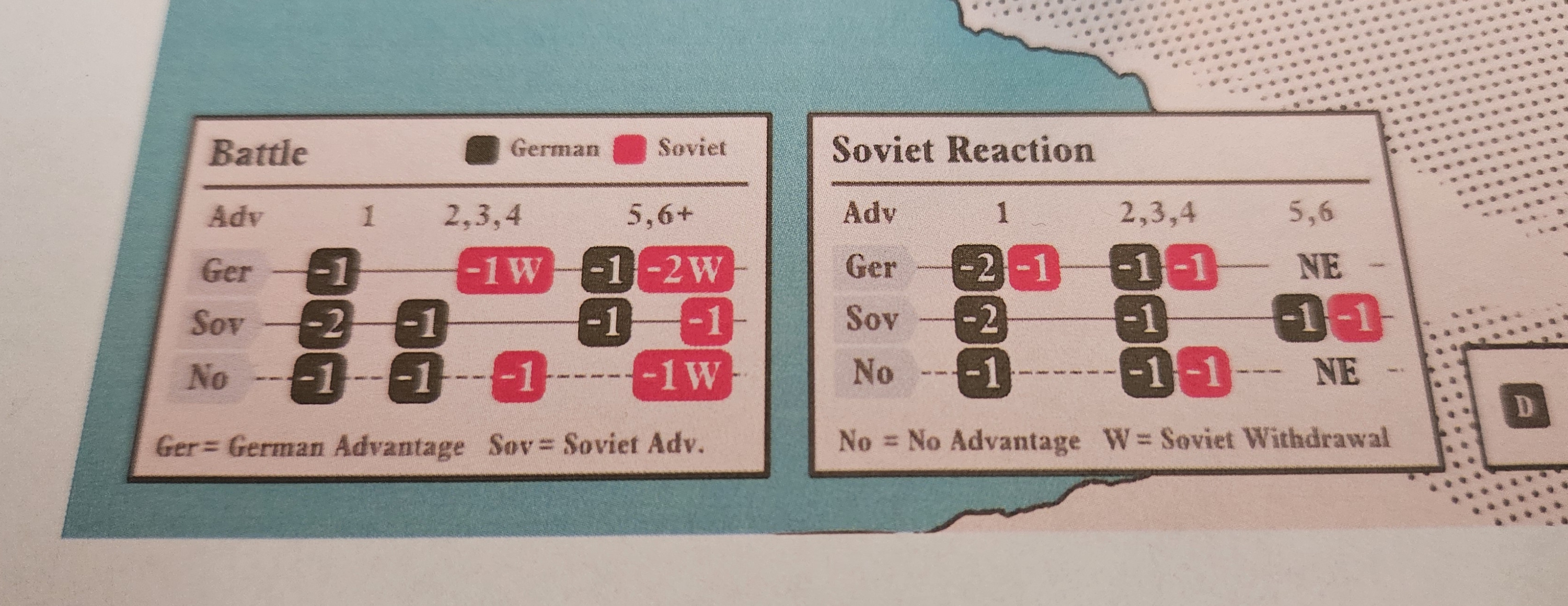
Combat results tables! We got ’em!
This isn’t to say the whole enterprise is doomed. The best scenarios offer some wiggle room between maneuver and chance. As the Canadians make a three-pronged drive up the Italian boot in the Moro River scenario, they must pause to reinforce any divisions that took a beating. As the Germans plunge toward the Caucasus oil fields, they need to decide when to split their forces into smaller but more vulnerable columns. Choosing where to fire your artillery at Mortain is… well, it isn’t the most complicated decision, but it would also be inaccurate to call it straightforward.
Again, though, that’s about as much mileage as anyone will get out of these print-and-plays. I’ve run through the entire series twice now, and the second time I found myself growing weary. This stands in strong contrast to those other Postmark titles. As score-chasers, there was always a reason to return for another attempt. Here, the entire format feels too compressed, like a States of Siege game without the chrome-laden considerations that made that series so interesting. Mostly, it was a nice way to organize my dice by color and size.
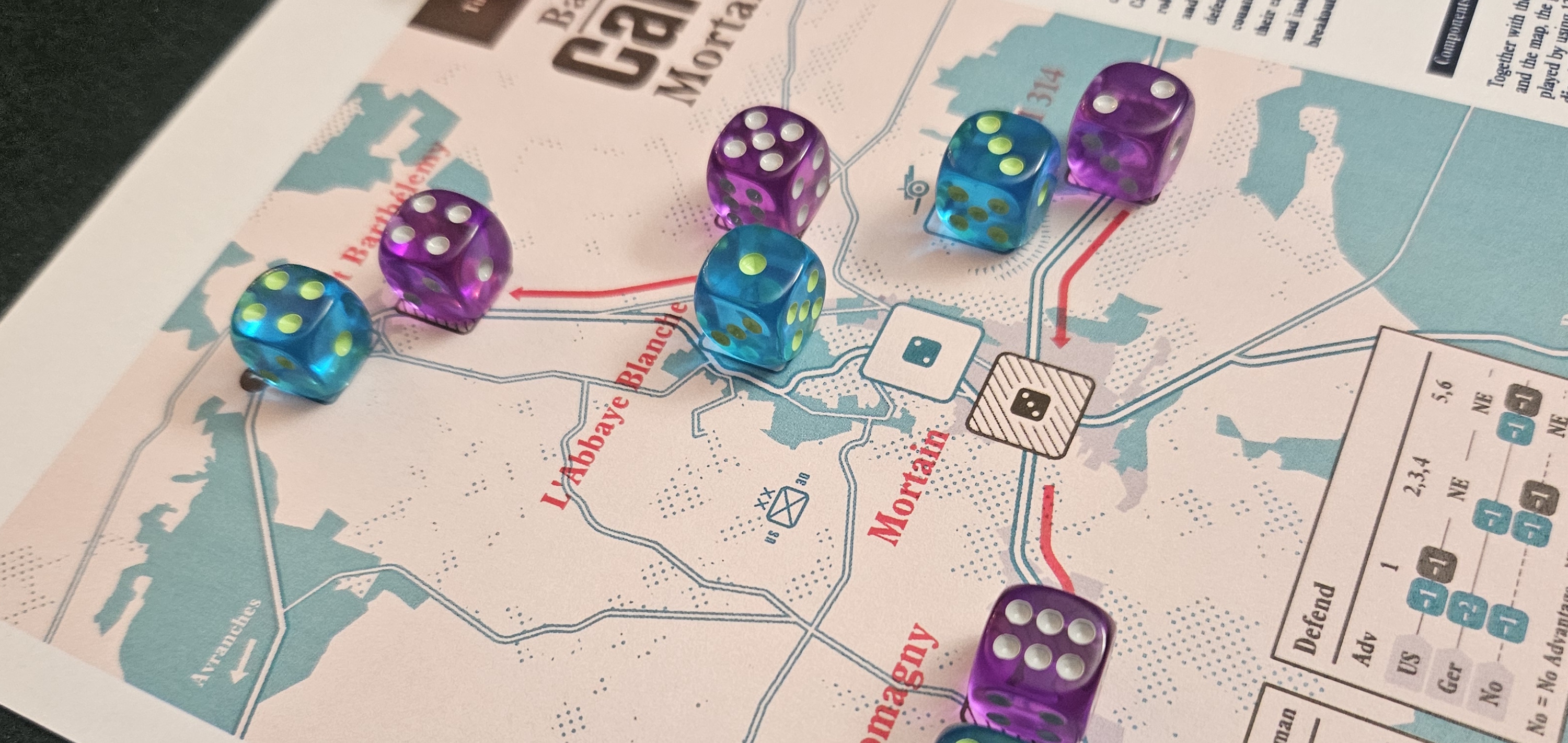
Firing the arty.
In a way, Battle Card isn’t that far off from looking at an animated battle map. All those little arrows and company designators. The towns changing hands. The roads, the weather. The relative strength of any given column. Battle Card is that with some marginal interactivity. As a middle-aged white guy, that’s my ken. But the joke’s on Battle Card. I already own a book of WWII battle maps. This is one instance where pushing the pieces across the board — sorry, the card — isn’t enough of an improvement.
Access to the files to print Battle Card was provided by the publisher.
(If what I’m doing at Space-Biff! is valuable to you in some way, please consider dropping by my Patreon campaign or Ko-fi. Right now, supporters can read my first-quarter update of 2026: the best board games, movies, books, and more!)
Posted on May 25, 2026, in Board Game and tagged Alone Time, Battle Card, Board Games, Postmark Games, Print and Play. Bookmark the permalink. 1 Comment.


Pingback: Space-Cast! #58. Postmarks | SPACE-BIFF!