Better Citizens than Netizens

Citizens of the Spark feels like it was custom-made with me in mind. It’s a tableau-builder (yes) designed by Philip duBarry and illustrated by Diego Sá (yes) seeded with a small selection from a huge pool of cards (yeeesss) that happens to be populated with anthropomorphic animals (eh, fine). Those animals, it turns out, are not your usual medieval-ish fare, but scientists, scholars, performers, and everything else, jumbled together to form a polis of intersecting interests and vocations.
Which is to say, it brought me around in the end.
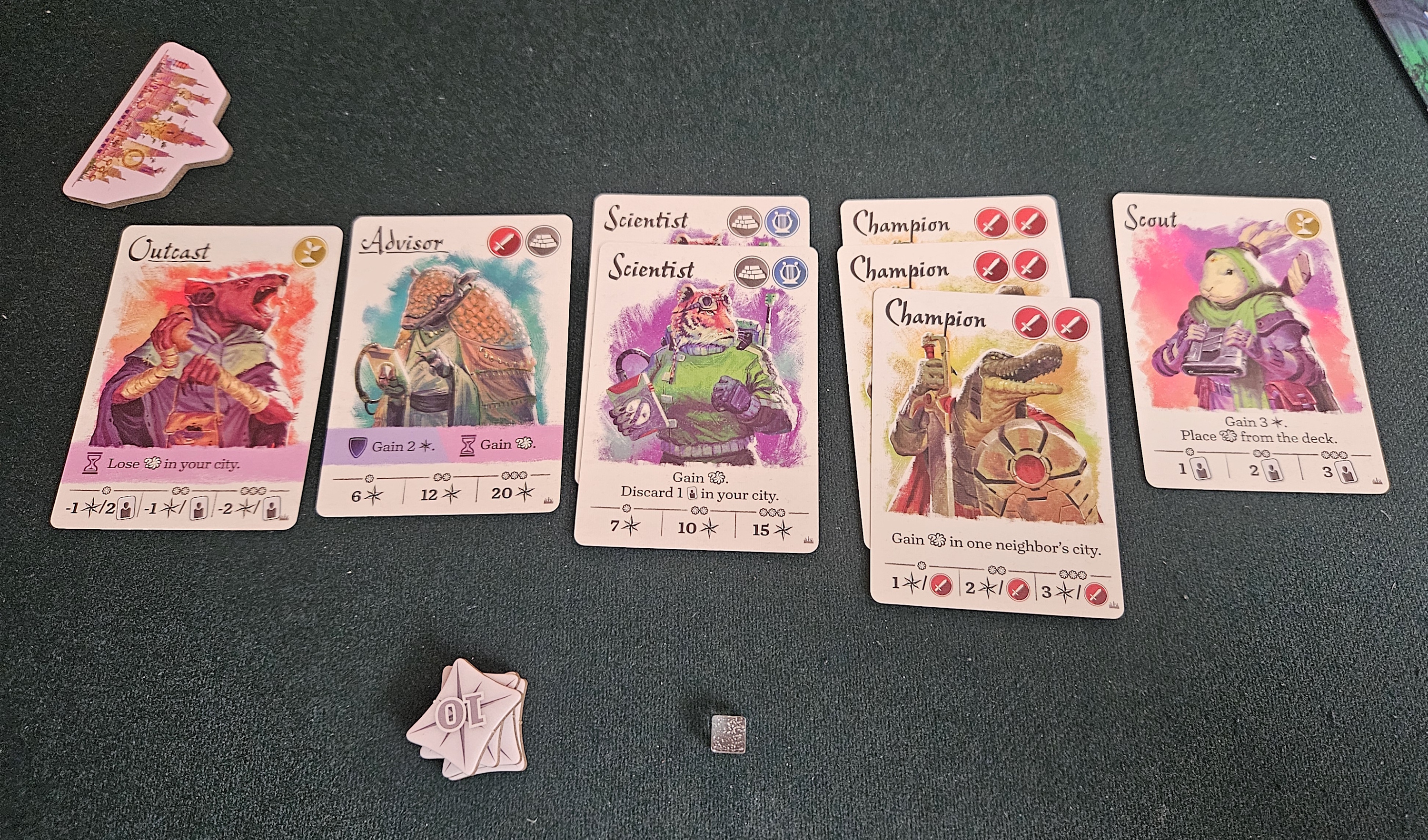
Ah, my pleasant animal polis.
It begins with a shuffle. Such a big shuffle, in fact, that my relatively broad hands ache at the strain of holding so many cards. There are thirty flavors of citizen in the box, a generous spread. Depending on your player count, you’ll take seven to ten of those sets, each set ten cards in size, and riffle them together until your knuckles crack.
And then you try to get them to work together.
Even in its earliest moments, there’s a tinge of something primal to Citizens of the Spark. Not primal in the sense of cavemen striving against the mammoth. Primal in the way the game asks you to create a society from these dissimilar peoples. This is the question that hovers over all of civilization. Can people who don’t see eye to eye live beside one another and strive toward a shared goal? It’s visible in Sá’s artwork. The Judge is a chicken. Not in the sense that she’s a coward hiding behind the bench and his robes. She’s literally a chicken. A hen. A producer of eggs. Tasty in peanut oil. She might share a city with one of her natural predators. An Agitator who happens to be a fanged reptile. A Soldier who is a bear. The tiger Scientist. To thrive, one presumes the city is governed by détente. No eating the judges.
As lovely as those illustrations are, duBarry encodes these dissimilarities into the cards themselves. In any given session, you might be presented with a society of Tyrants and Executioners. Yikes! But those dangerous creatures may soon prove paper tigers in the face of Traders and Politicians. Your task is to take these cards, measure their worth, and try to piece together something functional. There are natural imbalances, of course, but nearly any combination is playable, with the sole exception that you shouldn’t use more than a few underlined citizen sets at once. It’s impressive, both conceptually and as a way to ensure that every session presents a fresh conundrum for players to puzzle over.
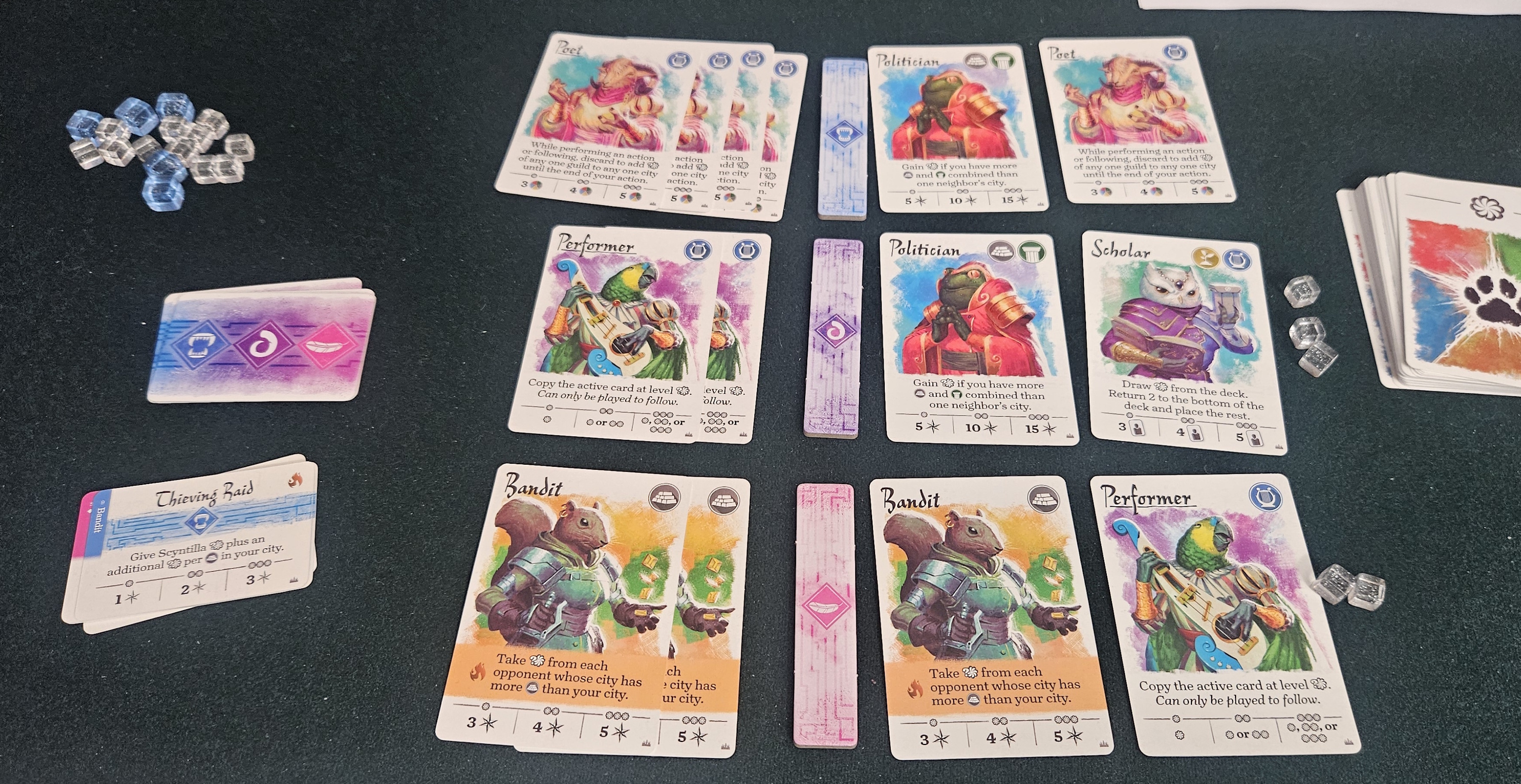
Cards are drafted from rows that gain more sparks as their denizens are neglected.
For all that, the actual gameplay is snappy and rules-light. First you choose a few creatures to add to your incipient polis. These are offered three rows at a time, each containing two or three cards, again depending on player count. As rows go unclaimed, perhaps because they include cards that don’t boast the same natural synergies as their peers, they accumulate sparks, the game’s currency of victory points. After a while, even outcasts accrue enough value to make them tempting.
As your city swells with citizens, you might want to trigger their actions. There are quite a few of these, attacks and defenses and trades and swaps and conversions, but their one commonality is that every action grows more potent with larger numbers of citizens. Here’s a simple example. If you have a Merchant, you can trigger its action to gain sparks for every brick icon in your city. With only one Merchant, that’s one spark per brick. With the maximum of three Merchants, that’s three sparks.
The limitation, though, is twofold. First, that citizen will depart your city forever. So there’s an element of press-your-luck to the whole thing, a barrage of micro-decisions over whether to activate your citizens right now, or wait until you have a bunch of them to trigger their more powerful effects.
Second, everybody else at the table also gets the chance to activate that citizen type. Sure, maybe we’ve tapped out the supply of Merchants, so I’m eager to earn a few points. But if your city is housing three times as many of the guys, or more of the icons they score with, then it’s entirely possible I’ve just handed you a powerful opportunity on your off-turn. Tradeoffs, tradeoffs.
Cluttering this headspace even further is the fact that the Merchant is about as simple as citizens get. The Scientist functions similarly, earning increasing points with more duplicates. But they also force another citizen to abandon your city entirely. Controversial research, perhaps. The Warrior earns points, but only if your city has greater military strength than a neighbor. The Bandit steals points, but you need to have fewer bricks than your victim; as a complicating factor they also provide the very same brick icon they’re trying to have fewer of.
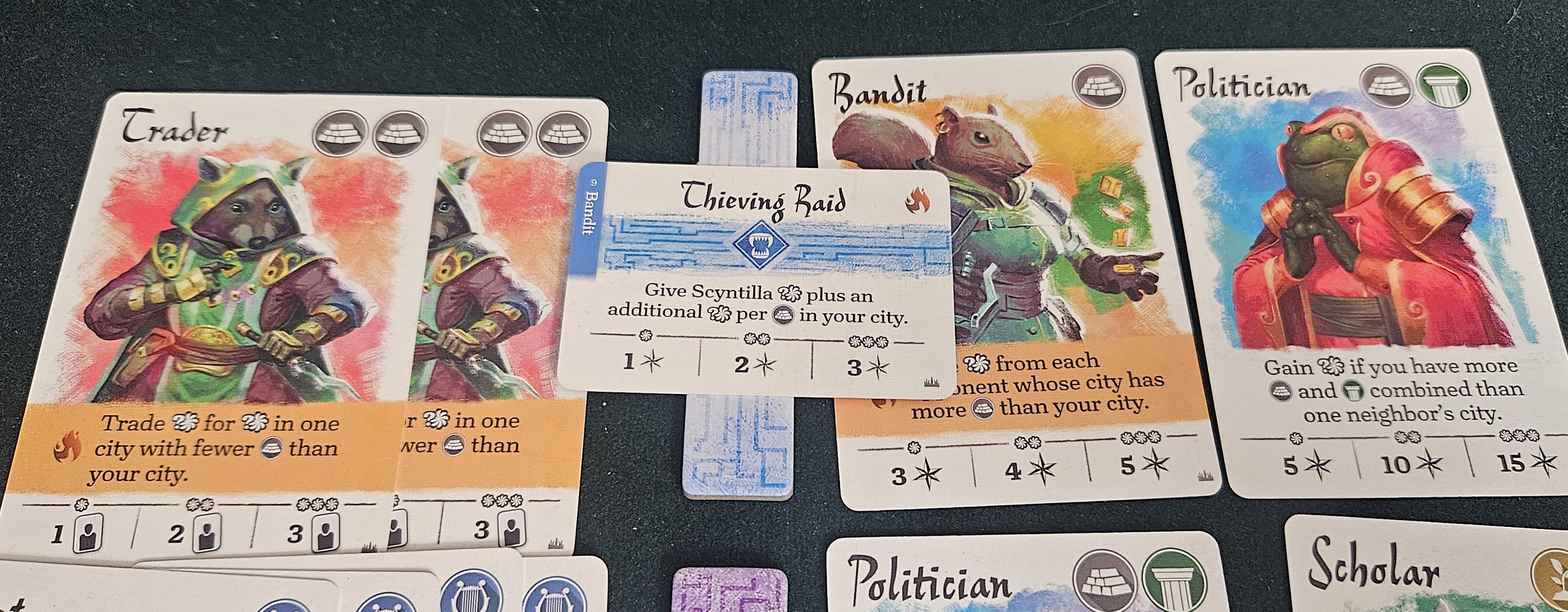
The solitaire mode is bastard-hard.
Put together, Citizens of the Spark is the sort of game that’s rife with imbalances, but those imbalances are the very thing that make it so riveting to explore. It’s almost unthinkable that any assemblage of citizens won’t come with at least one or two stinkers. Philosophers who don’t have anyone to philosophize to. Defensive Advisors and Diviners when there are hardly any attacks to defend from. Poets and Outcasts, the gummy citizens that steadfastly refuse to be put to productive use.
But that’s precisely when the game becomes interesting. Maybe everybody will squabble over the most valuable citizens, thus spreading them between too many cities to be valuable. Or maybe a few cards will sit in the offer so long that they become worth quite a bit more than their printed value. I’m already on the record as believing that “balance” is perhaps the most oversung element of board game design. In duBarry’s hands, the imbalances between citizens become the game’s most essential texture.
To be clear, Citizens of the Spark is a subtle game. It isn’t flashy. There are big swings, but they’re swings of points, a card moving from there to here, more points. There are plenty of turns that consist of grabbing cards, glancing at your tableau, and deciding that, y’know what, there aren’t any actions you want to take right now. Similarly, it’s a rather chancy game. Get ready to listen to that guy complain that no good cards are ever available on his turn.
Still, I can’t help but appreciate this one. I like its gentle ebbs and flows. I like how it feels warm despite its cutthroat tendencies. I like how it can wipe out a player’s city in the early stages, then still, more often than not, pave the way for a comeback with some grit and maybe some whining. I even like the solitaire mode, with its card-shifting and ability-triggering meanie of a bot.
Most of all, I like these dang cards. Their imbalances and chanciness, the way they reward focus and diversification at the same time. The fiction of them. They call to mind any number of successful cultures, from Persia to Star Trek to the Panspecificity, that fashioned functional states despite the vast differences between their subjects. Or maybe the most successful city on the table will be a government of predators. That’s how it goes sometimes. I like that, too.
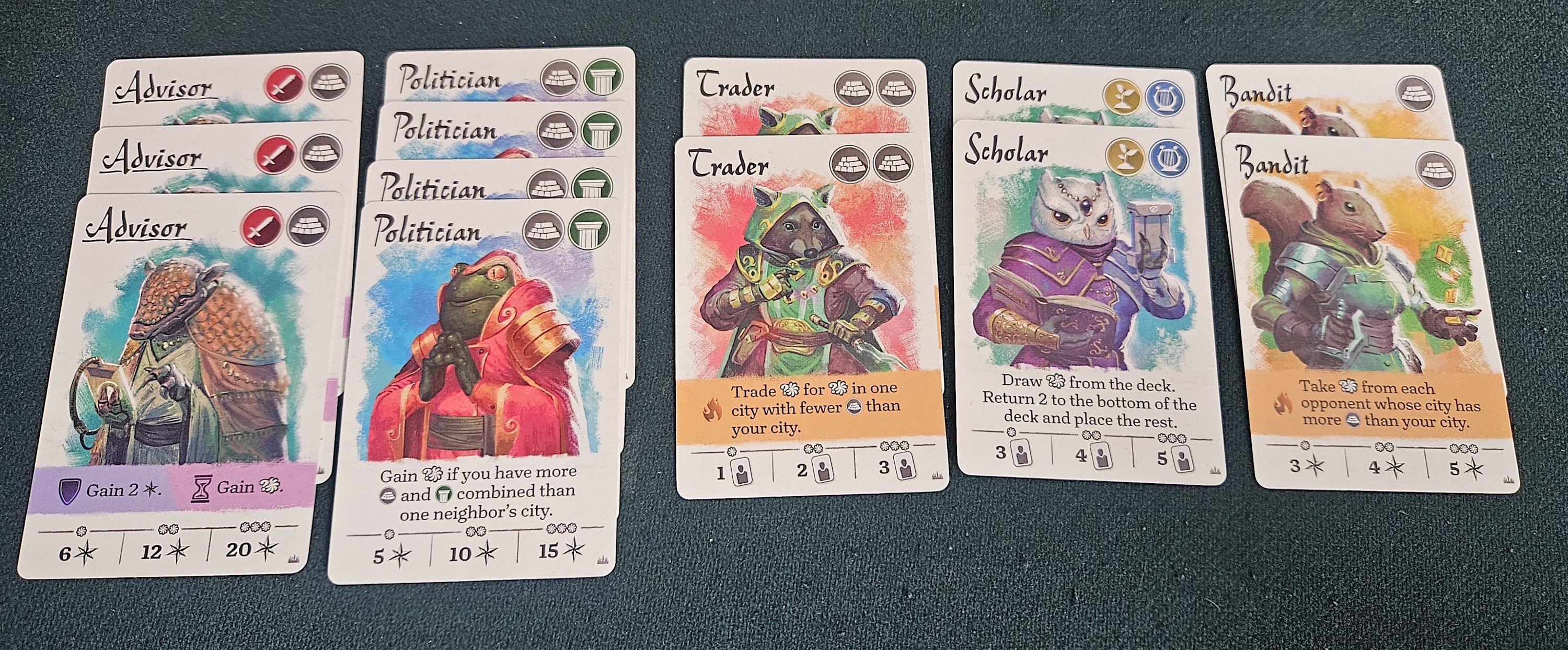
It’s a while before repeat combos show up.
Ultimately, Citizens of the Spark is a pleasant little thing, not groundbreaking or liable to show up in every game store, but still a quiet and compelling artifact of play that grows deeper and cleverer with each session. It’s the sort of game that feels like the beginning of something. More citizens? New modes? Another game inspired by this one’s muted success? Who knows. For now, it’s a game I’ll break out when I want to show somebody what can be accomplished with unassuming systems and some imagination.
A complimentary copy of Citizens of the Spark was provided by the publisher.
(If what I’m doing at Space-Biff! is valuable to you in some way, please consider dropping by my Patreon campaign or Ko-fi. Right now, supporters can read my first-quarter update of 2026: the best board games, movies, books, and more!)
Posted on May 13, 2026, in Board Game and tagged Alone Time, Board Games, Citizens of the Spark, Thunderworks Games. Bookmark the permalink. Leave a comment.


Leave a comment
Comments 0