Hey! A Place I’ve Actually Been!

At this point, it doesn’t seem far-fetched to crown Josh Wood the king of tableau-builders. Yes, yes, like a trampler of horse glue I’m invoking Santa Monica yet again, but the more relevant touchstone today is Let’s Go! To Japan, a lovely, if flawed, game about planning a vacation to Tokyo and Kyoto.
Let’s Go! To France is Wood’s follow-up to that latter title. It tackles every single one of my reservations with that game, and then goes on to produce one of the most delightful, evocative, and grounded tableau-builders I’ve ever played. Maybe it helps that I’ve actually been to France. More likely, it’s that Wood knows precisely what he’s doing with every mechanism, component, and locale.
I can even pronounce some of these words.
It’s going to be hard to not turn this into a comparative review with Let’s Go! To Japan, so let’s open with the basics. Let’s Go! To France is a game about planning and executing a trip. Not just any trip. A two-week trip to Paris and some portion of wider France, undertaken day by day and hour by hour.
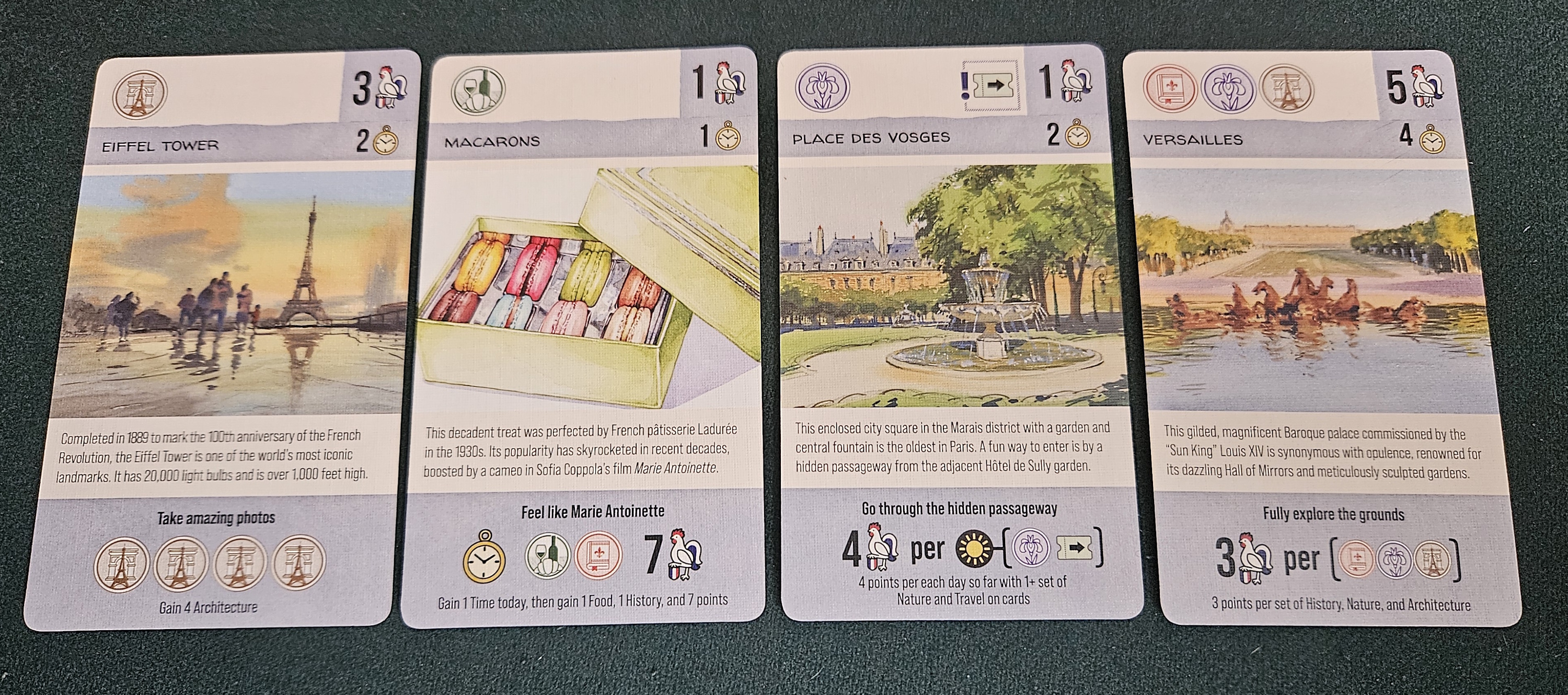
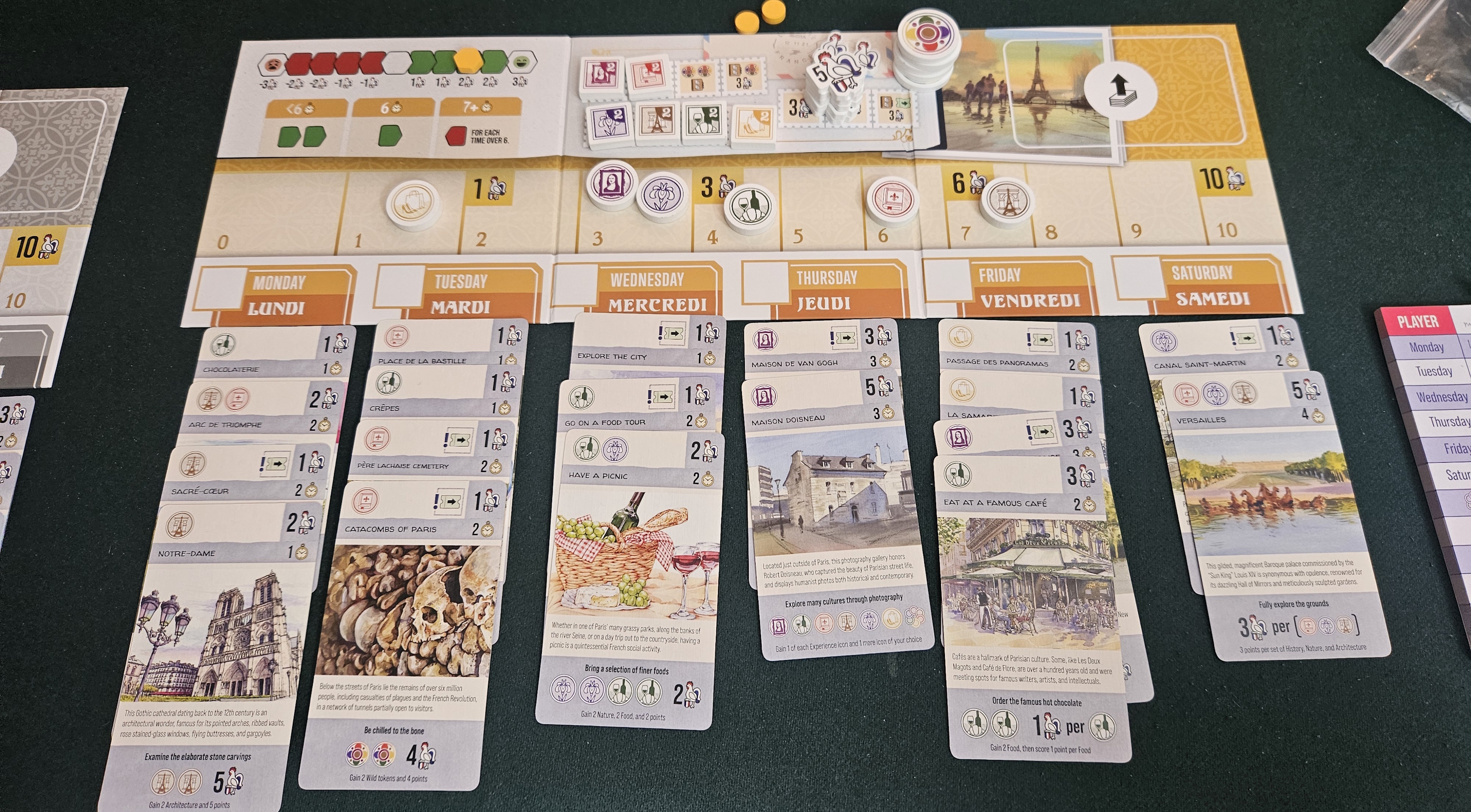
For all that, there’s an elegance to the whole thing. Turns are presented as simple drafts. You receive some cards. One or two of them will get scheduled into your itinerary. The rest are passed around the table. The cards each present a different activity in Paris: visiting a museum, snacking on delicacies, touring a park, shopping at an open-air market, finding an overlooked nook that you’ll boast about to friends for years to come.
Each card has four main components. Victory points — self-explanatory — some icons that increase the appeal of your trip on a numbered track, the amount of time required to fully visit that card, and lastly a scoring opportunity that will only trigger if this is the final event scheduled on any given day. Your objective is largely about optimizing scoring. To offer but one example, visiting the National Archives earns three points for every history icon you placed on that day. That’s a tremendous opportunity if you’ve arranged a day full of tours, but is easily dismissed if you’re planning on shopping or eating instead.
Those other considerations are no slouches, either. It’s possible to absolutely cram a day with activities, but your energy level will suffer, possibly resulting in subtracted points. There are also ideal conditions for each day, earning little bonuses for visiting the park when it’s clear outside or stuffing yourself with pastries on what I imagine is your cheat day. And if nothing appeals, Wood returns with a trick he deployed to great effect previously, letting any card flip to its reverse side to become a generic “Explore the City” activity.
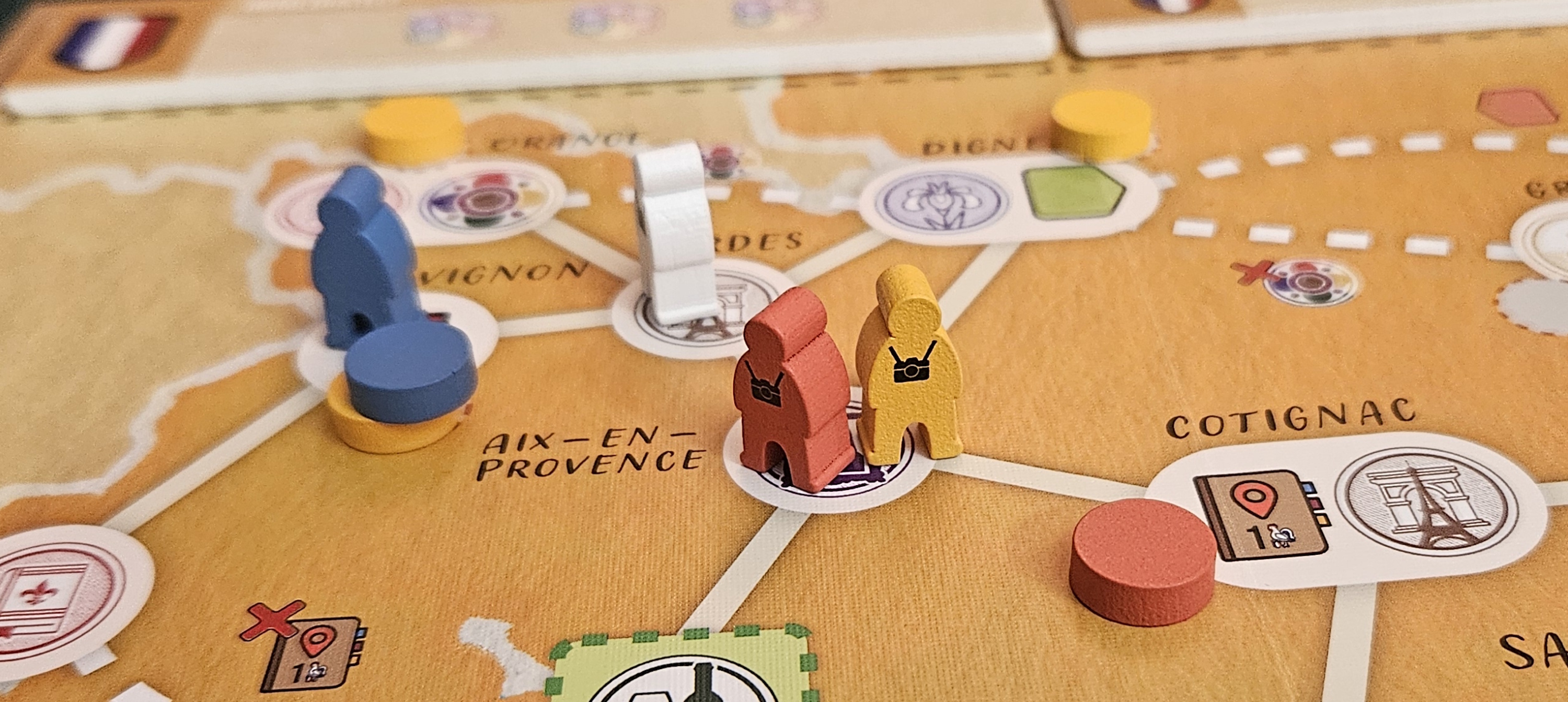
Spending a week in the country before heading to Paris.
If you’ve played Let’s Go! To Japan, this likely sounds familiar. Indeed, nearly everything here resembles Wood’s previous title, but has become the beneficiary of little tweaks that mark this as the far superior outing.
For instance, there’s the way those Explore the City activities are handled. Previously, exploring Tokyo or Kyoto resulted in your tableau receiving a random card during scoring. This could make or break your day, interjecting some randomness into what was otherwise a carefully structured experience. Here, exploring the city is its own pleasure; one doesn’t need to stumble upon a museum or garden to justify their time spent in Paris. This keeps your tableau in check and feels more appreciative of what makes such a trip worthwhile. Just being here is enough.
Similarly, the ideal conditions for each day are now portrayed as guidelines rather than dictates. It’s worth assigning activities to the corresponding days, but this is only mildly beneficial, and only the first two times you do it. Beyond that, you’re free to schedule your days as you see fit, without worrying that you’re missing out on another drizzle of points. It’s a small thing — basically, you’re earning a benefit just a little earlier than in the previous game — but it goes a long way toward letting you shape your own trip rather than ensuring there’s a history day, a food day, an architecture day, and so forth.
![Wait a minute, how dare you name a place Les Invalides? That should be reserved for hospitals and... [touches earpiece] it's a what? Ahem. Never mind.](https://spacebiff.com/wp-content/uploads/2026/04/4.-flex.jpg "Wait a minute, how dare you name a place Les Invalides? That should be reserved for hospitals and... [touches earpiece] it's a what? Ahem. Never mind.")
The tableaux here are much more flexible than those in Let’s Go! To Japan.
At times, there’s a sense of vague translocation. You are, in effect, planning Schrödinger’s Vacation, the cards signifying events in both past and future. But it’s a mild discombobulation at worst, one that lasts maybe five minutes before everything snaps into place. The overall process is much smoother than the previous game’s swapping between cities, and provides ancillary benefits to the game’s usual procession of daily scores.
You might, for example, begin your week in Paris already tuckered out from your time in the Loire Valley, prompting you to take it easy for a couple of days or chow down on some crepes for a sugar rush. Or perhaps you’ll arrive already enculturated by old architecture, letting you take advantage of a daily highlight that requires a certain number of icons before awarding big points. Where previously these objectives would only pay out in the later portion of your trip, it’s now possible to assemble a more robust tableau, one that feels rewarding from start to finish.
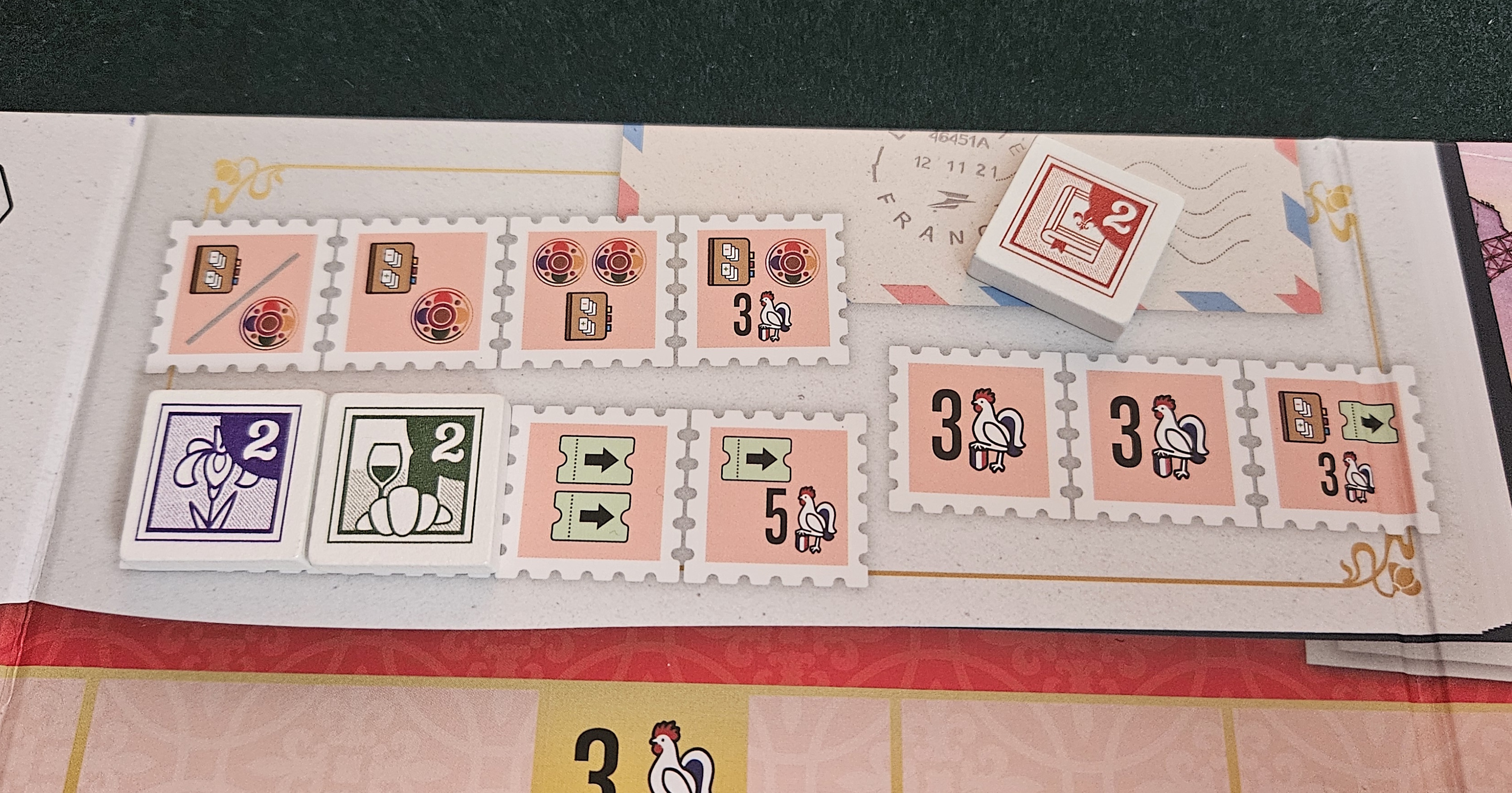
I appreciate a bonus.
As before, scoring is an active portion of the game, an event in and of itself where players walk through their trip one day at a time, tallying points and keeping track of their relative energy levels. This helps to digest the game’s point-salad fiber, but it plays an even more important role in contextualizing Paris as a geographic space with its own character and identity.
I’ve often praised Santa Monica as an ideal tableau-builder for the way it asks players to not only create a space, but also to inhabit it, to move around in it, to poke around its nooks and crannies. With Let’s Go! To France, Wood replicates the trick, albeit via an entirely distinct set of mechanisms and representations. This is Paris as a location out of time, the city that is at once a tourist trap and timeless. Around every corner there’s something new to see, some fragment of history that has been improbably preserved across the ages.
And that sense is communicated above the table as well. As one friend put it, you could take the deck to Paris as a reminder sheet of everything there is to see and experience. Playing this game, we found ourselves discussing the spots we’d seen and those we hope to see some day yet to come. The overlooked garden with the hidden entrance, where one friend drank wine and conversed with a farmer. The museum that sparked my imagination more than any other I’d ever walked. The sheer looming size of something. The joy of ducking into a random cafe and having one of the finest meals of your life.
I’d do that.
The effect is magical. In a sense, Wood has created a transposition of his own, a game at once past and future, both reminiscence and future itinerary.
He’s also crafted a game that’s nearly without parallel. That its best comparisons are Wood’s own past creations is a testament to his skill with this particular medium, but also to the city he’s chosen for us to experience all over again. In improving on its predecessor in nearly every way, Let’s Go! To France deserves its peculiar punctuation. Let’s go, indeed.
A prototype copy of Let’s Go! To France was temporarily provided by the publisher.
(If what I’m doing at Space-Biff! is valuable to you in some way, please consider dropping by my Patreon campaign or Ko-fi. Right now, supporters can read my first-quarter update of 2026: the best board games, movies, books, and more!)
Posted on April 16, 2026, in Board Game and tagged Alderac Entertainment Group, Board Games, Let's Go! To France. Bookmark the permalink. 3 Comments.


Preview works as a disclaimer in case things do change, as much as they may not. I like it! It means to me ‘don’t necessarily count on things looking and feeling just like I said and showed’.
As for the game, I like the theme of Japan better but the mechanics of this one do seem much improved.
Plus the “Allons-y!” in the title block are doing massive lifting in initial charm!
Thanks, Adam!
Pingback: Scooping Rick Steves – SPACE-BIFF!