Blog Archives
Fantastiqa: Pocket Dimension

There’s a certain enchanting quality to Alf Seegert’s latest, Rival Realms. Set in a sort of pocket dimension of Seegert’s wonder-realm of Fantastiqa — and literally sliding into a large pocket, how’s that for appropriate? — and expounding upon the card-laying system he first crafted in Musée, it’s an otherworldly experience, as though its players have left their concerns hanging in the wardrobe and stepped straight into Narnia.
The Lonely Degenerate
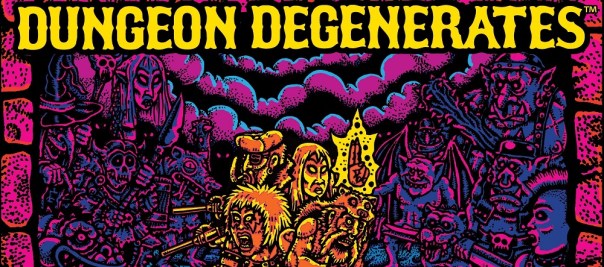
There’s a certain comforting blandness to the usual adventure game setting. Armored heroes. Lithe elves. Hardy barbarians. Green-skinned orcs and soaring dragons and icky spiders. A land of plenty thrown into peril. You know the drill. It’s certainly been the drill long enough.
Dungeon Degenerates isn’t satisfied merely breaking away from this formula. It also needs to smash it with a sledgehammer. After all, as spoken by another notable iconoclast, “When you come at the king, you best not miss.”
I’m going to spill the conclusion of this review right now: Dungeon Degenerates does many things, but miss is not among them.
Make a Million for You Overnight
Despite its staid outward appearance, Hardback is the byproduct of word game inbreeding. Its daddy is Tim Fowers, the same fella who brought us Paperback a couple years back, while its father is Jeff Beck, creator of last year’s Word Domination. Even a description of its particular playstyle feels like dendrochronology performed on a family tree: what Paperback was to Dominion, Hardback is to Star Realms.
Fortunately, that word-jumble statement is actually pretty easy to explain.
Four Little Pigs, Roasted and Stuffed

Allow me to indulge in my inaugural Old Man Moment by saying, hey, fairy tales used to be better. No, not back in my day. I’m talking way back, when the forests were thick and uncut, the sun only peeked through the pestilential clouds once a fortnight, and taking a wrong turn while returning home from the well might get you eaten by either wolves or Visigoths.
Strangely, Tim Eisner’s The Grimm Forest comes within an inch of evoking these older, more ominous stories, and all because this fairy tale’s got bite.
The Sun Also Rises

I’ve always been suspicious of that oxymoron called “big minis games.” You know, specimens like Cthulhu Wars and Assault of the Giants, wherein the little people’s gentlemanly war is interrupted by beasts twice their size and quadruple their strength, slammed onto the table with a diminutive rumble that could ripple water or quiver jello. With all that mass lumbering around, who’s going to work up the nerve to say that your game is too small in the areas that count?
It was Eric Lang’s Blood Rage that persuaded me that such a game could exist, and be worthwhile as a game, without leaning all its weight on its toy factor. Big monsters and cool sculpts, yes, but also a solid sense of what made for a good time. Brawny and brainy in equal measure. Big monsters who land heavily and earn their place.
And now Lang has crafted a spiritual sequel in Rising Sun. Brace yourself, because this one’s got some sharp edges.
The Wheel Turns Again: A Look at Imperius

Remember Solstice? It would be forgivable if you didn’t, since it’s one of the few games I’ve featured for Best Week that nobody actually played.
But here’s the thing. Imperius — which is Solstice but with some significant polish, expanded artwork, and a way more generic name — is coming to Kickstarter tomorrow, and I want to tell you why it should be the target of your latest machinations.
Illuminati House Party
One of the best things about this hobby is the possibility of stumbling across something entirely unfamiliar. Illimat, which was designed by the creator of Gloom and has something to do with a band I’ve never listened to, never fully crosses the line into alien territory. Instead, it steps up to the barrier and then moves sideways, somehow feeling familiar and forgotten both at once. Otherworldly, you could call it, as though it fits within some alternate dimension or half-recalled dream, only penetrating into our world at oblique angles.
That or it’s a card game that knows how to put on a good show. It’s tough to tell.
Wallets of Galloping Star Pioneers
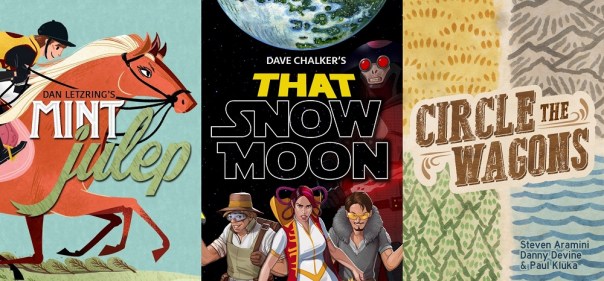
Button Shy is at it again. They’ve cornered a particular niche, games squeezed into plastic wallets approximately one-fifth the size of the leather brick I actually lug around. They’re tiny, consist of fewer than twenty cards, and most of them are rather pretty to look at. Good games, though? Let’s break down the most recent trio to find out.
Vaster Than Ever

I dug Vast: The Crystal Caverns back in 2016. More than that, I still dig it. Just a couple weeks back, I called it “the king of wild asymmetry that actually works.” And I stand by that. The beauty of Vast isn’t just that each of its five roles is fiercely different, it’s that they work in near-perfect harmony, breaking apart to pursue their own objectives only to come crashing back into one another’s orbit time after time.
With that in mind, does a game with five asymmetrical roles really need three more? Or worse, six more?
Empires of the Clutter II
Ryan Laukat’s original Empires of the Void was one of Kickstarter’s early success stories. It was 2011, long before everybody got jaded with underwhelming indie projects and enamored with the latest empty-headed box with miniatures in it. It pulled in somewhere upward of $35,000.
Now it’s 2018, Ryan Laukat has been a staple of the crowdfunding scene for years — long enough to have witnessed “phases” in his career — and now we’ve got a sequel. It made seven times more than the original game during its Kickstarter run. Does that mean it’s seven times more enjoyable?
Yes, that is how I think math works, thanks very much.

 SPACE-BIFF!