Blog Archives
Scry Guys

I know an uncanny amount about divination. Not because I believe in the stuff, mind you. It comes up a lot in my work, both as a practice in ancient religion and as a prominent branch in the history of board games.
So when Chris Chan’s Portents first hit my table, I was fascinated to learn which type of cleromancy it would use. Drawing Roman sortes? The knucklebones and dice oracles of astragalomancy? The fateful archery competitions of belomancy? We haven’t even touched upon the really cool ones. Maybe Portents would let us manipulate shards of coconut, or pour molten metal into water and examine the resultant shape’s shadow, or undertake bean magic. Yes, bean magic. Favomancy. It’s shocking how many forms of geomancy used beans. The possibilities for gamification are endless.
Turns out, Portents is about haruspicy via bird parts. And while any self-respecting haruspex would immediately note that it uses the wrong organs, never fear: this one is about fraudsters trying to out-divine one another.
Space-Cast! #22. My Father’s Interview
Have you ever gone mad pursuing a parent’s ambition? That’s the topic of T.C. Petty III’s My Father’s Work, a game of intergenerational trauma, weird science, and scaring off your loved ones. Also an app.
Listen over here or download here. Timestamps can be found after the jump.
It Also Means Goodbye Earth

For all their lightness, party games are tough to design. Probably because comedy is hard enough to create deliberately, let alone when you’re helping others create it out of thin air. It isn’t just a matter of setting up jokes. There’s careful timing to good humor, a cadence, empty spaces, gaps. It’s no wonder so many party games stick to mimicking Apples to Apples.
Heather and Christopher O’Neill’s Aloha Earth goes the other direction, and although the result isn’t quite as well-trod as having everybody play a card, the formula is still a familiar one. This time, one player places a prompt on the table. Everyone else tries to get that player to laugh. There’s a little more to it, but not much. That’s both a strength and a weakness.
Fireflop
Yesterday we looked at €uro Crisis, a sharp-toothed economic game from Doppeldenkspiele with one heck of a political system and a jaw-unhinging dose of satire. Despite some reservations, I appreciated its unexpected edges and depth of play.
Its follow-up title, Claudio Bierig’s Plutocracy, rockets the financial power plays into the far reaches of the solar system. Unfortunately, despite being given infinite wiggle room, it largely sticks to one corner.
€laborate Banality

There’s this devastating moment in one of my favorite shows of all time, Mr. Robot. This character, a banker, describes the day he and other high-level executives decided to cover up evidence that one of their factories was leaking toxic chemicals. Speaking to the daughter of an employee who died from leukemia caused by that leak, this banker details how rather than going public with the information, the company decided to stash some money for a possible future lawsuit. Any settlement today would be paid from a fraction of the interest earned on that investment.
In a show packed with bombastic conspiracies, it’s an understated moment. This particular coverup wasn’t about controlling the world. It was the banality of regarding human beings as risks to be managed, item lines to be balanced, expenditures to be weighed against other expenditures.
€uro Crisis, whose designer only goes by “Galgor,” and published by Doppeldenkspiele — to give you some sense of what’s to come, that translates to “Doublethink Games” — also isn’t about controlling the world. It’s about financial crises and the people who profit from them. And it cranks the banality up to eleven.
The Trance of Trick-Taking

Longtime readers know my blind spots. Trick-taking is a big one. My wife grew up with trick-takers. They were a regular family activity, so she learned their rhythm: the subtle tells, the contrasting modes of pressure and conservation and cooperation, the possibility of someone running away with a hand. When we try a new trick-taker, it doesn’t matter how different or innovative or oddball it happens to be — she settles back in like it’s the same game she’s played a hundred times before.
Shamans, the trick-taking game by Cédrick Chaboussit, falls into the oddball category. But despite a few departures from the normal template, it’s the first time I’ve slipped into the trancelike mindset of the trick-taker.
Gargling Brack

At some point the board game industry’s collective designers are going to stage a riot if we keep saying “It’s no Root.”
So let’s set that aside for now. Despite being published by Leder Games, illustrated by the inimitable Kyle Ferrin, and featuring four (mostly) asymmetrical factions of anthropomorphic animals fighting for control of its seascape — and despite some vaguely philosophical undertones — Greg Loring-Albright’s Ahoy is very much its own beast.
For one thing, it isn’t a hit.
Clank! Again!

I have mixed feelings about Clank! — and that’s a sentence that would sound much less dramatic without the obligatory exclamation mark. When I wrote about it way back in 2017, my stance veered wildly between “This is an approachable and clever hybrid deck-building game” and “This feels deeply artificial, and also there are way too many dead turns.” I haven’t touched its offshoots: no Clank! In! Space!, no expansions, not even the legacy-game version. Ask me what designer Paul Dennen has been up to and I’ll excitedly tell you about Dune: Imperium instead.
In a way, that remoteness gives Clank! Catacombs the air of a reunion. Not a high school reunion, and certainly not a creepy polygamist ancestors reunion. Rather, a reunion with an old friend — more of an acquaintance, really — who’s become way cooler than you remember.
Or Hog

Video game board game board games are an odd duck. I don’t mean board game adaptations of video games; I mean board game adaptations of video game board games. It hasn’t been that long since The Witcher 3: Wild Hunt included a ditty called Gwent. It was an absurd thing, impossible within the fiction of the game. Who exactly served as the Continent’s version of Wizards of the Coast? Were tournaments sponsored by Radovid the Stern? Were inks and cardstock imported from Nilfgaard? Did the Lodge of Sorceresses settle issues of power creep? To everybody’s surprise, Gwent had solid bones, perhaps because it drew from superior titles like Condottiere. Now you can play Gwent on its own. It even has two standalone story games.
Orlog goes the other direction. As a dice game, if feels right at home in the world of Assassin’s Creed Valhalla. What’s more natural than Vikings rolling some tombstones? Apart from sticking axes into Northumbrian levies or braiding each other’s beards, that is.
Too bad this adaptation is as cynical as they come.
Ophthalmology Is Not an Option
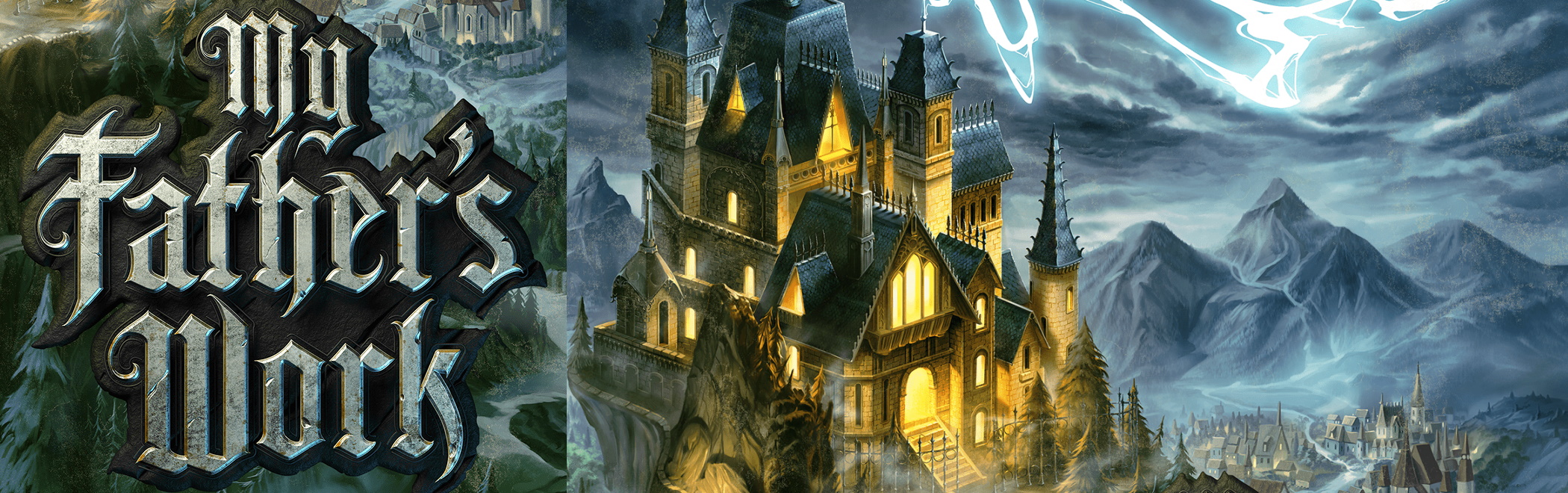
T.C. Petty III’s My Father’s Work is the sort of game that gets called “thematic.” Shiny with chrome, bursting with colorful verbs and adjectives, and narrated via an app, it’s the latest title to blur the distinction between storybook and plaything.
But it’s also thematic in the more universal sense: that it contains themes. Actual honest-to-goodness themes of obsession, selfishness, generational trauma, and the bewildering hilarity that tends to accompany the macabre. It’s a rare game that strives for commentary; this one could constitute an entire shelf’s worth of literary references.

 SPACE-BIFF!