An Untimely Decapitation

Ah, the stench of the arena. The sharp bite of steel, the tang of blood, the musk of fur and man-sweat barely concealed by a splash of olive oil. Breathe it in. Breathe it, I said. Because this is serious business, this gladiator stuff. Gladiat-ing has never been for the meek.
Carthage isn’t the first game to sashay into the arena, not by a long shot. But it just might be the first arena-smasher that’s actually a deck-building game. So: thumbs up or down? Let’s find out together.
Back to the Future, Past, and Present

Some games I appreciate for their elegance. Their brightness. Their sheer go-where-nobody-has-gone-before-ness. Others I appreciate because they’re garbage. Delicious, sugary, make-you-look-like-a-tire-swing-got-wedged-around-a-telephone-pole garbage.
See where I’m going with this?
It’s Pronounced “Dragger”

It’s a tale as old as time. Boy meets girl. Girl isn’t interested. The town of Stjørdal gets invaded by flesh-hungry undead. Flesh-hungry undead are the only ones who can pronounce “Stjørdal,” so by ancient tradition they now own the town. Boy, with nothing better to do with his misdirected masculinity, loads up on iron stakes and vials of holy water. It’s on.
We haven’t covered anything by prolific print-and-play designer Todd Sanders for a while, but the recent envelope printing of Todd’s solo microgame The Draugr by BoardGameGeek seems like as good a time as any to jumpstart our moldering heart. So listen up, because this one’s lean, gorgeously ugly, and arrives printed on paper you might bring groceries home in.
Sumter’s Going On Here

After spending six, seven, and eight hours respectively on the full campaigns of Churchill , Fire in the Lake, and Pericles, a bracing twenty-minute tug of war was the last thing I expected from Mark Herman. Yet here it is: Fort Sumter, a wargame more in the vein of 13 Days than Herman’s usual wheelhouse. But as an experiment in capturing the stresses of the U.S. Secession Crisis in as few minutes and moves as possible, it’s largely successful.
Introducing the Space-Biff! Book-Space!

In addition to board games, I’ve always had an abiding love for science fiction, fantasy, horror, post-apocalypsopoda, and… princess books? Yes. That’s me.
Now, in collaboration with Brock Poulsen and Somerset Winters-Thurot (no relation), comes the world’s first podcast about that very subject. Every month we’ll be reading and discussing one book — spoiler-heavy, no-holds-barred, all arguments and spats and talking points laid bare for all to witness. With your ears.
For our inaugural episode, we’re talking about The Fifth Season by N. K. Jemisin, the first entry in the Broken Earth series and winner of the Hugo Award for Best Novel in 2016. If you’ve read The Fifth Season, you can listen to our jabbering over here, or download the episode here.
Or read ahead and shoot your thoughts over to spacebiffbookspace@gmail.com to contribute to next month’s discussion of The Three-Body Problem by Liu Cixin.
Spew-Quiff!

There’s something about Grant Rodiek’s most recent designs that’s equally bold and foolhardy. Bold, because he’s willing to toy with our preconceptions about tried-and-true game systems to an extreme that most designers would balk at. And foolhardy for, well, pretty much the same reason. Whether you’re drafting somebody else’s cards in Solstice/Imperius or fumbling with the blind wagers and multi-use cards of Five Ravens, you can wager green money that his games will see you doing something familiar in an entirely unfamiliar way.
Enter SPQF. It’s a history pun, standing for the Senatus Populusque Forest — while gleefully disregarding that a Latin forest doesn’t begin with “F.” And it’s a Disney’s Robin Hood’s take on deck- and civilization-building with a Rodiek twist: cute animals, familiar concepts, and one bear of a first play.
Specter Oops They Did It Again
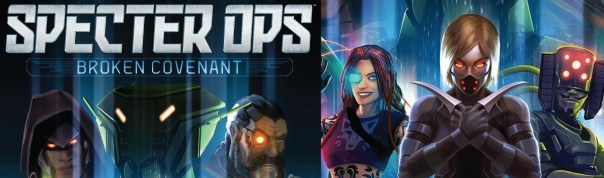
Five minutes into Broken Covenant, Plaid Hat’s standalone follow-up to Specter Ops, and I was already in trouble. Let me tell you why.
The Lonely Stoic

As the last of the Five Good Emperors, Marcus Aurelius was inclined to philosophy over military matters. So much so that he was given the totally unique nickname, “the philosopher.” But sadly for Marcus, his reign was quickly marked by trouble. When Roman soldiers brought home a nasty bout of plague from Parthia, it wasn’t long before Germanic and Sarmatian tribes took advantage of the weakened empire and begin their advance across the Danube and into Gaul. And no quantity of stoicism was going to solve that one.
Robert DeLeskie’s Wars of Marcus Aurelius covers a decade of brutal frontier fighting from 170 to 180 CE. And much like its source material, it’s full of hard decisions, infuriating reversals, and some slogging through the muck to get to the good stuff.
Starshiz Samurai

Every so often, along comes a board game so perfectly silly, so wonderfully bombastic, so altogether joyous, that how could it fail? Like Starship Samurai. This thing is a Saturday morning cartoon realized in cardboard. Gigantic mechs socking each other in the rivets, warring clans courted and spurned, and fighter craft glittering between the stars. Surely it isn’t possible that such a thing could be a painful unmemorable slog that happens to contain some reasonably pretty miniature robots?
Surely not.
Dur Dur Dûhr

Bemused was not only a fantastic game, it was also one of my favorites of 2017. Where most social deduction games revolve around a single secret of falsified identity, Bemused hosted an entire madhouse of enigmas. Obsession, passion, lust, petty hatred, unknown goals and broken promises — all crisscrossing over and under one another, and all as impenetrable and changeable as the players commanding their fates. It was both less and more than social deduction; just a social game full stop, ambiguous and uncertain.
Now Jim Felli has further refined the concept with Dûhr: The Lesser Houses. And although its name is guaranteed to elicit at least one sarcastic howl of “Dur dur dur!” per play, it’s an improvement on Bemused in every sense but one.

 SPACE-BIFF!