Scooping Rick Steves

I owe Abroad an apology. When it first landed on my doorstep, I set it aside for a solid month. My assumption was that it was another ultra-light globe-trotter, absent serious tension and disconnected from the locales it was asking me to explore. A game about travel, but not really about travel, if you take my meaning. Not to throw any specific shade here, but I figured it for a Trekking the World clone.
Designed by Rodrigo Rego and Danilo Valente, Abroad is anything but a clone, and it certainly doesn’t feel disconnected from its geography. If anything, it hews closer to the Let’s Go! series by Josh Wood, which invited us on vacations to Japan and France. Those titles drew us in with both tourist traps and local color, the unique contours of their cities, even the way these places’ infrastructure might require transit, downtime, or some extra effort to uncover something off the beaten path. The main distinction, of course, is that Abroad covers a continent rather than a single country. The remarkable thing is that it still manages to feel like a real place — and a highly competitive one at that.
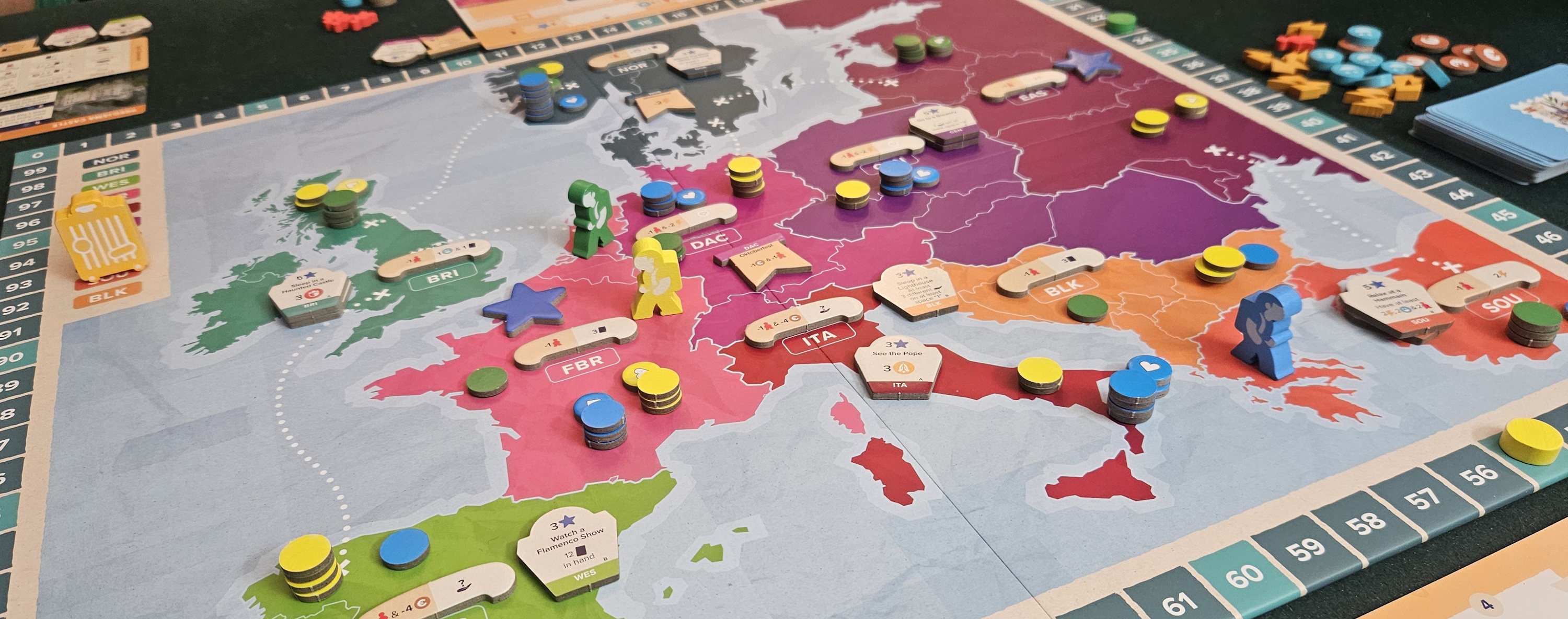
Trekking Europe (not that one)
Unlike the abstractions found in some titles, Abroad opens with quite the hook: you’re in the running for a position as a travel journalist. It’s a dream job for people who don’t mind trains, planes, and automobiles — that’s me precluded — and as such you have one month to visit as many regions of Europe as possible, cultivate local connections, write articles, and sometimes pass out from exhaustion.
Also, engage in a cutthroat area control minigame. But that comes later.
In a near mirror image of something like Trekking the World, it begins with a selection of cards that represent a whole range of possible destinations. Here those cards begin in your hand, subdivided by region rather than individual country. You might, for instance, consider swinging by the Alhambra Palace in Spain, the Isola Bella on Lake Maggiore in Northern Italy, and the Tsarevets Fortress in Bulgaria. Broadly speaking, your objective is to visit these destinations, necessitating some logistics as you balance flights against available funds and train rides against a steadily declining supply of physical energy.
So it’s a movement game! True. Getting around is one of Abroad’s central questions, especially when you get stranded in Greece because you hopped one too many trains. But it very quickly reveals other dimensions as well.
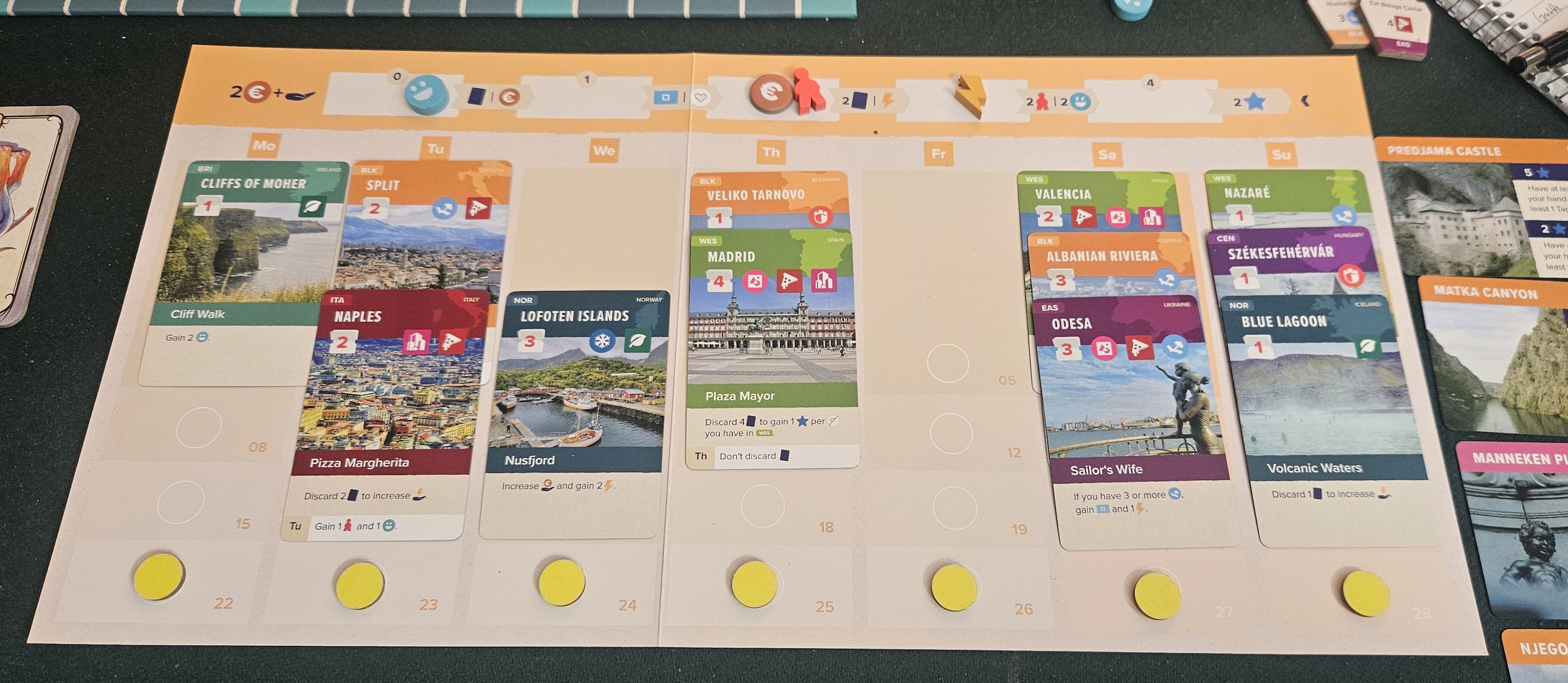
As any seasoned traveler can tell you, schedule is king.
The calendar, for instance. When you visit a location, you don’t just play the card and earn a bonus. Sure, you do both of those things. Playing cards and earning bonuses are both major components of the game. But the card is also added to an ongoing schedule that shows your four-week tour of Europe.
What’s more, the duration of that card matters. A small attraction, like an ancient amphitheater in Greece, might only require one day to visit, while something grander, such as the Fjords of Norway, takes four. To place such a card into your schedule, then, you must count that many spaces forward on your calendar. One, two, three, four. That’s most of a week. Maybe it would be better to see a bunch of smaller locales?
Except it isn’t that simple. First, there’s an entire resource system under the hood. You can spend motivation — which for those who are counting is a fourth resource to manage, in addition to cards, money, and energy — to subtract from a destination’s time requirement. Want to see the Fjords in two days? You can do that. It will cost you, but it’s possible.
Second, the slots on your calendar don’t only serve to mark time. They also demonstrate how much you’ve mastered the region you’re currently exploring. Visiting that day-trip amphitheater means you’ll only move one token from your calendar to the map. You now know something about Greece. Well done! But spending four days in Norway means placing four tokens. Sure, you could use motivation to shorten the trip. But that also decreases the number of tokens you’re placing on the map.
And tokens matter. Oh, how they matter. At the end of each week, there’s some quick upkeep. You earn income, which is nice. You discard and draw cards, which is even better. But the real headliner is that each region awards points to the journo who’s mastered it best.
Even then, this isn’t as simple as “most tokens wins.” Sometimes tokens can be flipped to their more powerful heart side. Then they function as trump cards, winning against any number of ordinary tokens. The result is a series of little bids across the map. My knowledge of the German-speaking countries gets one-upped by your heart token, so I counter by writing a great piece about hot spring destinations in Britain, eroding your base by way of revenge. It’s smart, emphasizing both time and mastery over our subject matter.
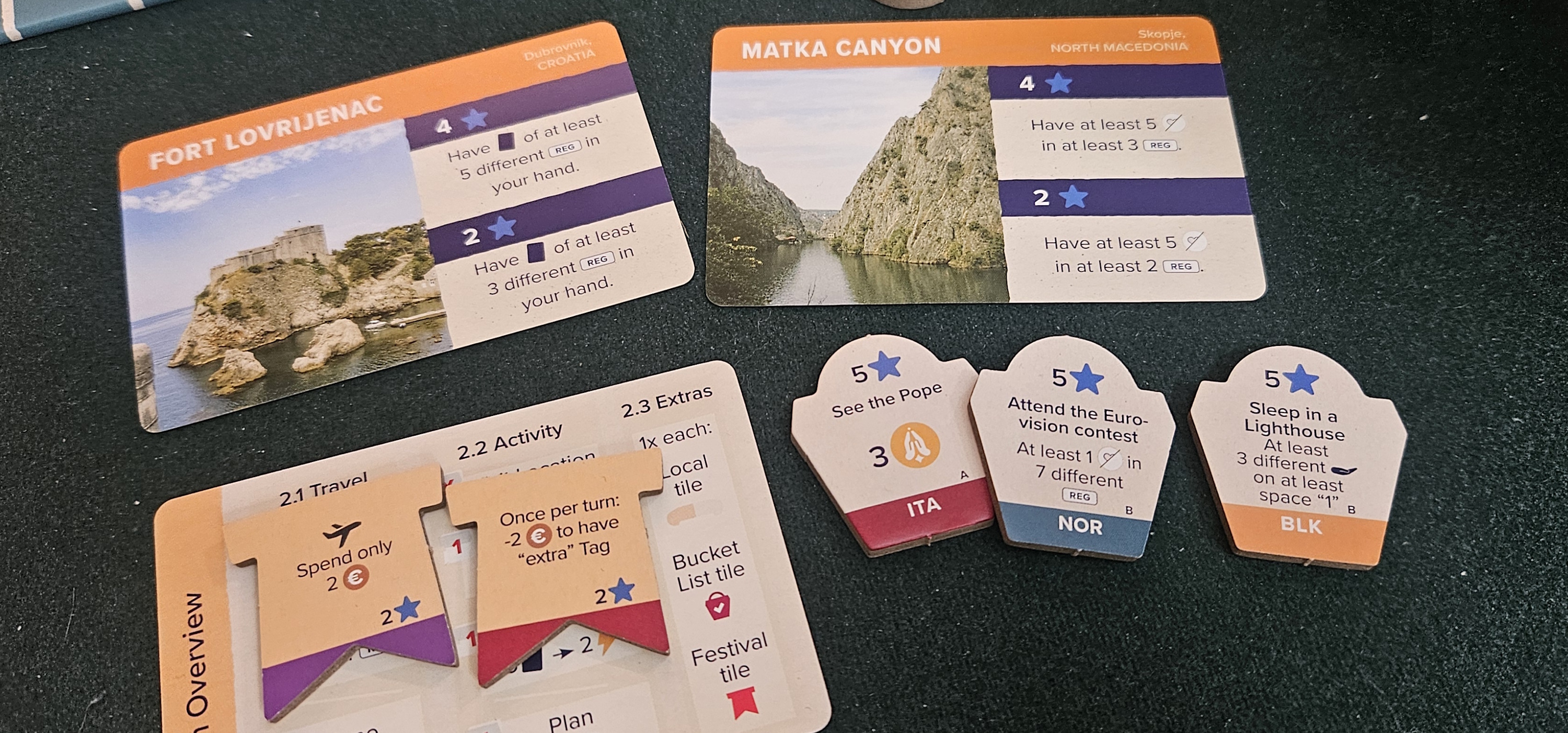
Postcards, festivals, bucket list items.
It’s also super, super mean. Just downright jerky. Snitty all the way through. Supernal area control, with all the little bid-sweeps and point-swipes one has come to expect from the mechanism.
Which is also, naturally, the best thing about Abroad. Generally, these travel games serve as comfort fantasies. If you could go anywhere, could take the time off work and afford any destination, what would you do? We play it out, and then we tally our scores to see who had the best trip. Which can be a great deal of fun, but isn’t exactly doing any heavy lifting with inter-player dynamics.
Abroad, on the other hand, never lets you sleep on its audition. Took a nap in France to recoup your energy? That’s a defeat. Paused to write a few articles for pocket money? That’s a chance for your peers to step ahead of you. Spent two whole weeks in Central Europe because you were holding a dozen purple cards? Sorry, you’ve overspecialized. You think Rick Steves only knows Poland? Baby, there isn’t a roadhouse or castle or war memorial between Portugal and Moscow that he hasn’t photographed or humped.
Along the way, you get to know these spaces. Not as intimately as the spaces in some games, it’s true. These are big attractions, not the gachapon shops and hidden gardens of the Let’s Go! titles. But one still develops a sense for Europe, its many sights, the festivals, the benefit of local knowledge. It’s only an impression, and barely an impression at that. But it’s more of an impression than most games of this stripe bother to make. It feels like it loves these places, wants them to be more widely appreciated, understands why people keep returning to them. They’re destinations, not points on a checklist. You’re only visiting, but you’re visiting something.
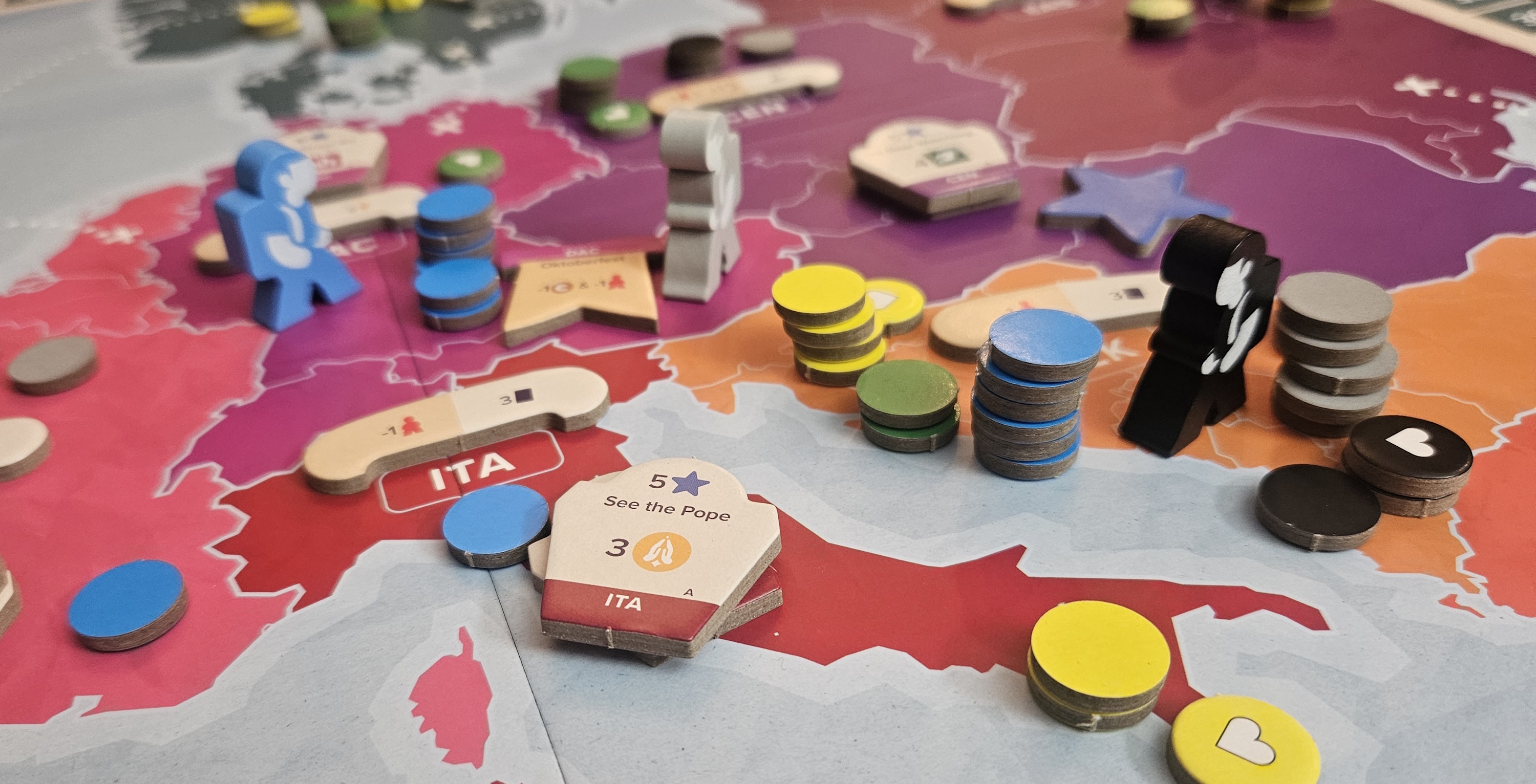
I will see the Pope today, dammit.
This marks Abroad as a success in myriad ways. Its sense of place, of course, but also its willingness to let players knock heads, to steal scoops from one another, to become the Prime Understander of Spain when nobody expects it. The result is wonderful to handle, from its calendar to its board, raising questions of timing and control and resource management and comprehension and more besides. I went in expecting a staycation; what I found is one of the finer travel games out there.
A complimentary copy of Abroad was provided by the publisher.
(If what I’m doing at Space-Biff! is valuable to you in some way, please consider dropping by my Patreon campaign or Ko-fi. Right now, supporters can read the next installment in my series Talking About Games, this time tackling the topic of what makes a good list! Naturally, the piece includes a list.)
Posted on September 9, 2026, in Board Game and tagged 1 More Time Games, Abroad, Board Games, Portal Games. Bookmark the permalink. 6 Comments.


Thanks, Dan – I do so haha if when you add things to my ‘To Do List’
That meant to say ‘hate’ but clearly the keyboard app has a better sense of humour than me. Thank you! 👍
Excellent review – thank you! I went and checked out a playthrough video on BGG right after reading your review and promptly purchased the game. Thanks again.
I hope you enjoy it!
Thanks, sounds like I might be edging towards an interest in travel games…well, at least this travel game.
Cheers.
I hope you get to try it!