Baudrillard in the Wetland
I don’t know what to make of Pond. Not as a board game — it isn’t that hard to get a handle on — but rather as an artifact of hyperreality, a signifier that has sprung into Pinocchio-like boyhood, a cardboard link to another game entirely.
Which, yeah, is to say that it calls to mind Root. It isn’t even that close, gameplay-wise. But when you put something on the table and three people blurt out “Is this that new Root expansion?” / “Wait, those aren’t the Root frogs” / “Huh, it even has four letters in the title,” just one part shy of a Barbershop quartet, reality begins to feel negotiable.
Frogs in their natural habitat.
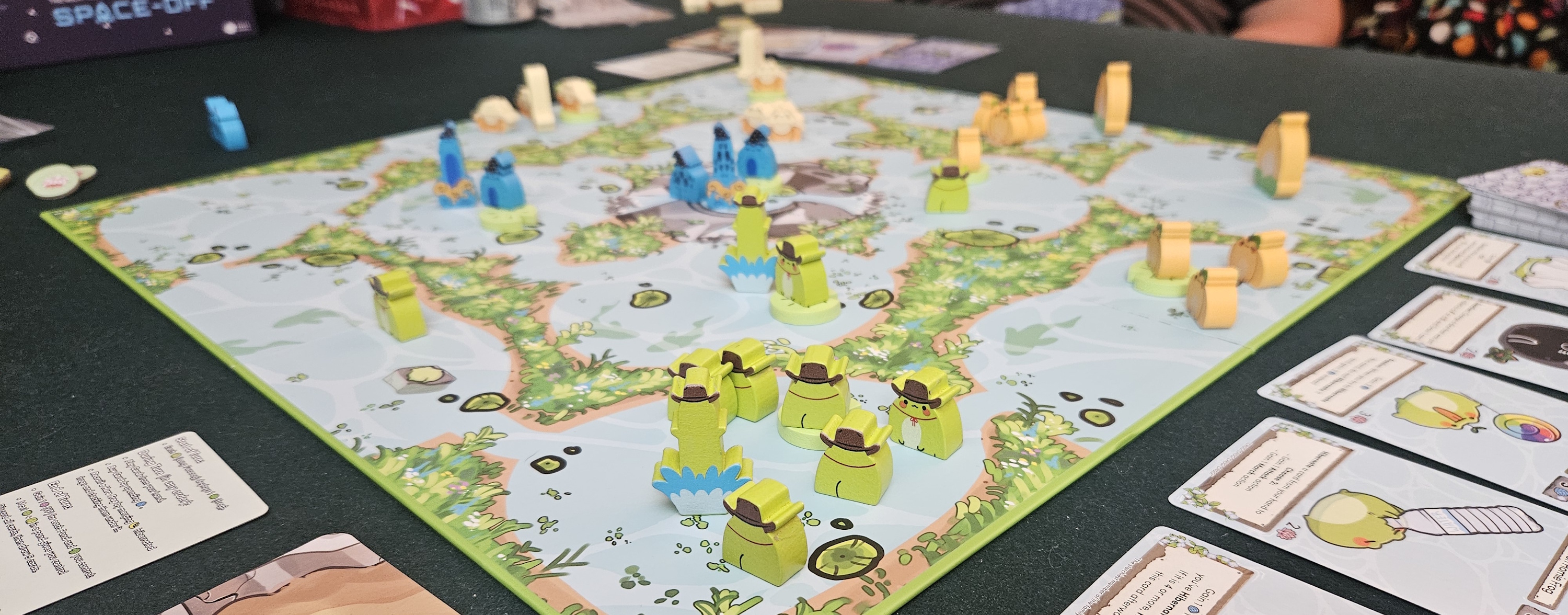
Picture this. Up to four factions of adorable wetland creatures have decided to duke it out for control of their local pond network. Each faction is asymmetric, with its own adorable superpower to attend to its adorable visual motif. For the most part, they are staffed with frogs. Just frogs: the infantry for this final war, the grist for this cuisses de grenouille.
There are also long frogs. Pardon me. Long fwooogs. That should tell you something about Pond’s sense of humor. If “long fwooog” strikes you as substantially cuter than “long frog,” this might be the game for you. At any rate, long fwooogs are the battlefield commanders who send their fellow frog-kind hopping into battle. They can be injured, in the sense that sustaining damage will result in points for your rivals, but never killed the way a lesser frog might be removed from the board. One imagines them the gentlemen officers of this particular campaign. Stiff upper lips when asked to call upon others to make the final sacrifice, quavering backs and sickbed sweats when it’s time to charge over the top. Which is perhaps why long fwooogs do not take part in battle directly.
As for the map, it’s arranged as concentric ponds that radiate from the center. Each pond is identical, but lily pads may be built to increase one’s scoring value. Movement tends to be rapid. In part because the map is rather compact, but also because factions can accomplish quite a bit on a turn. The art, as you might expect, is downright adorable. I don’t mean that in a belittling sense; some of the cards made me laugh out loud, in particular the “Biblically Accurate Frog,” with its seraph’s spokes of eyes and wings.
A pocketful of frogs.
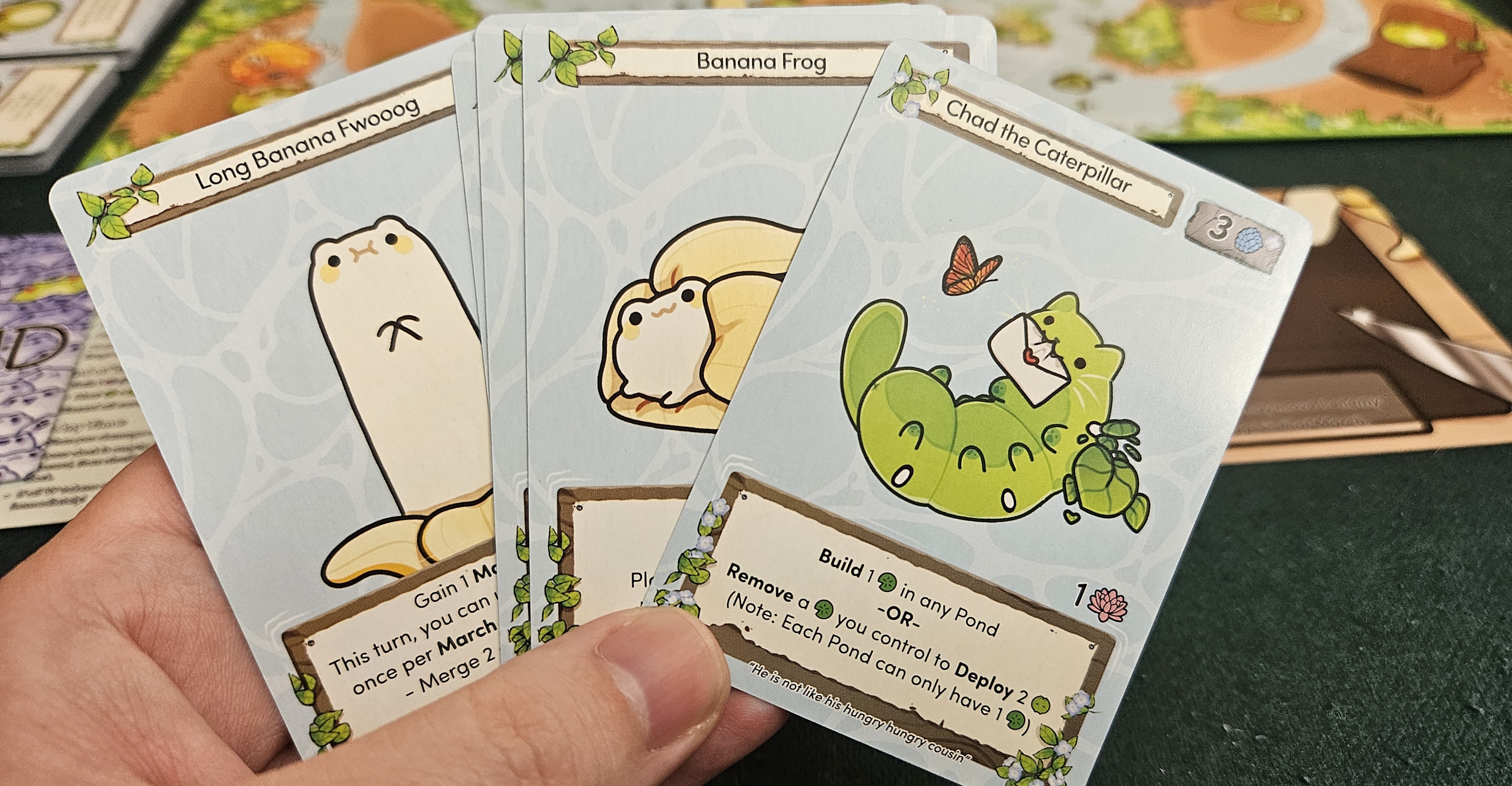
As for cards, there are heaps of the things. In a thankful departure from Root, Pond presents itself as a deck-building game. Everyone begins with a deck of ten cards, built from a combination of generic offerings (“Frog with a Knife” and “Frog with a Net”) and faction-specific troops that give each player their own dose of asymmetry without front-loading too many rules. Banana Frogs are slippery — they generate movement but also return to the top of your deck — while Wizard Frogs teleport around, Pumpkin Frogs produce lots of food, and Cowboy Frogs like to wrassle.
This is probably where Pond shines the brightest, not least because its card effects are all over the place. You might draft Jimmy the Bee into your deck to draw a card for every single lily pad under your control — potentially doubling the total action economy of your turn but also planting a target on all those lily pads. Or the Anarchy Frog, perfect for dumping all your stagnant frogs into a single pond and then lighting them on fire for a bunch of points. Swole Frog turns self-damaging battle results into offense-only attacks; Sneaky Frog deploys into any pond, even those you can’t normally reach; Cactus Frog pops a couple of attackers at the instant of their aggression. The whole thing feels wild and untamed. One might even say it doesn’t feel properly developed. All the better.
Of course, there aren’t infinite effects to tinker with. Indeed, one of the main limitations of the underlying system is that everything seems to revolve around four or five verbs — deploy, move, attack, build, hibernate — but within that rubric, there’s an impressive range of expression here. Some cards feel like outright showstoppers. As far as I’m concerned, that’s a great way to get the table to actually pay attention to the card market.
Hibernation leads to metamorphosis.
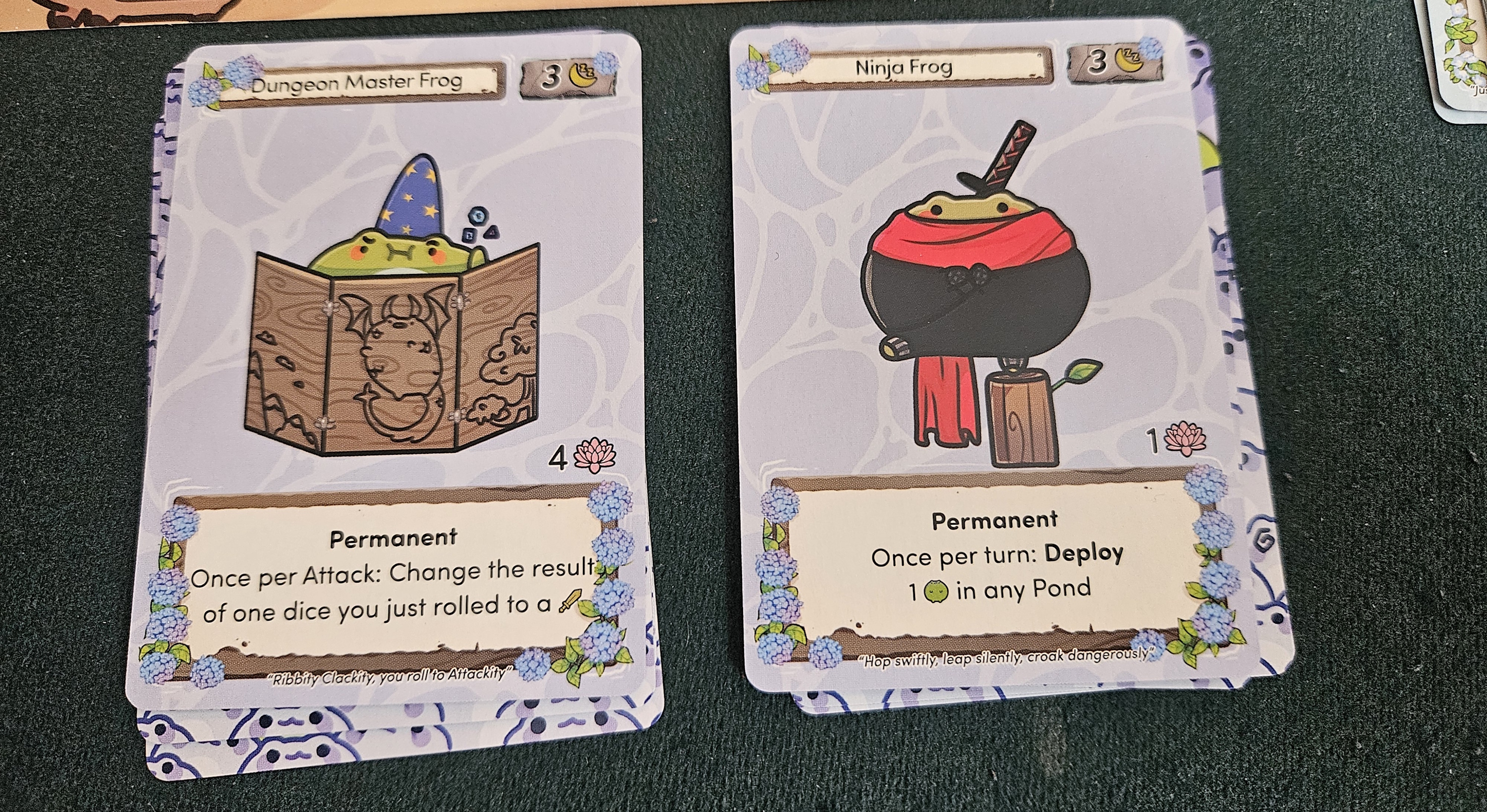
It helps, too, that card-winnowing is built right into the foundation. Whenever you shuffle your deck, you’re required to “hibernate” a frog, removing it from circulation while still preserving its point value. There are other ways to hibernate cards, too. They’re almost always desirable thanks to hero frogs.
What are hero frogs? Glad you asked. These are permanent upgrades that sit atop one, two, or three hibernated cards. That’s where the Biblically Accurate Frog comes in. Also the Unicorn Frog, the Leprechaun Frog, the Investor Frog, and so many more. To a one, these guys are valuable. First of all, you don’t need to shuffle them into your deck. Their ability is always there, ready to teleport a dead frog into your opponent’s swamp cooler.
At a more fundamental level, hibernation and heroes are a wonderful method for further defining all that factional asymmetry. Once again, almost no overhead required. This is probably where Pond deposits itself furthest from Root’s woodland. Where that game put all its chips on front-end asymmetry, requiring a tremendous initial investment before anybody could play — or at least play well — here the asymmetry is gentle at first, then slightly less gentle. It never becomes not gentle. Just more differentiated, with little perks that spring from the cards you’ve chosen to hibernate, draft, and deputize to hero status.
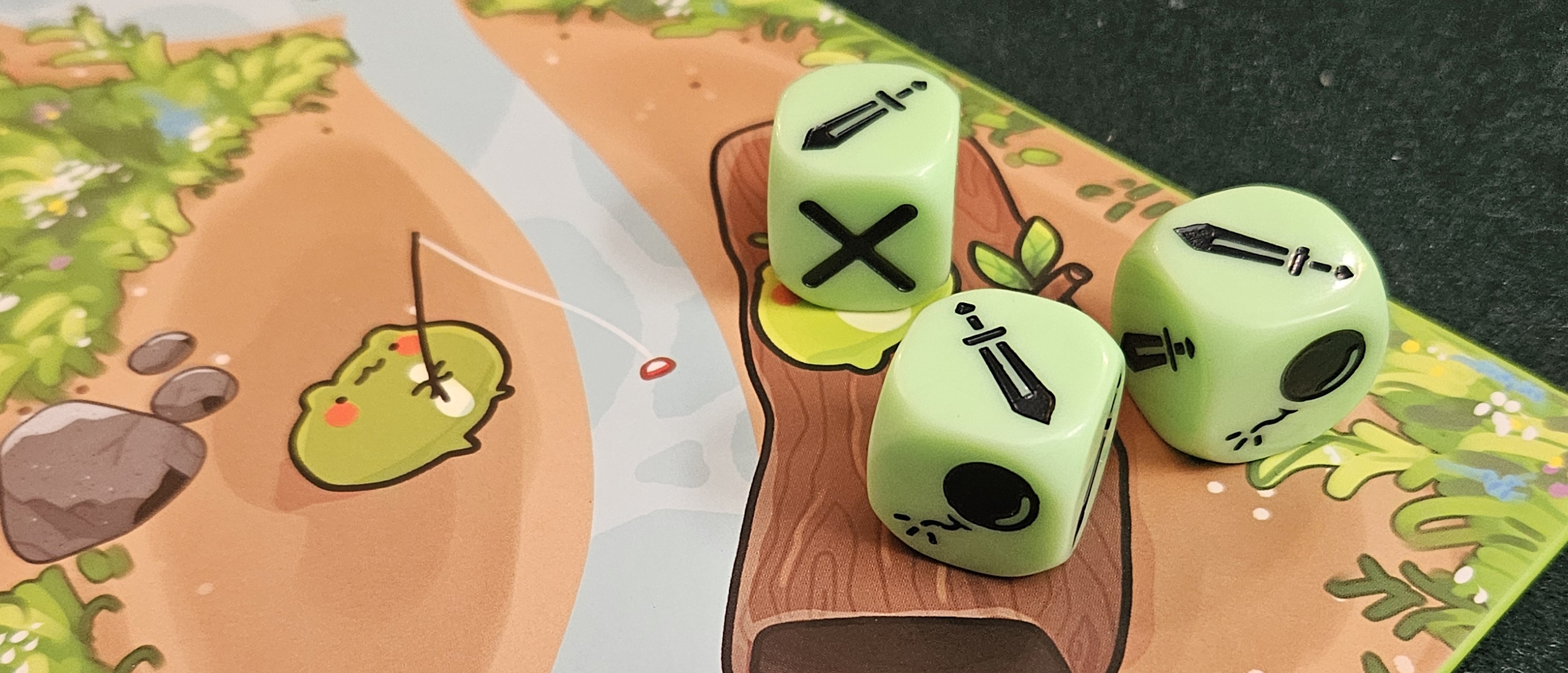
Frog battles are dangerous affairs.
Which brings us, inadvertently, back to Root.
I’ve seen some people call Pond a starter Root. My Little Root. Root for Babies. (Okay, not that one.) That isn’t too far off in the sense that its adorable artwork belies a confrontational race to score a certain number of points. But the games are surprisingly distinct in their underlying approach. They’re both volume-measuring tools with froggy eyes sharpied onto the side. But one is a funnel that runs from wide to narrow while the other is a bit more of a graduated cylinder. Despite some superficial resemblance, they move their liquids toward different purposes. A gulp versus a sip.
Those purposes, meanwhile, reach different conclusions. Root has been around for eight years. That’s a long time in this hyper-speed hobby of ours. Long enough to spawn imitators, some more flattering than others. Pond, in some senses, feels like a game that can only exist because Root existed first. But it carves out an identity that feels… still similar to Root, but not overly so. Not so close that it starts to feel like a ripoff. Just another perspective on similar themes. Root but easier to learn. Root with a first teach that doesn’t feel like reading a syllabus. Root that ends with a bang rather than a last little trickle of crafting points. Root without the near-infinite imaginary space.
(Root without Foucault? Yes. But Root as Baudrillard, as the signifier and signified getting mixed together until we can’t tell the difference. Root as the meme that has escaped containment. If it could ever be contained to begin with.)
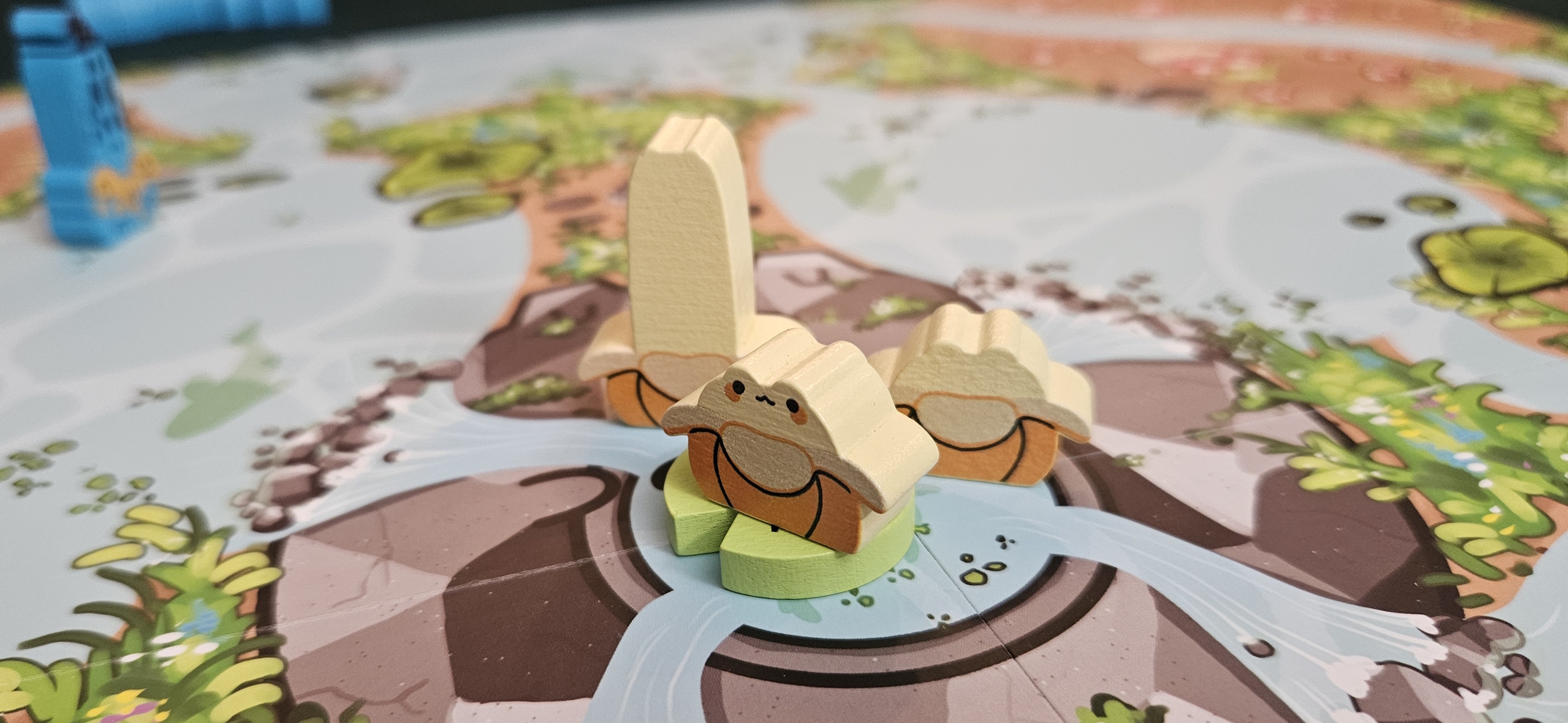
Sometimes a frog is only a frog.
This leaves Pond in an interesting place. There’s a spot for a lighter adorable woodland creature kingmaking asymmetrical game. Maybe not the biggest spot or the most lasting one. But it would be false to pretend that Pond hasn’t exerted some charm. I’ve enjoyed spending a few sessions with its Biblically Accurate Frogs and Frogs with Two Knives and, sure, even the Long Fwooogs, cloying as they seem. I don’t imagine I’ll keep coming back, but my romps through these wetlands have been enjoyable all the same.
A complimentary copy of Pond was provided by the designer/publisher.
(If what I’m doing at Space-Biff! is valuable to you in some way, please consider dropping by my Patreon campaign or Ko-fi. Right now, supporters can read the next installment in my series Talking About Games, this time tackling the topic of what makes a good list! Naturally, the piece includes a list.)
Posted on September 8, 2026, in Board Game and tagged Board Games, Brother Ming Games, Pond. Bookmark the permalink. Leave a comment.


Leave a comment
Comments 0