Spylune
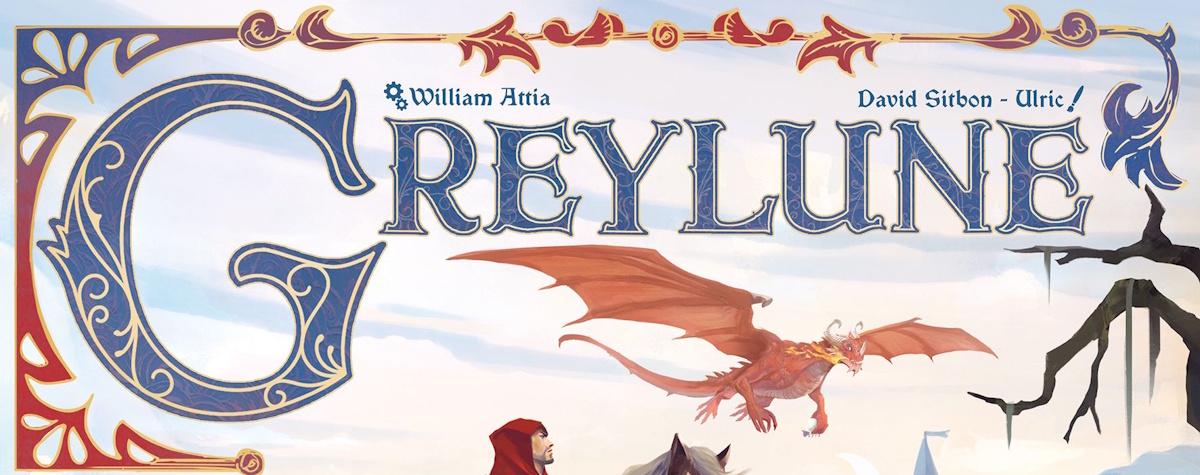
I never played Spyrium, William Attia’s 2013 game of steampunk factories, but I heard good things about its worker placement/removal system. Greylune, as near as I can tell, recaptures that title’s core appeal, while swapping the geared top hats for a more generic — but maybe more blandly appealing? — fantasy universe.
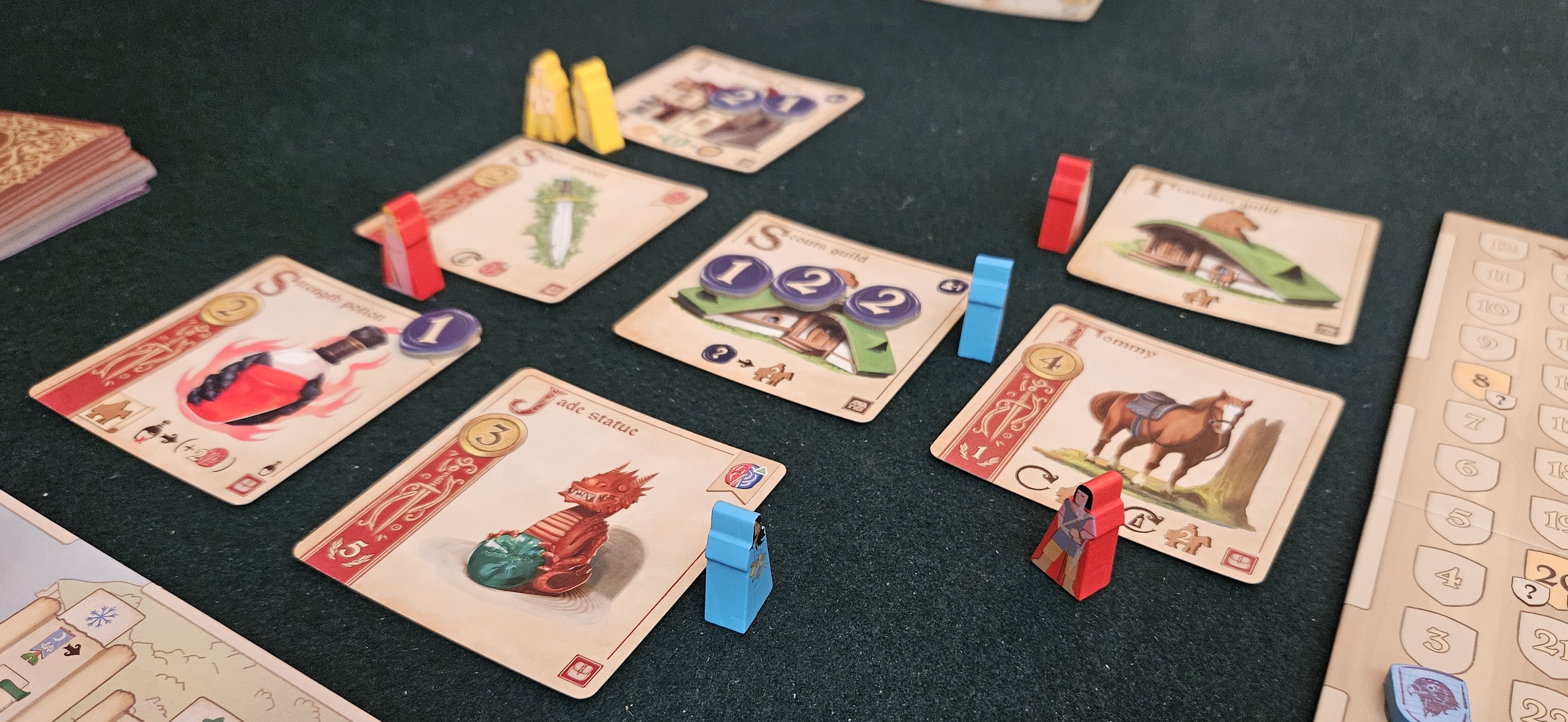
Your followers go into the market to buy goods… and steal gold? I think?
As expected, the best part has everything to do with the workers. The core system here is genuinely brilliant, a series of placements and eventual withdrawals that feel like direct assaults on one’s fellows at the table without ever laying a cross finger upon anyone’s shoulder.
The idea is that workers are placed into a marketplace to secure various goods. There are a few types of said goods: items and companions, both of which require purchasing, and amenities, which can be visited more than once. Their main commonality is that buying something from the market has two big restrictions. First, you can only purchase something by removing a worker — thus shifting yourself into the game’s second phase, which prevents you from placing any more workers until the next year — and second, the more workers there are surrounding something, the higher its cost.
The inverse is also true. Rather than pulling off a worker (teehee) to buy a card, their withdrawal can earn a pocketful of gold instead. This works by the same formula: you remove a worker, count how many other workers are next to the card in question, and then earn that many coins. They’re probably engaging in commerce or something. I preferred to pretend they were pickpockets.
As systems go, there’s no doubting its cleverness. Everything is wholly player-driven. It’s pretty rare that I’ll pay attention to how many coins a rival is holding, but here it’s common to tally someone’s holdings. Often, the placement of a single worker can drive up a price just beyond their reach, prompting them to first place another worker to earn the necessary cash, and thus providing a window to swoop in and nab whatever sword, horse, or buddy they were eyeing.
It’s a rather snitty game like that. Also a razor-taut one, every coin and card counted to its precise change.
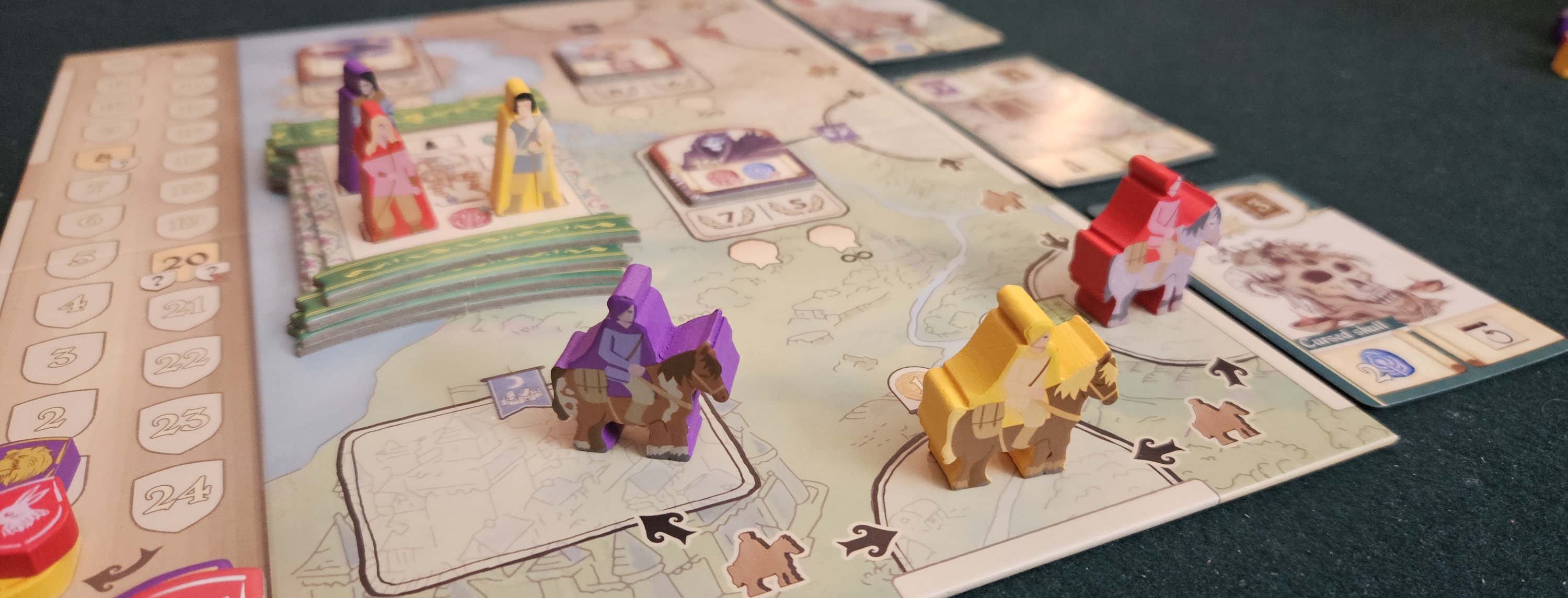
Ah, an adventure!
The reason for all those fairly-gotten gains is to outfit your knight for adventure. Everything has its place: companions provide reactive abilities that make it easier to travel and survive encounters, while items generally serve to improve your skills or move your knight deeper into the wild. There are also two flavors of strength, cherry and blueberry, to represent swords and sorcery.
So you head out into the unknown to beat up a troll, help a hermit, or take part in a joust. You know. Hero stuff. But in my favorite twist, it isn’t enough to accomplish an objective. These encounters are tucked under your player board, where they then sit, doing nothing, until you get around to sending one of your followers to boast of your achievements in one of the local taverns. This requires more worker placement and removal, whether the following spring or because you’ve planned ahead.
It’s rather impressive to see in motion. Despite the removal of anything resembling steampunk, the game moves according to clockwork logic, everything feeding back into itself: workers outfit knights who bring back deeds for workers to boast about or resources for them to spend at the market, around and around, until you’ve exhausted everyone and it’s time to tuck in for the winter.
At the same time, it’s a game laden with regrets. It isn’t uncommon to move onto the next phase only to immediately see the gap in your plans. Or, more often, for another player to come along and do something that forces you to think more reactively. Encounters exist to be stolen; quests to be one-upped; jeweled idols to be purchased out from under another prospective client.
It feels good, though. Really good. Which makes me wish the game didn’t feel like it was left at eighty percent completion. There’s a big difference between replayability and variety, with lots of modern games leaning toward the latter. I would guess that Attia was designing for tightness of experience.
But also… Greylune needs some variety. Every session reveals nearly every card, both in the marketplace and the wild. There’s such a lovely sense of discovery to those first sessions that I found myself wishing I could go back and experience it again. Here, knowing what’s coming is much of the battle. On my second play, I knew I would buy the horse if it showed up. Then I knew I would try for a potion strategy. In the last round, which features no variance from play to play, it’s inevitable that a powerful tavern will appear, one that awards rather large quantities of points. So I planned from the very beginning to save most of my quests for the last moment and forego adventuring altogether. There were little hiccups, but the strategy worked well enough to lap most of my opponents. It felt good, to be sure. But it also felt sterile and mechanical.
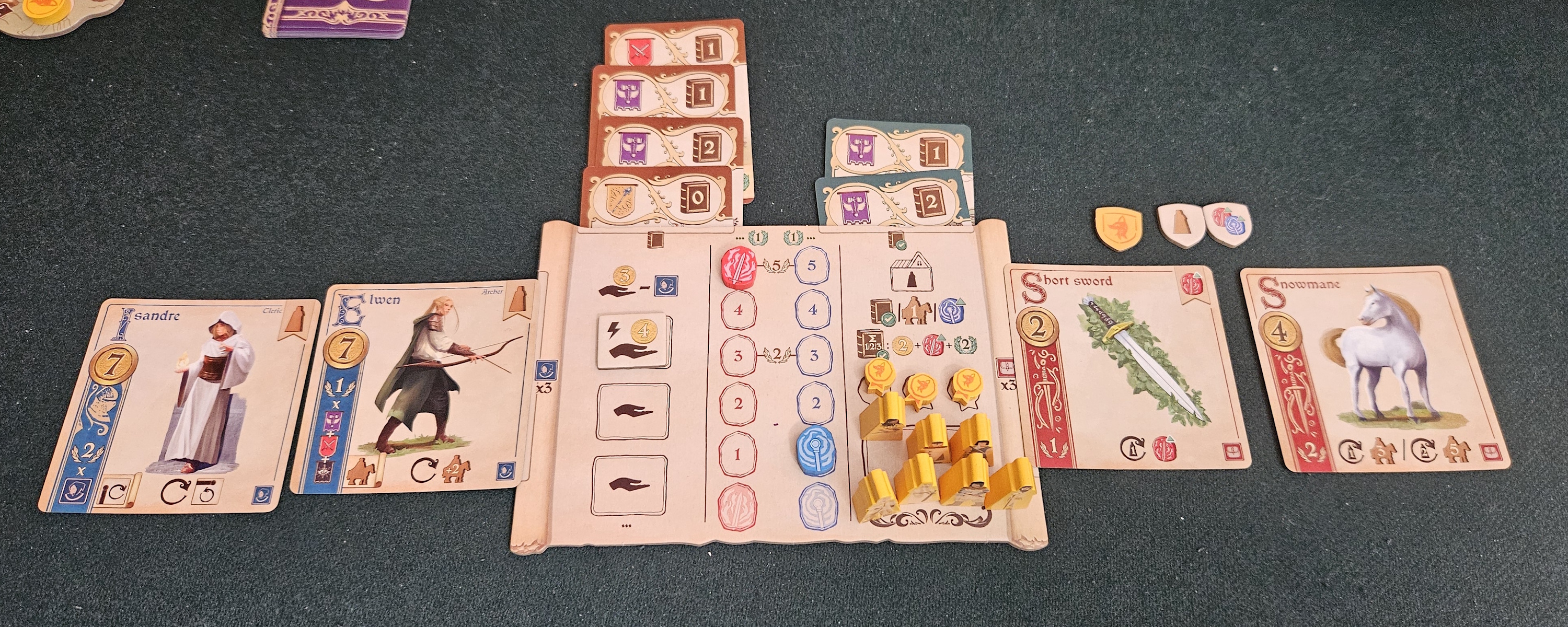
Everyone likes buying stuff, right?
Ultimately, Greylune both impressed me and left me chilly. Its core system is downright smart, and the set dressing around it feels good to handle. But it’s like handling a machine; a fidget toy, perhaps, or an orrery, spinning along its foreordained orbit. Pleasant but cold; beautiful but delicate. These days, I like my games to apply some force when they’re ramming their shield into my teeth, and Greylune’s touch is simply too dainty to cause so much as a wiggle.
A complimentary copy of Greylune was provided by the publisher.
(If what I’m doing at Space-Biff! is valuable to you in some way, please consider dropping by my Patreon campaign or Ko-fi. Right now, supporters can read the next installment in my series Talking About Games, this time tackling the topic of what makes a good list! Naturally, the piece includes a list.)
Posted on August 11, 2026, in Board Game and tagged Board Games, Greylune, Pandasaurus Games, Sorry We Are French. Bookmark the permalink. 9 Comments.


Thanks for this review! I’m a big fan of Spyrium and I’m glad the designer iterated upon it further.
Are you giving sufficient credit for it not being steampunk? For the love of god, anything but steampunk…
I’m a fan of Spyrium — but not a big fan. It also to me feels 80% done. Such an excellent worker placement-and-pullment system. But you build an engine that is at most 2 cards in size. And you run it about twice. Then you go for those big point cards which, like said Dan, always show up in the last round.
Man. I was really hoping this reworking of Spyrium went the final 20%. I would have been a huge fan.
Here’s the good news: engines are a little bigger than two cards! It sounds like Greylune improves on Spyrium in a few significant ways. Just not, y’know, as much as I would have liked.
Agree wholeheartedly – that’s exactly how I felt about Spyrium despite really, really liking the core worker placement twist.
(In isolation I’d call that mechanism a better Tzolk’in for being more fluid and interesting in choosing when to switch from placing to fetching, in creating much more interesting timing questions, and being more player-driven than just advancing all the tracks by one at the end of the round.)
If I would bet, I think the reason why Attia didn’t wanted a bigger village deck was to not imbalance the amount of companions, items and buildings you see throughtout the game, but still, that was the first alarm that sounded in my head when I read the rulebook, and I’m sad to see that it was indeed impactful in your enjoyment of the game. I can only hope for expansions that fix this issue, because I’m also excited about how elegant and interesting the core game is.
I tend to prefer reactive games to those that can be planned out comprehensively in advance. Which isn’t to say that Greylune can be charted all that comprehensively; there’s plenty of static that can arise from those rival players! But it certainly sits on the opposite end of the spectrum from the mode I prefer, so take my perspective with that dollop of salt.
I’m also a huge fan of Spyrium, in IMO the tightness of the core system and the reactivity asked of the players explains the rigid fixed card selection of the last round.
I read a lot of complaints about it in Spyrium, but it seems to me the necessary requirement to assure that you won’t end up high and dry after dedicating the four previous rounds to a specific strategy. It’s a very tactical game, but you still need a big plan, and the last round allows that (as well as salowing to salvage what you can if your plan goes astray).
To me, the variety comes less from the array of available cards than the way and when they are set up on the table, opening new dilemmas between plays.
However, the very mechanical feeling it evokes resonates with its theme (I also like the game because it’s pretty barebones and short compared to the brain power it asks of you), and Greylune might lose something by dressing itself in new clothes while retaining its heart of steel. I’ll happily try this new version, but I doubt I’ll enjoy it more than the original.
I hope you’ll be able to give it a try!