Revealing the Medium’s Secret

Houdini’s Last Act feels like a magic trick. And not only because designers Chris Zinsli and Suzanne Zinsli (no relation) (okay, maybe there’s some relation, but it’s rude to assume) provide an actual card-shuffling trick as an intermission.
Set during the final years of the escapist’s life, the game’s apprentices — of which there must always be precisely four — are here to assist Houdini in exposing various spirit mediums as frauds and hucksters. It’s a noble objective, protecting the bereaved from those who would take advantage of them. But it’s also a testy proposition, one liable to end in disaster. Thus the game’s core tension: Will you work toward the show’s success? Or look after your own self-interest?
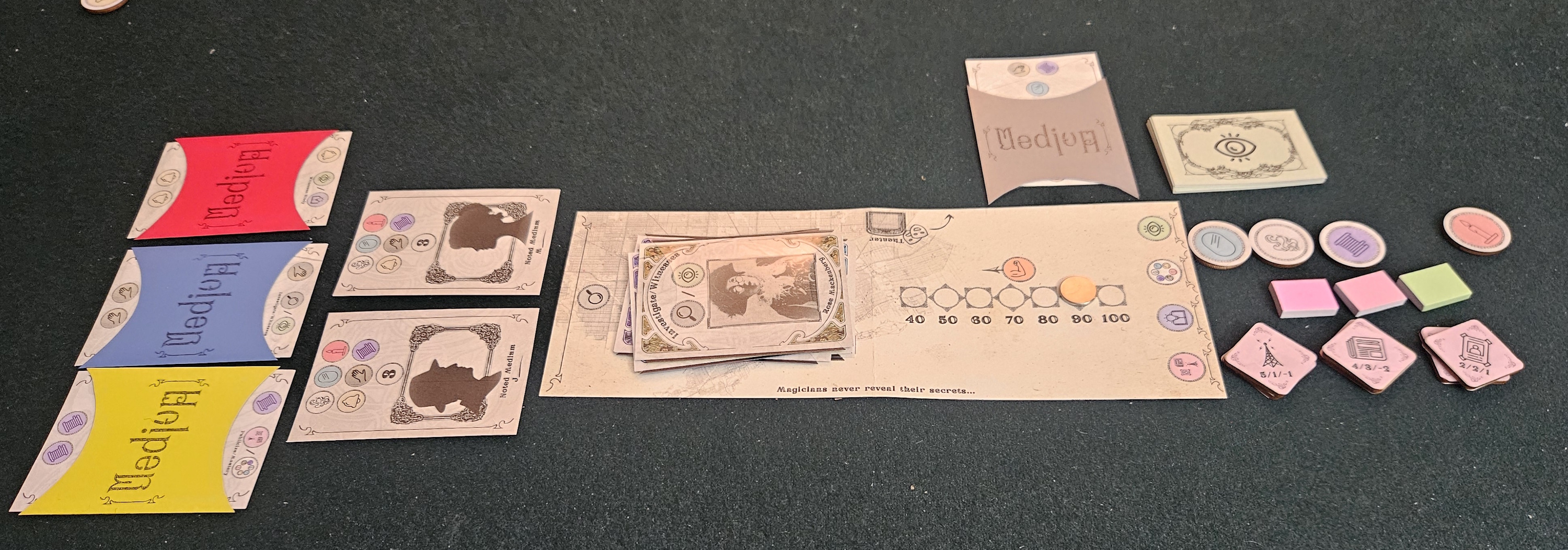
Preparing for the final show.
As a plaything, Houdini’s Last Act is tightly wound. There are two discrete acts, divided by the aforementioned magic trick, and it’s necessary to see them in motion to really understand what sleight of hand the Zinslis are getting up to. In other words, this is one magic act it pays to see twice. Which is no big thing, considering the entire game takes maybe half an hour to complete.
First come the preparations. Going around the table, everybody spends cards to get ready for the big show. There’s more to do than can all be handled at once, ranging from overseeing the show’s security and promoting it via pamphlets and airwaves to preparing yourself by mastering various magical techniques.
What’s interesting about the game is that each of these preparations is spring-loaded in its own way. Promoting the show, for instance, sees you claiming a private token that reveals whether the local public is on your side or feeling antagonistic. Positive numbers mean your show is more likely to succeed, while negative digits might mean… well, the other thing.
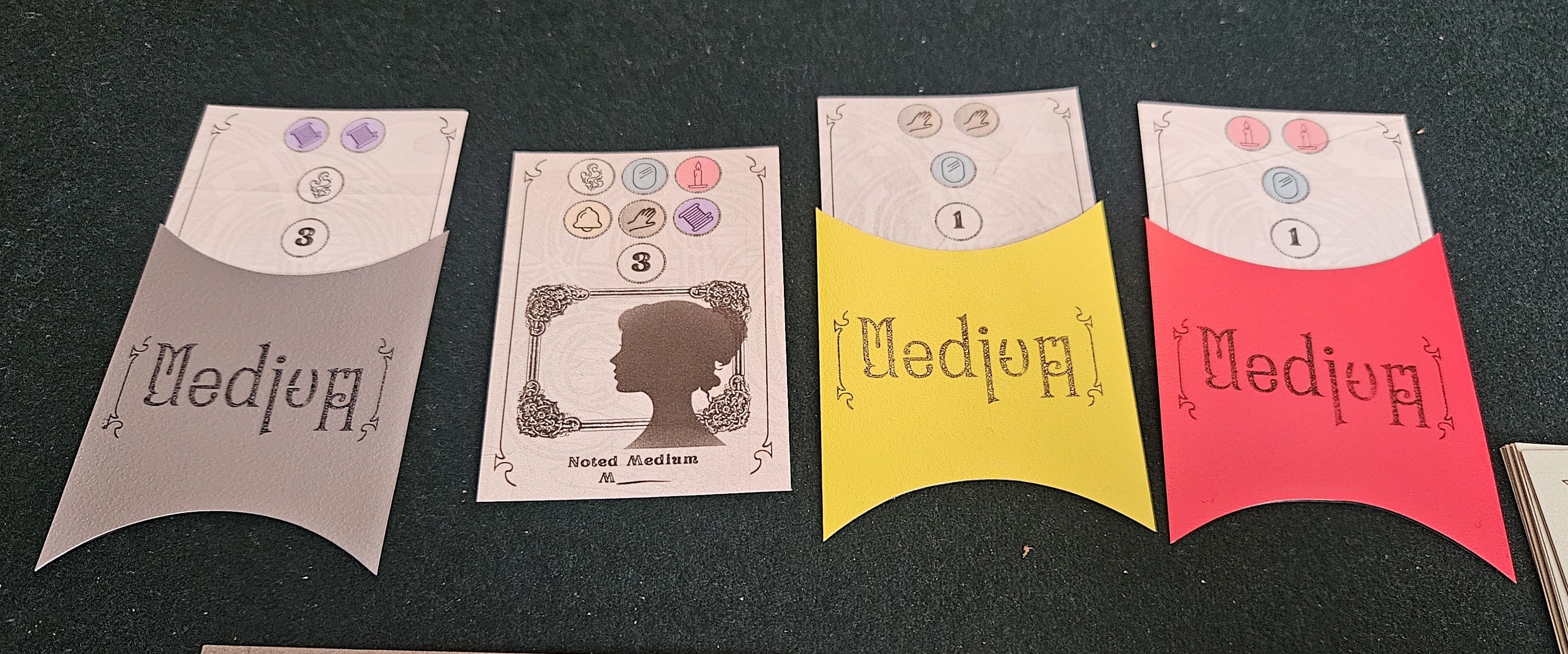
Just some of the frauds you might expose.
From there, the cards are (magically) shuffled and dealt back to the apprentices. Now it’s showtime. There’s still time for a few last-minute preparations, but for the most part this phase of the game is an icon-matching affair where you attempt to demonstrate the techniques the local mediums are using to defraud the public. It’s useful to cooperative tightly with your fellow apprentices. As with a death-defying escape act, any number of details might go wrong and spell disaster for the entire act.
It isn’t really until the final tally that the game’s legerdemain becomes apparent. Which is, incidentally, why I recommend any prospective players give it two tries back to back.
The first question is whether the show succeeds or fails. This is a mathematical question, the one portion of the game that feels more like bookkeeping than a careful balancing act. Provided all the mediums have been defrocked, there’s still the question of the event’s security — which sets the baseline score your team is required to beat — versus the product of those defeated mediums times the show’s publicity.
Look, the details don’t matter. The point is that you multiply one number against another, then check that result against a third number. If the show was a success, everybody wins. Otherwise, everyone reveals a personal goal card. And now the real chicanery is afoot.
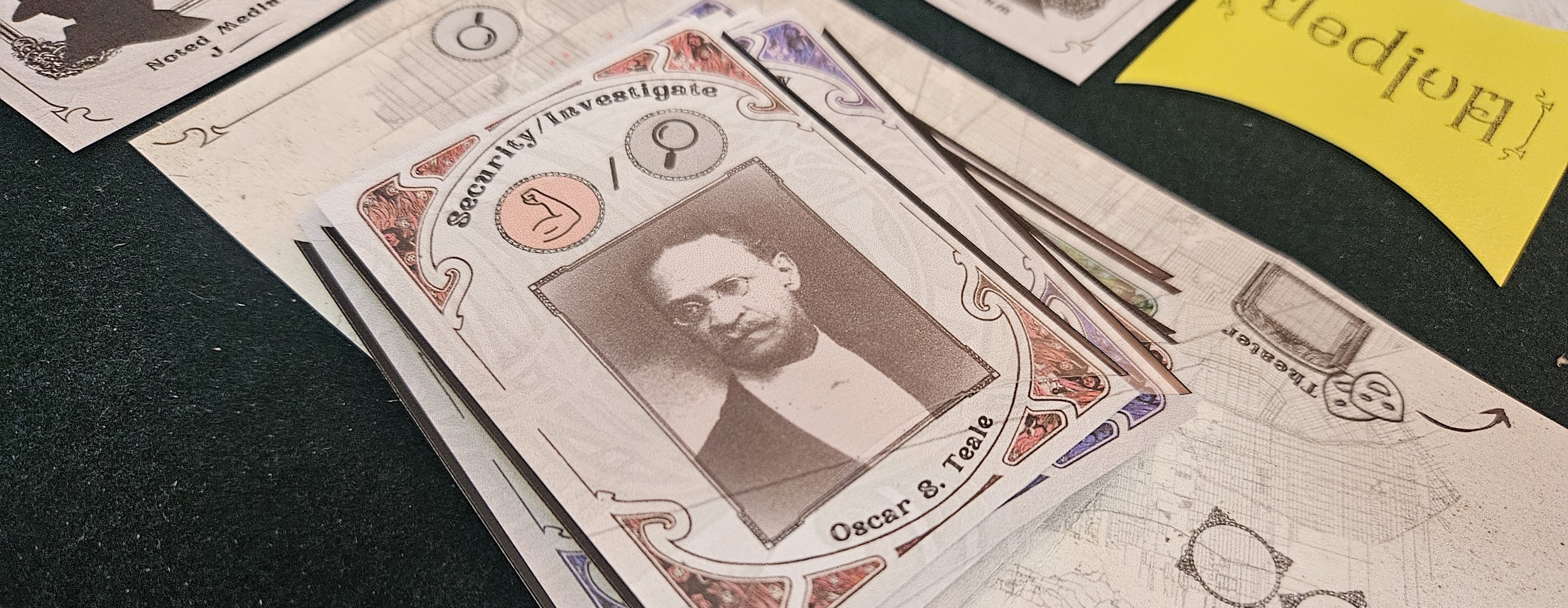
Every card can be used in multiple ways.
At heart, Houdini’s Last Act is a game about confidence. The confidence of its masters and apprentices and mediums, but also the confidence of its players, in themselves and one another. Because all those actions, the earlier ones in the preparation phase as well as those taken during the show itself, are slow-motion bets that your work will pay off. And depending on what you saw earlier, if you happened to publicize the event and saw which way the winds were blowing, or even if you just don’t think your crew can handle quite so much debunking in one sitting, your confidence might not be overflowing.
That’s where your personal objectives come in. If the show fails, the game switches tracks and checks the goals you’ve been tending this whole time. Maybe you want to expose a particularly skilled medium personally, ensuring your own legacy on the stage. Or maybe you’re more cynical, angling for the show to fail spectacularly. Either way, apprentices who aren’t feeling especially good about the tour’s odds can claim additional goal cards. But this is a dangerous proposition, threatening to sow discord. Wait, why did you draw another goal? Do you know something I don’t? Are we a team or what?
Even small doubts can have a corrosive effect. All it takes is one draw at the wrong time and suddenly everyone is thinking twice about overseeing security or learning stage techniques. Instead, they’re checking their little green objective cards and making weird decisions. Like insisting that we debunk more mediums than we can strictly handle, or getting flustered when somebody else claims the wire-work mastery token, or drawing two new goals in a row.
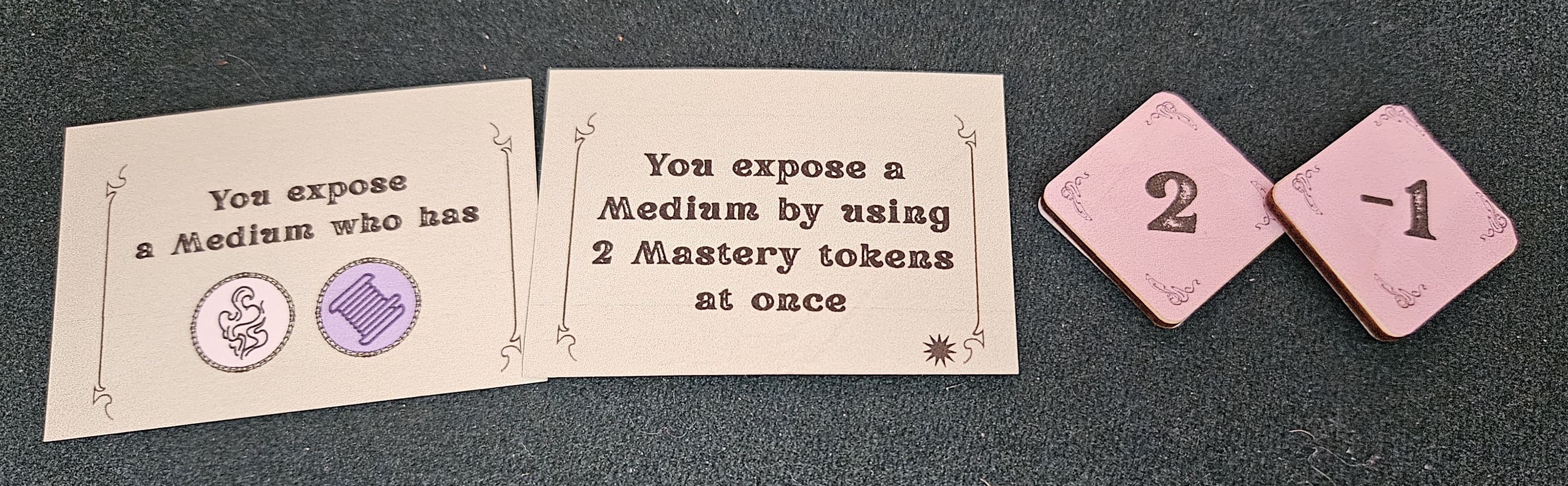
Some of the things you might know… and keep to yourself.
To be clear, Houdini’s Last Act never becomes more than a bite-sized experience. Even played twice in a row, it probably won’t consume a full hour. There are certain limitations to what can be accomplished in such a short span of time. Sometimes a longer duration is a boon. When it comes to ambiguous behaviors on the part of fellow players, a game this short doesn’t provide much room to observe whether people are acting squirrelly.
But the magic trick is that it doesn’t matter, at least not as much as it might have otherwise. Houdini’s Last Act works because it’s charming in all the right places. The way the sleeves are designed to let the cards slide one way or the other to reveal hidden information. The cardplay, which is simple but never shows even the slightest pound of extra weight. Putting on a successful show is genuinely challenging, enough so that pursuing a side hustle or two seems wise. Even the little magic trick in between acts is amusing, a ritual that takes so little time that you might as well go through the motions rather than dealing out the cards normally.
The result is a game that punches well above its weight. Not unlike the little escapist himself, come to think of it. For such a small thing, there’s some real verve here, a commentary on magic as showmanship and mystery versus hucksterism and superstition, about personal goals versus collaborative efforts, about we silly humans who love to be tricked so badly that we grow addicted to it.
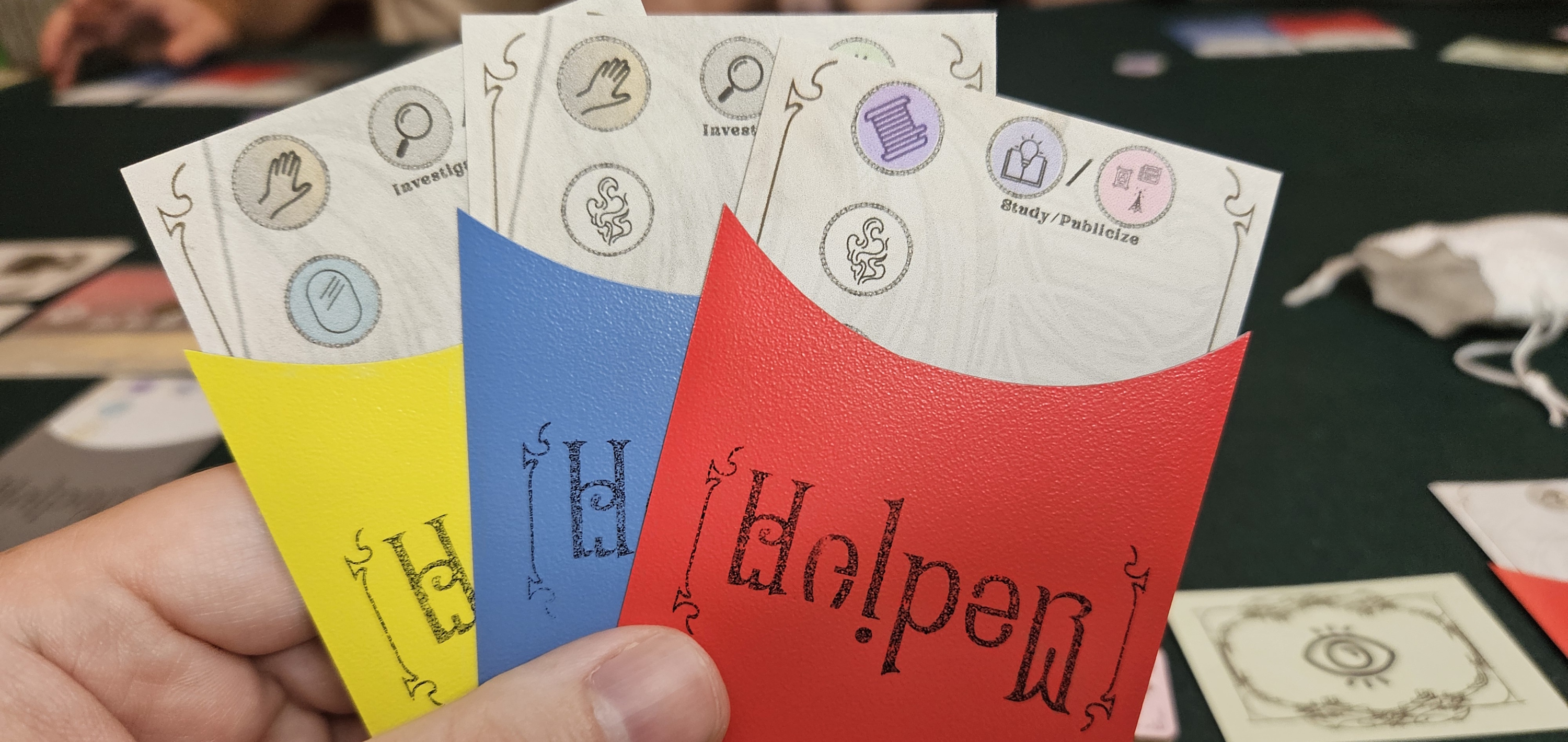
Improving your skills means revealing extra icons on your cards.
Which is, perhaps, the final flourish of this particular offering. Like all figures from history, Harry Houdini had his textures. But he also stuck by his principles, especially where it came to debunking those who took advantage of the bereaved. He sacrificed friendships over it — most famously with Sir Arthur Conan Doyle, that faerie-believing dork. As an offbeat and enjoyable expression of history, Houdini’s Last Act is a suitable tribute indeed, a brief foray into a world where magic and reason brushed shoulders and left audiences entertained.
A complimentary copy of Houdini’s Last Act was provided by the designers.
(If what I’m doing at Space-Biff! is valuable to you in some way, please consider dropping by my Patreon campaign or Ko-fi. Right now, supporters can read the next installment in my series Talking About Games, this time tackling the topic of what makes a good list! Naturally, the piece includes a list.)
Posted on July 28, 2026, in Board Game and tagged Board Games, Cardboard Edison, Houdini's Last Act. Bookmark the permalink. 2 Comments.


The subject is in prospect an interesting departure from the usual genre of games about producing shows (and the narrower sub-genre concerned specifically with stage magic).
As with Tesla vs. Edison: War of Currents, departure from history might turn out to be a mixed bag. Sometimes the real-world dynamics are arguably more interesting than the popular mythology.
In this case, we’re dealing with a watershed in the skeptical movement mustering science against chicanery.
That being so, it might seem meet somehow to incorporate practice of the process of critical thinking. Games involving inductive rather than deductive reasoning are very rare, and so far revolve around ringing changes on the basic formalism of Robert Abbott’s Eleusis; so to aim for innovation in that field might be setting the bar too high.
However, it would be a nice touch if there were more reflection of the subject in the form than I’ve seen in relation to algorithmic thinking in treatments of Ada Lovelace and her pioneering work with Charles Babbage.
It’s worth noting that spiritualism was at the time a prominent religious movement, with significant inroads in more mainstream sects of Christianity.