Satchel of Holding

There’s undoubted utility to a bag of holding, but I always imagine everything jumbling together like loose chicken parts. Magical tomes next to tavern dinners next to razor implements, sloshing around to produce a pulpy slurry.
Designed by Molly Johnson, Robert Melvin, and Shawn Stankewich — best known for Point Salad and Verdant, although my course of choice would be the excellent TEN — Satchel Quest might be the first game to really understand the problem. This is a bag-builder only slightly in the vein of The Quacks of Quedlinburg, featuring hints of that title’s press-your-luck gameplay, but really emphasizing the disorderly nature of a magical burlap sack where one’s potatoes are stored beside mana crystals and radioactive artifacts. For example, you’ve decided to hold not only an entire arsenal in your satchel, but also a whole bunch of monsters.
If that sounds like a bad packing decision — and I’m saying this as someone who grew up schlepping a half-dozen hardbacks on any given weekend trip — then rest assured there’s a reason for all those odds and ends.
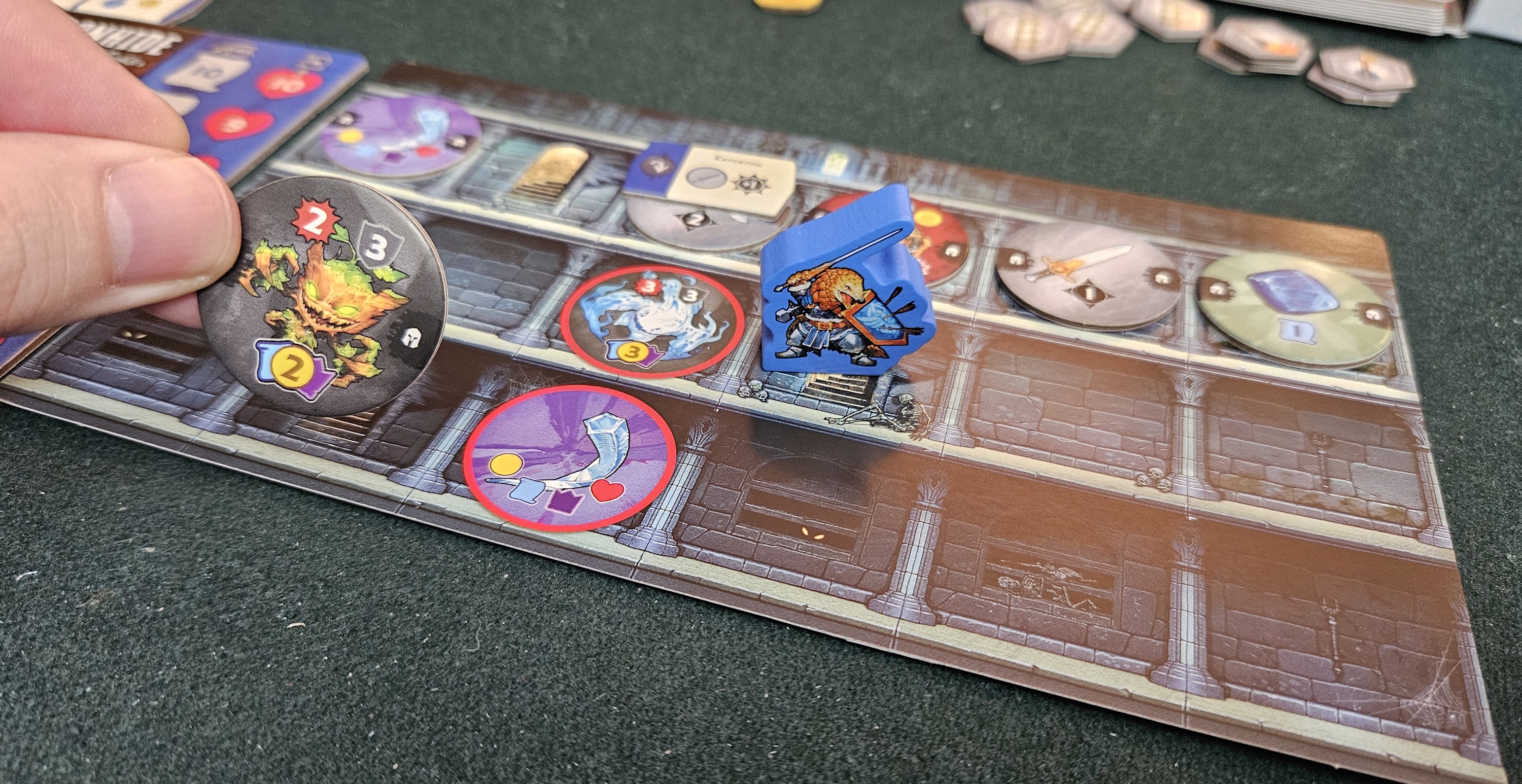
Exploring a dungeon, one chip at a time.
The centerpiece of Satchel Quest is an extended puzzle. Provided a dungeon mat, complete with a few enforced spaces like stairwells and maybe a monster or artifact, you draw chips from a bag and place them somewhere on your current floor. Often, these chips give you opportunities. Gold! Gems! Artifacts! Weapons! Whole suits of armor!
However, chips often present dangers as well. Or, if we’re in a sunny mood, opportunities. Chests double as traps, while monsters whittle away as much of your health as possible. It behooves any adventurer to tread carefully. While death doesn’t end the game outright, the penalties for bottoming out your health track are severe. This is excellent design, by the way. While there’s some rubber-banding in Satchel Quest to prevent errant players from falling too far behind, it’s hard to recover from a botched dungeon.
What soon becomes apparent is that Satchel Quest is as much about placement and foresight as stretching your luck to its absolute limit. Every type of chip presents its own conundrum. Gems only unlock their potential when placed next to as much gold as possible. Artifacts like to be clumped together for maximum returns. Chests are a whole mini-puzzle. When bordered by exactly the right chips, you crack them open without harm. Too few and you take damage; too many and you break them open through sheer brute force… but still take injuries from their protective trap.
Of course, the most impactful type of chip is the monster. You can dull their attacks by positioning shields and armor nearby, while slaying them requires careful arrangement of your own swords, bows, and staves. This isn’t as easy as it sounds. Swords only hit adjacent monsters. Bows and staves smack entire lanes, but only along diagonal or orthogonal lines respectively. In general, this requires you to produce little defensive clusters around shields, while weapons produce fields of damage.
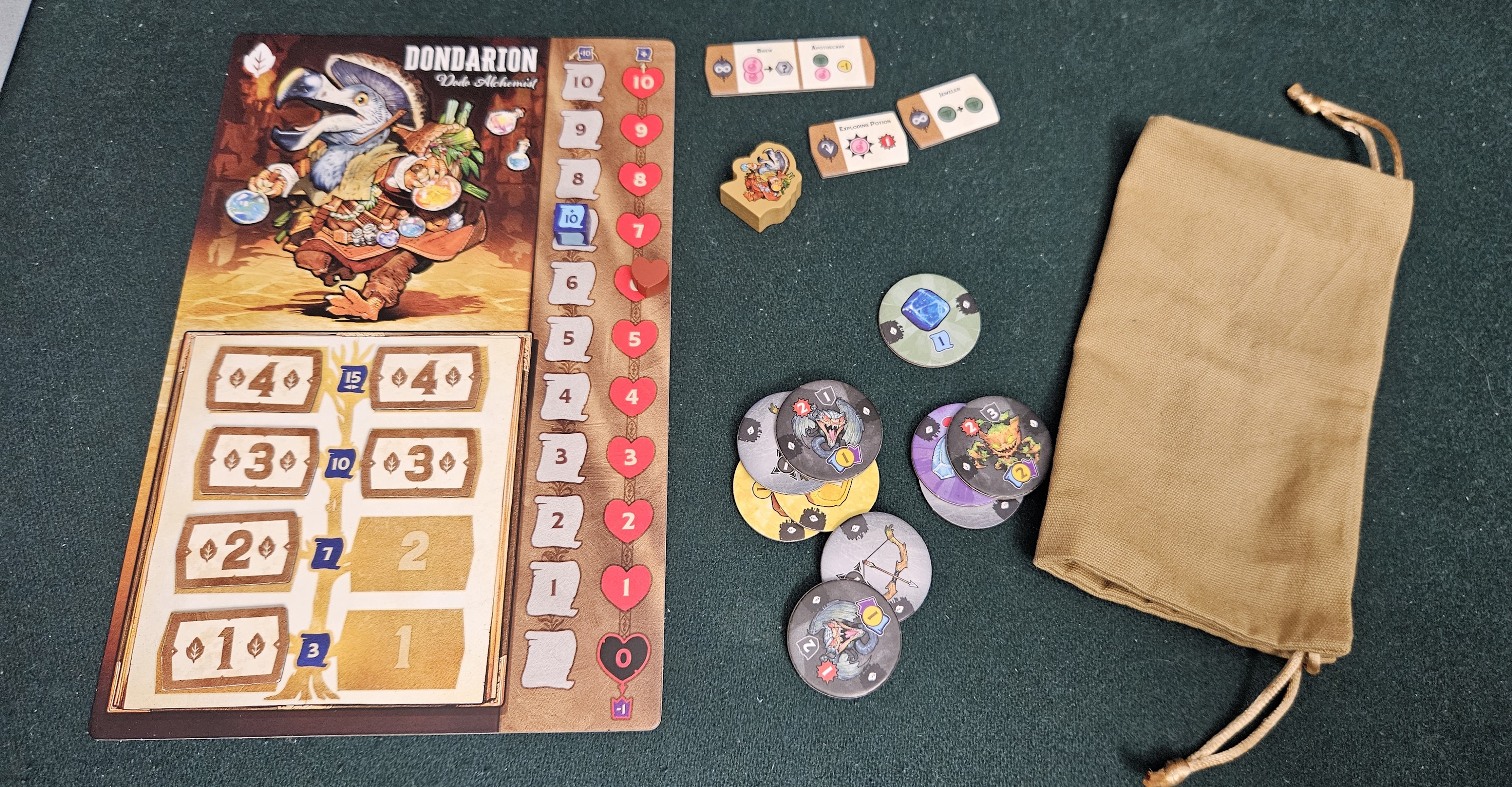
Hopefully this one won’t go extinct.
But this is where your satchel comes into play. Only rarely will things go according to plan. It isn’t uncommon to place a shield exactly where it needs to go, ready to block damage from three monsters at once, alongside an empowered staff for blasting the beasties. Only then you’ll draw a bunch of gold tokens, a sword that isn’t needed at the moment, and a gem that would pair nicely with the gold, if only that’s what you were trying to do right now.
It pays to pivot. It also pays to learn the tools of your trade. There are items, tools like keys for breaking past a sticky chest or torches that serve as extra draws from your satchel. Each hero also gets their own set of abilities, like the Dodo Alchemist’s taste for potions or the Pangolin Fighter’s layers of armor. It helps, too, that chips are double-sided. If you can’t possibly tackle that monster right now, there’s usually something helpful, or at least benign, on its reverse face.
This puzzle phase is Satchel Quest at its best and brightest. Everybody plays simultaneously, a barbed blessing if one player happens to be slower than everyone else, but considerably pacier than taking turns. And while most players will usually use every last chip in each dungeon, somewhat undercutting the game’s press-your-luck ethos, this puzzle is always engrossing. That goes double when things are going wrong. Johnson and company have done a solid job of ensuring that their game is at its most interesting when nothing is quite going your way, forcing you to use every tool at your disposal to come out of the dungeon alive.
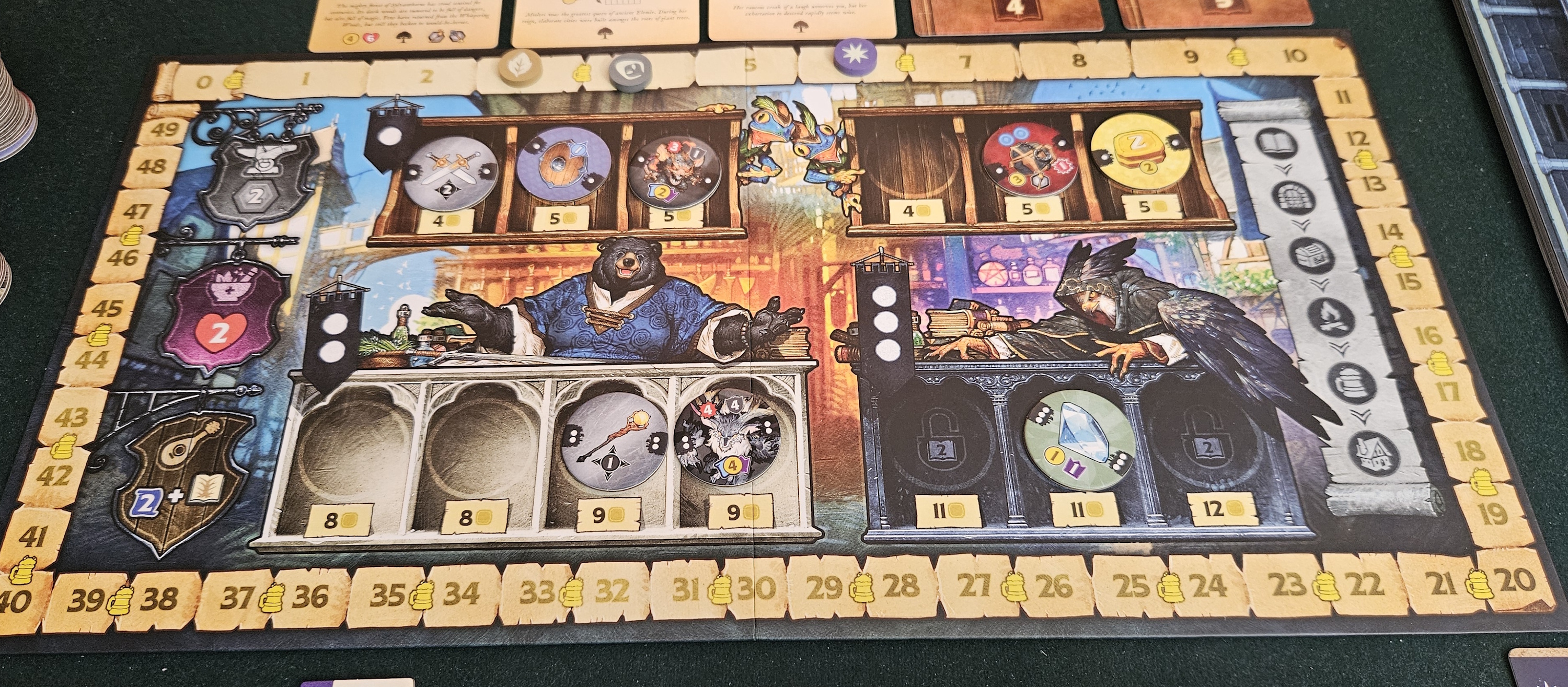
Shopping for new chips.
If you detect a Ginormous But lurking around the corner, you’re only half-right. For the most part, the remainder of Satchel Quest is similarly polished.
Consider the shopping phase, which uses the game’s double-sided chips to its advantage. Letting everybody check the reverse face of each chip would have been a horrible time-sink. Instead, everybody is allowed to “browse” one chip per turn, peeking at its reverse side before buying something — and that purchase might be a different chip entirely. This ensures there’s still an element of surprise, but also lets players wield some control over their destiny. No endless token-checking required.
Or there’s the way new adventure cards vary the puzzle from round to round. One dungeon might be rotated ninety degrees, requiring you to venture down a shaft with little room to maneuver, while the next is filled with placeholder gold that makes gems more valuable but combat unusually claustrophobic.
If anything, the Lesser But is that Satchel Quest overstays its welcome. Five dungeons is a lot to tackle, especially when you’re only adding one to three chips per round. This isn’t enough to mix up your bag’s composition, at least not quickly. While your bag will hold a different mishmash of weapons and monsters between the first and fifth dungeon, its changes are incremental, and therefore the puzzle feels samey from one delve to the next. This gives the game a fatiguing sensation, especially with additional players necessitating pauses while adventuring or shopping. Unsurprisingly, the solitaire mode sees the problem evaporating.
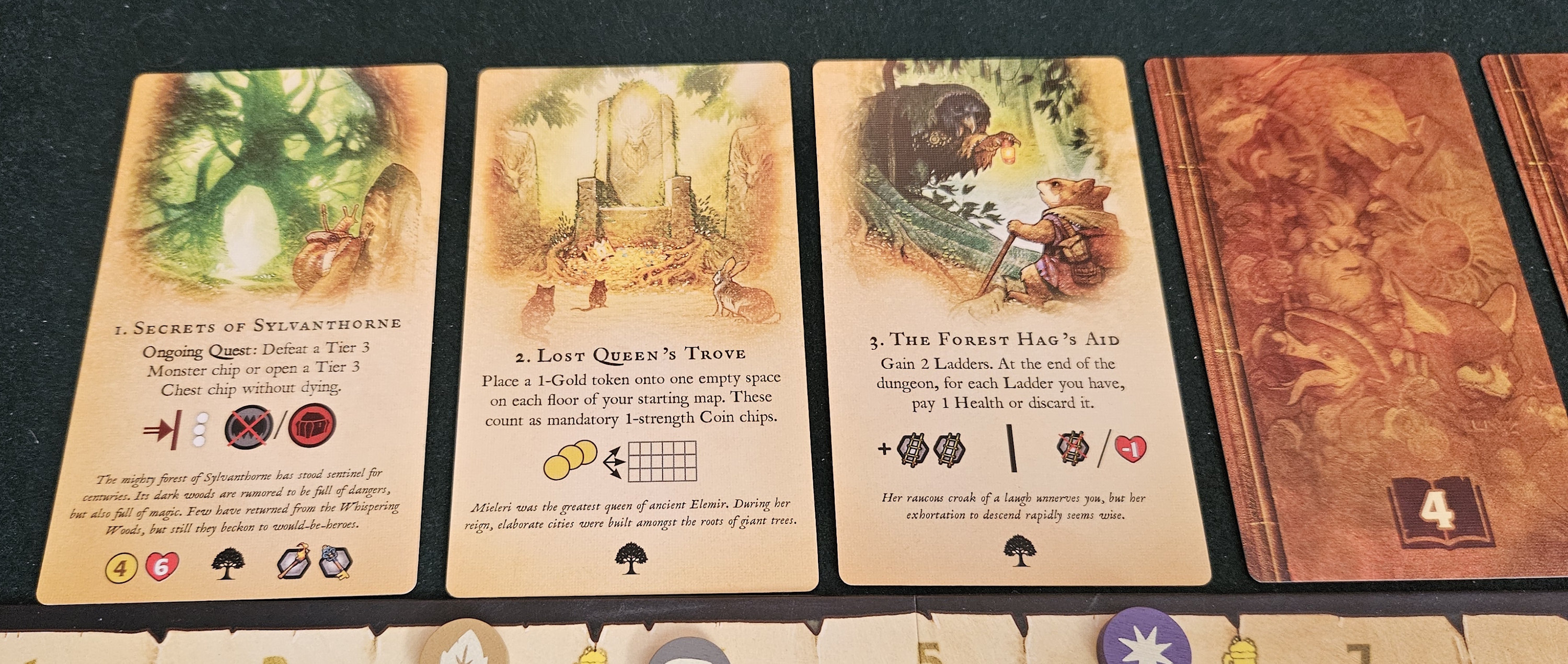
Every round has its own wrinkles.
On the whole, then, Satchel Quest is an admirable effort. It isn’t as varied or as punchy as it could have been, but its central puzzle is well crafted, with plenty of smart touches that ensure every draw presents its own attack of anxiety. I would file this under the “play a few times and pass it along” category — much like this bag of holding. Curse my stars for thinking I could store my good adventuring boots next to these vials of beholder pollen.
A complimentary copy of Satchel Quest was provided by the publisher.
(If what I’m doing at Space-Biff! is valuable to you in some way, please consider dropping by my Patreon campaign or Ko-fi. Right now, supporters can read the next installment in my series Talking About Games, this time tackling the topic of what makes a good list! Naturally, the piece includes a list.)
Posted on September 30, 2026, in Board Game and tagged Alone Time, Board Games, Satchel Quest, Weird City Games. Bookmark the permalink. 2 Comments.


I’ve been interested in Satchel Quest since it kickstarted last year, but I need it to play 5 players, so I’ve been waiting and hoping for an expansion before diving in… Glad to hear the game plays as well as it feels (and looks!) 🙂
It does seem like changing the count to five wouldn’t fundamentally alter anything.