Trench & Trough
Upland & Prairie is troublesome. Designed by the peerless Peer Sylvester, gorgeously illustrated and produced, and conceptually adjacent to certain Knizian disc- and tile-laying games, it has the makings of something wonderful.
The problem is that it doesn’t work. With some squinting, I believe I can see what Sylvester was going for. But it’s like looking directly at the sun: uncomfortable, fumbling, all its majesty blinded by sheer directness. I have worked to appreciate what is here. But the more I try, the more irritated I become.
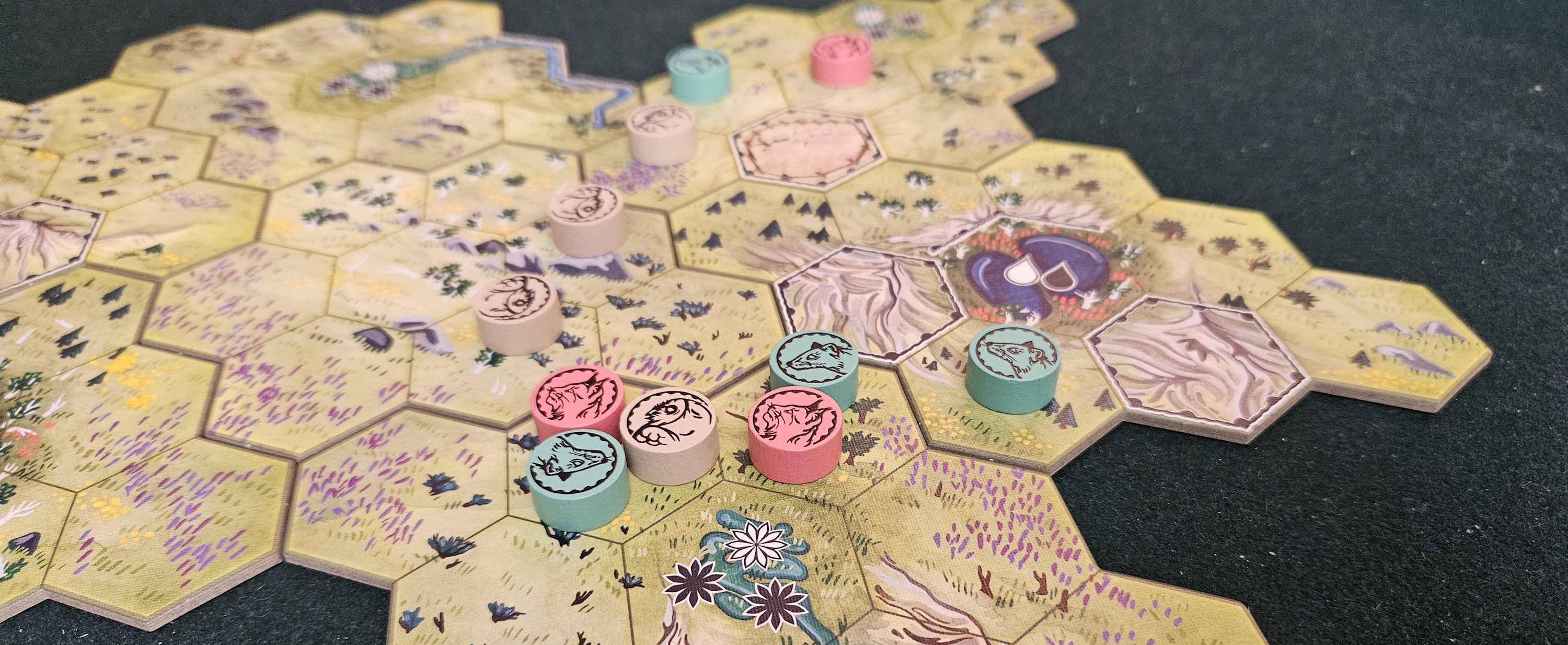
Early moves. Also maybe mid-moves.
At a soil level, Upland & Prairie is about placing discs in three colors to link together either two or three objective spaces. When this happens — if it happens — the color of that space-linking chain determines which type of token becomes the game’s victory condition. Thus, linking rodents means rodent tokens become the game’s means of success. If the chain is composed of owls, you’re hopefully holding the most brown tokens. Predatory cats… you get the idea.
The game’s sole action is dead simple. On your turn, you draw three tokens from the bag. One of these gets placed on the map. Another gets hidden behind your player shield. The third gets tossed back into the bag. Even at its slowest, it’s snappy.
In theory, this exiles players to donkeyspace. If you’re holding the most red tokens, you want the final chain to be red. But placing red tokens means you’re not hoarding red tokens; hoarding red tokens means you’re not placing red tokens. Meanwhile, if an opponent sees you moving to complete the red chain, there’s nothing preventing them from hoarding their own red tokens. It’s a pickle.
Conversely, the game might end with the bag running dry. When that happens, now players are looking to build sets of red, green, and brown tokens. In such on occurrence, hoarding was exactly the wrong thing to do. Now it’s variety you’re after. Choices, choices.
And there certainly are choices. Constrained choices, to be sure. Choices dictated largely by the draw. That’s no problem. They’re still informed choices, and theoretically interesting choices at that. Every little tidbit, every placement, becomes a trickle of water on an arid prairie. When an opponent tucks a ferret (?) into a corner, is that because they’re trying to run out the bag? Or are they just trying to deplete those green tokens because they aren’t holding enough of them? Could this be an opening? Or is it so much static, not a coherent signal?
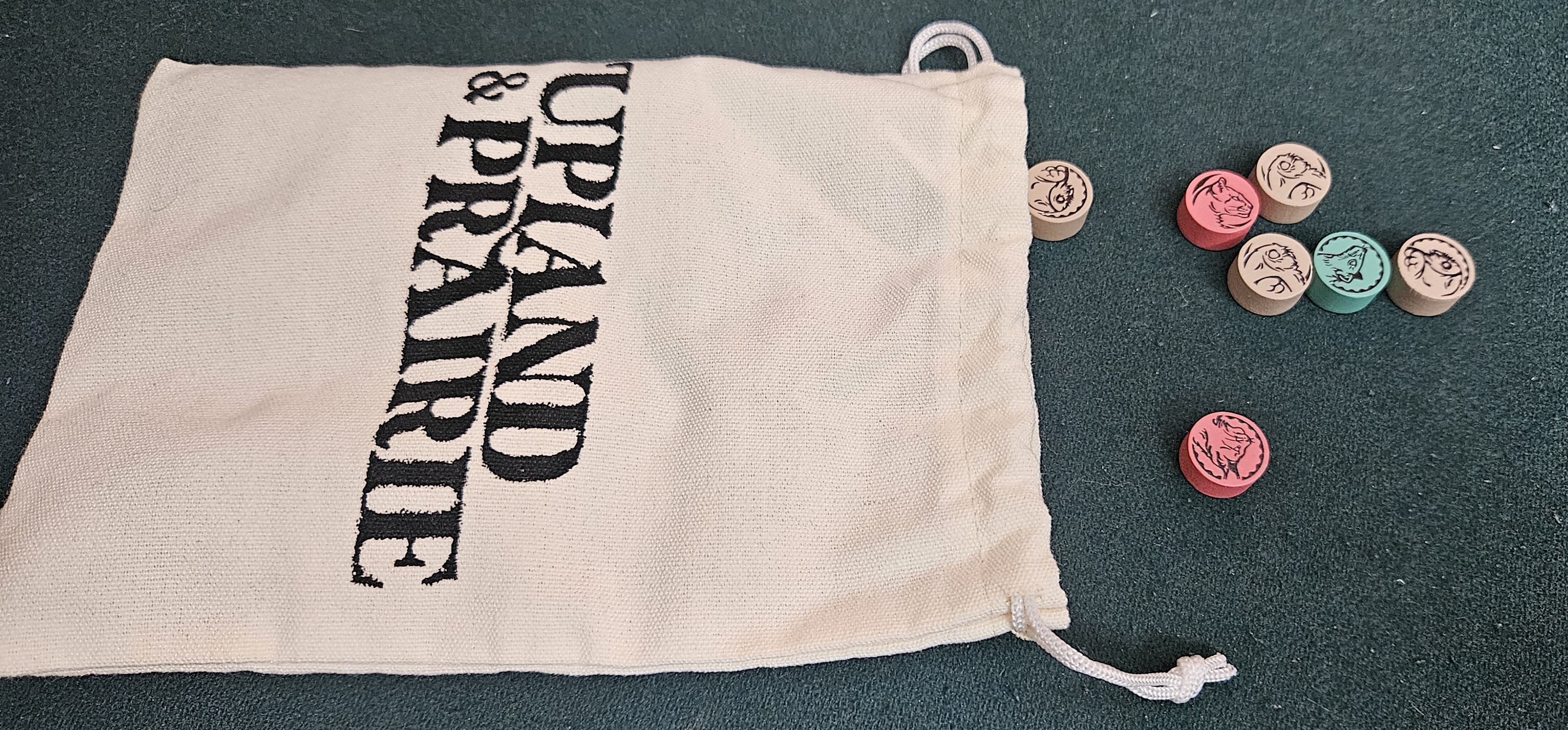
Now that’s one generous bag!
The foremost issue with Upland & Prairie is one of limitation. Not in the sense that it’s too limited. Rather, that it isn’t limited enough.
There are only three colors. Most of the time, this makes blocking a real problem. Now, in the game’s early stages, blocking is simple enough. If owls are threatening to end the session prematurely — a real possibility, given the tiny size of the map — then I might cut off your parliamentary incursion by placing a mountain lion. Easy enough.
But as the game progresses, other tokens might appear from the bag. These push up a tracker that increases how many tokens a space can hold. Where the game begins with each hex limited to a single disc, eventually it becomes possible to hold a second disc, and then a third. These moments, regulated as they are only by the draw-bag, are significantly harder to manage than ordinary token draws. It’s possible, as in a few of our sessions, that the game will open up its geography very early, in which case you might as well beeline toward the finish line with the color you’re holding the most of. If instead the game lingers a while, then the sudden appearance of a population-expanding token tends to favor the player upon whose turn it appeared. Now any bottlenecks can be pried open, and usually with ease.
Meanwhile, because the map is so small, these swings arrive with such suddenness that there isn’t much one can do to preempt them. Even if I’ve successfully walled off a particular species, a shift on my opponent’s turn — whether that’s one opponent or two, or perhaps two opponents and a partner, all depending on play count — can spell a very swift crumbling to that bulwark.
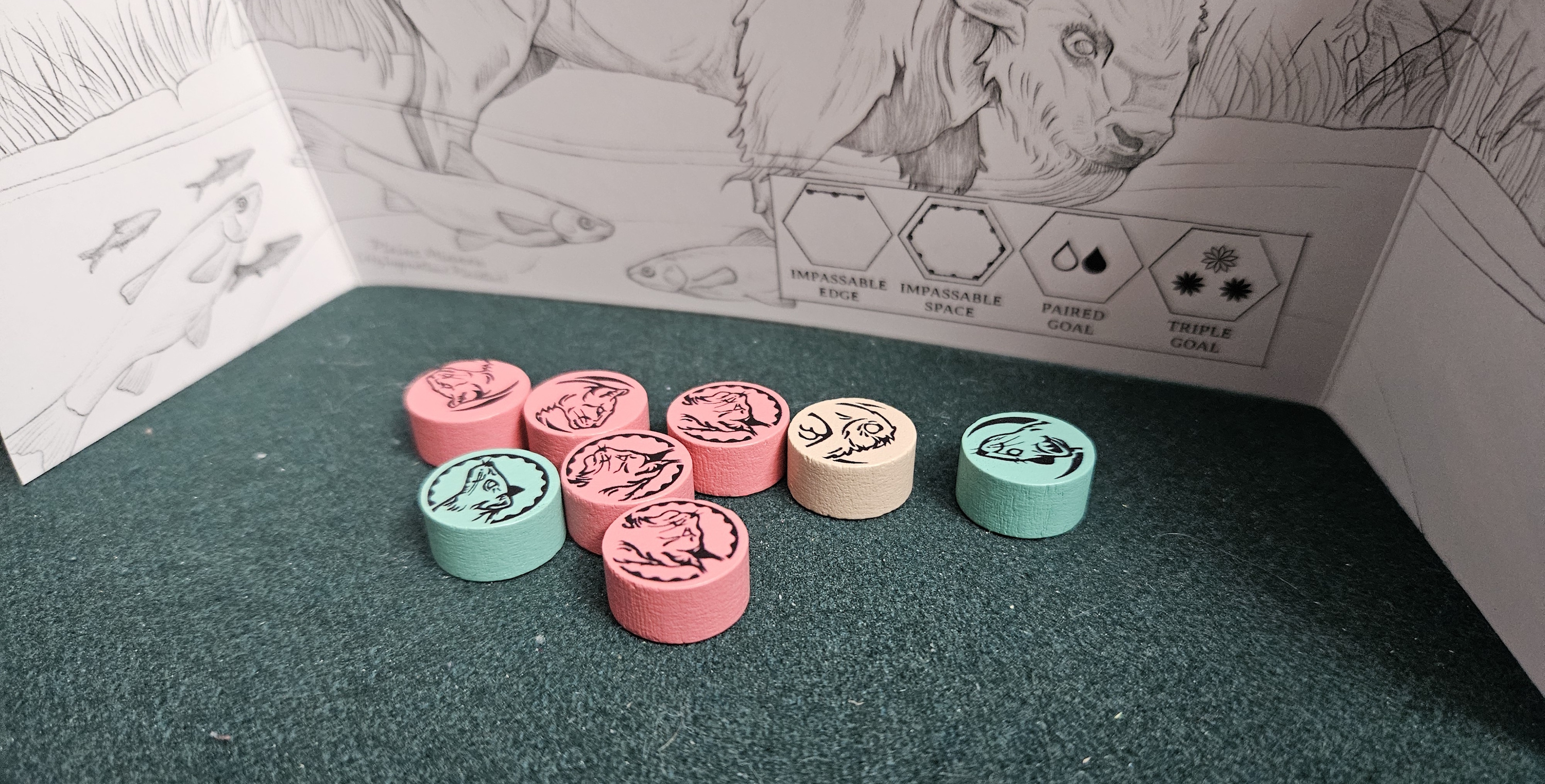
Hidden discs function as your score.
And then, when the game ends, there’s the very real possibility that it will end in a tie. There are tiebreakers, of course, and as in some of Sylvester’s better titles, The King Is Dead foremost among them, knowledge of the tiebreaker might be all-important.
Here, though, the tiebreakers feel more like concessions than objectives that can be shrewdly managed. In the case of a chain, tied players break their stalemate by who would go next in turn order. For an empty bag, it’s all about who holds the most animals of a single type. That might sound functional enough, but I’ve also seen that tally result in a tie. And the rulebook declines to address this possibility with either a second tiebreaker or a desultory “in this case, players share the win.”
This relates to my earlier issue. Upland & Prairie tends to end in a tie for the same reason that blocking is hard: the whole thing is simply too small. The map, the duration, the limits on placement, all of it. Sessions tend to end either swiftly or slightly less swiftly. There just isn’t enough time to build up a sizeable lead in any particular category. Nor is there room to suss out what an opponent is likely holding. The result is a game that presents pleasantly bite-sized decisions, but never enough of them to amount to a meal.
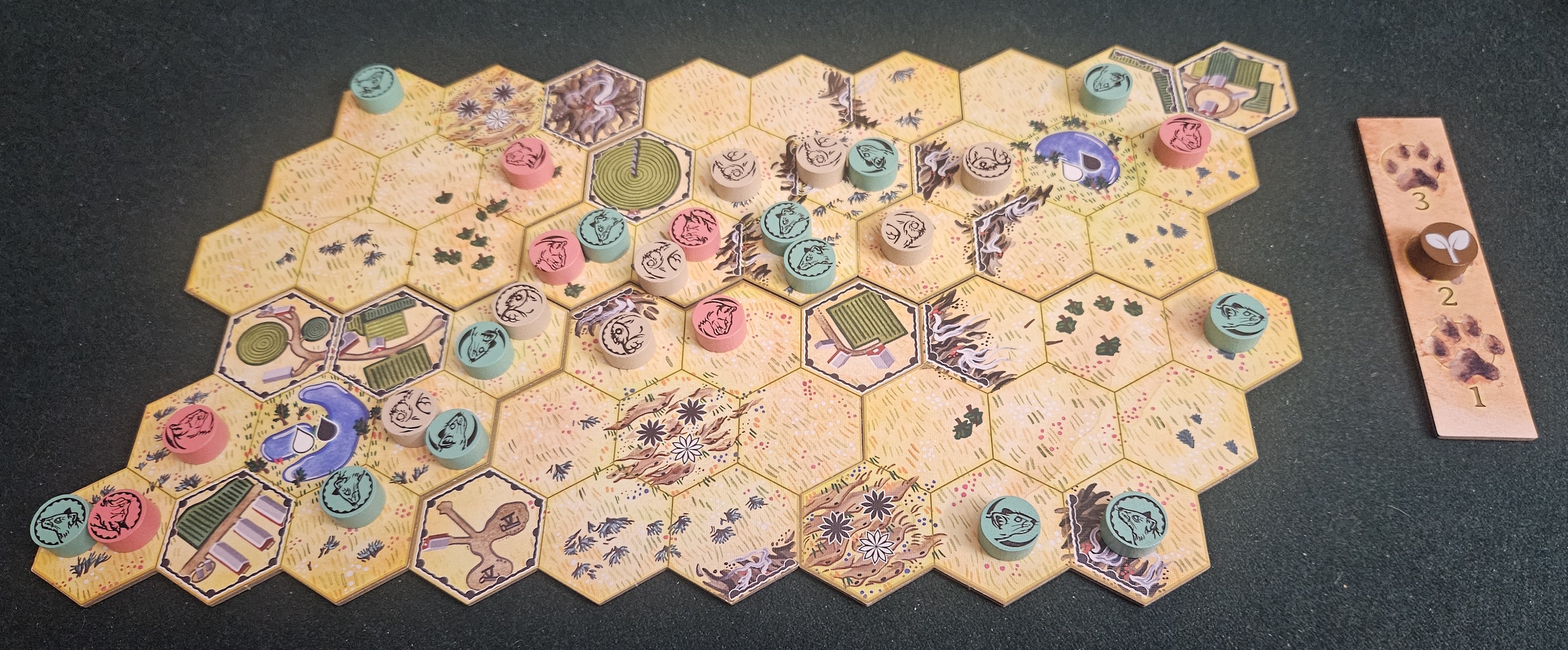
Big Sky. Tiny board.
It’s a shame, because I understand the desire to build a shorter tile-laying game. The famous Knizias — Tigris & Euphrates, Samurai, Qin, Babylonia — weren’t horrible time-hogs. But, sure, they could take a while to develop their board states.
Unfortunately, Upland & Prairie goes too far in the other direction. It prunes down not just the scope, but also the ability to stretch out, to take an opponent’s measure, to switch gears. Instead of coming across as a compact tile-layer, it feels like a novelty, like a mint-tin version of something more robust. And one that doesn’t succeed at compressing its subject matter, at that. This is no highland, no prairie. It’s a strip of lawn in a cookie-cutter suburb.
A complimentary copy of Upland & Prairie was provided by the designer/publisher.
(If what I’m doing at Space-Biff! is valuable to you in some way, please consider dropping by my Patreon campaign or Ko-fi. Right now, supporters can read the next installment in my series Talking About Games, this time tackling the topic of what makes a good list! Naturally, the piece includes a list.)
Posted on September 23, 2026, in Board Game and tagged Board Games, Osprey Games, Upland & Prairie. Bookmark the permalink. 5 Comments.


Sounds quite a bit like Turncoats. And isn’t it of similar scope?
Similar scope. Very different gameplay foundations.
This feels like a game idea that’s simple and compelling enough to have been something invented a thousand or more years ago, and in the intervening time, embellished with exactly the right complication to make it worthy and timeless.
Which is to say, it seems promising, but needs development. Hopefully less than a millenea of it, but probably more than it got.
I was hoping this might be a nice swan song for Peer’s line of Osprey Games. They’ve done a swell job with his other designs. Too bad to hear this one doesn’t have enough time to develop game play sufficientlly.
Maybe you’ll see the brilliance that I missed!