Doing Our Best
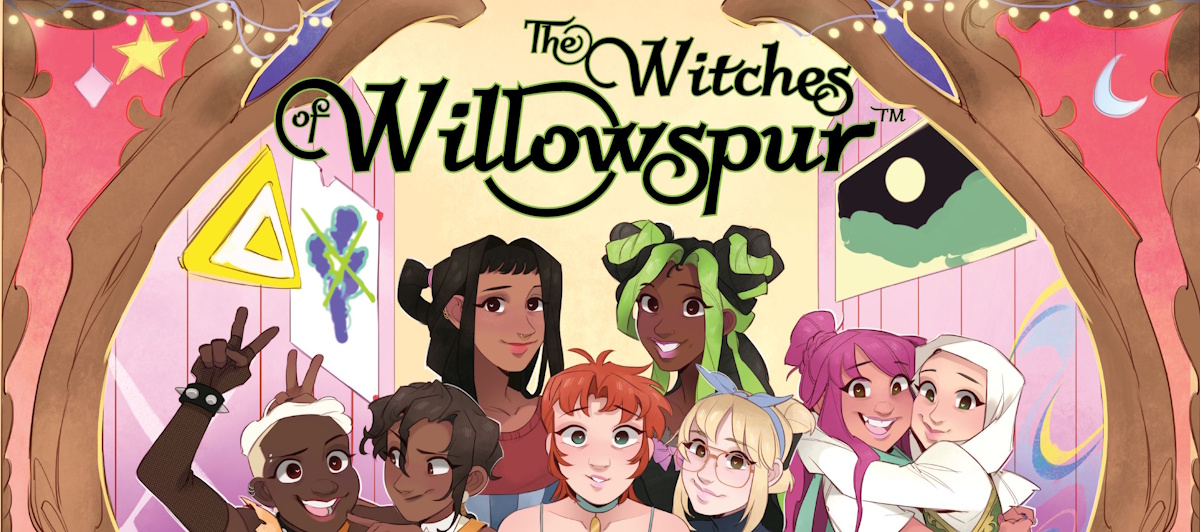
There’s a tagline on the box of The Witches of Willowspur, the latest game by Jenna Felli, that I appreciate deeply. “Doing their best,” it reads. It’s a reference to the titular witches, the daughters of wicked witches who, as a clique of misbehaving teens, have decided to get up to some good by releasing Prince Murray — the very same Murray the A**hole Frog who troubled the waters of his own title — from his shapeshifted form as… well, as a frog. Presumably not as an a**hole. There’s no counterspell for that malady.
“Doing their best.” It’s such a warm and reassuring phrase. This is a cooperative game about teenage rebellion and about teenagerhood more broadly, about finding one’s own goodness despite a world that would rather hammer you into a very different shape. Presumably Felli also did her best in crafting the game. I so very much wish it had resulted in something more playable.
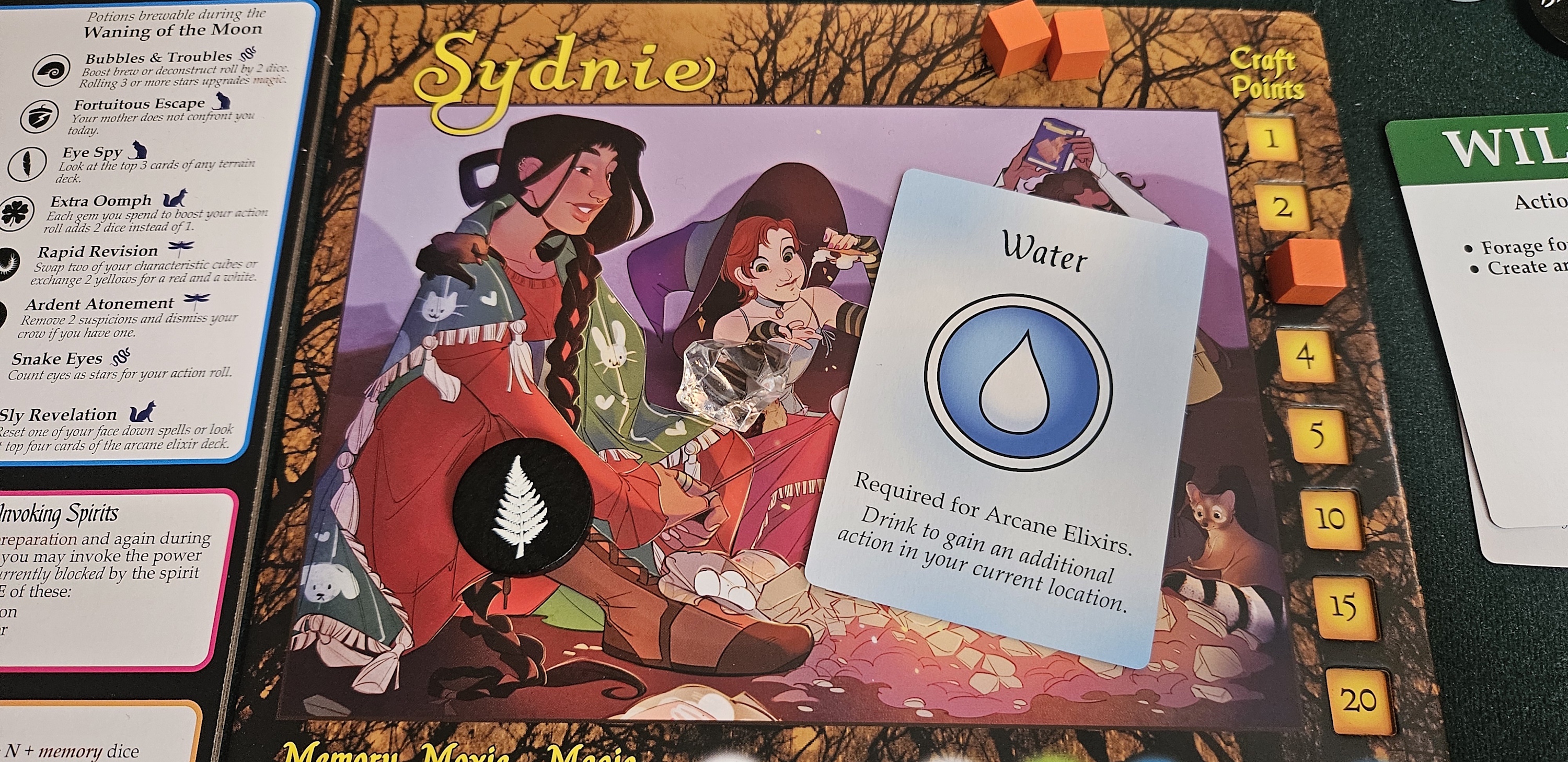
The witches are warm and wonderful.
Before we get into all that, I want to whisk us to a more distant vantage. The Witches of Willowspur is the first of Felli’s games that fully inhabits a shared world, at least without some measure of insider knowledge. Where her previous title made us despise the appearance of that blasted frog, this rulebook implores us to appreciate the Prince’s plight. To show some measure of understanding for someone who, let’s face it, is a bit of an asshole.
Enter the witches. There are ten in all, and it’s hard not to feel warmly toward them. There’s a lot to be said about their portrayal here; their diversity, their inclusivity of gender, the way each of them is introduced in company to produce glimpses of iron-bound friendship. Zara wears a headscarf that also houses her familiar. Abigehl holds herself with a rigidity that speaks to someone still learning to command her body. Sydnie has a stillness that’s always contrasted with the perpetual motion of her besties. Kate seems like the normie of the pack, which also marks her as the group mom. In them, I see people I knew in my own youth. People I still know, in some cases.
Which also speaks to the way even something like a board game, a narratively fluid medium very much unlike more set forms such as television or film or novels, can speak truth about the way we behave and commune and interact. One gets the sense that these teenage witches are good not in spite of their rebellion, but because of it. That’s the case with most teenage rebellion, or at least that’s how I’ve come to see it. I remember when my grandfather told me that he thought of my dad as having been a cold boy in his teenage years, distant, annoyed by family dinners and adult wisdom. And then, how, in a moment of sudden clarity and unexpected defensiveness for a father I was in my own period of rebellion against, I discovered myself coming to dad’s defense. He wasn’t cold; he was studious and dedicated and wanted to make the best of himself and, yes, sometimes getting together for dinner was an intrusion into those processes. I surprised grandpa, and surprised myself, and never bothered to tell dad about it, because such direct support is not something the men of our culture are permitted to share with one another.
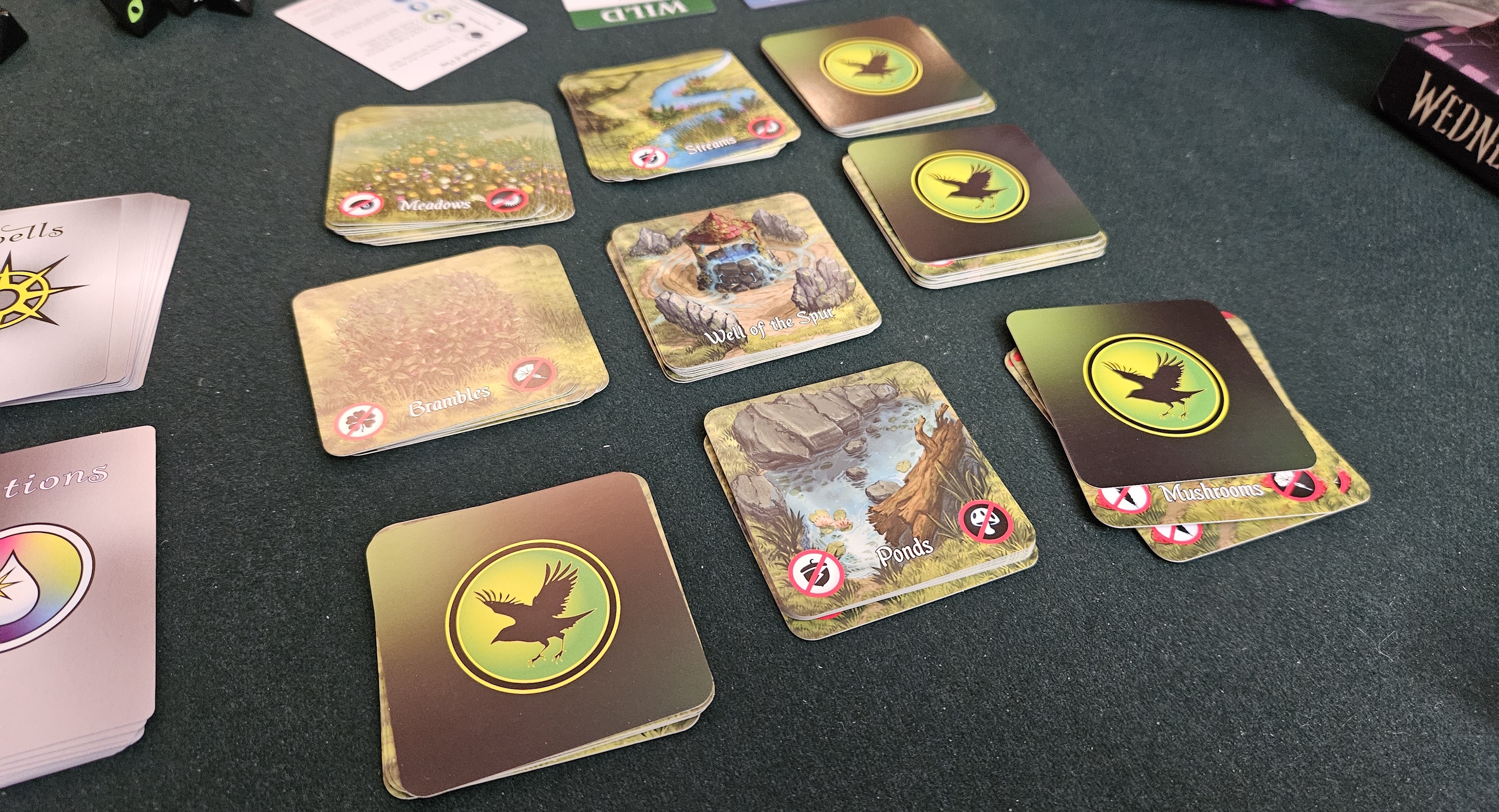
Foraging in the wild for ingredients.
Which brings us to the young Witches of Willowspur. Murray may be an asshole, but even an asshole probably shouldn’t be doomed to a lifetime as an amphibian. So these girls have decided to prove themselves through rebellion. They are not saving the world. They’re saving an entitled jerk, but that’s probably as far as their cantrips and familiars will permit at the moment. It’s practice, in other words, for the greater task of building communities and families, for the necessary rebellions that will come later.
Felli imbues this struggle with deft touches. It’s hard not to see the fingerprints of someone who cares deeply for this particular tale. Most of the game is concerned with questions of process: where our kids will focus their efforts today, whether they’ll work as a gang or labor apart, how to swap a crystal for some nightshade. All the while, however, the presence of the coven’s mothers looms large over the proceedings. It is the shadow of parenthood, the very same our protagonists are hoping to evade.
For example: when foraging for ingredients in the wild, the girls’ mothers have instructed ravens to watch for misbehavior. Normally the girls go out, roll some dice, and hopefully uncover the right ingredients for their brews and elixirs, or at least bottle some enchanted water. But when one of those raven cards is revealed, or even when the dice roll amiss, these carefree activities are intruded upon. Your mother’s suspicion ticks upward, perhaps resulting in a guardian raven of your own or a sentence of confinement in your room.
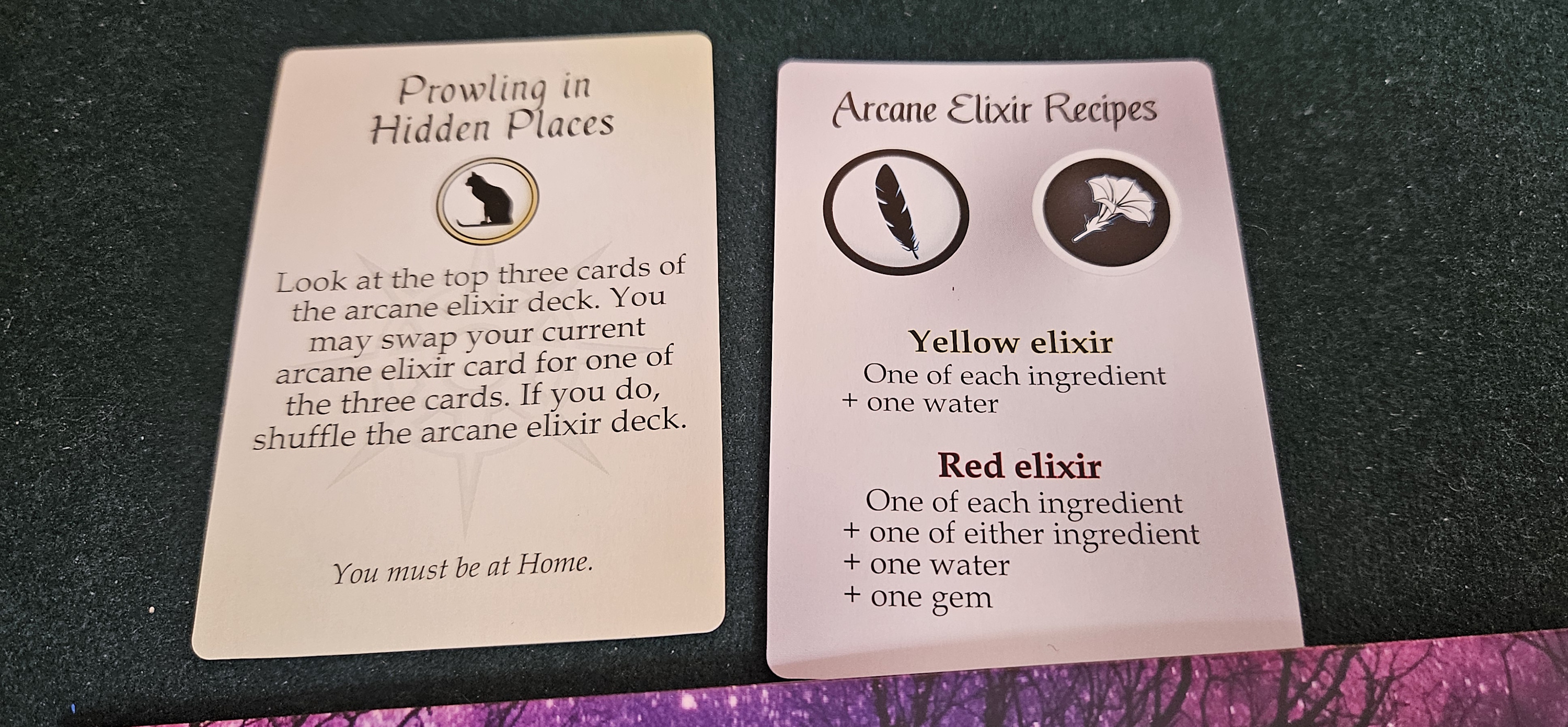
Spells and potions are admirably powerful.
But here’s the part that’s so relatable: your mother’s suspicion is tiered. There’s no difference between two and three suspicion, or four and five, or six and seven. The only thing that matters is when you pass one of those thresholds. Which means that, in being caught misbehaving, you’re encouraged to misbehave a little more. To press your luck, in game terms. But also in terms of teenage psychology. Because when you’re getting lectured, maybe that’s as bad as it’s going to get. You can make amends later, beg forgiveness, do chores around the house. In the moment, the mere reality of the punishment is enough to egg you into greater misdeeds.
Other touches are similarly adept. There’s the sheer potency of the game’s magic system, with its potions that can alter your luck outright and spells that ought to be cast as often as possible. Of course, these are paired with limitations of their own, but these once again open the umbrella of your mothers’ oppressive sheltering. Chugging an unnecessary potion in order to bypass the spirit ward that’s blocking the spell you’re hoping to cast is the perfect analogy for teenagers passing physical notes because their parents can read the text messages on their phone watches. The Witches of Willowspur is about slipping through the fractures that manifest in every parental monitoring system, given enough time and correspondence between dedicated teens.
Which only makes it all the harder to talk about the ways the game slips through fractures of its own. It’s a little heartbreaking, to be honest.
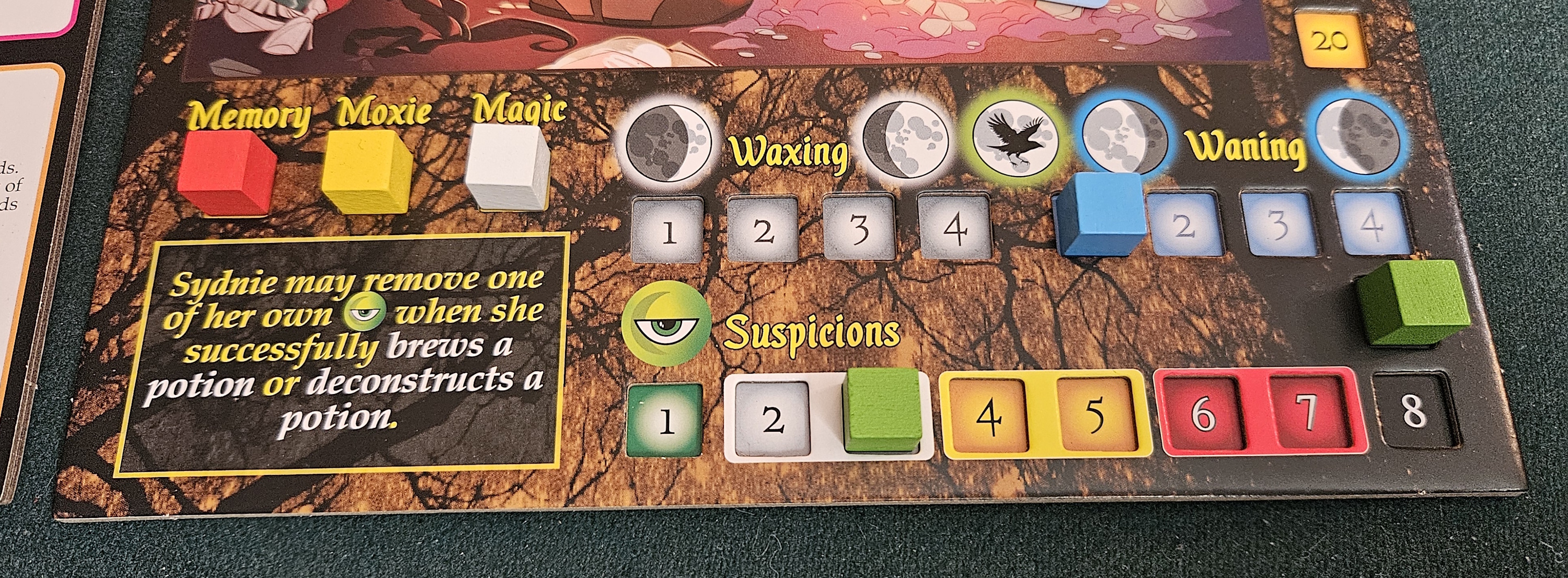
Parents suck, huh?
The earliest offender is the rulebook. Felli has always produced dense tomes of rules, and her games are nontraditional enough that they must be seen in motion to comprehend. Here, though, the instructions are a vertiginous mixture of thematic notes, roundabout instructions, and variable-stuffed formulae.
It doesn’t help that the resultant actions are similarly jumbled. Most actions require rolls, but not all, and those rolls will sometimes demand little adjustments according to your witch’s skill level in one of three traits. Those traits begin at zero rather than one, but then a formula will ask you to add one to the results, raising one’s eyebrows over why the bottom-level trait wasn’t listed as one to begin with to save on the extra operator in the formula.
As for the rolls, these are fraught things, nearly as likely to raise your coven’s mothers’ suspicions as produce successes. Except some actions require successes where others might benefit more from teamwork, while others still are performed without any sense of risk at all. The results are certainly textured, but to such a degree that we were forced to constantly refer to both the reference chart and the rulebook when the former neglected to include a crucial piece of information.
And then there’s the disconnected nature of the whole thing. Each witch has their own tracker for the day and the phases of the moon, but these would have been better served as a shared track in the center of the table. As it stands, a minor oversight on one player’s part results in a temporal mismatch that leaves everybody confused. The same goes for the whole location-visiting nature of the gameplay. It’s basically worker placement, except everyone uses their own set of cards to designate whether they’ll spend the day at home, in town, or exploring the wilds, necessitating constant updates where a quick glance at a shared board would have saved time and headache.
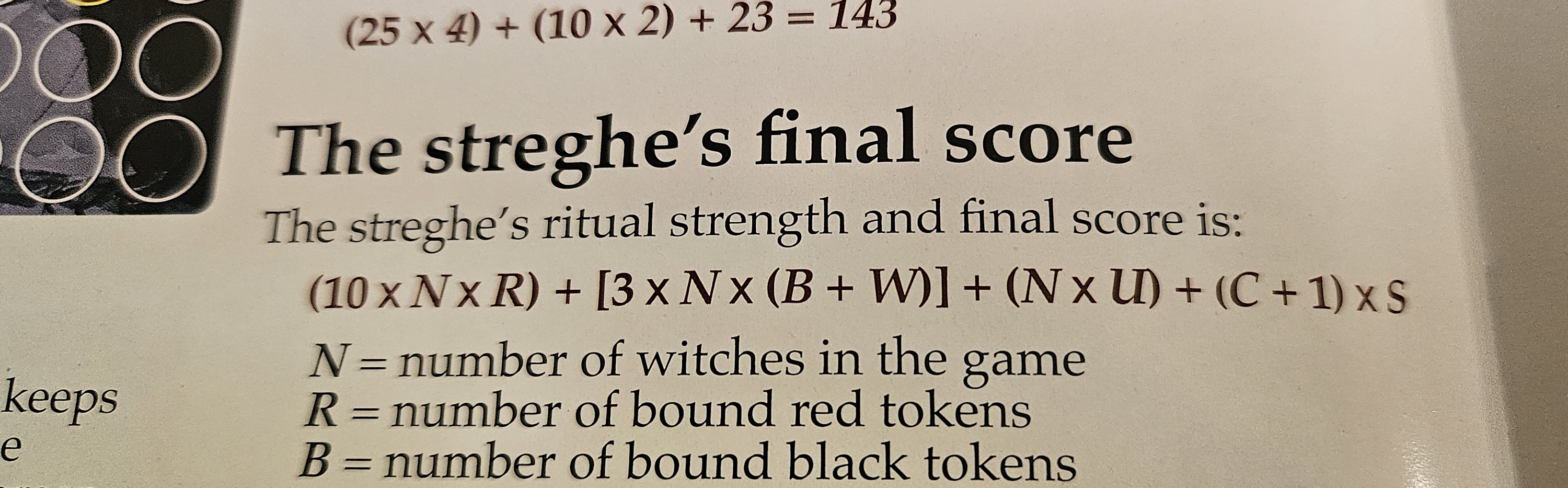
Um.
As for the actual objective of this whole shindig, The Witches of Willowspur presents a board where your mothers’ ongoing ritual against Prince Murray is tracked… except this bears little direct import on your own progress. There are a few methods for altering what’s happening over there, but there’s never really a case where, say, some adjustment to the ritual forces your witches to alter their plans. Ultimately, it’s a way to generate a score that you must beat through brewing potions, casting spells, and leveling up your skills, all of which produce their own numeric value, the opposite of violating a hex or brushing through a circle of salt. The game trundles on and on, then ends with dueling mathematical formulae rather than a confrontation. It’s as damp a conclusion as I’ve seen.
There are diagnoses I could offer. How a game this ambitious needed wider development, an outsider’s hand to pare away the dead branches, a stronger sense of internal consistency.
Really, though, the whole thing strikes me as tragic not because it’s a failure of design, but because it clutters such a keen portrait of adolescence on the cusp of adulthood. Playing The Witches of Willowspur, I find myself recalling my own youthful rebellions that were also my earliest attempts at goodness. Through illustrations and certain in-game activities, Felli captures those efforts in all their complexity, then fumbles at giving them the conclusive outcome they deserve.
Our witches, after all, are not rejecting their mothers’ lessons; they’re still practitioners of the dark arts. But in seeking to use those lessons for a more robust purpose than mere troublemaking, they embrace the renewed necessity that is youthful activism. We’re often told that age brings wisdom, but it also brings complacency, and often when an adult calls a particular cause “childish,” they fail to realize that they have identified the real nut of the problem. Some things are so obviously wrong that even a child can see it. So wrong that only an adult can persuade themselves to shroud its wrongness in nuance.
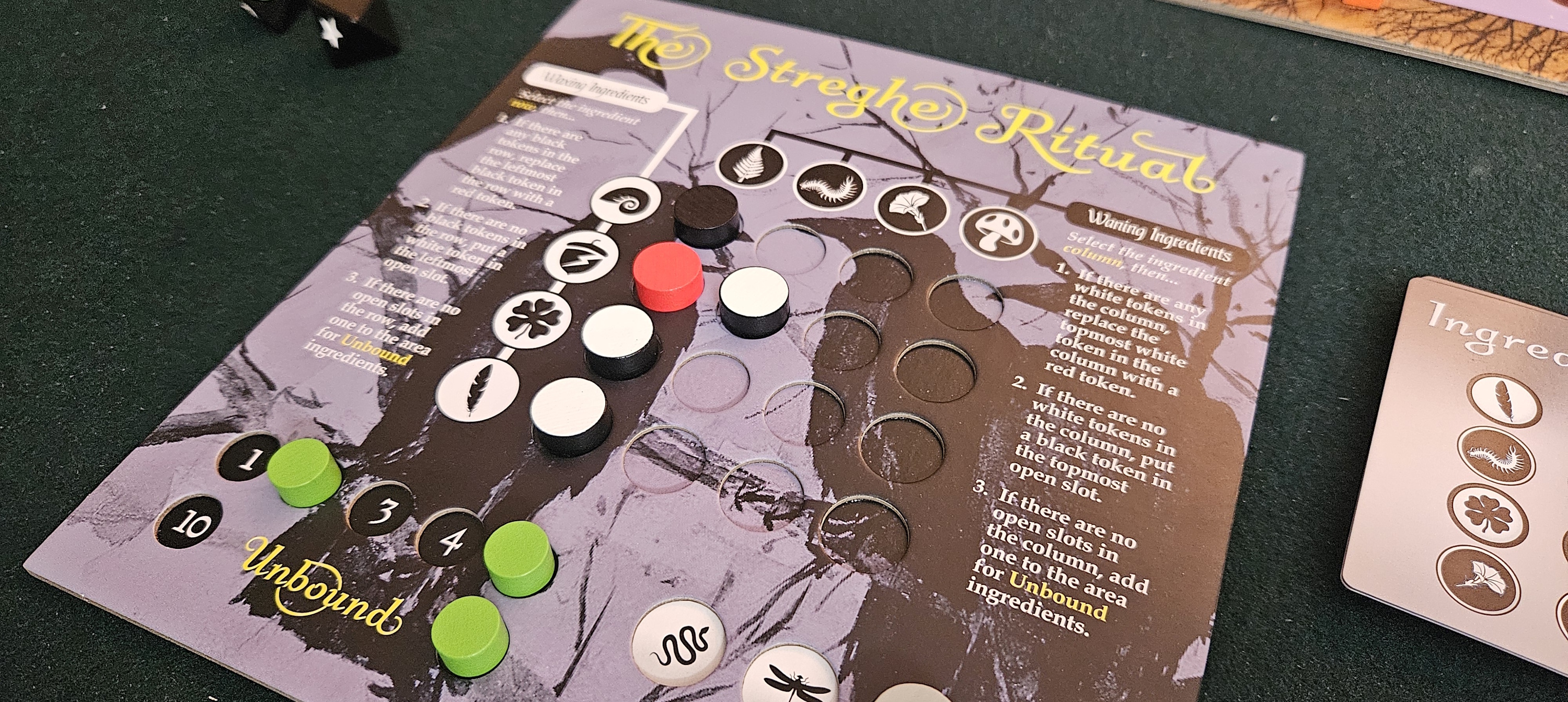
The ritual binding mostly serves to establish a score to beat.
In the end, The Witches of Willowspur is remarkable in its ability to capture some sliver of that hopeful adolescence. Win or lose, the witches are doing their best. I imagine Felli did her best, too, just as I’m doing my best to write about it, and you’re doing your best to understand it. Have we succeeded? Not as a board game, not all the way. Maybe not as a review, either.
Still, we come back to the reassurance of that line. Those of us who want to do good are doing our best. It’ll have to be enough. If it isn’t, nothing will be.
A complimentary copy of The Witches of Willowspur was provided by the designer/publisher.
(If what I’m doing at Space-Biff! is valuable to you in some way, please consider dropping by my Patreon campaign or Ko-fi. Right now, supporters can read the next installment in my series Talking About Games, this time tackling the topic of what makes a good list! Naturally, the piece includes a list.)
Posted on July 27, 2026, in Board Game and tagged Board Games, Devious Weasel Games, The Witches of Willowspur. Bookmark the permalink. 1 Comment.


Felli has impressed me, along with Amabel Holland and Cole Wehrle, as one of those rare designers whose ouvre frequently shows thoughtful attention to theme in the venerable literary sense.
Great game designers are fairly often not great writers of handbooks. I recently thought for a few minutes that the documentation for a very simple rules set had failed to stipulate the rule that a player’s piece cannot occupy the same space as another player’s piece; but it turned out to be buried in a “Helpful Reminders” section _following_ all the main body of algorithms!
Great _developers_ are rather unsung heroes in the industry, compared with editors in book publishing. For a designer become also publisher, there may be a combination of low budget and “entrepreneur’s disease” working against availing oneself of that asset.
A lot of refinement, both of fundamental design and of presentation, can come from the inputs of blind-testers; but that’s an understandably daunting process to undertake.