Grabble Grabble
CMYK is on a hot streak. Get it? Hot streak? Fine, I’ll just tell you about this other board game. Grabble is a remake of Naoki Fukuda’s Nuts a GoGo!, which probably doesn’t tell you much. Imagine a bunch of people scrambling around a box for mismatched components. Shortly thereafter, they wage a sudden-death competition with their foraged traffic cones, dice, and metal pigs. In and out, five minutes.
That’s Grabble. It’s fast, it’s silly, and then it’s over. Unless you play more than once, which is more or less mandatory. Unlike a few other recent CMYK releases, I suspect this one will prove too trifling for some. I think I’ve played it something like forty times in the past month alone.
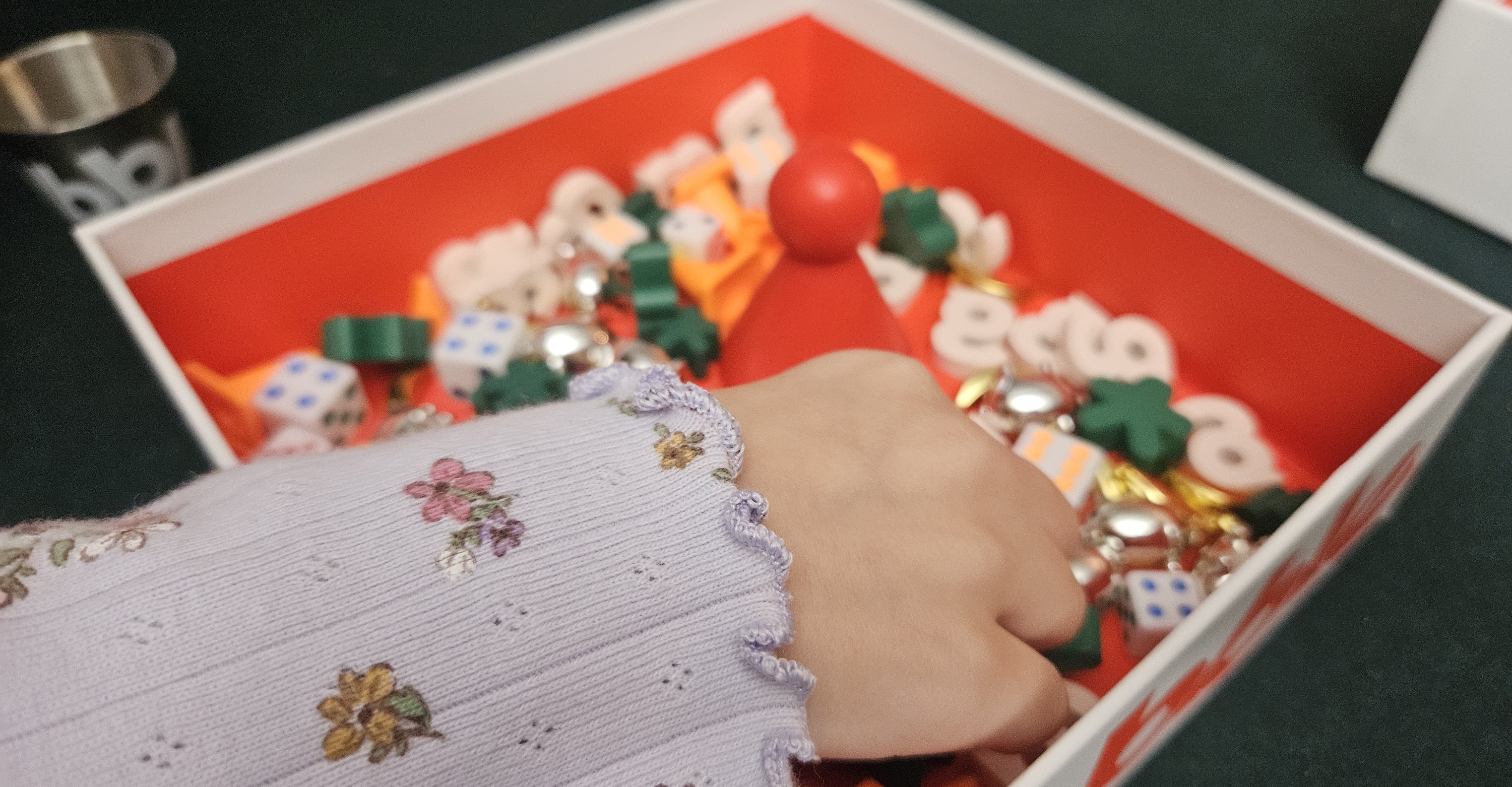
The grabbing portion of Grabble.
As noted, the rules for Grabble are compact. So compact that they fit inside the box lid. How’s that for a throwback? It’s the sort of game that can be taught inside of thirty seconds. Which isn’t to say there aren’t… not subtleties, exactly. Not even nuances. But there’s more than one might expect to Grabble.
Take, for example, the pieces. In the original Nuts a GoGo!, the pieces were all wood. They had different shapes: pegs, rings, pyramids, cubes. But they all had that lacquered brown shade, which made them hard to select in a lineup, let alone when five hands were groping around in the box. Here, the shapes are more distinct. Dice, both large and small. Traffic cones, also in two sizes. Wooden meeples, colored green so my seven-year-old calls them leprechauns. Metal pigs and bananas. A lower-case g. Not for Grabble, actually. For gumption.
The distinctiveness of these pieces is part of the game. When Grabble starts, everybody reaches into the box and starts grabbing stuff. The usual restrictions apply: one piece at a time, only one hand. Everybody deposits these pieces into their very own metal cup. If they fall out, they must be replaced before you can continue grubbing around in the box.
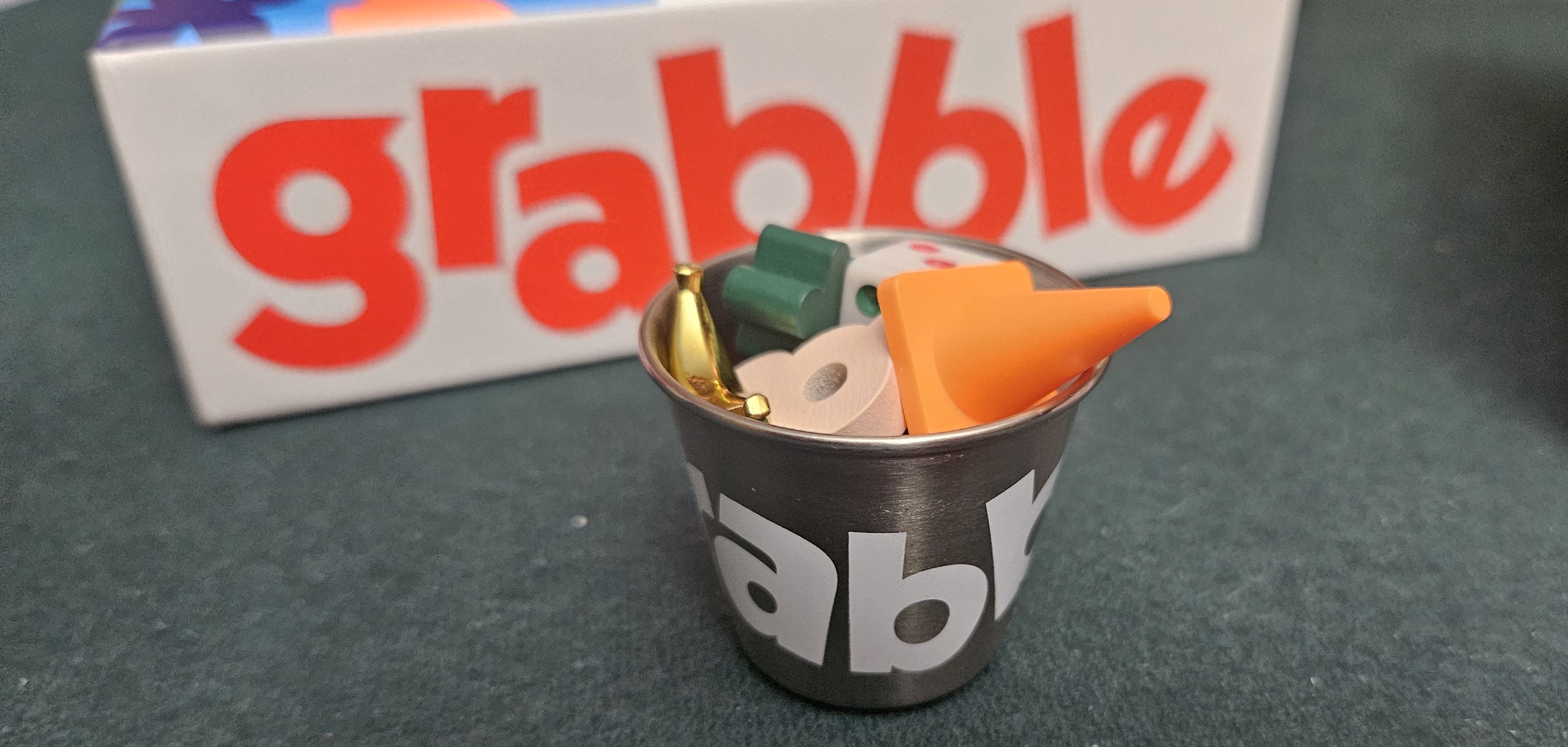
Cup o’ grabbins.
Already, there’s something here. Strategy. Tactics. Maybe not. But dexterity, at least. You’re targeting specific pieces. Don’t have a traffic cone? You’d better find one. Somebody seems to be moving too quickly? Shove your fingers under theirs, play a little defense. Thinking too hard? Don’t do that.
As soon as your cup overfloweth, you’re allowed to halt the festivities. You grab the big pawn — it’s huge, you can’t miss it — and shout stop. Everybody slaps the table. The last person to slap owes you a present from their cup.
This is where Grabble switches gears. Everybody pours out their cup, making sure to keep everything hidden. Then, starting with whomever ended the grabbling phase, you go around the table. On your turn, you declare a piece to throw back into the box. Pig! Everybody complies. Then the next person throws something back. Leprechaun! Then the next. Letter!
Here’s the rub. When somebody can’t throw something back, they’re out. It doesn’t matter how much they’re holding. The goal, naturally, is to be the last person standing. So you play… again, not quite strategically. But there is some sense in which you’re making informed decisions. The colorful and shapely nature of the components matters. Because, yeah, you noticed when such-and-such seemed to keep grabbing endless orange cones, or that somebody was taking pieces too quickly and maybe overlooked the tiny bananas that accrue beneath everything else.
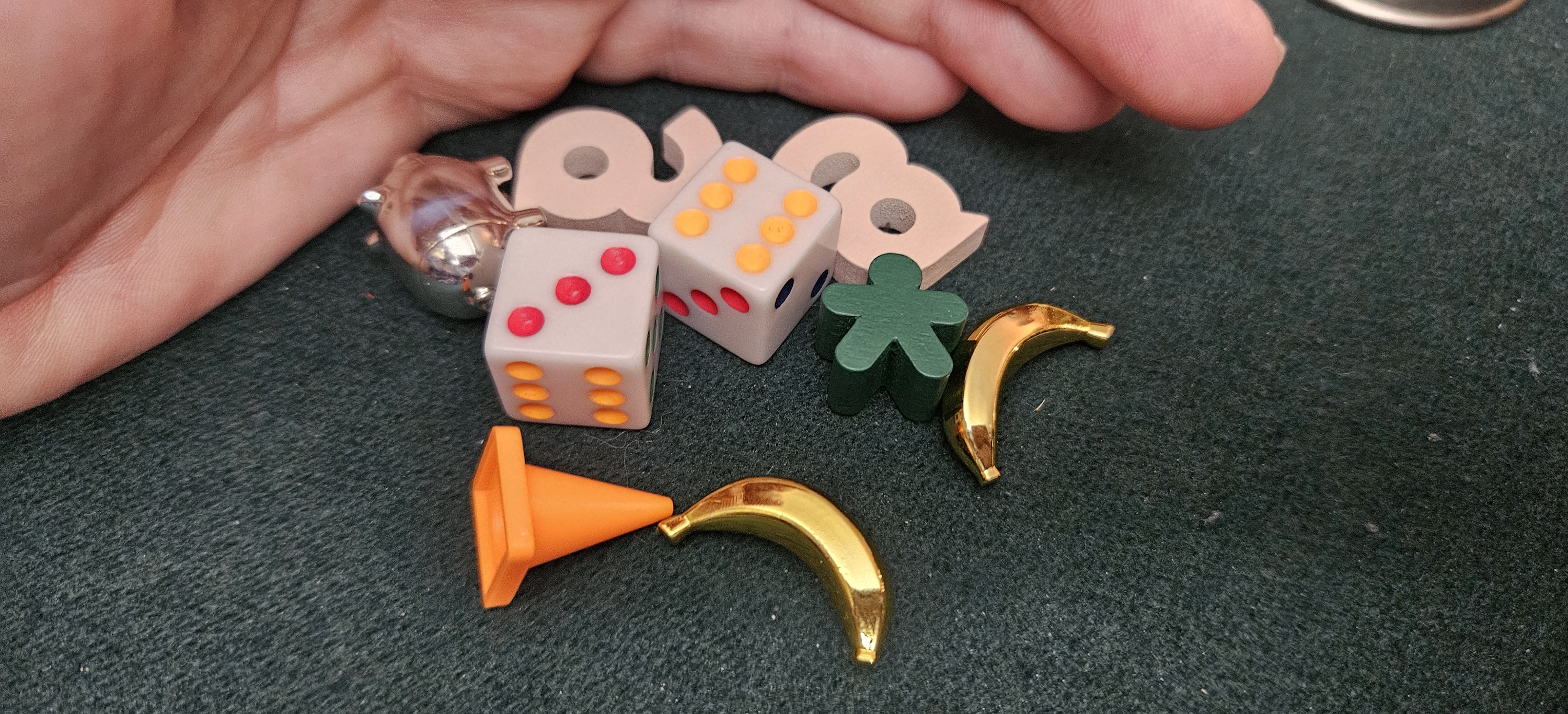
And now the ble portion of Grabble.
The funny thing about Grabble is that it doesn’t need these words. I’ve spent double or triple the wordcount describing Grabble than Grabble spends on itself. Any subtleties arise organically during play. All at once, it’s a dexterity game and a guessing game and a deduction game. It’s a player elimination game, too. But it doesn’t need descriptors. It’s Grabble. It’s itself.
It’s so wholly itself that it resembles some ideal form given shape and volume. When a half-dozen players are glazed over from some overwrought nu-euro, Grabble is there to shake off the mental cobwebs. When my seven-year-old wants to play something before school but she’s taken too long picking out an outfit, we can get in a session of Grabble, no problem. When my twelve-year-old wants to host a game night for her friends but isn’t confident she can teach something complicated, Grabble breaks the ice.
Even compared to some of CMYK’s recent catalog, it’s short, giddy, and not especially long on player agency. Then again, there’s a thinkpiece about what “player agency” actually means in there. Everything passes at lightning speed in Grabble. But it never really feels like it’s out of control. Only that its control is always at risk of slipping away, a finger’s length from being firmly grasped.
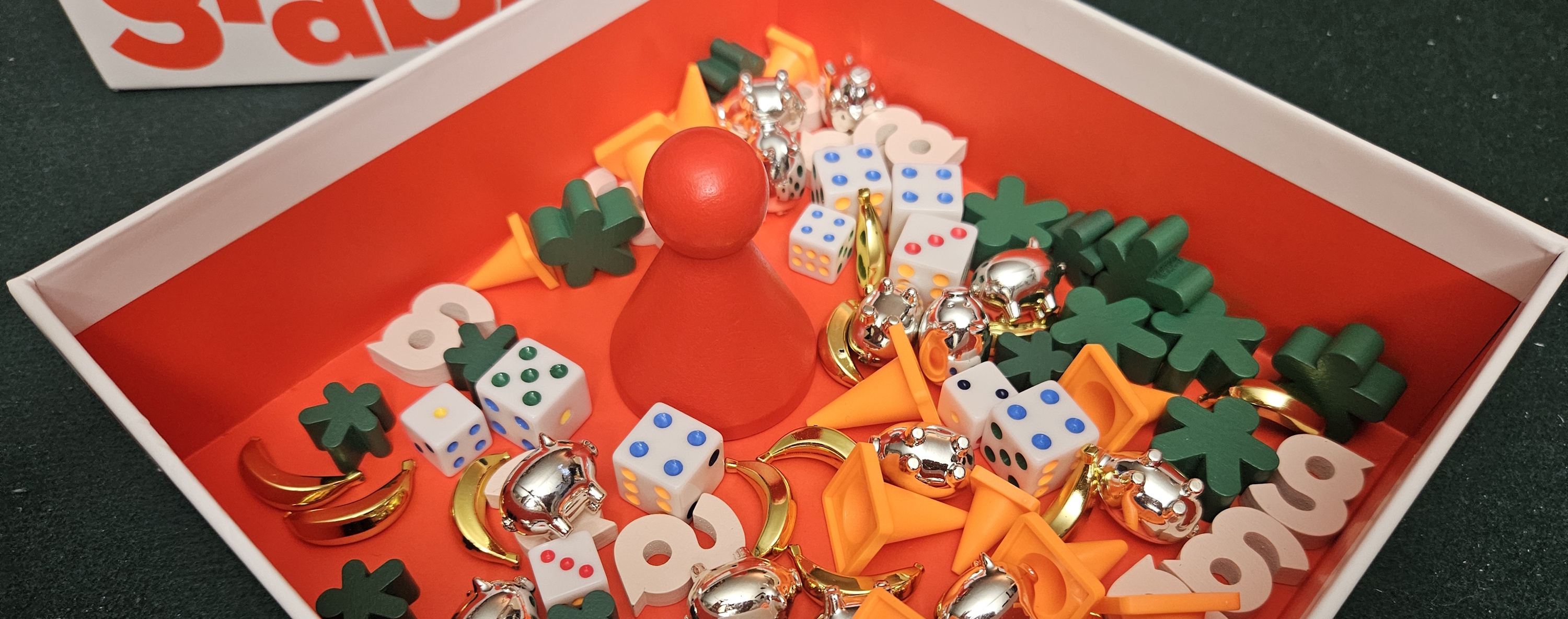
Grabbed.
Or maybe control doesn’t matter. Not always. Not all the time. Maybe player agency is overrated, at least in some cases. I worry that some people will think themselves too mature to appreciate what it gets right.
But I hope not. Maybe with titles like Magical Athlete and Hot Streak and Dino Racer in favor again, people will see Grabble for what it is: the purest, most perfect way to laugh for five minutes while out-slapping, out-grabbing, and out-guessing one’s family members.
A complimentary copy of Grabble was provided by the publisher.
(If what I’m doing at Space-Biff! is valuable to you in some way, please consider dropping by my Patreon campaign or Ko-fi. Right now, supporters can read the next installment in my series Talking About Games, this time tackling the topic of what makes a good list! Naturally, the piece includes a list.)
Posted on September 29, 2026, in Board Game and tagged Board Games, CMYK, Grabble. Bookmark the permalink. 6 Comments.


Often, when I play games that result in players tallying point tokens, I ask everyone to hide their tokens behind their hands. Then, we take turns calling out point amounts, often synonymous with token amounts (“3 points!?”) and everyone discards that number of points from behind their hand. We keep going around until people start dropping off (“I’m out!”), and finally there’s one person remaining, removing their hands and revealing their final points (essentially their point lead over everyone else).
I always found this to be a more fun way of determining the winner over a silent multi-solitaire game of arithmetic.
Anyway, all this to say that I was delighted to see that someone actually came up with a game about this very practice!
What a lovely idea! It is much more fun than counting points in loneliness, no doubt!
This is a perfect dumb fun game. It won’t win any awards, but it’s perfect for what it is.
This looks like such a fun time.
I’m glad to see Nuts a GoGo! reimplemented for a larger audience. This game is pure, silly fun.
Yes! So good.