Again, Opium War, Again
When Cole Wehrle first unveiled An Infamous Traffic way back in 2016, it was a scrappy little devil. Not only was it Wehrle’s second design, it was also among the earliest releases from Hollandspiele. As such, its constraints were stark: a handful of counters and dice, a paper map, and one of the worst rulebooks ever written. (That last one was included in the contract: “The designer will include a horrible rulebook that doesn’t explain the game in the slightest.”)
Now a second edition is on the way. Much like Wehrle’s second stabs at both Pax Pamir and John Company, this is the work of a designer who knows what he wants to say. More importantly, it’s the work of a designer who’s spent the intervening decade learning how to use the curious medium of tabletop board games, simultaneously one of our ancientest and most recent arts, to paint a compelling and damning landscape of 19th-century business.
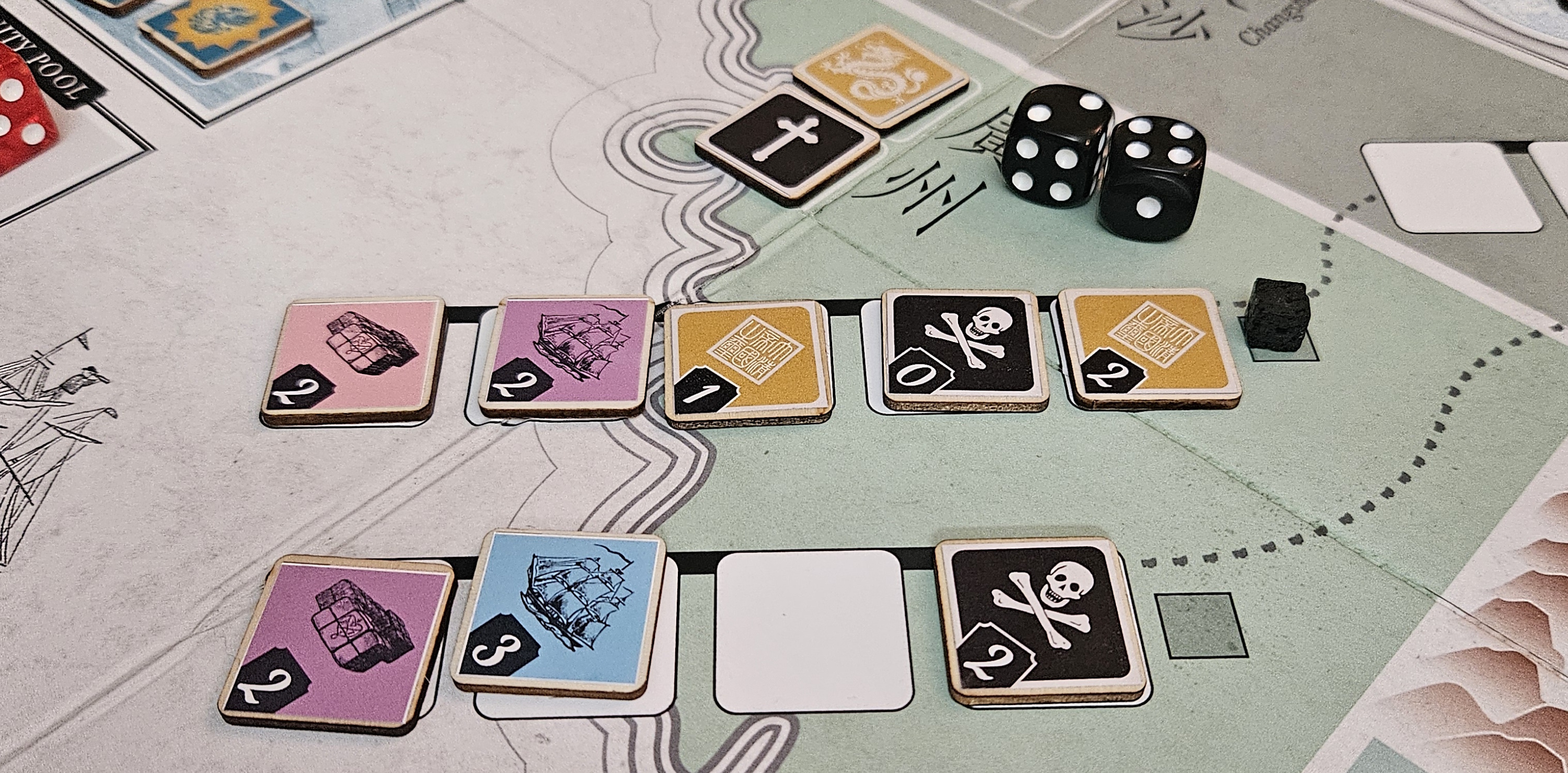
Econ 101: supply chains.
An Infamous Traffic functions as a prologue. To the single most profitable good of the British Empire across the entire 19th century. To two state-backed drug wars, the establishment of Hong Kong, and the Chinese Century of Humiliation. To the association of opium with Chinese immigrants, from Sherlock Holmes to the first anti-drug law in United States history, passed in San Francisco in 1875 to curb the rising popularity of smoking dens.
And it all begins with supply and demand.
When the game opens, Christian missionaries and a handful of smugglers have brought opium into Canton. From your perspective as a well-to-do mercantile family, the immiseration of those hooked on the drug represents an opportunity.
As in the original game, this largely means filling supply chains with tokens that fulfill the demand for opium. The raw bales, produced in India; the vessels used to transport them across the sea; the merchants who sell them locally. In this last case, that can be your own agents, smugglers, or corrupt diplomats happy to look the other way for a cut of the profits.
Of course, this process isn’t as easily done as said. There are complications. The right opportunity needs to present itself, abstracted by dice that must be matched between a special pool and the region where you’re peddling your product. There must be sufficient demand to pay the prices you’re asking, sometimes resulting in little bidding wars — an example of Adam Smith’s invisible hand driving down prices to favor the consumer, if you want to be cynical about it. Eventually, the danger of enforcement rears its heads. But that’s a way out.
At this level, An Infamous Traffic functions much as the original edition did. It’s a game about the early decades of capitalism as not only a theory but as a practice. As a natural right, as the Crown would argue when its gunboats later forced the Qing to open their ports to an addictive poison.
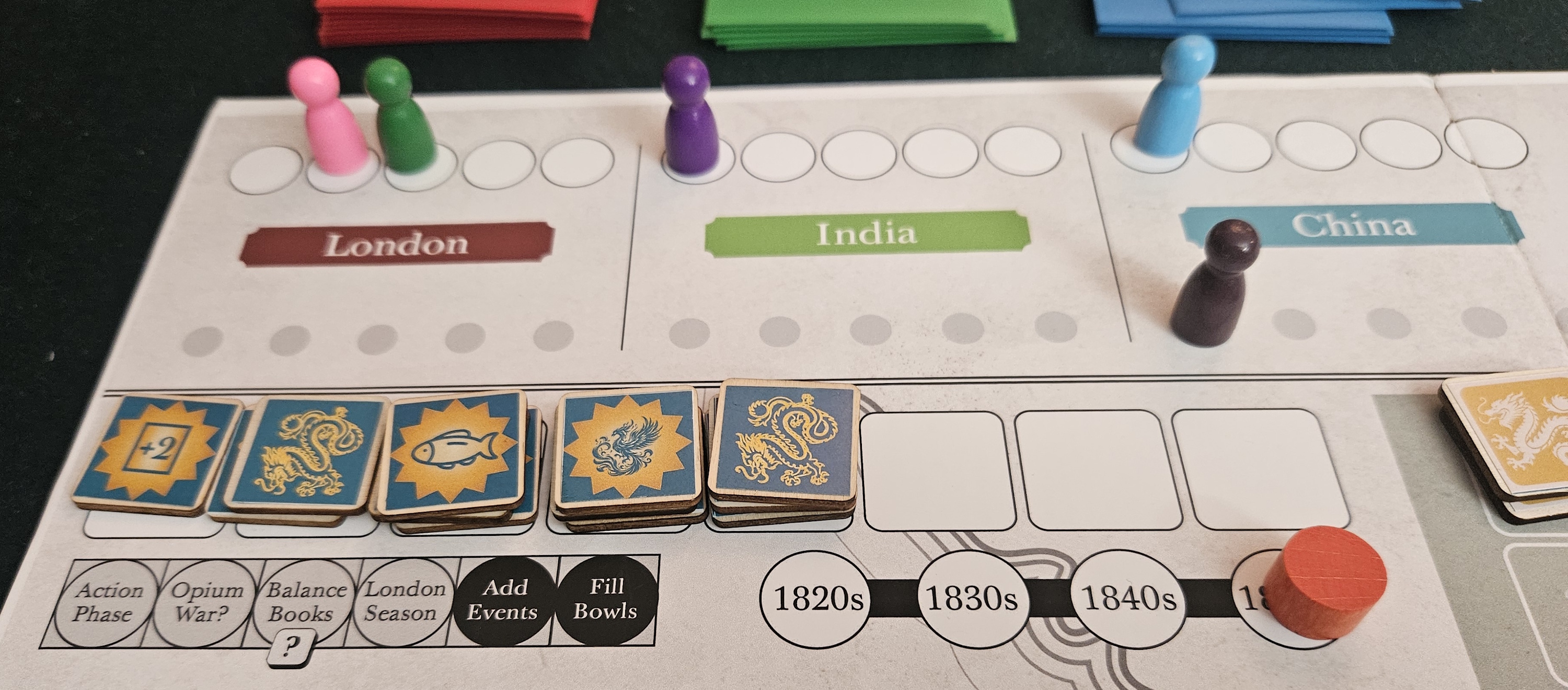
Travel and events both play an expanded role in the second edition.
But there were problems with the first edition. Quite a few, some of them apparent more in hindsight than at the time of the game’s authoring. This new edition rectifies these problems, both mechanically and narratively, to craft a better-rounded experience, not to mention one that’s shorn of the madcap silliness that sometimes marked the original.
The most visible transformation is one of scope. An Infamous Traffic was always cosmopolitan in scale. Your objective wasn’t really to sell opium. Rather, it was to take the profits from slinging dope to improve your standing in polite society back in London. At the end of each round, players would send their family scions back home to compete for various rewards. The latest fashions, highborn marriages, or in some cases terrible hunting accidents, all served to tweak your family’s fortunes. The more profits you’d clawed out of China, the better your reward.
The second edition keeps most of that intact, and does so by adjusting the lens to show not only China, but India and London as well. Your current position is shown by a moveable pawn. Just as a 19th-century merchant was likely to expend a third of their lives at sea, your pawn spends a not-insignificant portion of its time shifting between locales. To India you sail to secure poppy contracts. Over to China to manage your supply lines. Then back to London in time to throw a fancy party. There are questions of timing to consider, such as whether you’ll dally too long in one port and therefore miss out on an opportunity elsewhere. Sometimes seniority matters, as when one firm reaches China before the others and can therefore pounce on an opening.
Along the way, Wehrle ameliorates, or at least numbs, some of the issues that harangued the first edition. It’s still possible to undersell a rival, but the original game’s race to the bottom has been dulled by the need to actually take on debt to recreate an opponent’s network. Gone, too, are the “industry leader” positions that previously protected one from these little predations.
But that’s all granular stuff that won’t matter to newcomers. The point is that An Infamous Traffic now operates sans the bechromed rules that were necessary in the original game, and does so in such a way that makes both its gameplay and its core arguments cleaner and more impactful.
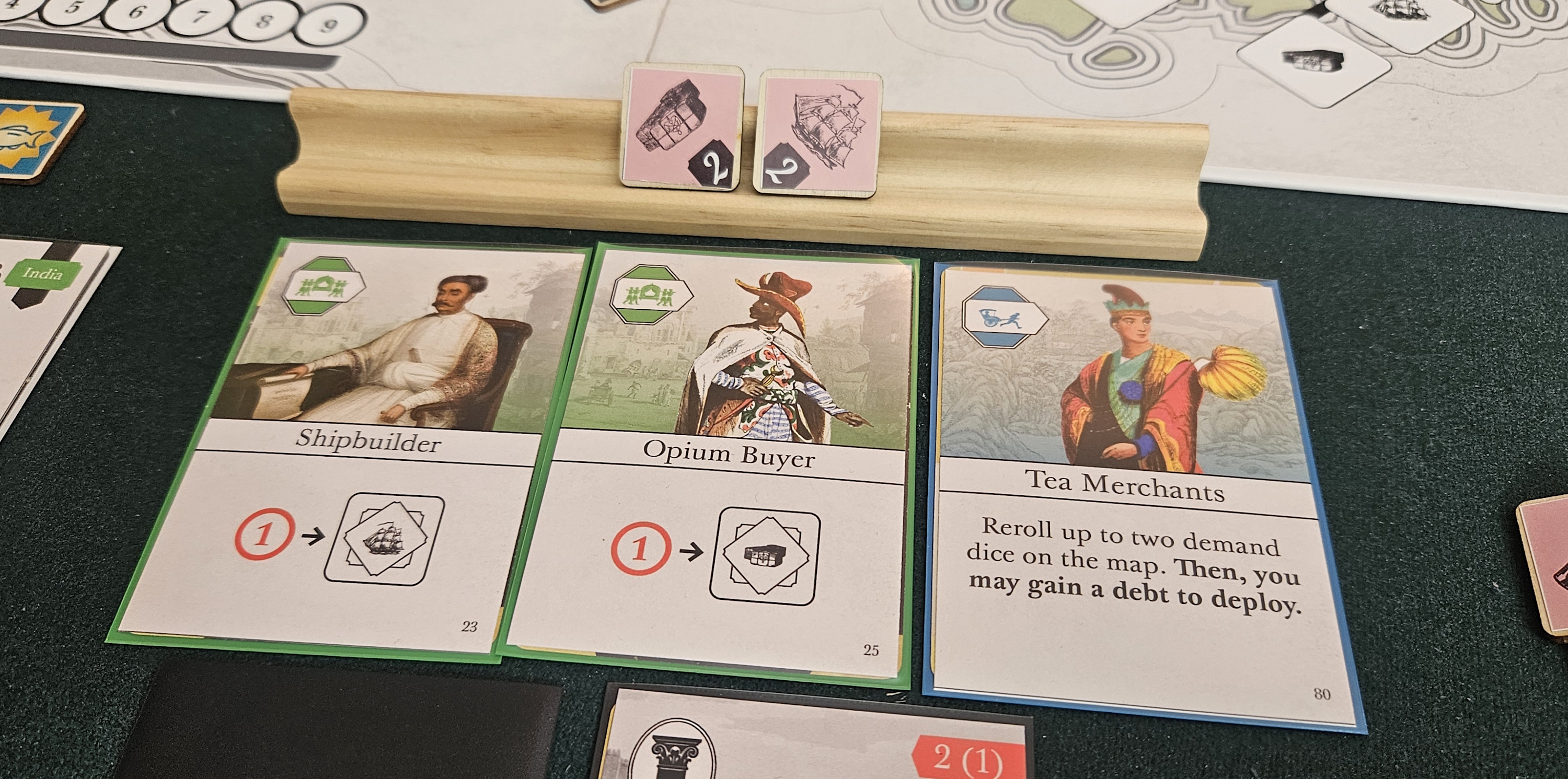
This time around, you must manage business connections.
For the most part, Wehrle accomplishes this by altering the nature of An Infamous Traffic altogether. Where the original limited its components to a counter-sheet and a handful of dice, the production has expanded to include four decks of cards. Each setting — London, India, and China — now feature decks where players can make and take advantage of business connections, turning the game into a minor tableau-builder.
It works like this. While located in one of these spots, you might choose to delve into the deck. You draw three cards from the corresponding deck, select one to keep, and place the other two back on top. It’s surprisingly similar to the system Wehrle used in Oath, keeping certain cards in circulation. You’re not only getting a glimpse at the business opportunities your firm can take advantage of, but those your rivals are likely to capitalize upon at any moment. The alternative is to forego a selection altogether, instead burying the draw at the bottom of the deck.
Once secured, cards become the activities you can take at their location. London tends to produce sturdy ships and enterprising individuals. India, of course, is packed with sources of opium. (Production was enforced by the East India Company and later the British Raj, lest anybody get the idea that opium was a uniquely Indian vice. Let’s not shift our blame only halfway to where it belongs.)
Over time, these cards generate a tableau of business connections. Sometimes, you’ll establish a leapfrog network from London to Shanghai, requiring your attention in dribs and drabs at each locale. At other times, it pays to specialize. If you hold the monopoly on cheap poppy production, while your rivals can only secure expensive secondhand products back in Britain, you could turn India into a one-stop shop before setting sail once again for China.
There are other possibilities in each deck. In London, you might gain the prime minister’s ear, letting you noodle with parliament’s view of China or take direct command over any ensuing opium wars. The investment of an Indian prince could allow you to warehouse a few extra tiles in between decades, while a plantation of your own makes it harder for opponents to undersell your product. The deck in China, meanwhile, is special abilities all the way down: local bodyguards for scaring off rivals, pirates for protecting your vessels, bandits willing to strangle a rival’s activities. An Infamous Traffic no longer requires the former edition’s persnickety rules because every exception has been offloaded to a card. It’s a blunt-force approach, but it’s one that gives each player their own bespoke selection of advantages, not to mention makes the rules considerably easier to keep straight.
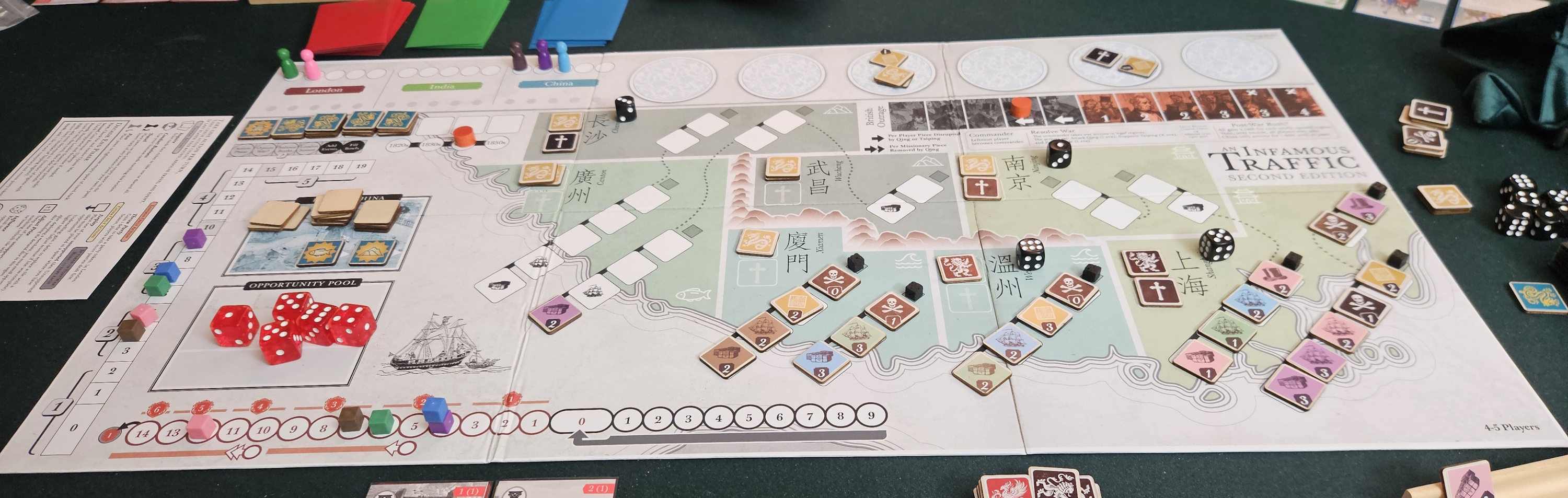
Here comes a century of humiliation.
This system also adds little moments where player agency is suddenly, sharply undermined. For instance, mixed in among the China deck is Lin Zexu, the imperial commissioner who cracked down on the opium trade. His appearance is never welcome, ruining the current player’s turn and tossing an extra chit into the event bag.
Speaking of which, the entire event system has been overhauled. In the first edition, the players’ opium firms wielded outsized, even comical command over the course of events in China. Now these events are drawn from a bag, which makes Lin Zexu’s intervention all the more untimely. Events might not matter in the slightest. Or they could throw the entire course of the game into disarray. An ill-timed crackdown can unravel an entire supply chain. Rebellions can plunge regions into chaos. Even the whims of parliament might rear their head, bringing about an opium war, your chance to fling open a free port where your cartels can freely sling their product, or keeping parliament at a simmer that never quite boils over.
All the while, your objective remains consistent. The fourth and final deck merges this game’s first edition with the second edition of John Company. These are the rewards your merchants hope to secure back home. Beautiful estates, sturdy marriages, fat children. Sometimes these rewards are conditional. In one session, I was an insufferable Christian accelerationist whose money went toward assisting the Taiping Heavenly Kingdom gain a toehold in China. In another, a friend desperately sought a marriage card so he could realize a bevy of ambitions that wouldn’t trigger until he achieved holy matrimony. Naturally, the rest of us conspired to prevent any eligible ladies from falling into his orbit.
In all cases, these elements are as sobering as they are compelling. When you realize an ambition card — say, by siring a son with an interest in joining the clergy, or penning a self-aggrandizing memoir, or even retiring to Grosvenor Square — the cost of these luxuries becomes apparent. These are nice things, to be sure. Comfortable arrangements. Desirable ornaments. And they only cost another few thousand addicts. Another back-alley knifing. Another cannon-shot war. Another starving orphanage. Another century of humiliation. You didn’t force the milk down anybody’s throat. You didn’t light the fuse. You didn’t withhold the bread. All you did was conduct business.
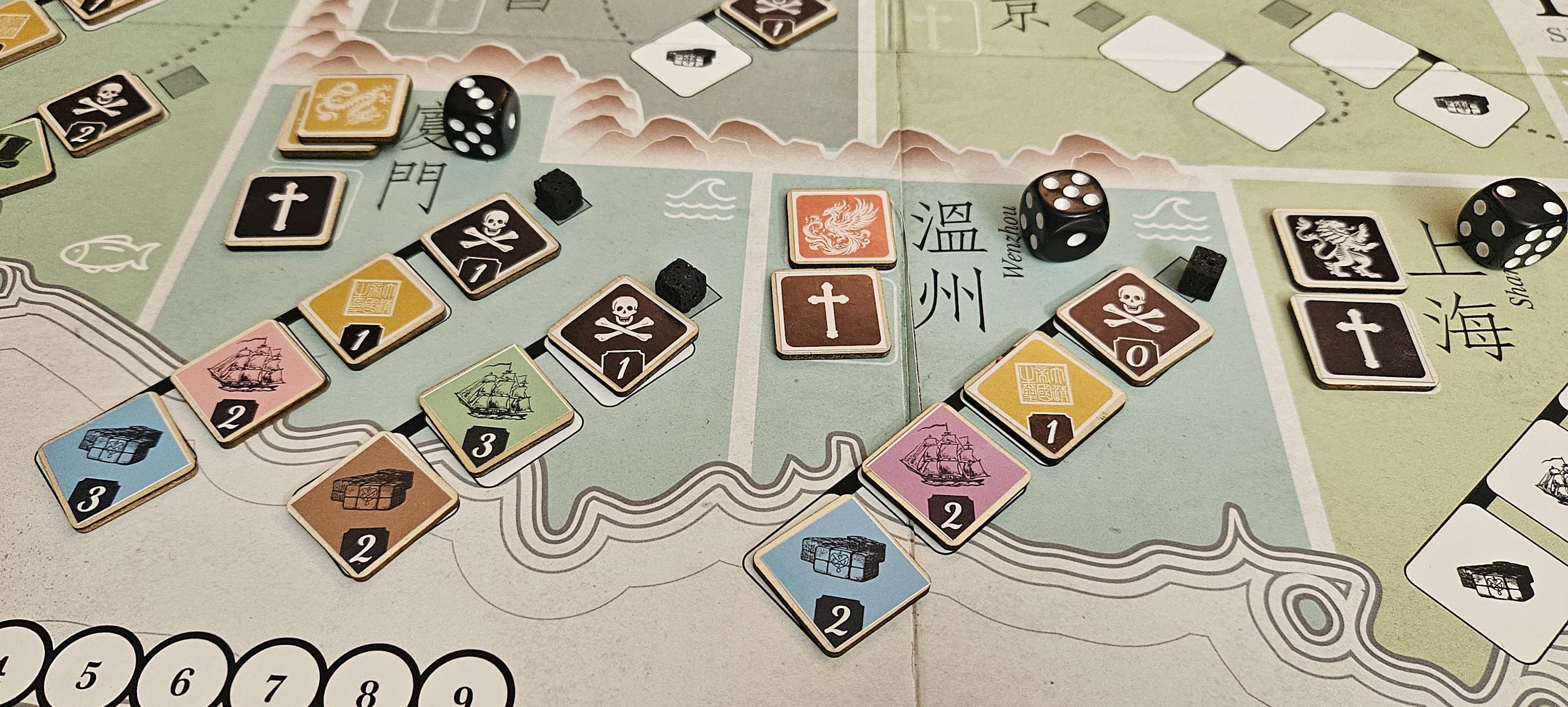
Rebellion can be a profitable business.
In every way that counts, the second edition of An Infamous Traffic is superior to the original. It produces a more robust history, plays more smoothly, and argues more clearly.
That argument, as presented here, is an asymmetry of comfort and misery that never lingers far from mind. Far from being limited to a bygone century, it’s as relevant today as it was when Lin Zexu wrote to Queen Victoria. Here is your drug. Here is your fruit company. Here is your gambling app. Here is your plagiarism machine. Here is your extraction from the many for the sake of the few. Here is your war fought to preserve the right of the rich to grow richer. Again. Again. Again.
A prototype of An Infamous Traffic was provided by the designer/publisher.
(If what I’m doing at Space-Biff! is valuable to you in some way, please consider dropping by my Patreon campaign or Ko-fi. Right now, supporters can read the next installment in my series Talking About Games, this time tackling the topic of what makes a good list! Naturally, the piece includes a list.)
Posted on October 5, 2026, in Board Game and tagged An Infamous Traffic, Board Games, Wehrlegig Games. Bookmark the permalink. 18 Comments.


Come to papa.
The game, not opium.
I’m currently reading Imperial Twilight about the Opium Wars while I learn Mandarin and teach English overnight to Chinese kids. I’m a fan of Wehrle’s other designs as well. I guess you could say this one’s in my wheelhouse.
I’m loving the look of this second edition. The soft lines and pastels. All those beautiful characters in Xiamen, Shanghai, Nanjing. These are the places where some of my favorite people live. I’m hoping I can play it without it breaking my heart in two.
Great review. That closing, from “Here is your drug…” Chef’s kiss.
“Here is your drug. Here is your fruit company. Here is your gambling app. Here is your plagiarism machine.”
Well said.
great prose as always. Great overview. I’m sold
Beautiful writing. Stirring conclusion.
I can’t justify owning everything Cole Wehrle produces, as badly as I want each individual game. I almost want to study this more than anything, as hard as it will be for me to find time with the right friends to play it.
Love your review, Dan. Despite owning a good number of them, I find Cole’s games fairly insufferable, more complicated than needs by half and with massive blind spots in terms of design. I own the first edition of this but have never been able to find anyone interested in playing. I am mostly glad I didn’t given the judgements above, and would like to try this edition. I’m just looking for that phase change where Cole goes from history major making overly complicated systemic simulations that pass as games to good games deeply informed by historical perspectives. Please let me know which side this games falls.
I’m probably the wrong person to ask, since I like Cole’s games quite a bit!
Never commented before but that closing paragraph was fire.
Thanks!
I actually found 1st edition rule book quite straight forward to follow.
love your reviews! How does this compare to Pax for you? I know Pax was a 10. Would you prefer one over the other? Thanks again!
If we’re talking about Cole’s Pax Pamir, I would personally rate this just under that. But let’s keep in mind that Pax Pamir is one of my favorite games ever designed. I could play it a hundred times and not get bored.
How would you contrast John Company 2ed from AIT 2ed? I have to say, when I read over the material for the game, I was like, “Wait, isn’t that John Company?” Especially now that we have the London scene with very similar “rewards”?
To be so gauche as to say, but ignoring the thematic tie-ins, how are they different games during gameplay?
They’re quite different on the table. AIT is shorter, more directly competitive, not quite as subtle. You’re different companies, not members of the same company. Less reliance on dice rolling and more on putting pieces where they need to go.
Cheers.
BTW, a comment on BGG alerted me to the fact you have a cute alt-text for each image. You sneaky boy. I’ve missed that for, I dunno, I think I’ve been reading your blog for over 5 years now.
They’ve been there since I started! Mostly as a treat for myself. If anyone else sees them, that’s a bonus.
Yeah. I mostly used mine to help SEO, back when we cared more about those things.