Playing with Cellulose Fiber
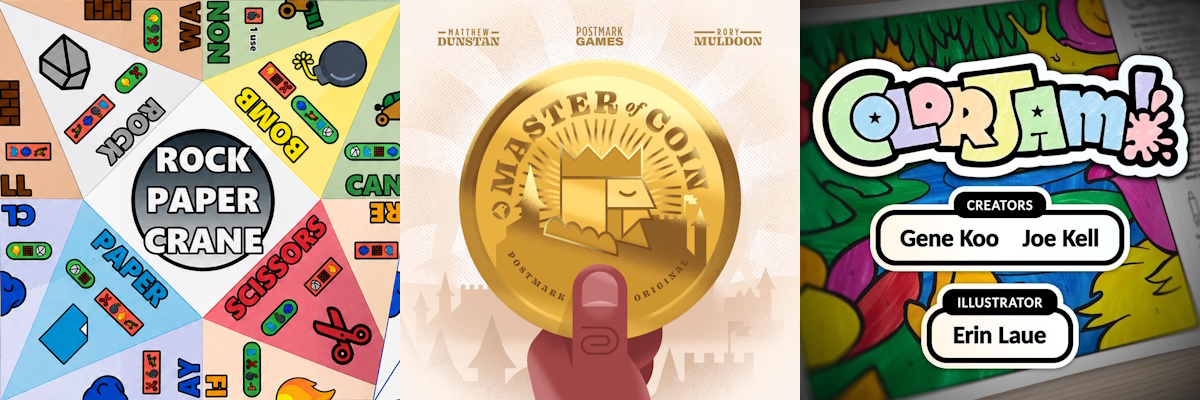
Paper! Despite the meddling of the internet, it’s still everywhere. There’s a good chance you have some in your very own home. In fact, it’s probably within arm’s reach right now. Coming for you. Fluttering closer. Ready to give you a stingy cut on the fingertip.
But for all its sins, paper is good for a few things. Making board games happens to be one of them. And today, I’m going to talk about three paper games I’ve been playing this week.
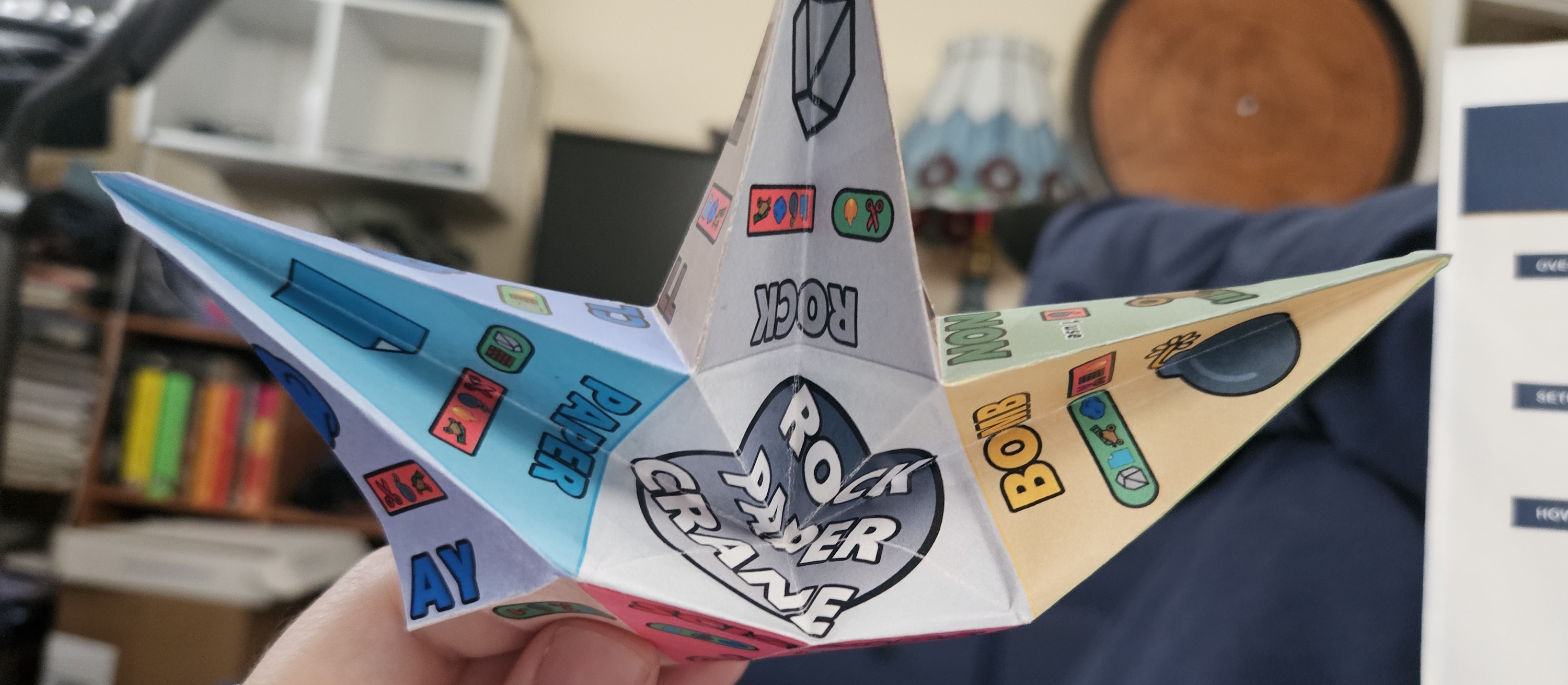
A crane chick.
Rock Paper Crane
Rock Paper Crane bills itself as the world’s first-ever origami card game. True to its word, its construction requires you to craft the first couple of steps for making an origami crane.
Okay, so that’s the first problem. I dabbled in origami once. But I also happened to be six years old. Also, my little sister ruined my collection of nice origami papers, so I decided to spite her by never going back to the hobby or informing her or really imposing even the slightest imposition on her in any way. Which is to say, I finally fumbled together those first few steps. But the magic is in the fingers, not the voice, so as I labored to instruct my wife in how to shape her crane, I may have uttered the phrase, “You need to tuck in that piece, you’ve got it all popped out and flabby,” to which she replied, with a rather elevated voice, “You’re all popped out and flabby!”
So. Um. Be careful who you play Rock Paper Crane with.
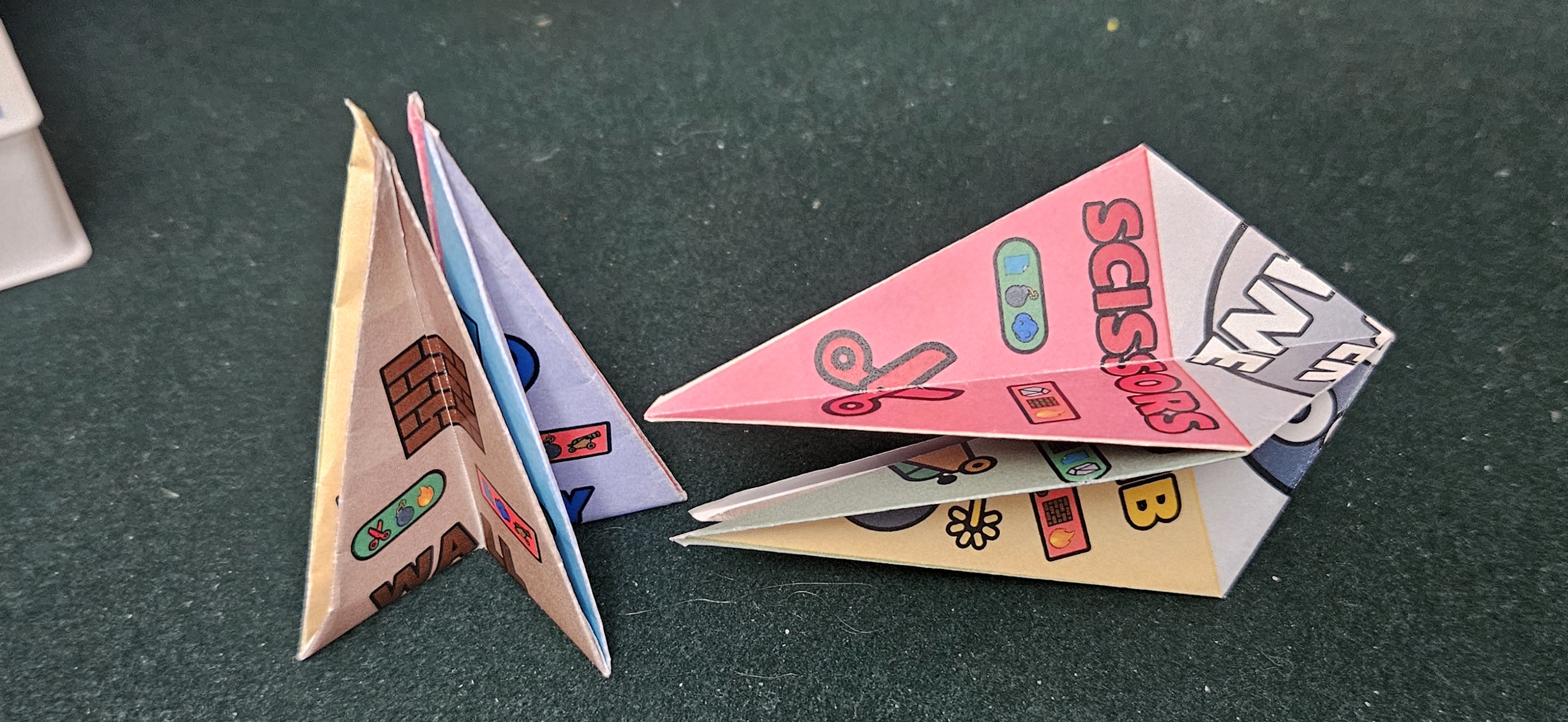
Crane, interrupted.
Once assembled, Rock Paper Crane is Rock Paper Scissors with extra steps. For one thing, there’s an extra piece, the bomb. For another, winning a throw means you upgrade one of your sides. (Pause for origami.) Rock becomes wall. Paper becomes clay. Scissors become fire. That sort of thing.
Your objective, ultimately, is to win four throws, which will bring you one step closer to a finished crane. More importantly, you will have won the game. Or lost it, which is just as good, because, like I said, Rock Paper Crane is Rock Paper Scissors with extra steps.
Did I finish my crane? Nope. I couldn’t remember past those first two steps. Honestly, it’s pretty amazing that I got this far at all. Maybe I could have looked up the next instructions. But I swore an oath to never finish an origami ever again, and I’m true to my word. Take that, Mary.
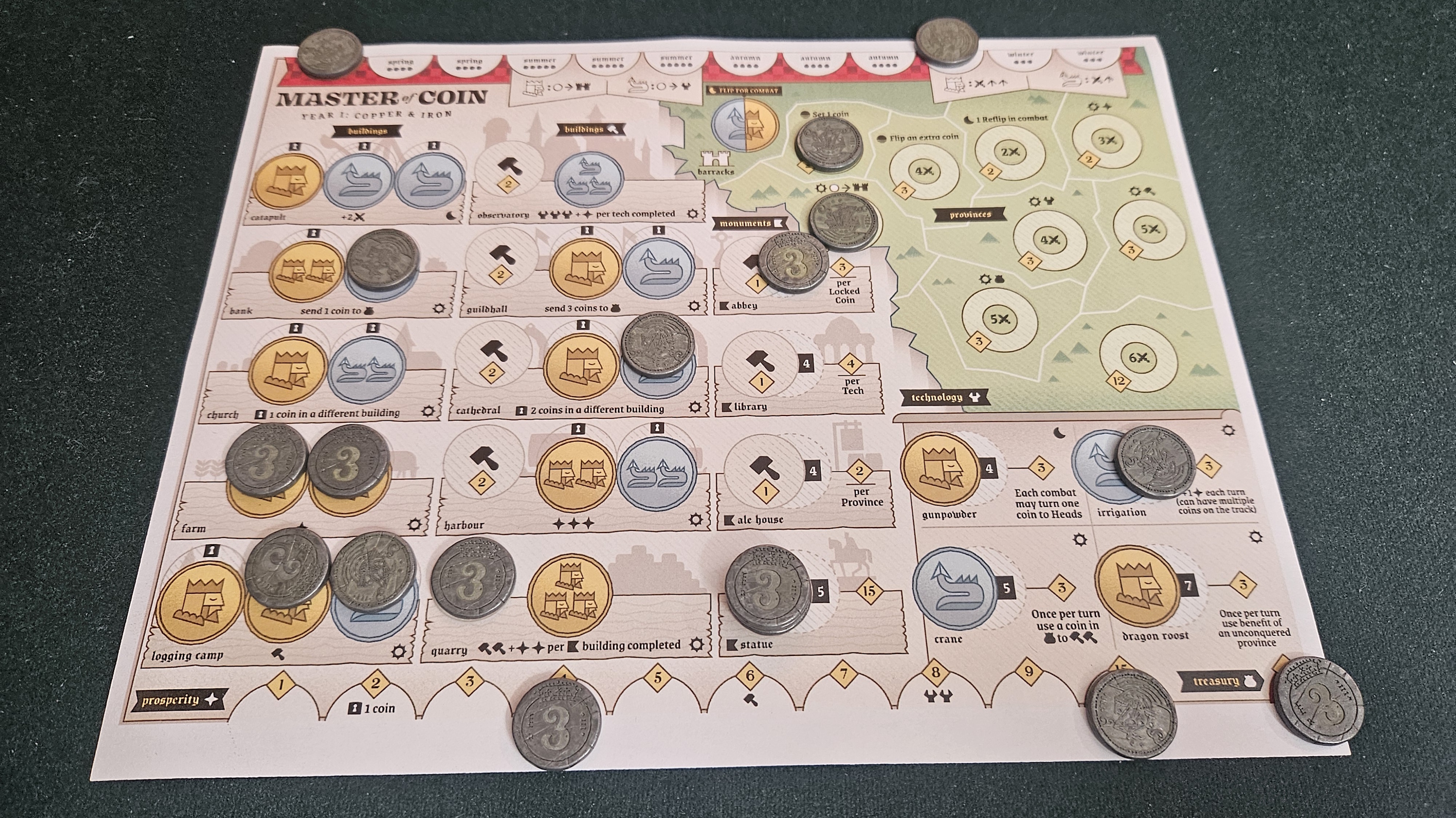
Putting coins on paper.
Master of Coin
Master of Coin is the eighth title from Postmark Games that I’ve played, and this time Rory Muldoon and Matthew Dunstan are ditching the dice and the cards. Their replacement? Coins, of course. It’s right there the title.
As you might expect, Master of Coin makes good on its conceit by requiring you to flip so many coins that your fingers will start to smell rather pockety indeed. Covering a single year in the history of a small kingdom, you begin each month by picking up some number of coins — the exact quantity varies by season — and flipping them to determine how many heads and tails you have to work with.
Early on, your options are finite. A few basic buildings, some technologies, and any leftover orphans packed off to the army. But it isn’t long before the gameplay begins to accelerate. Once completed, you can clear a building of its coins to activate its ability, whether to unlock better structures, develop your nation’s economic infrastructure, obtain perks in war and peace, or maybe construct monuments that unlock better scoring benefits. Crucially, some abilities let you “lock” coins, sliding them a few millimeters upward on your sheet. From that point on, when you clear the corresponding structure, any locked coins stay in place.
As a concept, Master of Coin is solid. Consider the army. When it’s time to march on neighboring provinces, you pick up all the coins in your army and give them a flip. Heads become indicators of conquest, while tails are failures. But there are so many ways to massage the odds. Certain buildings, like the catapult, can be cleared to produce guaranteed successes in battle. Or there are techs, like gunpowder, that let you shift a coin from tails to heads, saving you in the nick of time. All this is to say that there are ample ways to get ahead. Even if you, as happened to our group, happen to play a session with novelty coins that always flip heads.
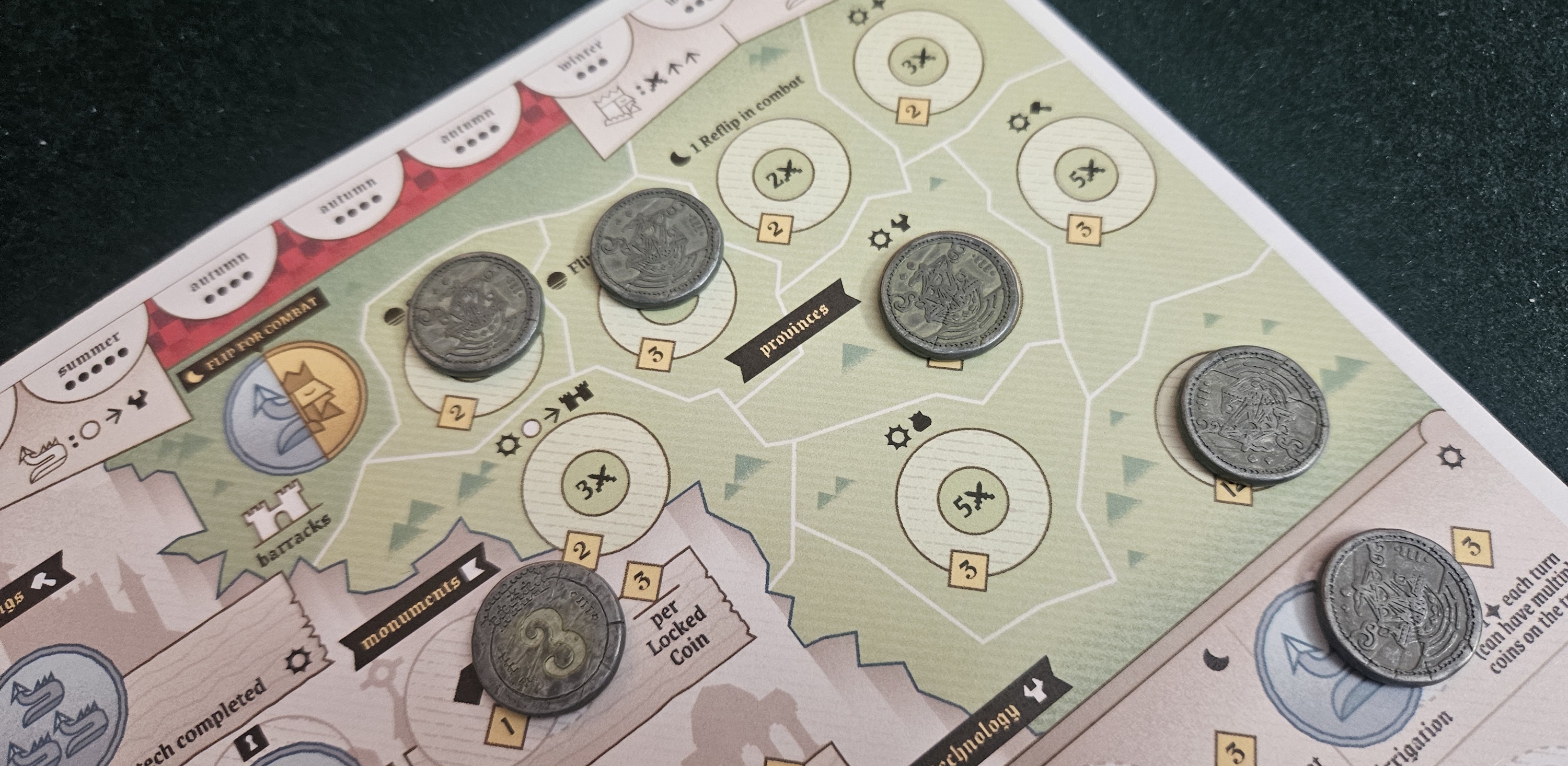
Money is great for conquering distant nations.
Of course, there’s more to be seen. As with previous Postmark titles, Master of Coin isn’t limited to a single map. The game is on Kickstarter right now, and according to the campaign there will be five scenarios in all, each adding a year to the story of this wealthy kingdom and its unfortunate neighbors.
Unlike those previous Postmark titles, however, I’ve only tried the first scenario, so I’m unable to furnish a full review at this time. The good news is that what I’ve played has been exemplary. Very quickly, I was surprised that my kingdom’s main limitation didn’t lie with having too little money, but rather in keeping too many coins tied up in other projects. The kingdom only has access to twenty coins, you see, and two of those are reserved for tracking the month and any possible events. It isn’t long before you’ll need to make some tough decisions, forsaking certain appendages of your financial project altogether to double down on whatever has become most important.
Anyway. After not being all that enthralled with Postmark’s playing card games, Master of Coin feels like a return to form, capturing some of the tight but expressive playspace of titles like Voyages and Waypoints. I’m excited to see how this one develops.
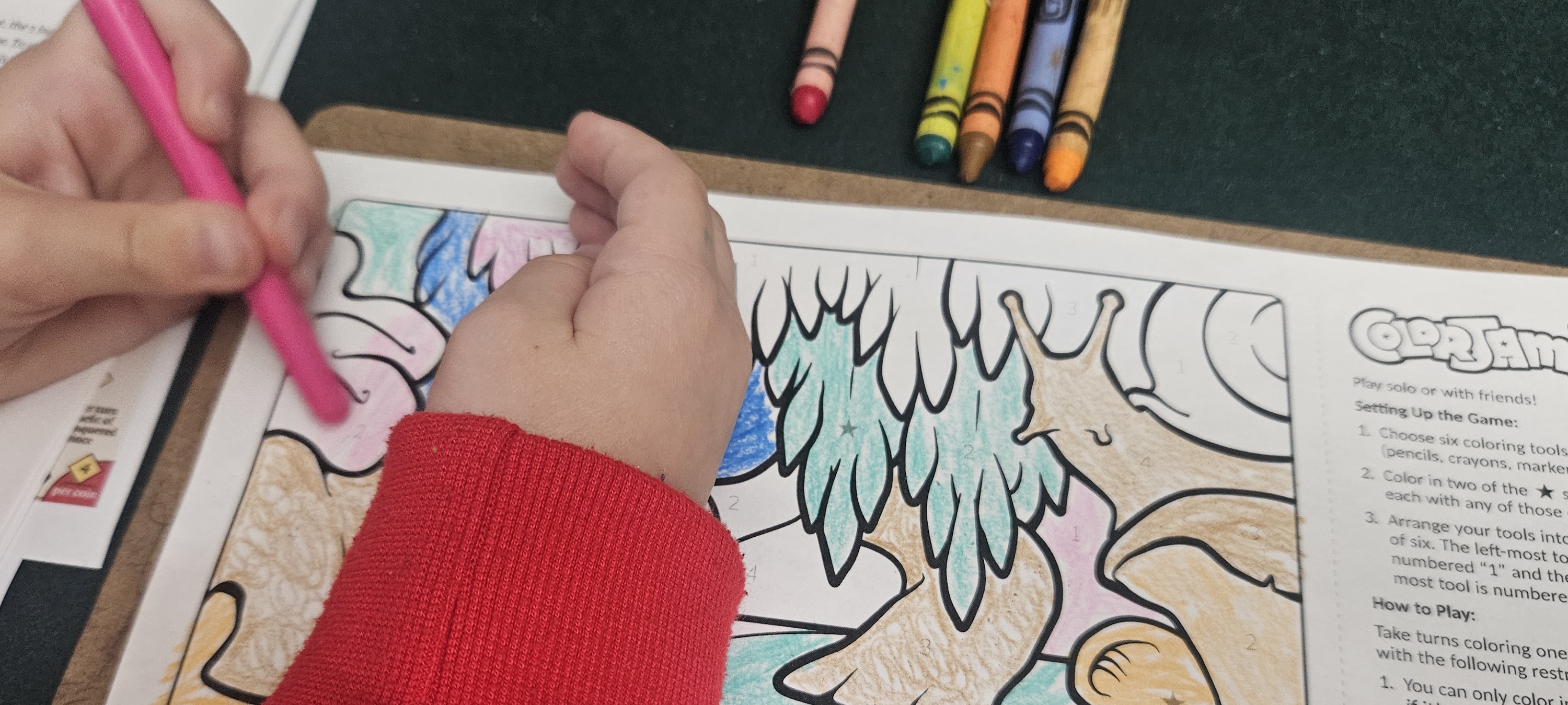
I love little fingers.
Color Jam
When’s the last time you colored by numbers? Being a parent to a recent kindergartner means it hasn’t been as long as it might have been otherwise, but this still isn’t a regular occurrence of my daily life.
Until Color Jam. Designed by Gene Koo and Joe Kell, and illustrated by Erin Laue, Color Jam is about coloring by numbers. And contrary to my expectations going in, it’s wonderful.
But first, a note. Color Jam is being published by Lunarpunk Games, the indie imprint operated by Xoe Allred and Matthew Hocker. If you’re elbows-deep in the indie scene, this might already tell you something about the game. Foremost, Color Jam doesn’t have the usual victory conditions. Nor does it really have goals, at least not goals of the foreordained variety. You’re here to make your own fun, set your own benchmarks, and, hopefully, come away charmed.
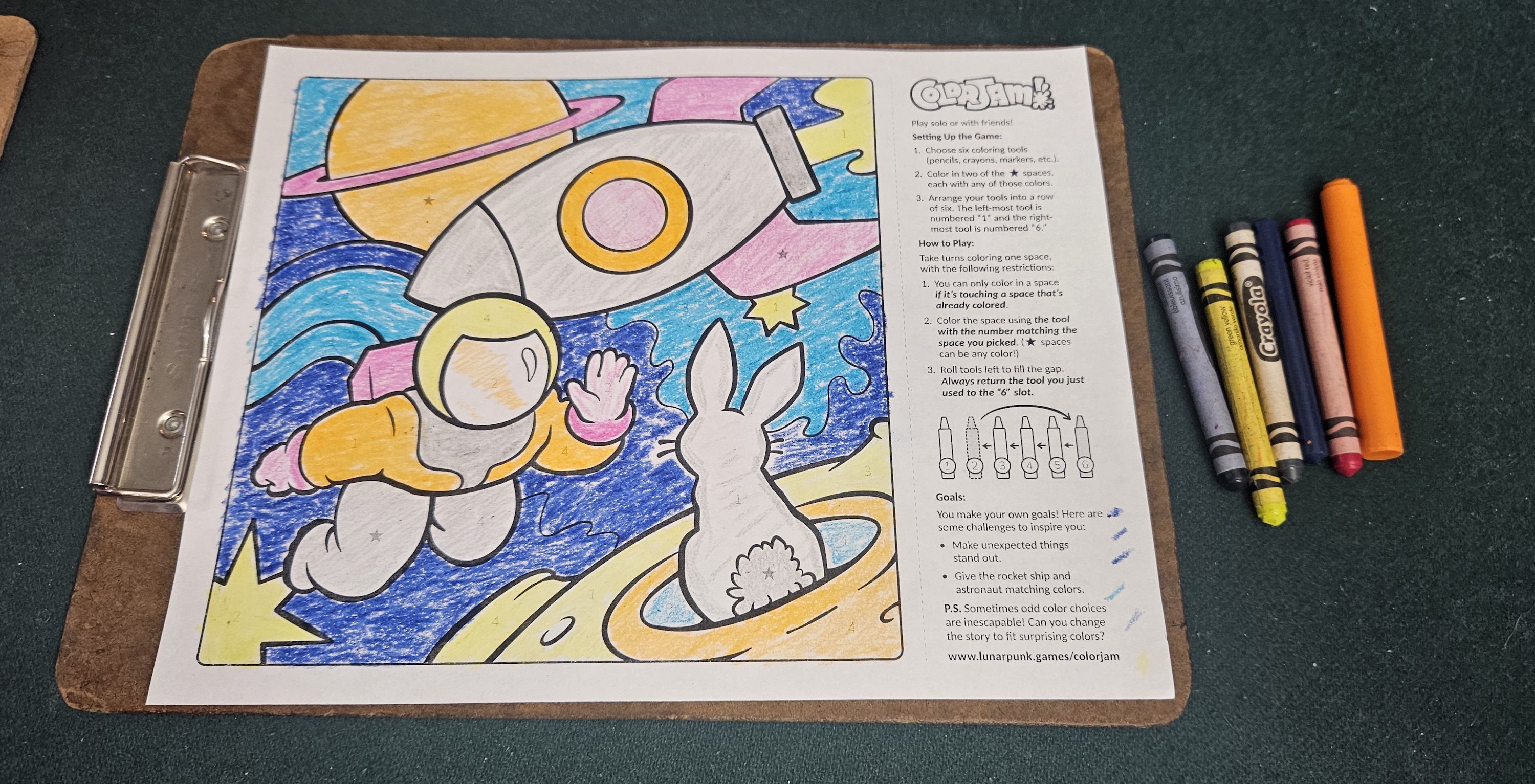
I am inordinately proud of my art.
The basic idea is as simple as it gets. You take a picture and six crayons. Then you color in two of the spaces with stars in them. There are always four options, giving you some range to where you begin on the page.
From that humble beginning, you start to color in the entire thing. But there are limitations. Beautiful, expansive limitations. For one thing, you can only color a cell next to something you’ve already filled in. More importantly, those six crayons? You put them in order, numbered one to six. When you color a space, you use the corresponding crayon. Then — and this is where the game starts to breathe — you take that crayon and shift it to the last place.
Now, this might not sound like much. But it transforms Color Jam from an elementary school project into something unexpected. You might want consistency. The wings of a butterfly to align, perhaps. But the right crayon might not be available. Or, when the right crayon comes up again, maybe you’ll want it for something else.
What do you do? Well, you get creative. Maybe this butterfly is prismatic, like a jeweled brooch, its colors vibrant but mismatched. The colors can become revelatory, streaks of the unexpected in what might have otherwise been an ordinary picture. Or maybe you start to plan ahead, counting the crayons down until the right one is ready for another scribble, transforming the page into a low-stakes logic puzzle. Or perhaps you get artistic. You can do a lot with shading, with the strokes of a crayon, with the application of a smudge or a smear. Two spaces that both use orange don’t need to look the same. This isn’t the paint bucket in an image editor. You can do whatever you like.
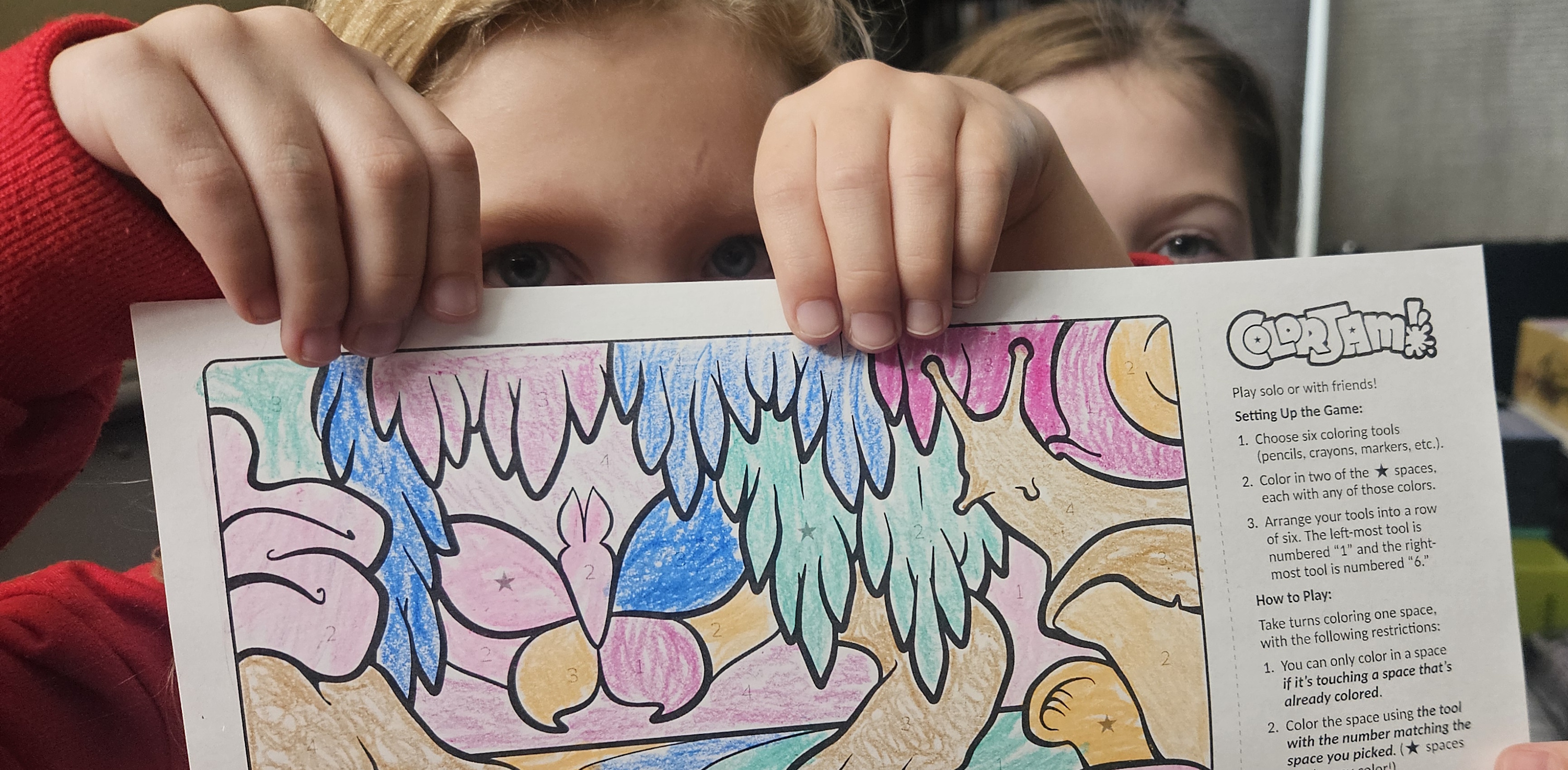
The artists.
More than that, Color Jam is flexible. It’s possible to play solitaire, one person making every decision. But it’s also possible to play as a group. I played with both of my daughters, and everybody got a say in the creation of our picture. Over which crayons we pulled from the bucket. Over the turn order. Eventually, over how to account for colors that wouldn’t quite fit where we wanted them.
The most unsurprising thing about Color Jam, but which bears repeating, is that it’s simply delightful. It’s soothing to play, but thinkier than one might expect from a distance. We played together, and then we all played apart. And then Summer came home and wanted to play as well, so we did that, too. In each case, we came away having crafted something wonderful, whether in collaboration or on our own, whether according to strict logic and long-term thinking or creative storytelling, and felt all the richer for it.
Color Jam will be on Kickstarter sometime in the next month or so.
Access to the files and/or complimentary copies of Rock Paper Crane, Master of Coin, and Paper Jam were provided by the designers.
(If what I’m doing at Space-Biff! is valuable to you in some way, please consider dropping by my Patreon campaign or Ko-fi. Right now, supporters can read the next installment in my series Talking About Games, this time tackling the topic of what makes a good list! Naturally, the piece includes a list.)
Posted on July 24, 2026, in Board Game and tagged Color Jam, Lunarpunk Games, Master of Coin, Postmark Games, Print and Play, Rock Paper Crane, The Vanilla Folder. Bookmark the permalink. 3 Comments.


I love how “and in the game” now has its own acronym. =)
aitg
Pingback: Space-Cast! #58. Postmarks | SPACE-BIFF!