Blog Archives
Combat Results Tables Above the Reich
My grandfather was a bomber squadron commander in the Army Air Corps in WWII. I went most of my childhood without knowing that. He didn’t speak of his time in the Pacific until late in his life, and then only sporadically, quietly, with great effort. He saw friends die and planes fall. His own plane fell. He spent months in recovery before resuming combat missions. The first I heard of his service was at a family gathering. My cousin loaded up a flight sim, undoubtedly rudimentary but photorealistic in my memory. Grandpa watched, hands on hips, frowning in disapproval. One of my uncles told us to turn it off. That it was bothering grandpa.
Grandpa jabbed a finger at the screen. “No, that isn’t it. It’s all wrong. You don’t hit a bridge there. They’d rebuild it in a week. And you need to approach from a wider angle. Out of the sun.” And then he told some stories. Just the silly ones. Running alcohol, almost crashing into a mountain, the fellow squadron commander who died to “friendly fire” for always assigning his own plane in the lead position. The ones that haunted him would wait until we were older.
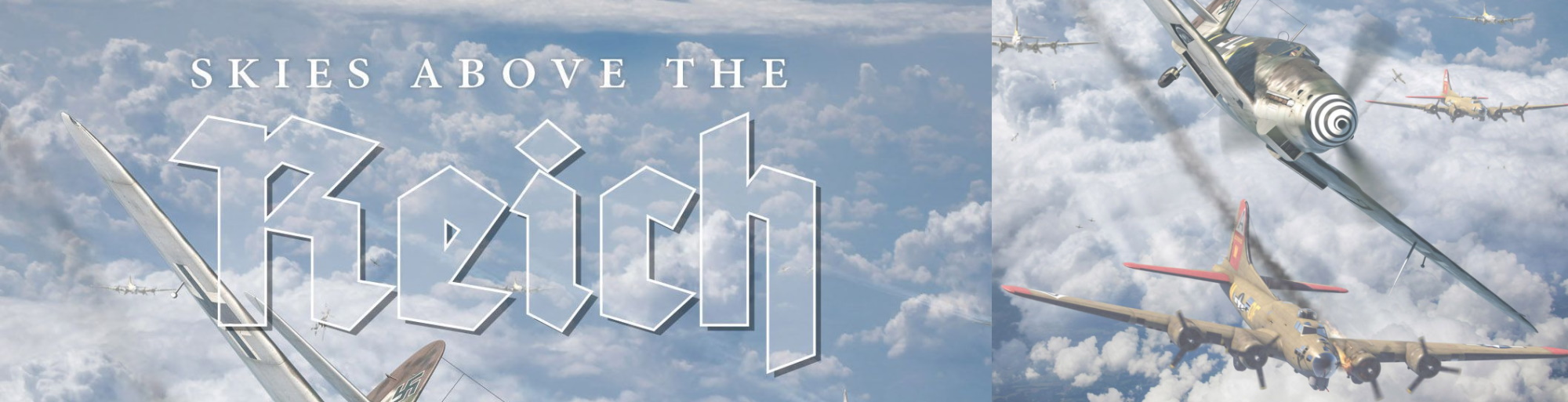
And then there’s solo wargame Skies Above the Reich by Mark Aasted and Jeremy White. Guess I should probably talk about that.
Redaunted 2: The Redaunting
In my review of Trevor Benjamin and David Thompson’s Undaunted: Normandy, I noted that it could be the beginning of something truly special. To some degree, that original box already contained plenty of special in its own right. Where I had expected deck-building and squad tactics to make an uncomfortable pairing, Undaunted nudged them together like old friends. The rules were streamlined, the decisions meaningful, the odds of landing a shot were long but not too long, and if it occasionally became a little too tit for tat in its exchange of fire, well, I’m sure there were plenty of infantrymen outside Caen who felt the same way.
Undaunted: North Africa is Benjamin and Thompson’s second take on the Undaunted franchise, and I couldn’t be more pleased that they’ve opened a second front. From the very first mission, it’s apparent that this is an improvement in nearly every regard.
The Intellectual Desert of Party Games

Mitch Turck’s Origin might as well be a game without an origin. See what I did there? Snark aside, it’s true. After much searching — there are a lot of games with “origin” in the title — I came across a page on BoardGameGeek that repeated the blurb on the back of the box. Apart from that, there was nothing. No box image, play images, comments, forum posts, nothing.
Which raises the question: while playing Origin, if I reveal an origin card that mentions “The origin of the game Origin,” what is the actual origin of that origin card?
Derp Vents

Deep Vents is certainly the bluest game of the year. Or is it the purplest game?
Coming as a surprise from Ryan Laukat and T. Alex Davis, Deep Vents plunges into territory I haven’t yet seen explored in cardboard. Can you guess the setting? Nope, not bay fishing. Nor is it about oil rigging. Rather, Deep Vents is about creating a flourishing ecosystem around a deep vent. Bet you didn’t see that one coming.
Talking About Games: Felber’s Farewell

Deep breath. Let’s talk about something controversial.
If you’re a hobbyist board gamer, there’s a good chance you’ve heard about Tom Felber’s farewell article, “Tom Stops! 10 (Not Just Nice) Things He Wants to Say at the End.” It’s sparked plenty of angry words, both in support and in repudiation, some defensive and others thoughtful. It probably doesn’t help that the original is in German (Felber is Swiss), which, as those of us who speak the language can tell you, tends to come across more frankly than English, especially in translation.
Unforgettable Waters

What do storybooks, Crossroads events, digital apps, worker placement, countdown timers, skill checks, and Mad Libs have in common? They all appear in Forgotten Waters by J. Arthur Ellis, Isaac Vega, and Mr. Bistro, the latest title from Plaid Hat Games! And although that might sound like the setup to a crack about how too many ingredients makes for one nasty porridge — especially after their last Crossroads game, Gen7, was such a bust — it turns out that Forgotten Waters is more than the sum of its parts.
Brass Age

One of the things I appreciate most about John Clowdus is the way he peppers his games with moments of thematic coherence, when systems and setting enter into alignment to create an intuitive shorthand for what the game is asking you to do. In Omen: A Reign of War, these moments revolved around mythological beasts upending both the rules of nature and the rules of the game. In The North, it was sparse actions reinforcing the sense that you were renovating long-dormant machines. Even Mezo spun a cosmology in which the gods were always peering around the corners of reality, inspiring as much as directly intervening.
And in Bronze Age, this coherence has everything to do with the collapse.
Space-Cast! #4. Big Box Games

John Clowdus is best known for his small designs. And, naturally, in today’s episode of the Space-Biff! Space-Cast!, he’s willing to talk to Dan Thurot about small games old and new, including which of his titles he prefers to Omen: A Reign of War. But now Clowdus is also a bona fide big-box game designer thanks to Mezo. Listen in as he spills the beans about the challenges and advantages of designing a game that can’t fit into your pocket.
Listen over here or download here. Timestamps can be found after the jump.
Blunder: A Pirate’s Life
Pirates are this year’s Cthulhu. That isn’t a complaint. If anything, piracy as we popularly portray it is a democratizing force, the revenge of the have-nots against the haves. Never mind how the have-nots somehow got their yo-ho-hoing mitts on a frigate in the first place. Forced redistribution was never so soaked in rum. Or so gleefully vicious.
And then there’s Plunder: A Pirate’s Life, which is about as gleeful as watching your frigate get pulled apart plank by plank by a whirlpool. At least it understands that pirates and board games are both meant to look good.
Roman Through the Multiverse

It has often been said that you can learn a lot about an era by how they portray Rome in its heyday. To the historians of the British Empire, the eternal city was both pomp and melancholy manifest, a promise of what could be accomplished with well-drilled lines of soldiery, but also a lingering reminder that the lights of empire would inevitably wink out. To the fascists of Italy and Germany, it was a city of racial hierarchies, Nordic masters overseeing Mediterranean laborers. For a time Americans regarded it as both an exemplar of civic duty and a suitable antagonist, that great subsumer of individuality and Jesus Christ alike. Later it became the dingy city of corruption and gang rule, populated by kleptocrats stuffing their pockets while sending children to die on foreign soil. I’ll leave it to you to guess which era thought of it in those terms.
The Ragnar Brothers (Gary Dicken, Steve Kendall, and Phil Kendall) aren’t quite striving for that degree of granularity with their latest game, The Romans. Nor do they seem to be evaluating Rome as anything other than a sequence of shifting boundaries. Even so, at some level, The Romans beholds all those contrasting interpretations and seems to query, Why not all of them?
But to make sense of that statement, first we need to talk about parallel universes.

 SPACE-BIFF!