Blog Archives
Goodbye Summoning Stones, Hello Crystals

I have a great fondness for Summoner Wars. Six years ago it became my most-played game of all time, prompting me to assemble custom tuckboxes for each of its factions, pen over twenty articles both here and elsewhere, and at one point I even designed a custom faction based on Central European serfdom and manor-dwelling therianthropes. No, you can’t see it.
That said, Summoner Wars had a few problems, many of which only became apparent over time. Its units grew more complicated and text-heavy with each new set, pro-level strategies became increasingly counter-intuitive to ordinary play, and it never sat right with me that one of its premier opening strategies was to cannibalize your own units.
Crystal Clans, from Summoner Wars designer Colby Dauch, plus J. Arthur Ellis and Andrea Mezzotero, in many ways plays like an antidote to some of that game’s biggest errors. But is it enough? Let’s figure that out together.
Four Little Pigs, Roasted and Stuffed

Allow me to indulge in my inaugural Old Man Moment by saying, hey, fairy tales used to be better. No, not back in my day. I’m talking way back, when the forests were thick and uncut, the sun only peeked through the pestilential clouds once a fortnight, and taking a wrong turn while returning home from the well might get you eaten by either wolves or Visigoths.
Strangely, Tim Eisner’s The Grimm Forest comes within an inch of evoking these older, more ominous stories, and all because this fairy tale’s got bite.
Cubes of the American Revolution

It’s appropriate that Benjamin Franklin’s chopped-up snake should emblazon the box front of Supply Lines of the American Revolution: The Northern Theater, 1775-1777. Historically, Franklin’s 1754 political cartoon JOIN, or DIE represented the fragmentary nature of the colonies chafing under British rule. In designer Tom Russell’s hands, the image takes on a second, more immediate meaning. It’s one of transmitting biscuits and bullets from one place to another, of connecting or severing the head from the tail, of your own winding snake and its integrity.
Here, the image communicates the need to string together your logistics. Everything in Supply Lines of the American Revolution is about the all-important distance between your supplies and the soldiers who need them. Join them together, or die. After all, as Jesus of Nazareth once uttered, “Amateurs study tactics. Professionals study logistics.”
The Sun Also Rises

I’ve always been suspicious of that oxymoron called “big minis games.” You know, specimens like Cthulhu Wars and Assault of the Giants, wherein the little people’s gentlemanly war is interrupted by beasts twice their size and quadruple their strength, slammed onto the table with a diminutive rumble that could ripple water or quiver jello. With all that mass lumbering around, who’s going to work up the nerve to say that your game is too small in the areas that count?
It was Eric Lang’s Blood Rage that persuaded me that such a game could exist, and be worthwhile as a game, without leaning all its weight on its toy factor. Big monsters and cool sculpts, yes, but also a solid sense of what made for a good time. Brawny and brainy in equal measure. Big monsters who land heavily and earn their place.
And now Lang has crafted a spiritual sequel in Rising Sun. Brace yourself, because this one’s got some sharp edges.
The Wheel Turns Again: A Look at Imperius

Remember Solstice? It would be forgivable if you didn’t, since it’s one of the few games I’ve featured for Best Week that nobody actually played.
But here’s the thing. Imperius — which is Solstice but with some significant polish, expanded artwork, and a way more generic name — is coming to Kickstarter tomorrow, and I want to tell you why it should be the target of your latest machinations.
Ro Ro Ro Your Rokugan
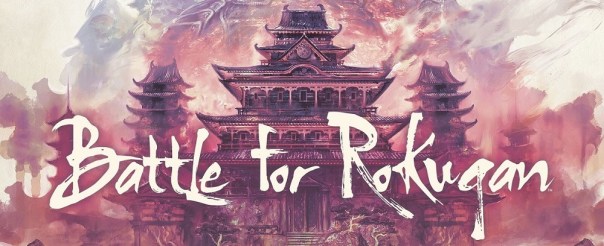
Half a decade ago, I pronounced A Game of Thrones: The Board Game to be the good version of Diplomacy. All the intrigue, shorter playtime. The ability to outwit your friends without losing your friends. Dragons in place of Prussians.
Battle for Rokugan is proof that history repeats itself, because after some hefty miniaturization, this is the good version of A Game of Thrones. Plenty of intrigue, takes a third as long. You’ll still piss off your friends, but at least that knife you’ve lodged between their thoracic vertebrae doesn’t take five hours to still their wiggling. And in place of dragons, this one has, I don’t know, shadowy barbarian lands or something.
Look, I’m not sure what a Rokugan is. All I know is that this scorpion has got some sting to it.
Illuminati House Party
One of the best things about this hobby is the possibility of stumbling across something entirely unfamiliar. Illimat, which was designed by the creator of Gloom and has something to do with a band I’ve never listened to, never fully crosses the line into alien territory. Instead, it steps up to the barrier and then moves sideways, somehow feeling familiar and forgotten both at once. Otherworldly, you could call it, as though it fits within some alternate dimension or half-recalled dream, only penetrating into our world at oblique angles.
That or it’s a card game that knows how to put on a good show. It’s tough to tell.
Wallets of Galloping Star Pioneers
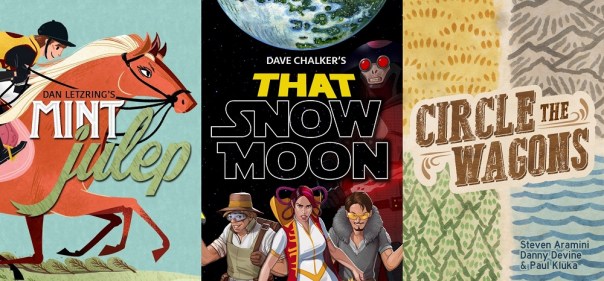
Button Shy is at it again. They’ve cornered a particular niche, games squeezed into plastic wallets approximately one-fifth the size of the leather brick I actually lug around. They’re tiny, consist of fewer than twenty cards, and most of them are rather pretty to look at. Good games, though? Let’s break down the most recent trio to find out.
Graft Company

In many ways, John Company feels like it might be Cole Wehrle’s magnum opus — which is one heck of a thing to say when you consider that it’s only his third published game. It certainly has the scope of a life’s work. Where Pax Pamir and its expansion Khyber Knives dealt with a British Empire willing to do anything to preserve their trading monopoly over India, and An Infamous Traffic got grimy up to its elbows with the business of the drug pushers who would collapse the Qing Dynasty for profit, both might pass as single-action blips in the course of John Company.
It’s appropriate, then, that Wehrle’s tale of the East India Company — the joint-stock enterprise that boasted an army twice as large as the British Army, grazed its grubby fingers over half the world’s trade, and still ultimately squandered its supremacy — should be one of accomplishment, failure, and biding your time. And often all three at once.
Vaster Than Ever

I dug Vast: The Crystal Caverns back in 2016. More than that, I still dig it. Just a couple weeks back, I called it “the king of wild asymmetry that actually works.” And I stand by that. The beauty of Vast isn’t just that each of its five roles is fiercely different, it’s that they work in near-perfect harmony, breaking apart to pursue their own objectives only to come crashing back into one another’s orbit time after time.
With that in mind, does a game with five asymmetrical roles really need three more? Or worse, six more?

 SPACE-BIFF!