Blog Archives
I Hope They Call Me on The Mission
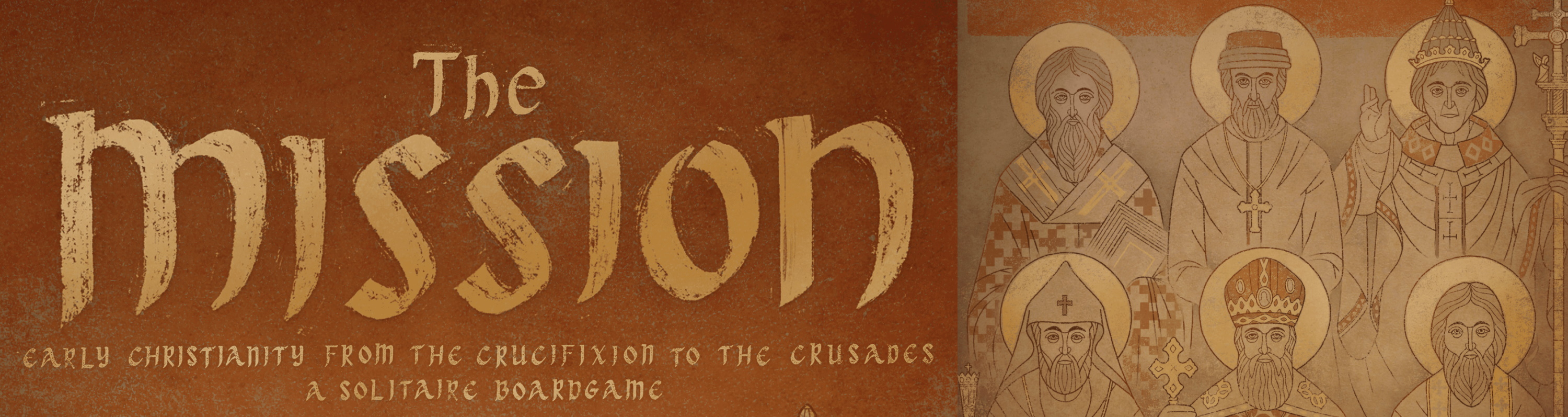
In my very first course after changing my major to history, my midterm paper came back with a scrawled note in purple ink: “Good writing, good argumentation, but too polemical.”
Too polemical. I’ve been waiting to drop that one on some unsuspecting victim ever since. You could even say it’s one of the reasons I was so eager to write about Ben Madison’s solo game The Mission, which charts the history of Christianity over its first thousand years. “From the Crucifixion to the Crusades,” as its subtitle goes. Sounds polemical to me! Brace yourself, Ben Madison, for thou art—
Medium polemical? Somewhat polemical? Acceptably polemical? Certainly not polemical enough for “too” polemical. If any “too” should be deployed, The Mission is too preoccupied with being playable. A difficult charge to make stick in court. If it please your honor, The Mission is guilty of being too good to be polemical. First-degree playable, second-degree polemical. And here I’d expected those to be the other way around.
Last of the Loner Romans

Poor Rome. No matter how many centuries fly by, her problems remain the same. When last we spied the immortal city — or at least the version found in Robert DeLeskie’s solo wargame Wars of Marcus Aurelius — the Marcomanni, Quadi, and Iazyges were harassing the frontiers. Now it’s the Goths, Vandals, and an upstart general named Constantine III who’s decided he’d rather call the shots for a change. Thank goodness for loyal half-barbarian Stilicho, ready to defend the young Emperor Honorius from all comers.
One Thousand Years of Solitude

When I heard that Tim Hutchings’ Thousand Year Old Vampire was a solo RPG, my response was pretty much, “Buddy, if I wanted to pretend to be somebody else when I’m all alone, that isn’t a game. That’s my life. Now cease disturbing my slumber.”
The first chink in my armor was the book itself. If it weren’t so pristine, this thing could have passed for a tome stacked under a hundred years’ worth of library sediment. The title and byline appear as though they’ve been shoddily glued into place, the description on the back secured with masking tape that’s peeling at the edges. The cover’s golden debossing calls to mind pottery mended by kintsugi, but more veined, more branching, like rivulets of blood straining for shared warmth. With great restraint, in only a few spots, the spine exhibits dents and tears. And within, an academic’s trove of article clippings and telltale stains and artwork of a dozen styles, none of it detracting from the actual utility of explaining how you, the reader, will spend the next few hours sharing the story of a vampire in bloom and decay, love and ruin, tragedy and beauty.
As for partaking of a solo role-playing game, pay no attention to my earlier reaction. Thousand Year Old Vampire is devastatingly therapeutic.
Alone(ish) Against the Umayyads

The First Jihad is a shout of defiance — in more ways than one. Designed by Ben Madison and Wes Erni, it’s a long-in-the-making riff on the States of Siege formula, that old hallmark from Victory Point Games that saw lone players fending off encroachments along multiple lanes. Here, however, the concept is turned inside out. Rather than defending a central entity, you’re cast as up to fourteen different empires, city-states, tribes, and kingdoms as they weather the long century of Islam’s expansion under the direction of the Umayyad Dynasty. Less siege, more doomed containment.
Breezy stuff. Fortunately, Madison and Erni have a keen eye for how to capture the sweep of an era with a paper map and some chits.
Combat Results Tables Above the Reich
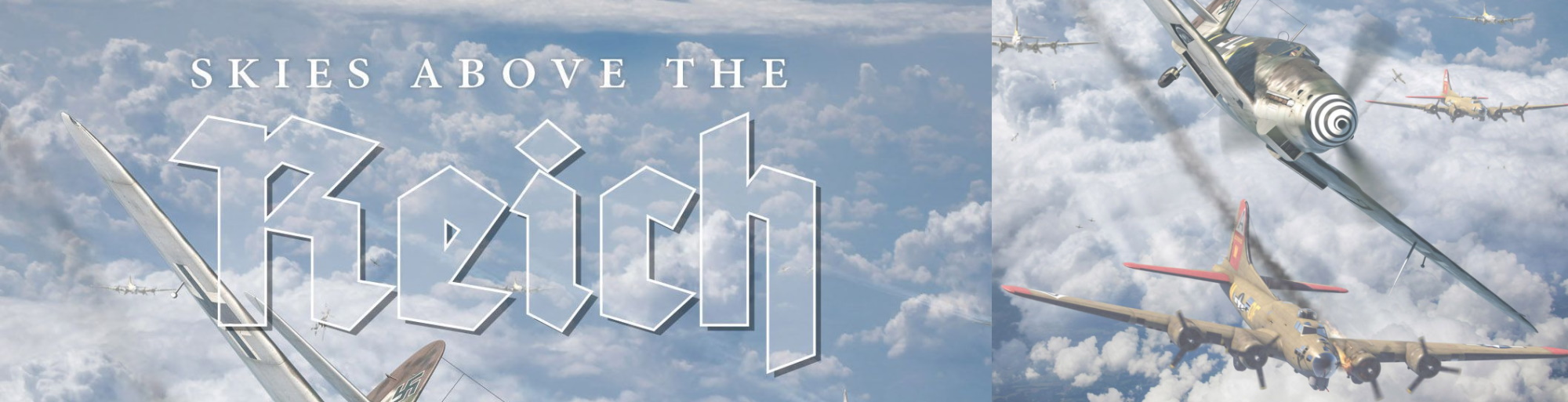
My grandfather was a bomber squadron commander in the Army Air Corps in WWII. I went most of my childhood without knowing that. He didn’t speak of his time in the Pacific until late in his life, and then only sporadically, quietly, with great effort. He saw friends die and planes fall. His own plane fell. He spent months in recovery before resuming combat missions. The first I heard of his service was at a family gathering. My cousin loaded up a flight sim, undoubtedly rudimentary but photorealistic in my memory. Grandpa watched, hands on hips, frowning in disapproval. One of my uncles told us to turn it off. That it was bothering grandpa.
Grandpa jabbed a finger at the screen. “No, that isn’t it. It’s all wrong. You don’t hit a bridge there. They’d rebuild it in a week. And you need to approach from a wider angle. Out of the sun.” And then he told some stories. Just the silly ones. Running alcohol, almost crashing into a mountain, the fellow squadron commander who died to “friendly fire” for always assigning his own plane in the lead position. The ones that haunted him would wait until we were older.
And then there’s solo wargame Skies Above the Reich by Mark Aasted and Jeremy White. Guess I should probably talk about that.
Sensitive Ghosts

I’m terrified of and fascinated by blindness. On more than one occasion, driving along a stretch of Montanan highway with no cars in sight, I would close my eyes and see how long I could last before my nerves peeled apart and my sight restored itself through sheer reflex. Another time, walking to class, the same experiment caused me to turn my ankle so violently that a moment later I awoke on some very uncomfortable pebble landscaping, pain alight from foot to pelvis, shoe braced tight from the swelling. I’ve since learned better than to flirt with the abyss.
Blindness seems like the perfect target sensation for a genre that so often resorts to flipping cards at random. Yet apart from performative pieces like Nyctophobia, not many games have toyed with the concept of not being able to see what’s right in front of you. At least until Sensor Ghosts, Janice and Stu Turner’s sequel to their first published game, Assembly. Having escaped a contaminated orbital platform, you’re blasting your way back to Earth through a micrometeorite storm. Except the sensors on your ship are throwing up all sorts of noise. The result is profoundly evocative — and more than a little shaky.
Then again, perhaps those are two ways of saying the same thing.
Alone in Nubia

Each Monday, I share a list of the past week’s played titles on social media, along with a few short details and a picture of each. When it came to sharing a snapshot of Wes Erni and Ben Madison’s solo wargame Nubia: Egypt’s Black Heirs, I suffered from a rare moment of hesitation. Like the last of Madison’s games I covered here, The White Tribe: Rhodesia’s War 1966-1980, Nubia is frank about the racial dynamics of its topic. Unlike The White Tribe, Nubia might not be sturdy enough to shoulder that weight, at least not quite as levelly. To examine why, we need to talk about slaves — both the broad history and the in-game tile.
Alone Outta Hades

Fred Manzo’s Escape from Hades isn’t what I expected. So much not what I expected, in fact, that I can’t quite remember what I expected in the first place. Certainly something fluffier, something reflective of its radioactive candy-corn cover. Maybe something that didn’t require quite so many gut-checks and mid-play rulings. A handful, sure. After all, this was brought to life by independent publisher Hollandspiele. But this many? This often?
What I expected least, however, was that in between the neon surface of the Hades and too many clarifications resided a story generator as daring and dashing as a WW2 commando film.
Alone with My Palm (Island)

I’m a sucker for portable card games and a double-sucker for those that can be played without a surface. Never mind that I’ll never find myself in a situation where I’ll actually want to play one. In the car? Motion sickness. On an airplane? Tray table. Eating a meal on the airplane? Then I’m eating, you goofball, not playing a card game. Standing in the Fantasy Flight line at Gen Con? Never again.
But I made a promise to my grandfather that I would find the perfect surfaceless card game, so I grabbed Palm Island and gave it a few plays, all within approximately two meters of a clean tabletop. Still, it felt good to do right by old gramps. He died never having owned a table. The real tragedy was not knowing where to set all the food everybody sent over.
Oh, right, Palm Island. Let’s talk about that instead.
Lonesome Alcibiades

Know how you can tell I’m a phony wargamer? I don’t play against myself. Sure, I’ll play solo, but that’s a different thing entirely. I’m talking about playing both sides. Working against my own interests. White knight takes black bishop. Simply can’t do it. What if I need that black bishop’s services next turn? As sure as rain makes pavement smell better, I’m picking a favorite and leading them to victory.
That is, until Mark Herman’s Peloponnesian War. First published way back in 1991 and only recently given a fresh printing, it’s possible that this is the finest play-against-yourself solo system ever crafted.

 SPACE-BIFF!