Category Archives: Board Game
Alliances Mega #1: Hogar’s Run
Deals have been struck. Some benevolent, some… well. It was always inevitable that once the Summoner Wars began in earnest, the sixteen factions who found themselves in possession of summoning stones would seek alliances, no matter how desperate or ill-motivated. And when it’s between the Tundra Guild and the Cave Filth, that’s one fight you sit back and let run its course.

Groanland
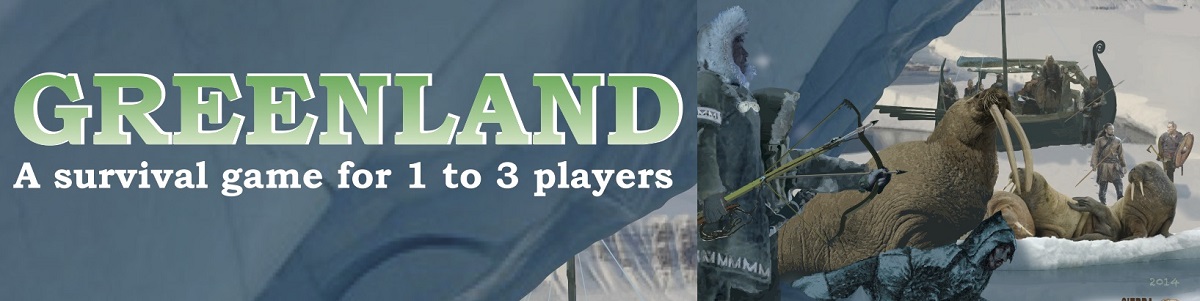
Like so many of Phil Eklund’s games, including the hit Pax Porfiriana, the cards transform after a couple games. At first, they’re cluttered with text and competing symbols, so many that they’re nearly impossible to parse. After sending your tribe to hunt polar bears, you’ll reach out to pick up your failed rolls for another try, only for another player to bark at you, “What are you doing? You can’t reroll those.”
“Yes I can!” you’ll insist. “It says so right here.”
“That’s a Sage,” they’ll point out. They might even reach across the table and tap your tribe elder card. “Your Sage lets you reroll fours, yeah, but only for metallurgy rolls. See? See the difference? You’d need a Tracker to reroll fours while hunting on land.”
After a while you’ll spot them, the tiny symbols that represent metallurgy and land hunting. You’ll nod slowly, staring at the cards spread across the table. Then your opponent will clear his throat. “Oh, and hey, threes mean the polar bears ate your guys. So you just lost two hunters.”
Do Deus
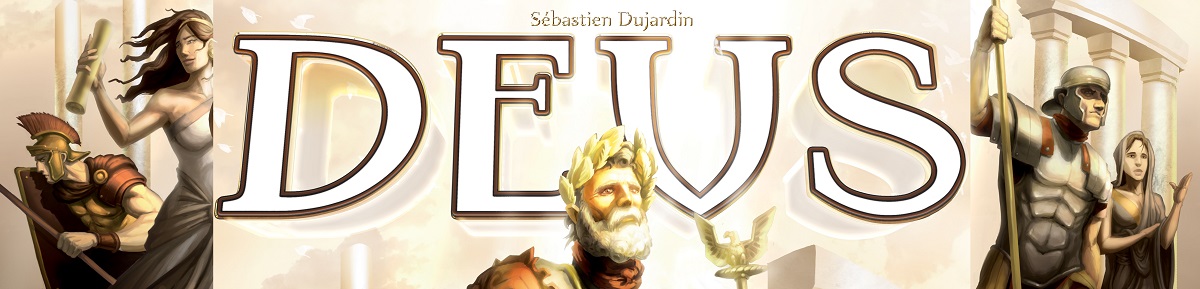
When it comes to board games, one of the few things I enjoy more than arranging tableaus is arranging tableaus that matter.
What on Earth do I mean by that, you ask? Basically, that you should play Deus.
The Scramble for Ganymede
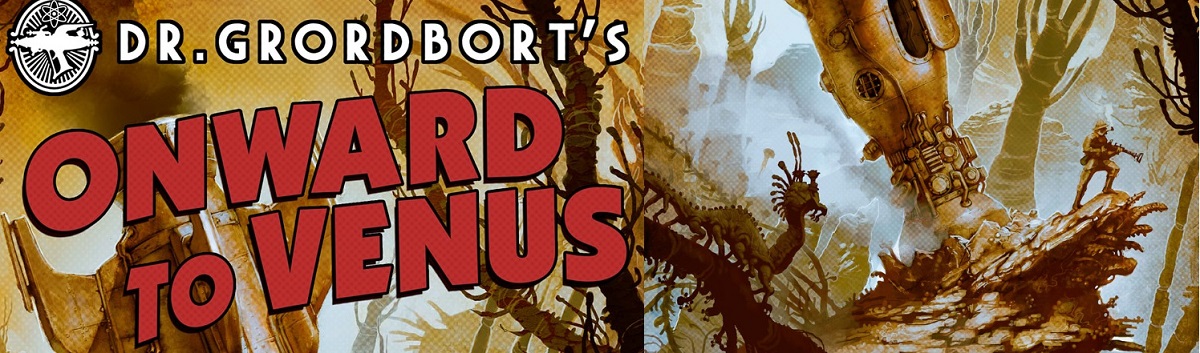
While the European powers of our universe were bloody to the elbows with the “Scramble for Africa,” invading, occupying, and colonizing the continent down south, their near-exact counterparts of Greg Broadmore’s Dr. Grordbort’s setting had already taken to the stars — to invade, occupy, and colonize everything other than Earth. It’s the difference between Heart of Darkness and Heart of Darkness on Titan, with helpings of big game hunting, resource exploitation, and suppression of unruly and many-appendaged natives.
Considering the delightful eccentricity of its setting, it’s hardly surprising that Onward to Venus should be designed by Martin Wallace, whose unconventional design philosophy resulted in that other alternate-history mashup, A Study in Emerald. But where A Study in Emerald was about the paranoia that surrounded European anarchist movements in the 19th century (plus aliens), Onward to Venus is concerned with the aforementioned explosion of colonialism at roughly the same time. Plus aliens.
Not too much in common, then.
Fief: Chocolate and Raspberries Edition
The vanilla edition of Fief: France 1429 already contained about 76 things to keep track of at once, so it’s only natural that it should already have five expansions to round that number out to an even hundred. All including the biggest of these expansions arrive in a small package, but even the smallest wants to add a whole mess of extra things to one of the busiest games I’ve played in recent memory.
Since adding the expansions presents almost as much difficulty as learning the base game itself, let’s talk about all five, what they do, and whether they exacerbate or alleviate Fief’s madness.
Love and Hate in the 15th Century

I’m a historical kind of guy. I like my women in hennins, the sleeves of my cote-hardie decorated most ostentatiously, and my games to reflect the harsh realities presented by merely getting dressed on any given morning in the 15th century.
With that in mind, Fief: France 1429 ought to be the greatest game I’ve ever played. Instead, I’m prepared to make two completely true statements:
1) I absolutely hate Fief.
2) I absolutely love Fief.
Being Pheidippides
It’s possible that my fascination with ancient games traces to the fifth grade. We were required to do a project on Dynastic Egypt, and while the other students were thatching Nile boats or mummifying the family cat, I drew up a theoretical set of rules for Senet, a game dating to around 3100 BCE. The rest, as they say (literally in this case), is history.
Ah, to know the true rules to Senet! Or to the other Egyptian board game mystery, the serpentine Mehen! To play the Royal Game with the Kings of Ur, or wager blankets against Montezuma’s riches in Patolli! To march hoplites through the narrow canyons of the Peloponnese in Nika—
Right. That one’s possible.
XCOM: Board Game Unknown

There’s a gentle irony to one of PC gaming’s most beloved turn-based games being turned into a real-time board game, but don’t let that fool you into thinking that XCOM: The Board Game doesn’t understand what gave XCOM its hallowed reputation. It’s almost a shame that the Best Real-Time Board Game Ever Award was granted in perpetuity back in 2008, because this right here represents something monumental in board game design.
Print and Play (Oh My Darling)

Staying up to date with all of Todd Sanders’ projects is functionally impossible — for reference, he’s already finished four games in 2015 alone, and we’re only halfway through the year’s second month. But it’s been a long while since we examined anything by one of the most prolific creators of free print-and-play projects, which means it’s high time we dive back in. This time, the game in question is Do Not Forsake Me (Oh My Darling), one of the winners of the BoardGameGeek 18-Card Minigame Contest.
Yes, you read that right. 18 cards.

 SPACE-BIFF!