Category Archives: Board Game
It’s Cuh-razy Kuh-rats

Occasionally, I’ll stumble across a game that’s so perfectly chaotic, so adept at creating memorable moments through my own fumbling ineptitude, that I have no desire to ever become good at it. Becoming good at that rare unicorn of a game would be to destroy precisely what I love about it. Such a game abhors an expert.
This time, Crazy Karts is that game.
Zimby. Mojo. Zimby. Mojo.

Remember when Dominion first splashed onto the scene, and its rulebook completely belabored how to pull off the whole deck-shuffling thing? There were diagrams and everything. You might have been a deck-building genius from day one, but I remember not entirely wrapping my head around it. My brother-in-law had to stop me from shuffling my discard pile prematurely. It wasn’t that the concept was complicated; there just wasn’t anything like it.
Well hold onto your socks, because when it comes to Jim Felli’s Zimby Mojo, there isn’t anything like it in the whole damn universe. Nothing. Zip. Not even close. It’s one of the weirdest, most bewildering, out-there games I’ve ever played. And if you know anything about my taste in games, that makes it an absolute winner in my book.
Four Alone

A couple hundred years before it would fall for good, the Roman Empire faced a half-century of panic and defeat. Internal competition had split the once-great state into three conflicting portions, barbarian invaders ransacked the countryside, and a series of plagues depopulated much of the continent. Even the emperors weren’t safe, as one after another they succumbed to assassination, disease, and battle, the average span of rule during this period amounting to a mere two years. Even their nickname, the “barracks emperors,” betrays the speed with which they were hauled out, crowned, and used up.
Saving the empire came down to four men. Diocletian, when he realized that the task of administrating the empire was too much for one person to handle, split his authority first with co-emperor Maximian, then Constantius and Galerius as junior emperors. Of course they ended up feuding later on — they were still Roman statesmen, after all — but for the time being, Diocletian’s tetrarchy was enough to save the empire from total collapse.
The Glorious Blandness of Runebound

Much as I love Fantasy Flight’s line of rune games, the Rune Ages and Runewars and Descents of the world, there’s something faintly desperate about the Terrinoth setting itself, as though it’s terrified of standing out from the crowd. “You want undead? Sure, we got undead. Demons? Yeah, there are demons everywhere. Mechanical men? Of course, we’ve got mechanical men coming out our ears. Pixies? Um, absolutely, we can cram some pixies in there.” In envisioning a world where any manner of creature might appear, there’s hardly any reason to be surprised when it does.
And yet, Runebound, which is on its third edition, is one of the better adventure games out there. The very fact that it’s survived to see three editions is already proof of that.
A Helm’s Deep Simulator

For all those who watched The Two Towers and thought they could do a better job of defending Helm’s Deep — and all those of us who were black-hearted enough to think the same thing but in favor of the Uruk-hai — the sparkled-up second edition of Stronghold is your game. It’s got humans. Orcs. A desperate battle to either hold out until the eighth hour or claim the fortress before reinforcements arrive. The only real difference is that both sides are competent.
Rome Didn’t Dominate You in a Day

What do Julius Caesar, Hannibal Barca, Hammurabi, Cleopatra, and Pericles all have in common? If you guessed “they were contemporaries,” um, no, that’s really very incorrect. Caesar and Cleopatra knew each other (double meaning!), but other than that, these people had about as much chance of rubbing shoulders at the corner pita shop as Ronald Reagan and Charlemagne.
So Mare Nostrum: Empires, which pits these pivotal ancient statesmen against one another in a sort of fantasy grudge match, isn’t too keen on getting its dates straight. No problem. When you’re a game about bullying trade in the Mediterranean — and when “bullying” means you spend a lot of your time being an honest-to-goodness bully — you can bend history into as many pretzels as you like.
Ten Minutes to Kablooie

Only a few weeks ago, I offered a review of five-minute game Meteor, arguing that it was one of the easiest games to put on the table for its brevity, simplicity, and real-time goodness.
Well, that review was apparently a thrown gauntlet, because I’ve been challenged to take a look at FUSE, another real-time game — ten minutes long this time — which I will never again type in all caps.
The Other House on the Hill

Things aren’t all right in Hunt: The Unknown Quarry. On a hill (not in a quarry), an old house sits, haunted to the rafters, scratching in the basement, the flapping of wings in the aviary—
And right there, that’s your problem, sir. If you want to build a big house on a hill without attracting your garden-variety haunting, you shouldn’t be installing things like aviaries. Big cages, spooky black-feathered birds — they’re all fun and games until a monster takes up residence and a pack of bounty hunters come calling.
The Space-Biff! Space-Cast! Episode #1: Paranoid Cuneiform
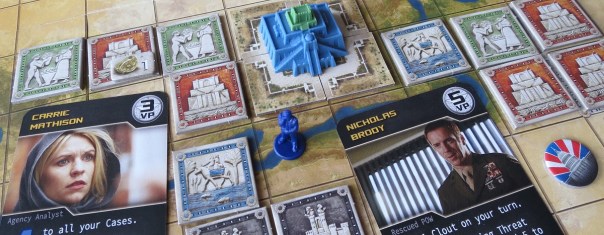
In the inaugural episode of the Space-Biff! Space-Cast!, what do Homeland: The Game and Reiner Knizia’s classic Tigris & Euphrates have in common? Listen as Dan Thurot, Rob Cramer, and special guest Mark Henderson attempt to stretch these games like taffy in order to find out. Special thanks to Michael Barnes for changing the conversation about theme and setting.
You’ve Got to Run, Run, Run

Escape from the Aliens in Outer Space isn’t a new game, and in some ways it shows. It isn’t as slick as the third edition of Fury of Dracula, for instance, last year’s reimagining of 2005’s reimagining of the 1987 classic. In that case, Fantasy Flight had the experience of multiple decades to draw on, resulting in one of the best sneak-around games ever made. And it certainly isn’t as agile as Specter Ops, which portrays tiptoeing past corporate security guards as not only a question of positioning but also one of velocity.
And yet, the ultimate edition of Escape from the Aliens in Outer Space is still a beast worthy of consideration — though perhaps only after being tamed with a healthy heaping of house rules.

 SPACE-BIFF!