Category Archives: Board Game
Best Week 2016, Indexed!

Once again, we had a fantastic Best Week, perhaps because 2016 was a pretty terrific year for board games. Down below are the links to each day of lists — just click the picture to be whisked away to that day’s compilation, courtesy of Internet Magic!
Best Week 2016, Unique!

Best Week 2016 has come a long way. A very long way. We’ve looked at all sorts of bests. And all of it has led us here, to the final bests, the best unique games of the year.
These are the games that caught me by surprise. Critical darlings, some of them, the sorts of games that appeal to us weathered old sea-hags who write about the things. We’ve seen too much, and regular pleasures no longer delight us, so we seek ever-more peculiar novelties. Or so the conventional wisdom might claim. On the contrary, the games listed here are ones I’d stack up alongside all the others I’ve highlighted thus far. Welcome to day five.
Best Week 2016, Lessons!
One of the things I’ve always loved most about board games is their ability, with proper consideration and rules, to transpose difficult concepts into the simplified languages of play. To distill, to crystallize, to render out the most crucial pieces of information, conflicts, and interactions for our consideration, and to do so while we’re goofing around. We’re spoiled, basically, to be alive and playing in an era when games are so readily handling tricky issues and ideas and not sucking at the same time.
What follows are my favorite “lesson” games of the year. This doesn’t always mean that the lessons were particularly deep or insightful, but rather that these are the titles that pay their subject matter that extra level of consideration and are all the better for it.
Best Week 2016, Iterated!
Innovation is tough. Not just in the sense that being innovative is sort of like being told to sit on your couch and produce the finest cheeses from thin air. But also in the sense that it doesn’t always pay off. Most people don’t chow down on fine cheeses, for one thing. Why not craft the perfect cheddar? Everybody loves cheddar.
Today is a celebration of the year’s best iterative games. That is to say, the games that do the same old stuff all over again, but do it so well that I’m glad they showed up for the party, like friends from elementary school who never changed all that much, just grew up and became better versions of who they’ve always been. These are the games that refine the formula, that snobby critics call “workmanlike” and “uninspired,” while the rest of us slather ourselves in their goodness like a piece of toast before the fondue vat. Apparently I’m hungry tonight. On to the games.
Best Week 2016, Adorable!
Sometimes, all you need to achieve greatness is a dash of cuteness, the nutmeg of game design. What follows are the best adorable games of the year, which means these are probably the games I’d play when I’m not in a particularly serious mood, or perhaps with a young child. Though, yeah, you caught me: I’d play almost anything with a young child because I lack any filter for what’s appropriate at any given age. So it goes.
Best Week 2016, Overlooked!
Like the slow release of a long-held breath, Best Week 2016 has begun. For the vast majority of the internet, this is old news, to be expected, and all’s well now that it has arrived. For the rest of you, the first-timers and late-goers, we welcome you to the most objective, least biased, most correct of any Best List in the history of this year. Five days, 40 games, only the best.
Today we celebrate the games you probably didn’t play — only worse, you probably didn’t even hear about them. These are the short geniuses in a tall crowd, the unsung heroes in a battle of choirs, the board games with insufficiently-staffed public relations departments.
Big vs. Small
The greatest programmed movement games are nearly always the ones that go all-in on their own eccentricities, mitigating the frustration of planning out everything in advance by casting themselves as exercises in silliness. In Space Alert, that means your star-charting astronauts are afflicted by the space-bends or mere panic; if they should stumble down the wrong corridor or slam the incorrect button when the klaxons are blaring in their ears, who’s going to blame them? In The Dragon & Flagon, your adventurers are blind drunk after a tough dungeon run, so a swing’n’miss is the expected order of things. And the train-robbery-gone-wrong of Colt Express is at its best when the train thunders into a tunnel and your banditos resort to slugging blindly at whomever happens to be standing nearby.
The point is, these games work best when things are going south. Since roughly half of a player’s time in a programmed movement game will be spent screwing up, why not make screwing up the best part? This is gaming as a gag reel. It must be about spinning in circles, wrestling for control, failing to get anything done. Success must be a revelation, as grounded in chance as in anything else. And above all else, your game must be funny.
Fortunately, Mechs vs. Minions understands this principle down in the marrow of its bones.
The Space-Biff! Space-Cast! Episode #7: Welcome to the Sandbox
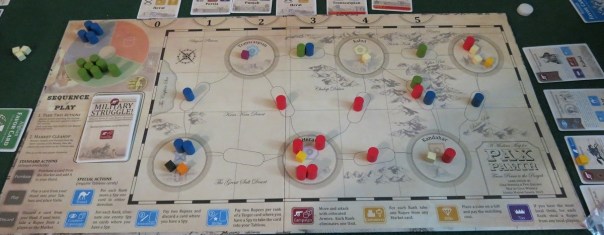
For the first time ever, the Space-Biff! Space-Cast! is all about Dan Thurot’s uncertainty about Cole Wehrle’s paternity, the definitions of sandbox games, as well as a number of Great Games, from Pax Pamir to Pax Renaissance and An Infamous Traffic. Great Games: in these hands alone, that’s a pun intended only for the cleverest of humans. Perhaps you’re among them. Perhaps.
Schwarze Kapelle
“There remains an experience of incomparable value. We have for once learned to see the great events of world history from below, from the perspective of the outcasts, the suspects, the maltreated — in short, from the perspective of those who suffer. Mere waiting and looking on is not Christian behavior. Christians are called to compassion and to action.”
_____—Dietrich Bonhoeffer, 1906-1945, Letters and Papers from Prison
Black Orchestra is one of those rare games that revels in the hopelessness of its situation. Wallows in it, more like. As one of the conspirators bent on overthrowing Adolf Hitler — whether you’re a civilian businessman or politician, Abwehr or Wehrmacht officer — your chances are, as was the case in the real-life Schwarze Kapelle, nearly hopeless. It’s less an exercise in excitement and explosions, and more a game of waiting, of chewing your fingernails until they’re raw, of walking the line between playing it cool under pressure and taking foolhardy risks the instant an opening presents itself.
By way of example, let me tell you about three plots to assassinate Hitler.
Here I Stand II: Renaissance Gone Wild
![In Old French, "Renaissance" translates roughly into "before [they] knew to look straight at the camera."](https://spacebiff.com/wp-content/uploads/2016/12/1-header-renaissance-which-is-kind-of-a-big-deal.jpg?w=604&h=240 "In Old French, \"Renaissance\" translates roughly into \"before [they] knew to look straight at the camera.\"")
Let’s say you’re making a game about the Renaissance. Not merely a slice of it. Not patronage of the arts, the rise of science, Florentine or Venetian city councils, Reformation and Counter-Reformation, trade routes and the tension between East and West, or the exploration of the New World. I mean all of it. The entire thing. The whole loaded ball of wax. Where do you start? Where do you finish? Perhaps most importantly, who are you, the player?
Pax Renaissance is a game with aspirations no less grand than capturing the entire ideological struggle of the Renaissance, the churn of ideas about religion, state, art, science, law, and every other little thing that produced Western culture as we now see it. Which isn’t actually all that surprising, given its pedigree. Both Pax Porfiriana and Pax Pamir were ambitious games as well, functioning as statements and simulations and playthings with equal mettle. This is the broadest topic yet for the Pax series, however, and it wouldn’t be hard to imagine the entire thing going up in flames as surely as Girolamo Savonarola’s attempt at governing Florence.
And yet, while Pax Renaissance is forced to make a few compromises in service of its gameplay, the final result is nothing short of a triumph.

 SPACE-BIFF!